Depuis la France : faites votre Aliyah ! Demandez-leur d’appeler l’Agence juive pour lancer la candidature formelle 0-800-916-647 ou par courrier électronique à gci-fr@jafi.org https://www.jewishagency.org/fr/
|
|
|
|

France quietly ends visas for El Al flight security guards in Paris amid Gaza war tensionsAmid tensions over Gaza war, France stops renewing work visas for El Al flight security guards, forcing them to stay without visas or return to Israel; guard says no renewals issued in 6 months; Israeli embassy in contact with French authorities over matter
Itamar Eichner | 11August2025 | 22:11 https://www.ynetnews.com/article/bjw8x3wdxl
Over the past six months, French authorities have quietly stopped renewing work visas for El Al flight security personnel employed in Paris as ITAN workers (Israeli citizens supporting diplomatic missions) through the Israeli embassy, sources familiar with the situation told Ynet on Monday, explaining that the decision stems from rising tensions between Israel and France over the Gaza war and attributing it to anti-Israel motives within Parisian authorities.
The work visas previously granted to the Israeli security staff allowed them to live and work legally in France. Now, with the visa renewals halted, some of these workers find themselves residing in the country illegally. While some remain in France without valid permits, others have been forced to obtain diplomatic visas through the Israeli embassy, granting them temporary status to continue their stay.
“In the past six months, none of the employees whose work visas expired have received renewals,” according to an El Al flight security guard stationed in Paris. “This has never happened before, and no one has been granted new approvals. It seems they are trying to end the employment of El Al security personnel in France.”
In response to a Ynet inquiry, the Foreign Ministry said that “the matter is being handled by the embassy in coordination with the French Foreign Ministry.” The French embassy in Israel declined to comment, referring inquiries to the Israeli embassy. El Al also directed questions to the Foreign Ministry and the Shin Bet internal security agency, which did not provide a response.
Tensions between Paris and Jerusalem have deepened following a series of incidents involving the French authorities and pro-Palestinian activists. Last week, pro-Palestinian demonstrators vandalized El Al’s offices in Paris, splattering them with red paint and labeling the airline a “genocide airline.” In June, the Israeli pavilion at the Paris Air Show arms fair was unexpectedly blocked by organizers and covered with black cloth  El Al offices in Paris were vandalized
 In June, the Israeli pavilion at the Paris Air Show arms fair was unexpectedly blocked by organizers and covered with black cloth
Speaking at a press conference Sunday night, French President Emmanuel Macron condemned plans presented by Prime Minister Benjamin Netanyahu to take over the Gaza Strip, calling it a “disaster waiting to happen, and a step toward an endless war.” Speaking to reporters during a briefing from his office, he warned, “The Israeli hostages and the people of Gaza will be the first victims of this strategy. The government in Israel needs to stop the war now with a permanent ceasefire.”
Macron also proposed the formation of an international coalition under the United Nations aimed at combating terrorism in Gaza and stabilizing the region.
Last month, Macron announced on his X account that France would officially recognize a Palestinian state. He said he plans to make a “ceremonial declaration” to this effect at the UN General Assembly in September. His announcement sparked a wave of similar moves, with several countries expressing readiness to recognize Palestinian statehood. Australia announced Sunday night it would move in a similar direction, while New Zealand stated it was “considering the move.”
In his declaration, Macron emphasized the urgency of ending the war in Gaza and delivering aid to civilians. “Peace is possible. There must be an immediate ceasefire that includes the release of all hostages and massive humanitarian aid to the people of Gaza,” he wrote.
He also stressed the necessity of disarming Hamas, ensuring Gaza’s security and rebuilding the territory. “Finally, it is essential to establish the Palestinian state, guarantee its existence, and allow it, through receiving disarmament and full recognition by Israel, to contribute to security in the Middle East.”
|
|

The E1 battle: Why Israel can’t bow to Macron’s Palestinian fantasyThe E1 corridor, connecting Jerusalem to Ma’ale Adumim, is a vital buffer against the encirclement of Israel’s capital by a hostile Palestinian entity.https://www.jns.org/the-e1-battle-why-israel-cant-bow-to-macrons-palestinian-fantasy/
Fiamma Nirenstein
(20August2025 / JNS) Israel’s recent approval of 3,401 housing units in the strategic E1 corridor has unleashed the usual chorus of outrage from world leaders and Palestinian statehood advocates. Chief among them is French President Emmanuel Macron, who is pushing to force a United Nations General Assembly vote on Palestinian statehood in September.
For Macron, it’s a grand gesture—a pacifist fantasy that pretends a Palestinian state is the antidote to war. But for Israel, it’s an existential threat.
The E1 corridor, connecting Jerusalem to the city of Ma’ale Adumim, is a vital buffer against the encirclement of Israel’s capital by a hostile Palestinian entity stretching from Ramallah to Bethlehem. Without it, Jerusalem risks becoming isolated and vulnerable, as it was between 1948 and 1967, when Jews were barred from the Western Wall.
This is why Finance Minister Bezalel Smotrich pushed the plan forward. Detractors dismiss him as a hardline minority voice. Yet the truth is that his stance reflects a sober reality: Israel cannot trade its survival for international applause.
The Palestinian leadership has never renounced its jihadist vision. It never condemned the Oct. 7, 2023, massacre. It continues its “pay-for-slay” policy that rewards terrorism. And now it proudly declares that thanks to Oct. 7, it is winning the war of opinion.
Macron and his allies—Australia, Canada and others—are effectively rewarding Hamas by pressing for Palestinian statehood at the U.N.
Israel has been here before. The Arab League’s “three no’s” after the Six-Day War left no room for compromise. Every Israeli offer of peace has been met with terrorism, from Arafat’s rejectionism to Abbas’s intransigence. The so-called “Green Line” was never a border, merely an armistice line, and today it is being used as a weapon against Israel’s legitimacy.
E1 is more than a housing plan. It is a shield for Jerusalem and a message to Israel’s enemies: this nation will not be divided or surrounded again.
Whatever the U.N. decides, Israel will chart its own course. Macron may dream of playing Europe’s anti-American visionary, but Israel has a far more urgent role—to eliminate Hamas, protect its citizens and partner with moderate Arab states to build a safer, more stable Middle East.
The alternative—handing jihadists the victory they seek—is unthinkable.
|
|
 Commentary Magazine-logo https://www.commentarymagazine.com/ Israel Shows Some Diplomatic Spineby Seth Mandel 28August2025 https://www.commentary.org/seth-mandel/israel-shows-some-diplomatic-spine/
Israel is responding aggressively and appropriately to two recent public relations challenges, suggesting Jerusalem understands the gravity of its situation as well as the fact that it is in the right on both.
The first is the “famine” libel. Israel is asking the IPC, the multinational monitor, to retract its debunked report on Gaza City. According to Reuters, the Israeli Foreign Ministry is warning that “if a new report were not presented within two weeks, Israel would continue to challenge the assessment and would ask the IPC’s donors to halt their financial support.”
Good. Israel can no longer afford to simply be correct on the merits. If corrupt global agencies are going to insert themselves as partisans into this war then they’ll learn to take a (metaphorical) punch.
As a reminder, Israel first meticulously proved the report false based on the IPC’s own data, which suggests the agency is not merely incompetent but corrupt and compromised.
Indeed, it’s clear the report was released as a preemptive attack on Israel’s new operation in Gaza City. The IPC simply declared famine in the one place in Gaza that the IDF was looking to enter, which was also the one place in Gaza relatively untouched by the war. Still, it’s important to have the numbers on your side, and Israel did (all emphasis in the original):
“The report relied on only half of the data actually collected in July — five sub-samples covering 7,519 children, described on pages 49–50 of the FRC report, with a combined average of roughly 16% — just above the threshold.
“By contrast, a Nutrition Cluster presentation released on August 8 — a week before the August 15 cut-off date — reported the full July sample of 15,749 children. Those results showed unweighted and weighted GAM rates of 13.5% and 12.2%, respectively — both well below the famine threshold.”
So the data were clear: no famine. That the IPC chose to manipulate the data for political purposes suggests the agency has forfeited its legitimacy. Additionally:
“The IPC itself acknowledged that available data on non-trauma mortality were nowhere near the famine threshold of 2 deaths per 10,000 people per day. Based on its own population estimate for Gaza Governorate — about 937,600 people — this threshold would correspond to roughly 188 non-trauma deaths per day. By contrast, the Hamas-run Ministry of Health reported that as of 15 August the five-day moving average across all of Gaza was just six ‘malnutrition-related deaths’ per day.
“Even if every one of these had occurred in Gaza City and were actual malnutrition-related excess deaths, the non-trauma death rate would still be an order of magnitude lower than the famine threshold.”
It didn’t have the numbers on its side, so the IPC made them up, claiming that the difference was made up of unreported (imaginary) cases.
Again, Israel seems to understand the gravity of the IPC’s corrupt interference on behalf of a terrorist organization. There is no reason for Israel to let up on the agency, and so far, it isn’t.
Then there is the lingering question of how to respond to the impending recognition of a Palestinian state by France and others joining the bandwagon. As I argued previously, this is a unilateral move by the Palestinians and their supporters, and so it must be parried with a unilateral move by Israel.
As France continues to up the ante, so must Israel. France suggested—then claimed it was an error when Yigal Carmon caught it—that it would support a Palestinian “right of return,” a euphemism for the destruction of Israel as a Jewish state. So Israeli leaders know France is at least considering such a move. Paris is also contemplating opening an embassy in Ramallah.
What to do? Amit Segal points to an interesting piece by Yoram Ettinger (in Hebrew) on a meeting of Benjamin Netanyahu’s inner circle about whether, how, and where to apply sovereignty to parts of Judea and Samaria. Certainly this is under consideration apart from the French declaration of Palestinian statehood, but apparently the Israeli government is considering making such action a direct response to unilateral measures by European states, France included.
This makes sense: Unilateral moves that chip away at Israeli sovereignty will be met with unilateral moves that reclaim Israeli sovereignty. At the same time, it’s a highly controversial step that will no doubt earn passionate denunciations and maybe more. Israel has to decide whether the reward is worth the risk, and will likely at least wait to see what happens at the UN General Assembly next month.
But here’s a key quote Ettinger supplies from an unnamed participant in the meeting with Netanyahu: “It is not enough to close a French consulate in the face of recognition of a Palestinian state.” The logic is clear: recognition of a Palestinian state on disputed land would contravene the Oslo Accords and all that followed directly from that track. If France—or anybody else—is going to take a lighter to three decades of diplomacy and compromise, they’re going to get burned.
|
|
Come home NOW – ESPECIALLY THE JEWS OF FRANCE
Number #1 threat: radical Islam.  Rabbi Shalom Arush – Breslev English-tweet-9October2025-come home now especially the jews of France
|
|
UPDATE: 🇫🇷🇮🇱 FRANCE IS NOW LEADING THE WORLD IN ALIYAH TO ISRAEL140 new immigrants from France arrive in Israel on ‘Families Flight’“It’s so moving to see young families choosing to make aliyah to Israel, especially now. They are choosing to raise their children here in the State of Israel, the home of the Jewish people,” said Minister of Aliyah and Integration Ofir Sofer.
The Jewish Agency for Israelhttps://www.jns.org/wire/the-jewish-agency/140-new-immigrants-from-france-arrive-in-israel-on-families-flight
 Doron Almog, chairman of the Jewish Agency (far right), and Ofir Sofer, Israeli Minister of Aliyah and Integration (to his left), with a family from France arriving to make their new home in Israel, Aug. 3, 2026. Credit: Courtesy of the Jewish Agency.
(Aug. 6, 2026 / The Jewish Agency for Israel) A total of 140 new immigrants from France arrived in Israel on Aug. 3 aboard a special “Families Flight” organized by Israel’s Ministry of Aliyah and Integration and the Jewish Agency for Israel, in partnership with the International Christian Embassy Jerusalem (ICEJ).
Israeli Minister of Aliyah and Integration Ofir Sofer and Jewish Agency chairman Maj. Gen. (res.) Doron Almog accompanied the new olim (immigrants to Israel) on their journey to Israel. Among those arriving in Israel were dozens of young families, including 80 infants, children and teenagers who will begin the upcoming school year in Israel’s education system.
Since the Oct. 7 terrorist attacks, more than 7,000 new immigrants from France have made aliyah. Today’s flight reflects the continued growth in immigration from France, as increasing numbers of Jewish families choose to build their future in the Jewish state.
One of the most memorable moments of the journey took place at 35,000 feet, when every new arrival received their official Israeli identification number. In a symbolic moment, before even landing in Israel, they officially became citizens of Israel and members of Israeli society.
Among the passengers were three sets of twins: four-month-old Mia and Ethel, five-month-old Noam and Nerly, and 11-year-old Noa and Avidan. The oldest passenger aboard the flight was 85-year-old Annie, who fulfilled her lifelong dream of reuniting with her children who already live in Israel.
According to figures from the Ministry of Aliyah and Integration and the Jewish Agency, approximately 2,400 Jews from France have arrived in Israel through the end of July 2026, representing an increase of more than 30% compared to the same period last year.
Interest in aliyah from France has risen sharply since Oct. 7. In 2023, 1,097 people from France made aliyah. That number more than doubled in 2024 to 2,234 and continued to climb in 2025, when 3,357 new immigrants arrived from France.
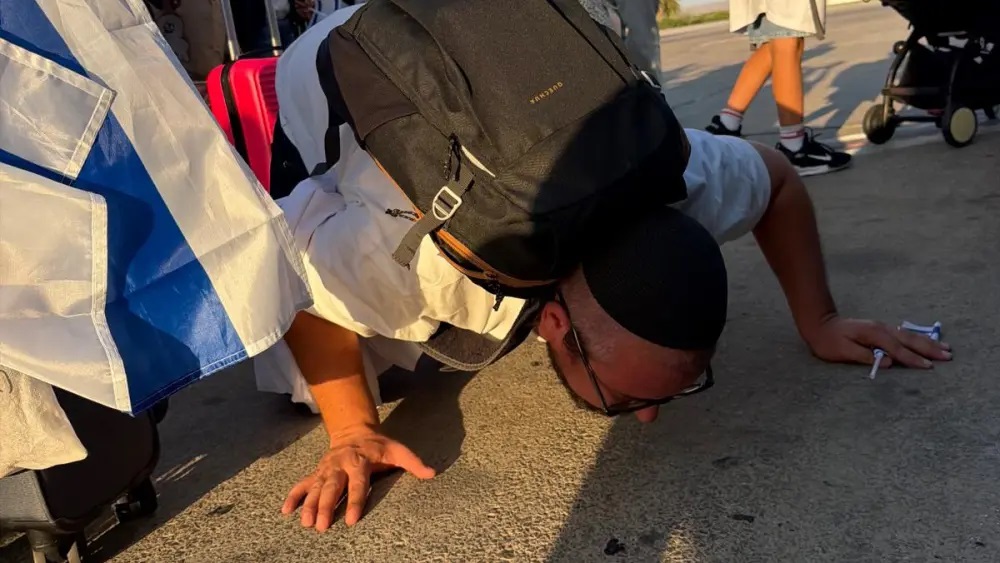 A new immigrant to Israel traditionally kisses the ground upon arrival in the country on Aug. 3, 2026. Credit: Courtesy of the Ministry of Aliyah and Integration.
The growing interest is also reflected in the number of aliyah files being opened. Since Oct. 7, 2023, approximately 80,000 Jews from around the world have opened aliyah files through the Jewish Agency’s Global Aliyah Center, which operates with the support of the Ministry of Aliyah and Integration. Of those, approximately 20,000 have been from France, including roughly 2,800 applications opened since the beginning of 2026, a nearly 30% increase compared to the same period last year.
Upon landing at Ben-Gurion International Airport, the incoming group was welcomed at a festive ceremony attended by family members, representatives of the Ministry of Aliyah and Integration and the Jewish Agency, supporters of the International Christian Embassy Jerusalem and members of Israeli youth movements, who greeted them with Israeli flags, music, dancing and celebration.
“It’s so moving to see young families choosing to make aliyah to Israel, especially now. They are choosing to raise their children here in the State of Israel, the home of the Jewish people,” said Minister of Aliyah and Integration Ofir Sofer. “Over the past few years, we have led a series of reforms designed to make the aliyah and integration process smoother, including programs for students, the streamlining of professional licensing, housing solutions and more. All of these are meant to help newcomers integrate quickly into Israeli society and the workforce. But above and beyond all the reforms and changes stands the great Israeli spirit, and that depends on all of us, on each and every one of us. Welcome to Israel.”
“Aliyah is the growth engine of the State of Israel. Seeing children excited to board the plane in France and stepping off it as Israeli citizens, alongside parents who choose to start a new life here despite all the challenges, is a reminder of the power of Zionism,” said Almog. “Every family that arrives strengthens the State of Israel, and our mission is to accompany them from the very first moment and ensure they feel that this is their home.”
“The increase in aliyah from France at this time is deeply moving for Israel and especially encouraging given the country’s ongoing security challenges,” said Jürgen Bühler, Ph.D., president of the International Christian Embassy Jerusalem. “We are honored to support this new wave of Jewish olim who will make meaningful contributions to Israel’s economy, society and cultural life.”
The Jewish Agency for IsraelThe Jewish Agency for Israel has been working since 1929 to secure a vibrant Jewish future. It was instrumental in founding and building the State of Israel and continues to serve as the main link between the Jewish state and Jewish communities everywhere. This global partnership has enabled it to address the Jewish people’s greatest challenges in every generation. Today, the Jewish Agency connects the global Jewish family—bringing Jews to Israel and Israel to Jews—by providing meaningful Israel engagement and facilitating aliyah. It also strives to build a better society in Israel and beyond by energizing young Israelis and their worldwide peers to rediscover a collective sense of Jewish purpose. The Jewish Agency continues to be the Jewish world’s first responder, prepared to address emergencies in Israel and to rescue Jews from countries where they are at risk.
UPDATE:🇫🇷🇮🇱 FRANCE IS NOW LEADING THE WORLD IN ALIYAH TO ISRAEL
Nearly 4,000 Jews have moved from France to Israel so far in 2026, with the number expected to reach around 5,000 by year’s end. According to Makor Rishon, 2026 is the first year in which any country has overtaken Russia as the leading source of immigrants to Israel. Source: @MakorRishon 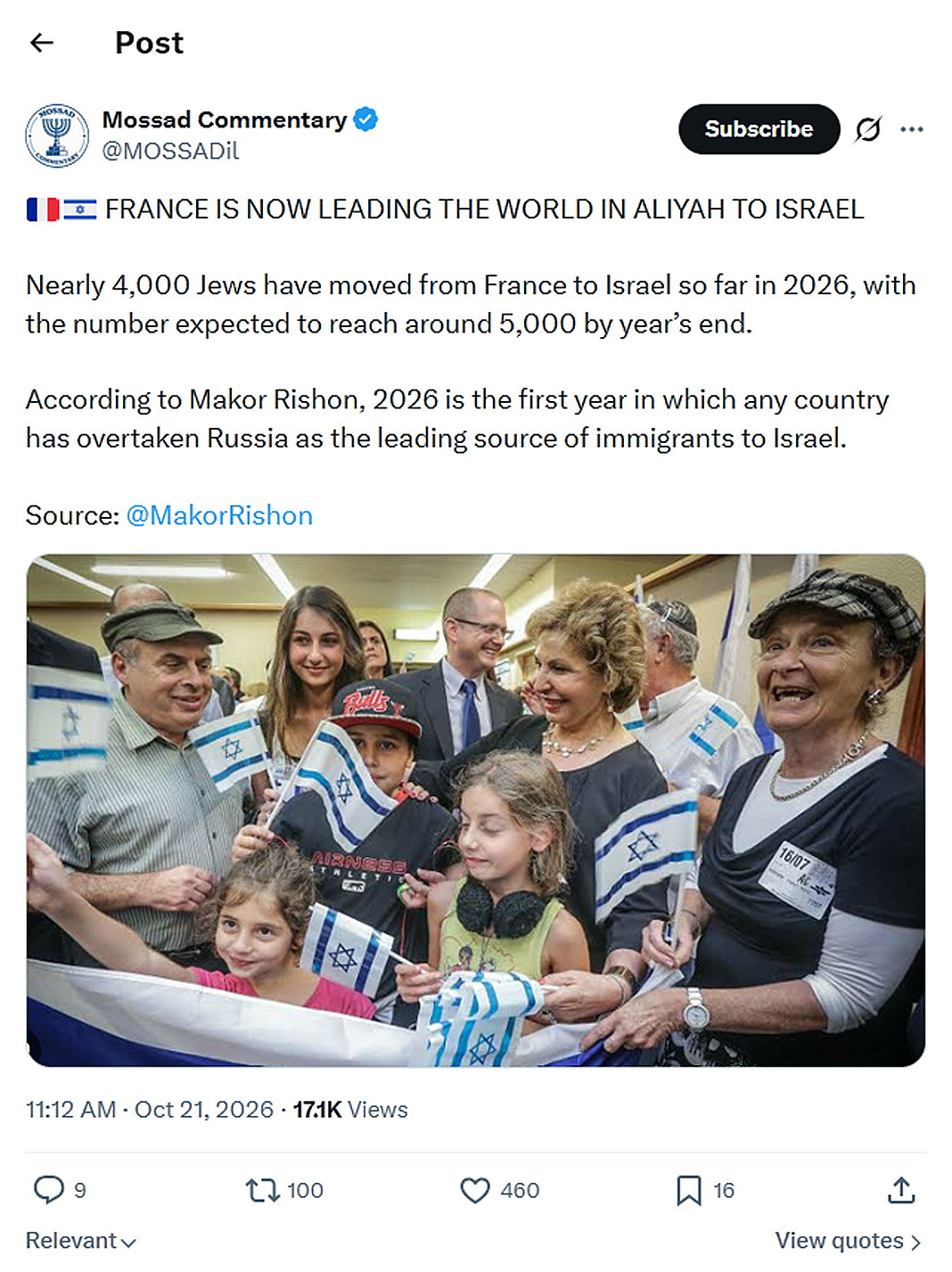 Mossad Commentary-tweet-21October2026-FRANCE IS NOW LEADING THE WORLD IN ALIYAH TO ISRAE
|
|
Western aliyah rises even as overall immigration fallsA drop in arrivals from Russia drove a 34% decline in total aliyah in 2025, while immigration from Western countries—led by France—more than doubledhttps://www.jns.org/western-aliyah-rises-even-as-overall-immigration-falls/  New immigrants from France arrive on an “aliyah flight” at Ben-Gurion International Airport, Aug. 1, 2024. Photo by Tomer Neuberg/Flash90.
(29December2025 / JNS) In the first 11 months of 2025, Israel saw the arrival of about 20,000 Jews and their relatives from abroad, marking a 34% drop from the corresponding period last year, due mainly to a massive decrease in aliyah from Russia.
Jewish immigration to Israel, or aliyah, from Western countries, meanwhile, more than doubled, jumping to 9,256 in the first 11 months of 2025 from 4,570 in last year’s corresponding period. Israel’s government has not yet published figures from December 2025. In previous years, about 2,000 newcomers came in December.
The drop in aliyah from Russia accounted for most of the difference between the periods, going from 18,313 in the first 11 months of 2024 to 7,993 during those months this year—a 56% decrease. Aliyah from Ukraine dropped by 14% to 805 newcomers, according to the records of Israel’s Ministry of Aliyah and Integration.
In February 2022, Russia invaded Ukraine, triggering a war that has affected Ukrainian population centers and ravaged both countries’ economies amid a curtailment of civil liberties on both sides. Aliyah surged in 2022, with more than 60,000 moving to Israel from Russia and Ukraine out of 74,474 in total—a two-decade record high.
Aliyah from Ukraine subsided after that, partly because of emergency provisions preventing military-age men from leaving, and because European countries, as well as Russia, opened their borders to war refugees.
On Oct. 7, 2023, Hamas invaded Israel and murdered some 1,200 people, triggering an Israeli counterattack against Hamas in Gaza and a two-year regional war. Following the war, aliyah decreased drastically. In 2024, Israel received a total of 32,161 olim—a 30% decrease from the 2023 tally, and a 56% drop from 2022.
During the first 11 months of 2024, aliyah from Western countries totaled 6,986 arrivals. In the corresponding months of 2025, Western aliyah has increased by 35%.
Following the slump in aliyah from former Soviet countries, and the increase in Western aliyah, the two contingents—which account for most olim—were almost equal during the first 11 months of 2025, split 10,098 and 9,256, respectively.
“Aliyah from the West continues to rise, probably due to Zionism and antisemitism,” Howard Flower, director of aliyah for the International Christian Embassy Jerusalem, told JNS about the data.
Among Western countries, France saw the highest increase in aliyah this year: A 45% jump to 3,030 over the corresponding period last year. Germany saw a 19% hike to 204, the United Kingdom had a 16% rise to 760. Aliyah from the United States and Canada rose only slightly, by 4% and 5%, to 3,257 and 388, respectively.
France is home to Europe’s largest Jewish community, estimated in a 2020 study as numbering 449,000 people who self-identify as Jews.
Amid rising antisemitism there, France has a “unique potential for providing Israel with olim who possess both strong professional skills, a democracy-oriented social skill set, and a deep attachment to their Jewish identity,” Dov Maimon, a senior fellow at the Jewish People Policy Institute (JPPI) think tank in Jerusalem, told JNS.
The less well-off French JewsBut to tap more effectively into that potential, Israel must better compete with the myriad social benefits on offer to French citizens, Maimon, who was born in France, said.
“The less well-off French Jews, of which there are at least 100,000, live in uncomfortable proximity to hostile Muslim populations. They suffer a grinding routine of harassments, but they know that if they make aliyah, they will live in abject poverty,” Maimon said.
Consecutive Israeli governments have launched initiatives to attract more olim from Western countries and beyond in recent years. In August, the government launched one such plan tailored to bring in skilled olim, and physicians especially.
Under an incentive package unveiled this year, physicians who make aliyah and settle in southern or northern areas affected by the war may be entitled to a grant of up to $116,000.
In parallel, Christian Zionist groups and donors have increased their involvement in facilitating aliyah.
Earlier this year, Keren Hayesod, also known as United Israel Appeal, arranged a visit to France for Pastor Larry Huch of the New Beginnings mega-church in Texas. He met olim there who left for Israel aboard an aliyah flight that his church funded.
Huch was astonished by the accounts of French Jews who told him of experiencing antisemitism on an almost daily basis, he told JNS. “We’ve heard about it in France, but we didn’t realize how severe, pronounced and constant it is, the hatred that our Jewish brothers and sisters face over there every day,” he said.
Despite this, the communities Huch visited displayed a joie de vivre and optimism about making aliyah. “It was amazing. The atmosphere was jubilant. The people I met in synagogue before their aliyah were applauding, cheering, shouting happily. They didn’t behave like refugees or victims, but people with a mission. It was inspiring,” Huch said of his June visit, which was facilitated by Keren Hayesod.
Sam Grundwerg, world chairman of Keren Hayesod–UIA, told JNS, “It’s a testament to the determination and attachment that French olim have to Israel and Zionism, that even during war, they’re coming to Israel in their thousands.”
This also “shows the potential for much more aliyah when these challenges subside,” added Grundwerg, whose organization is the fundraising arm of the State of Israel and funds many welfare, immigration, absorption and education projects.
Maimon, who this year published a book titled “La Fin des Juifs de France?” (“The End of French Jewry?”) along with co-author Didier Long, estimated that over the past 25 years, some 100,000 Jews have left France, with half moving to Israel. The 2015 Hyper Cacher murders of four Jews at a kosher supermarket in Paris marked a significant acceleration in departures, he said.
The United States, United Kingdom, Canada and Australia received most of the remaining half of departing French Jews, Maimon said. Yet Israel has become a more attractive destination for departing French Jews after Oct. 7, 2023, Maimon argued. Antisemitic incitement and violence have since proliferated not only across Europe, but also in North America and Australia, making those areas less desirable for Jews.
On Dec. 14, two suspected jihadists murdered 15 people at a Chanukah party in Sydney, Australia. The following week, prosecutors in Canada revealed that they had exposed a ring of three men, including an alleged ISIS operative, who planned to abduct Jewish women.
Amid these developments, efforts must be made to mitigate Israel’s high cost of living, Maimon said. “Housing is the main expense,” he added. Maimon favors a business model in which wealthy French Jews and others provide discounted accommodations to French olim. Maimon called this the Telfed Model after the modus operandi of Telfed—South African Zionist Federation, Israel.
“Just as the arrival of one million Russian-speaking Jews in the 1990s changed Israel and its status in the Middle East, so can this next wave of aliyah, that’s waiting to happen, boost Israel even further and, at the same time, solve the plight of Diaspora Jews,” Maimon said. “If we think a little bit out the box, we can make it happen sooner rather than later.”
|
|

Jewish advocates warn France entering ‘new phase’ of antisemitismBy Emily Hallas October 7, 2025 6:00 am https://www.washingtonexaminer.com/news/world/3839904/jewish-advocates-france-new-phase-antisemitism/
French Jews are increasingly weighing leaving their country as advocacy groups warn antisemitism in France is morphing into widespread discrimination.
A combination of factors has led to antisemitism being normalized in new ways, particularly in work and educational arenas, according to data and numerous interviews conducted by the Washington Examiner. Escalating political instability, which is weakening institutions, and the rise of a radicalized antisemitic Islamist faction in French society are contributing factors that are leading Jews to alter their behavior as a self-protection mechanism, hide their ethnic and religious identities, limit activities in the public arena, and even consider leaving their homes altogether, human rights organizations and Jewish advocacy organizations reported.
The Jewish Agency for Israel, which handles “Aliyah” applications, or requests from Jews to immigrate to Israel, has seen a surge of inquiries from France. There was a 400% increase in Aliyah applications from France last year, according to the agency’s analysis. That number compares to a 70% increase from the United States and Canada.
The total proportion of French Jews considering leaving their country stands at 52%, according to Fondapol and AJC Paris’s 2024 survey of antisemitism in France. An analysis conducted by the European Union Agency for Fundamental Rights, or FRA, also concluded last year that more than half of respondents had either emigrated or considered emigration in the five years prior to the survey. Of those, 41% said they considered doing so because they don’t feel safe living in their country as a Jew, and 32% stated concerns about not being able to live an openly Jewish life.
“People are not just curious but genuinely considering aliyah,” Shay Felber, deputy director-general of the Jewish Agency, told the Jerusalem Post, adding that rising interest is matched by increasing rates of actual immigration.
“In France, we’ve doubled the number of immigrants compared to last year, reaching over 2,000 this year compared to 1,000 last year,” he said.
Over the summer, Jewish Federation of Greater Washington CEO Gil Preuss accompanied a group of over 100 such emigres from Paris to Israel. Preuss said during an interview that he heard from French Jews, such as a university student union leader, that they are becoming increasingly isolated. It’s a “guilty by association” ideology that has led to a broader trickle-down effect of wider discrimination, he said, explaining that residents who might not necessarily harbor antisemitic views are feeling increasingly pressured by anti-Zionist factions not to befriend Jews or frequent Jewish events due to accusations they are “pro-Zionist.”
His worries come as France is home to the third-largest Jewish population in the world, making human rights trends in the country a leading indicator of attitudes toward Jews in Europe.
Preuss said many of those he escorted from France to Israel were families who say their children are being subjected to antisemitism, particularly in the education system.
“A lot of kids were between the ages of 6 and 12, 6 and 14, and they probably experienced a variety of antisemitism, and just decided that it was time to move,” he said. “We had some families who said that in public schools, increasingly, Jewish kids may not be invited to birthday parties or other types of people not wanting to associate with members of the Jewish community.”
“It’s not so much the statements that people make or the acts that they do. It’s the increasing exclusion of Jews from society,” Preuss added.
FRA communications chief Nicole Romain referenced research from the EU’s only human rights institution that “confirms the concern about rising antisemitism.”
“We had examples in our surveys where Jews said, ‘Well, when we call in to a restaurant to book a table, we generally don’t give our family name. We just give our first name,” she said during an interview. “So this is one of the indicators as well of how they protect themselves or protect their identity of being Jew.”
Mounting fears over Jewish exclusion from society come amid data from the FRA indicating 43% of French Jews avoid certain neighborhoods and local areas because they “do not feel safe there as a Jew.” The Fondapol-AJC Paris survey found 44% of Jews in France who wear distinctive religious symbols have stopped wearing them in public spaces since Oct. 7 amid attacks. One in 5 has removed their mezuzah from homes, and 16% have changed their name on delivery apps for fear it might betray their identity or religion and lead to an attack. Since 2023, another 33% of French Jews have reduced or stopped using Uber services.
Twenty percent of European Jews in FRA’s survey said they felt discriminated against for being Jewish, mostly in educational and work settings. Roughly 4 out of 10 reported they are “rarely” or “never” open about being Jewish at work or school, with 33% and 41% stating they frequently conceal their identity at work and school, respectively. Seventy-six percent reported hiding their identity at least occasionally, up from 30% in 2013. Another 34% avoid visiting Jewish events or sites because they do not feel safe there as Jews, up from 23% just over a decade ago. As a reaction to online antisemitism, 24% avoid posting content that would identify them as Jewish, 23% say that they limited their participation in online discussions, and 16% reduced their use of certain platforms, websites, or services.
AJC Vice President of Europe Anne-Sophie Sebban-Becache, who most recently led AJC Paris, highlighted recent multiple incidents that have triggered concerns that France is moving from relatively “standard” antisemitism to a widening acceptance of broader discrimination.
“What we’ve seen during the summer in France … is this new web of antisemitic incidents, where it’s not only pure hatred like it used to be. It’s not only like attacks on goods or persons, violent attacks, or, you know, the accusation of genocide. It’s now like discrimination,” she told the Washington Examiner. “And this is something really new for France because Jews were facing antisemitism — so, hate — but they were not facing discrimination or exclusion.”
The incidents named by Sebban-Becache included a group of French Jewish teenagers who were expelled from a Paris-bound flight over the summer, an incident in which French left-wing party La France Insoumise in April called for a ban on Israeli pop star Eyal Golan’s concert in Paris, and accusations that a leisure park in southern France refused to admit a group of 150 Israeli children in August. She also referenced allegations surrounding incidents at Pantheon-Sorbonne University in which students created a group chat on Instagram that excluded students based on Jewish-sounding names and a controversy that sparked when a student created a poll in a WhatsApp group chat titled “For or Against Jews?”
“This is showing you the trends. It shows that there is some openness to being antisemitic, like when you go to the point that they feel perfectly OK to say that they don’t accept Jews in certain spaces,” the AJC director said. “For me, it’s showing that we have entered a new phase.”
The FRA’s Romain noted 2025 data from the Service for the Protection of the Jewish Community in France showing that recorded antisemitic acts stabilized in 2024, at 1,570 compared to a record high of 1,676 the previous year. Still, the 2024 numbers mark a surge compared to incidents recorded the year before, when the SPJC reported under 450 antisemitic acts. And critics warn that data on anti-Jewish discrimination remain incomplete, noting that many incidents go unreported due to fears of retaliation or the belief that doing so will change nothing.
Additionally, only acts reported through police reports are counted in data collection examining discrimination against Jews, meaning the methodology may underestimate the true extent of antisemitism, according to the Institute for the Study of Global Antisemitism and Policy.
For instance, only 49% of incidents of antisemitic violence and 11% of antisemitic discrimination were reported by European Jews between 2023 and 2024, according to the FRA. In the Fondapol-AJC Paris survey sample, just 14% of the 83% of French Jews who reported having been the victim of antisemitic attacks had filed a police complaint.
Jewish advocacy groups still sounded notes of optimism about France during interviews. The community is resilient, they say, and has become more tight-knit in the wake of anti-Israel sentiment sparked by the country’s sweeping military response to Hamas after the 2023 attack. FRENCH PRIME MINISTER RESIGNS AFTER LESS THAN FOUR WEEKS IN OFFICEBut Sebban-Becache warned red lights are blinking, suggesting there are certain similarities between the antisemitism rising in Europe and the hostile environment Jews faced in the years leading up to the Holocaust. Narratives that Israel is committing genocide against Palestinians living in Hamas-occupied Gaza have justified increasingly normative discrimination against Jews, she added, as critics use tactics observed “back in the ’30s with propaganda … when it has become a legitimate and even so-called moral battle to fight against the Jews.”
“The form is different, but the mechanism is the same,” she said. “The accusation of Israel being a genocidal state and Zionists being a genocidal people — it’s the modern way to dehumanize Jews, to make it legitimate to target them.”
|
|


Emmanuel Macron President Second French Vichy government
 Dr. Eli David-tweet-5October2024-Emmanuel Macron President Second French Vichy government
|
|

The Holocaust in Francehttps://www.yadvashem.org/holocaust/france.html
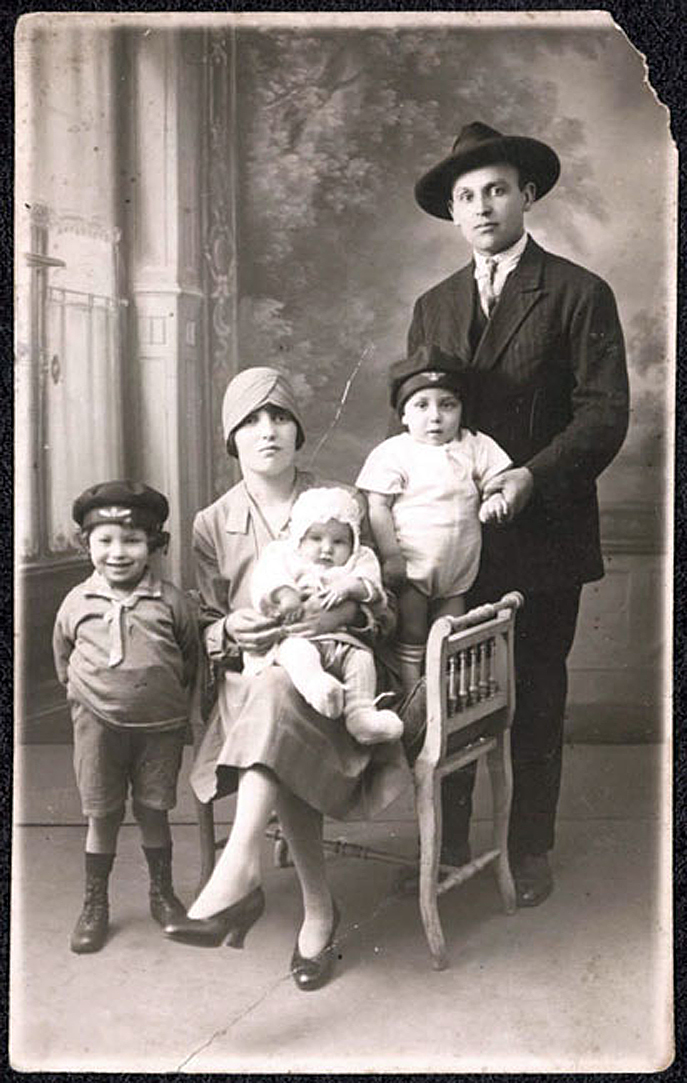 Paris, 12 June 1928. David and Renee-Rivka Ehrlich and their children. Jewish Immigration from Eastern Europe to Francehttps://www.yadvashem.org/holocaust/france/jewish-immigration-from-eastern-europe-to-france.html
The Jewish immigrants from Eastern Europe wanted to become integrated into French society, which they considered their adoptive country. Approximately one third of them received French citizenship. Most of their children attended the state-sponsored, secular, French school system. The Ort network of vocational schools initiated professional training for Jews, primarily in industry and agriculture. Most of the students in these schools were Jews who had immigrated to France from Eastern Europe. Many of the immigrants were employed in manual labor, but some of them obtained a higher education, studied French, pursued liberal professions and even acquired financial, social, political and intellectual status within French society, some volunteered to serve in the Foreign Legion of the French army. Prominent examples of the “upward mobility” of Eastern European immigrants to France include Helena Rubinstein and the Marxist thinker Charles Rappoport.
Former Polish Jews who had emigrated to France set up Jewish newspapers, which worked alongside the established French Jewish press. Organizations of Jewish immigrants cooperated with French Jewish organizations to produce significant cultural events, such as ceremonies held in 1939 in honor of the 150th anniversary of the French Revolution. Despite such cultural co-operations, many of the immigrants from Poland preferred to pray in synagogues of Jews from Eastern Europe. Some of the French Jews had reservations about the Eastern European Jewish immigrants and so created additional, exclusive, organizations.
During the 1930s many French Jews had reservations about the immigrants, claiming that they constituted an additional increase to the workforce in an economy that was already suffering from unemployment. Another argument was that the new immigrants would seek retribution against Nazi Germany for its actions against Jews, thereby entangling France in another war. In 1936 the Jewish Socialist Léon Blum was elected as Prime Minister. The result was a sharp increase in French antisemitism.
Most Jewish immigrants who successfully obtained French citizenship had immigrated to France from Eastern Europe before the First World War. The majority of the immigrants did not receive French citizenship, even after years of living in France. The importance of this status became very clear during the years of deportation (1942-1944), as the “stateless” Jews were the first to be deported.
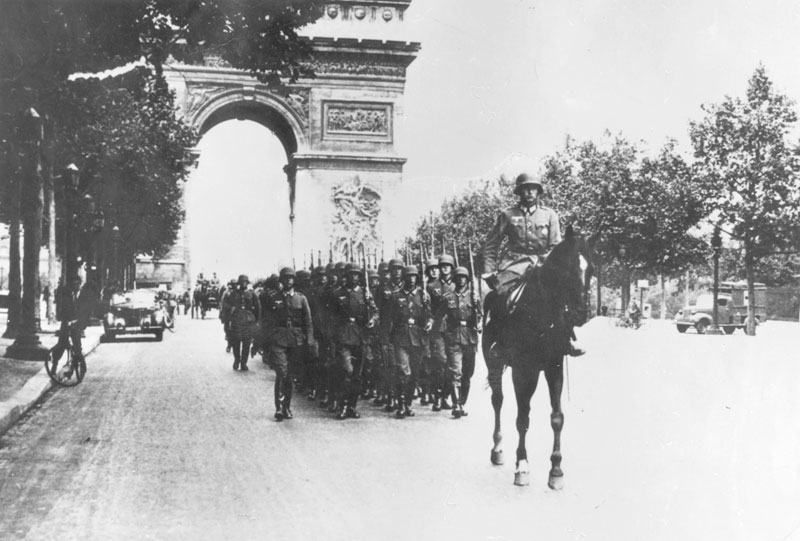 A German military unit, marching down the Champs-Élysées; Paris, 4 July 1940 The German Occupation of Francehttps://www.yadvashem.org/holocaust/france/german-occupation.html
In May 1940 France was invaded by German forces. Within a month France was defeated. An armistice was signed on June 22, 1940 and following it France was divided into a German occupied zone in the North, a French governed zone in the South, also known as Vichy, which collaborated with the Germans and had certain authority also in the German-occupied zone, and a small demilitarized Italian occupied zone in the Southeast.
In July 1940, a special commission (commission de revision des naturialsation) was set up to review naturalizations issued after 1927. Trials to denaturalize French citizens went on throughout the war. About circa 15,000 persons were de-naturalized. Of the 15,000 persons denaturalized during the war about 6,500 were Jews.
Anti-Jewish measures were placed in both zones the cornerstone being the Statut des Juifs (anti-Jewish law), promulgated by the Vichy Government, on October 3, 1940; this Statute was later amended with additional anti-Jewish measures. The First Jewish Statute called for the drastic decrease of Jewish involvement within French society. It announced who in France was considered a Jew, a definition stricter than determined in Nazi Germany. It removed Jews from the army, civil service and closed off top public offices while putting a quota on Jews working in various professions. A law passed on October 4, 1940 allowed for the detainment of Jews of foreign nationality. By February of 1941, 40,000 foreign Jews were detained in camps of the Unoccupied Zone alone. Three arrest operations in the occupied zone throughout 1941 led to the detainment of close to 9,000 Jews in camps of the occupied zone, most of foreign nationality. Over time, these camps would claim the lives of some 3,000 Jews, the first victims of the Holocaust in France.
A Second Statut des Juifs was issued on June 2, 1941, in which the definition of who was a Jew became more rigid. It used the term religion, which was poignant on account of France’s liberal tradition. The new Statute called for the removal of Jews from industry, business, and liberal professions. The Statutes were enacted in both zones and in France’s overseas territories.
From June 1942, Jews in the Northern Occupied Zone had to wear the yellow star on their clothing. It was not required in the Southern Zone. A first deportation to Auschwitz – the first one from Western Europe – left France on March 27 1942. The July 16-17, 1942 “Vel d’Hiv” roundup of Jews in Paris instigated the systematic mass deportations from France which included three transports per week, through the summer and fall of 1942. In November 1942, the Germans occupied the Southern Zone and continued the ongoing actions to arrest Jews and deport them to their extermination. Thousands of Jews fled to the now expanded Italian Zone to escape persecution. On September 8, 1943, the Germans entered and occupied the now former-Italian Zone.
On June 6, 1944, the Allies invaded the coast of Normandy in Northern France. In August 1944 Paris was liberated, and by the later part of the year France was free. Franco-German collaboration facilitated the arrests and deportations of approximately 78,000 Jews, about a quarter of French Jewry, to extermination camps.
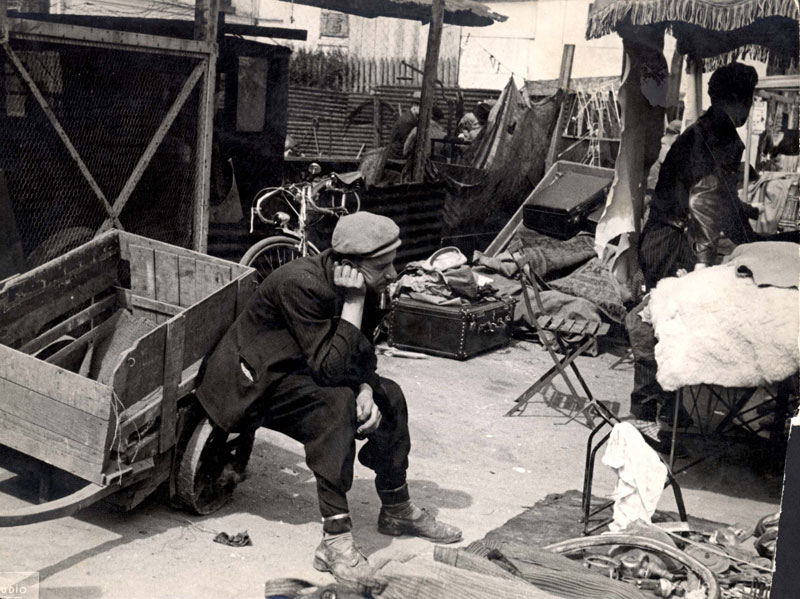 May 1941, the flea market in the Jewish quarter in Paris. The First Wave of Arrests in France: May 1941https://www.yadvashem.org/holocaust/france/first-arrest-wave-may-1941.html
On the 14th of May, 1941, Jewish men between the ages of 18 and 40 were called to present themselves to the Paris police. They were summoned using a green postcard, for which this wave of arrests became known as the “billet vert”. More than 5,000 Paris Jews were taken into custody in this wave of arrests, almost all of them of Polish extraction. A few Jews of Czech and Austrian origin were also arrested. After their arrest, the prisoners were sent to the detention camps of Pithiviers and Beaune-la-Rolande.
“They wake them from their sleep at six o’clock in the morning, and at seven o’clock they get a kind of unsweetened coffee and no bread,” wrote the Jewish journalist Jacques Bielinky in his diary, “These people, who have committed no crime and will not stand trial, suffer from a well-organized hunger.”
The Jews of Paris were gripped with crippling anxiety. Many were afraid to sleep in their own homes, while others avoided going out. Entire synagogues, particularly those catering to émigrés from Poland, now stood vacant. A Jewish aid organization, formed after the wave of arrests, collected large sums of money for the families of the detainees.
In the beginning of June, 1941, a new and more severe Jewish statute was passed, and the propaganda against the Jews became even more acerbic. After Germany invaded the Soviet Union on 22 June 1941, many Jews with Soviet citizenship were arrested in France. On the 20th of August some 3,000 Jews were arrested in a sudden operation, undertaken with joint French-German collaboration. These arrests were assisted by detailed lists prepared by French police officers. “In Drancy a Jew is walking in the street, carrying a doll. He went out to buy a doll for his little girl, but on the way home he was arrested and interned in Drancy,” wrote Bielinky in his diary.
In Autumn 1941, during the High Holidays, the turnout in French synagogues was even more meager than usual, primarily due to fear of further arrests during the holidays. However, by November 1941 many of the detainees had been released. There was widespread relief in light of this event, and many Jews considered the worst to be behind them. But in December 1941 the arrests resumed. This time they were conducted by the Germans. While the arrests were being carried out, the Germans sought to assuage Jewish fears by encouraging them to volunteer to help the war effort; pamphlets were circulated, advertising the need for thousands of Jewish volunteers in the Ardennes region in Northeastern France. Hundreds of Jewish men were arrested and sent to the Compiègne internment camp, north-east of Paris, yet in the months that followed they were released. Thus, before the arrests resumed in March 1942 – deportation to the East began in July of that year – there were less than 10,000 Jews interned in the concentration camps in France.
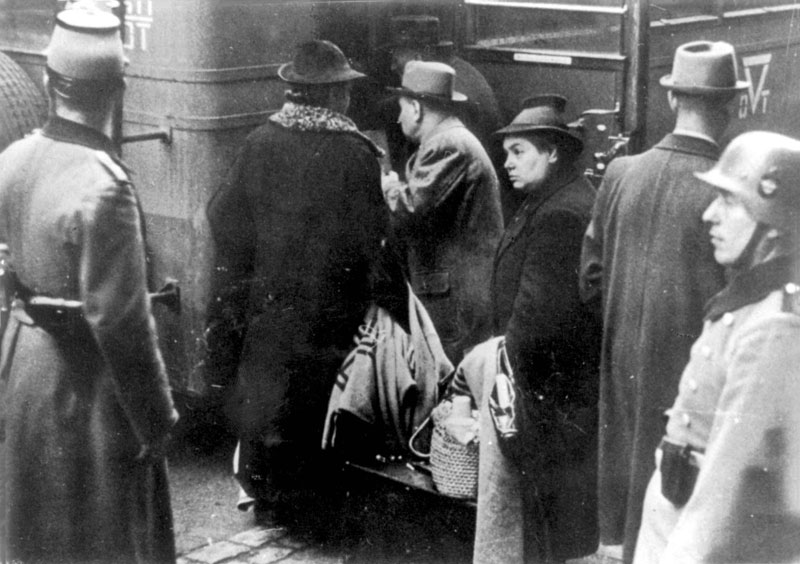 Deportation of Jews to the Gurs concentration camp in France Concentration Camps in Francehttps://www.yadvashem.org/holocaust/france/camps-in-france.html
When, in May 1940, the Germans invaded France, thousands of immigrants who held German citizenship or were of German descent were concentrated in the “Winter Stadium” (Vel’ d’Hiv) in Paris. These immigrants were considered enemy aliens. Among those detained were thousands of Jewish men, as well as Jewish women who had no children. The detainees were deported to the Gurs concentration camp near the French-Spanish border.
After the anti-Jewish legislation of October 1940, the Vichy regime broadened its actions to arrest and detain Jews in its territory. They were incarcerated in 15 concentration camps which included the camps of Gurs, Le Milles, Rivesaltes and St. Cyprien. By the beginning of 1941 some 40,000 Jews had already been arrested. In addition to those arrested, some 35,000 Jewish men were conscripted by force into the “Labor Corps”, or Compagnies de Travail. Almost all the foreign Jewish men, more than a third of the population of foreign Jews in France, were either conscripted into the Labor Corps or incarcerated in concentration camps.
The concentration camps provided only meager nutrition and faulty sanitary facilities. The prisoners had no possibility of appealing their internment or of trying to alleviate their conditions. The food provided was not enough to sustain even a bare minimum of existence. Hundreds of prisoners died due to disease, cold and starvation; thousands of prisoners reached a state of malnourishment.
Dozens of Jewish and Christian aid organizations, both French and international, tried to infiltrate the camps in order to aid the prisoners, primarily by supplying them with food and care for the children. These organizations succeeded in smuggling children out of the concentration camps and transferring them to orphanages which were under their control, to Christian foster homes and abroad.
During the period of German occupation 26 concentration camps operated in the Occupied Zone. The central concentration camp in France was Drancy, not far from Paris. Following the German occupation in 1940, Drancy was initially used as a camp for French and British prisoners of war. Beginning in the summer of 1941, when the roundup of Paris Jews began, Drancy was used to imprison Jewish detainees. From March 1942 Drancy became a transit camp for Jews who were being deported to the East.
In the vicinity of Paris and in Northeastern France there were additional concentration camps run by the Vichy regime. Among these were Pithiviers, Beaune-la-Rolande, Besançon, Compiègne and others. Of the 54,000 Jews who passed through the camp of Compiègne, 50,000 were deported to their extermination. The Jews who had been arrested in the big waves of arrests, in May 1941 and July 1942, were interned in Pithiviers. Just as in the case of Drancy and Compiègne, beginning in July 1942, thousands of Jews were deported from Pithiviers and Beaune-la-Rolande to Auschwitz.
The concentration camps in France continued operating during the summer of 1944, which marked the height of the battle for Paris and the Allied campaign to liberate France.
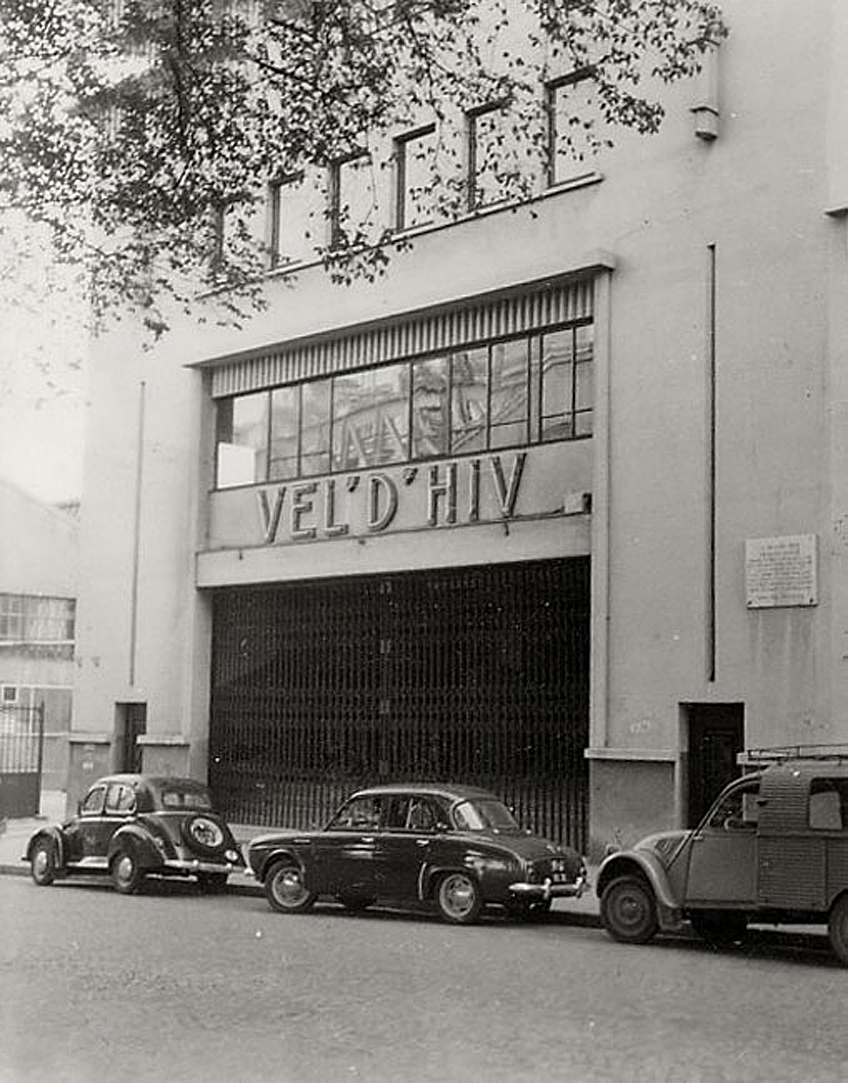 Entrance to the Vel’ d’Hiv (the Winter Stadium, or Velodrome d’Hiver), where Jews were detained en-masse in preparation for their deportation to concentration camps in France. The Vel’ d’Hiv Rounduphttps://www.yadvashem.org/holocaust/france/vel-dhiv-roundup.html
In May and June, 1942, Reinhard Heydrich (head of the SS Sicherheitsdienst, or SD), Fritz Sauckel (who organized the employment of forced labor for the German armament factories) and Adolf Eichmann (the SS official in charge of Jewish Policy), visited Paris. In June and July 1942 the French administration in charge of the Jewish question in France was replaced by a German one. As a result, French anti-Jewish policies were exacerbated. At dawn on the 16th of July, 1942, some 4,500 French policemen began a mass arrest of foreign Jews living in Paris, at the behest of the German authorities.
Over 11,000 Jews were arrested on the same day, and confined to the Winter Stadium, or Velodrome d’Hiver, known as the Vel’ d’Hiv, in Paris. The detainees were kept in extremely crowded conditions, almost without water, food and sanitary facilities. Within a week the number of Jews held in the Vel’ d’Hiv had reached 13,000, among them more than 4,000 children. Children between the ages of two and 16 were arrested together with their parents. Among those detained were Jews from Germany, Austria, Poland, the Czech Republic and Russia. Though many Jews had been forewarned of the danger, they had assumed the deportation would only target men, as they had in the past; consequently, women and children did not go into hiding. In the week following the arrests, the Jews were taken from the Winter Stadium to the concentration camps of Pithiviers and Beaune-la-Rolande in the Loiret region south of Paris, and to Drancy, near Paris. At the end of July and the beginning of August, the Jews who were being detained in these camps were separated from their children and deported. Before deportation, each prisoner’s head was shaved, and his or her body was subjected to a violent search. Most of the deportees were sent to Auschwitz and murdered. More than 3,000 babies and children were left alone in Pithiviers and Beaune-la-Rolande. At the end of August and during the month of September these children were deported alone, among adult strangers, in sealed railway wagons, to Auschwitz, where they were murdered.
In the two months that followed the Vel’ d’Hiv arrests some 1,000 Jews were deported to Auschwitz every two or three days. By the end of September 1942 almost 38,000 Jews had been deported to Auschwitz from France. In 1945 only some 780 of them remained alive.
The French reactions to the arrest and deportation of Jews varied between active collaboration with the Germans, indifference, and empathy toward the persecuted Jews. Most of the civil administration and the French policemen who had been allocated to conduct the arrest collaborated with the authorities. A minority, however, tried to aid Jews in escaping, either by turning a blind eye toward escapees, or by actively aiding such escapes and providing Jews with hiding places. Many elements within French society – leading figures in the Church, the press and the underground – expressed revulsion at the events and protested against them. Public condemnation of the arrest and deportation of Jews was primarily sparked by the difficult sight of women arrested along with their babies. This negative public sentiment found its way into the official reports of governmental authorities and even the police.
The Vel’ d’Hiv round ups, organized by the French authorities and carried out by French policemen, became engraved in French national memory as a symbol of the responsibility of the regime and the French nation for the Holocaust of the Jews of France.
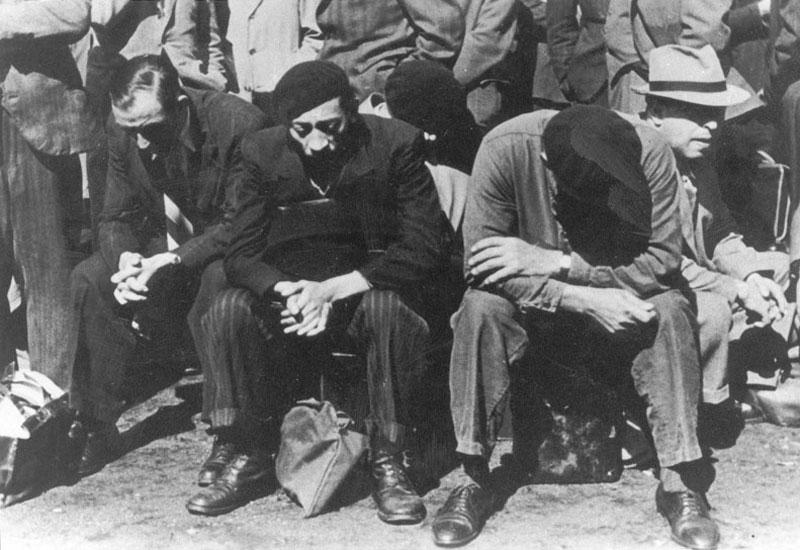 Paris, 20 August 1941: Jews on the street before deportation. The Deportation of the Jews from Francehttps://www.yadvashem.org/holocaust/france/deportation-from-france.html
The Jews in France were deported to the East at the height of a two year process of persecution and aggressive legislation. The laws passed included statutes defining who was to be considered a Jew, isolating Jews from French society, divesting them of their livelihood, incarcerating many of them, and registering their names with the police.
From winter 1940-1941 French Jews began to be imprisoned in concentration camps. Thousands of Jews were imprisoned in camps in the vicinity of Paris and Southwestern France. In May 1941 many more thousands of Jews were arrested.
In March 1942 some 1,000 Jews were arrested and sent to the Compiègne detention camp, from where they were deported to Auschwitz. The transports took two days to arrive at their destination. Most of those who were still alive at the end of the jouney were murdered.
In July 1942 some 23,000 Jews were arrested in Paris and in the remainder of the Occupied Zone. At the initiative of Pierre Laval, the Prime Minister of the Vichy regime, most of the Jewish children were deported to the East together with their parents. The arrests and deportations were conducted in a very violent manner, often enforcing the separation of couples, parents and children, and brothers and sisters. “A cruel destruction of Jewish families,” wrote the Parisian Jewish reporter, Jacques Bielinky. In August 1942 the arrest of thousands of additional Jews began in the territories of the Vichy regime. The arrested Jews were imprisoned in concentration camps and deported to their destruction in the East. “The deportations are creating tremendous pressures in the concentration camps and wreaking havoc within the Jewish families,” wrote Bielinky on the 18th of August 1942. “To date,” he continues, “nothing is known about the fate of those who have been deported.”
In September, Paris policemen arrested some 1,000 Jewish immigrants from Romania, and sent them to the concentration camp of Drancy. Almost all of them were murdered in the extermination camps in the East within three days of their arrest. In November another wave of mass-arrests was carried out in Paris. More than a thousand Jews of Greek origin were arrested and deported to the East.
The Jews reacted to the deportations by ceasing to cooperate with the German and French authorities, and the Jewish aid organizations which they had founded. Many Jews went into hiding in some 6,000 villages and small towns across France. The German and French authorities responded by organizing raids in rural areas, including the territories of the Vichy regime.
Activists in the Jewish aid organization “Amelot” sent packages to the arrested Jews, helped maintain contact with the deportees, and procured permits which helped Jews escape deportation. Furthermore, they saved Jews from deportation by hiding children and distributing forged documents. The UGIF (l’Union Generale des Israelites de France), a forced representative organization for French Jews set up by the French and German authorities, succeeded in saving more than 1,400 Jewish children with French citizenship from deportation. Their parents, however, were deported.
Jewish organizations helped the children by providing social welfare, opening shelters and sending the children to the villages. Jews joined the Jewish Resistance in France, as well as the French Resistance. A few Jews tried to escape the deportations by converting to Catholicism. Thousands of Frenchmen tried to help the Jews hiden from the deportations. Many of them paid for this with their lives. “Let us thank those who threaten us,” reads an editorial in a French Socialist newspaper, “for it is thanks to them that we must think dangerously, and thereby restore our own dignity.” Since 1962 a total of 3,925 French men and women have been recognized by Yad Vashem as Righteous Among The Nations (as of January 2016).
A total of some 76,000 Jews from France, most of them from Paris, among them 11,000 children, were deported by train to the East. Most of the deportees were murdered in Auschwitz. Most of the deportations left France from the concentration camp of Drancy. The deportations continued even as the Allies had begun to liberate France. The last transport left France in August 1944, while the battle for Paris was being fought. Of all the Jews deported from France to the extermination camps in the East, a total of some 2,500 survived.
|
French Jewish leader calls on government to declare emergencyThe head of the country’s second-largest community blamed the far-left for widespread rioting, which he and others said featured Palestinian symbols.
Canaan Lidorhttps://www.jns.org/news/world/french-jewish-leader-calls-on-government-to-declare-emergency  A protester holds a Palestinian flag as a bus stop burns during a demonstration at Place de Republique in Paris, Oct. 17, 2026. Photo by Guy Smallman/Getty Images.
(Oct. 18, 2026 / JNS) A leader of French Jews on Sunday called on the government to declare a state of emergency to deal with nationwide rioting, which he said was being organized by the far left.
“I believe we need to declare a state of emergency in France, send in the army, massively increase law enforcement personnel and arrest these rioters and vandals by every means,” Bruno Benjamin, the president of the Marseille-Provence branch of the CRIF umbrella group of French Jewish institutions, told JNS.
On Sunday morning, congregants of one synagogue in Paris found that it had been ransacked on Saturday, Jewish community sources said.
Hundreds of thousands of people have participated in protests in cities across France over the weekend. The protests, which have been going on for several weeks in waves, began over conditions at public schools, according to some protesters, but have devolved into vandalism, looting and violence against police.
Some 1,200 people have been arrested over the weekend and at least 150 police officers were injured. Footage from Marseille showed police coming under heavy volleys of stones and other objects on a central square. A police station was ransacked in Marseille and in the city of Limoges, City Hall was torched. 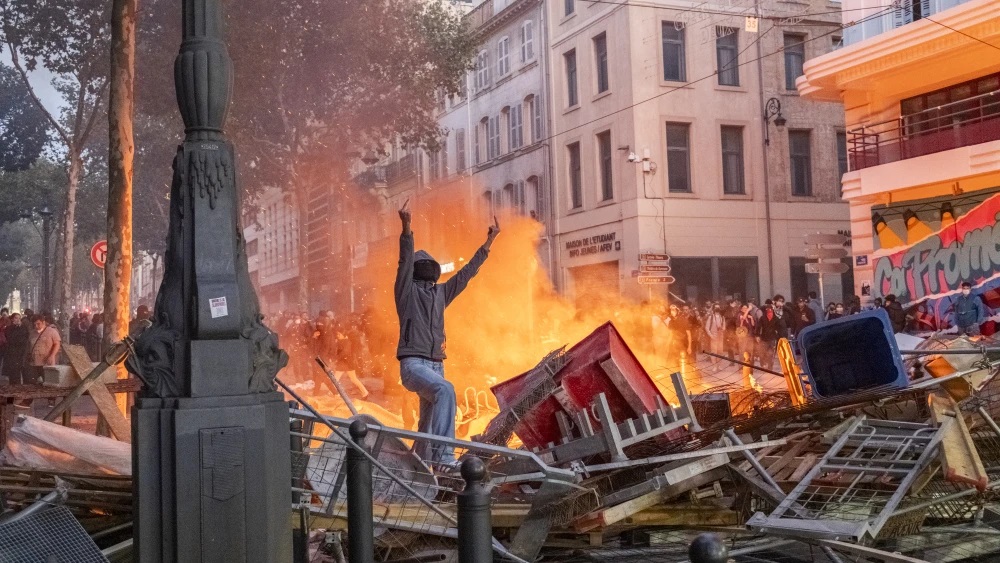 A protester gives the police the middle finger from between the barricades in Marseille, France on Oct. 17, 2026. Photo by Sener Yilmaz Aslan/Getty Images.Sener Yilmaz Aslan/Getty Images
Many protesters carried Palestinian flags, Benjamin said, but there has been no indication of Jewish institutions being targeted in Marseille, the second largest city in France and home to the country’s second-largest Jewish community, after Paris.
In Paris, Meyer Habib, a French-Jewish former lawmaker, told Channel 14 that Place de la République, where rioting also occurred on Saturday, was “flooded” with Palestinian flags.
“While French President Emmanuel is giving advice to Israeli Prime Minister Benjamin Netanyahu about security, the main square in Paris, the Christian Dior shops, the Apple shops, even grocery stores, [are looted] by whole families, mothers with their children.”
He added: “I feel pain for France, my country, and call on my French brethren: Wake up before it’s too late.”
#MorningInIsrael 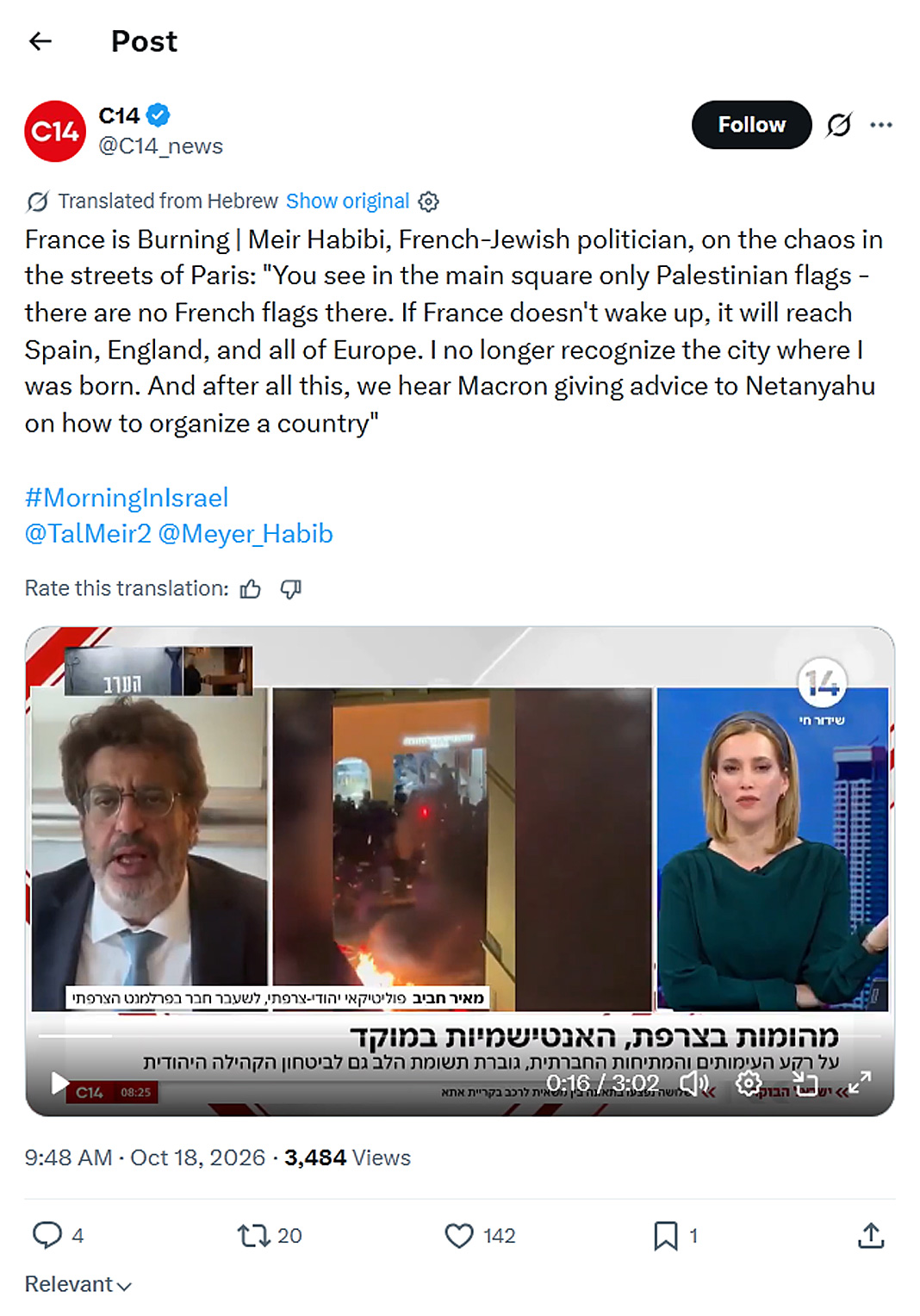 C14-tweet-18October2026-France is Burning
In Marseille, as elsewhere in France, synagogues remained open for morning, afternoon and evening prayers, with the Jewish Community Protection Service, or SPCJ, maintaining vigilance despite weeks of strain, Benjamin said. “For now, there are no warnings or warning signs that would lead us to say we need to close the synagogues,” he said.
Community officials had considered whether synagogues in the city center could come under attack, Benjamin said. Those fears did not materialize. “No synagogue was attacked. No Jews were assaulted,” he said of that day’s violence.
Asked whether the unrest could prompt more French Jews to move to Israel, Benjamin said Jews must retain the freedom to choose where they live.
“Those who want to make aliyah should make aliyah because they want to live in Israel,” he said. “Those who want to stay must be able to stay, because we must continue fighting to ensure they can live and build their lives in France as they wish.”
Describing the broader violence, Benjamin said vandals had exploited a protest to smash and loot businesses. Some shopkeepers had closed after thieves stole their merchandise and destroyed their premises, he said.
He expressed sympathy for those merchants and for exhausted police officers, saying the unrest had continued for more than a month.
Until the previous day, Benjamin said, he had trusted the authorities’ ability to maintain order. Seeing police overwhelmed had shaken that confidence. “We are questioning whether they can ensure everyone’s safety,” he said.
Benjamin also criticized the display of Palestinian flags at the demonstrations, describing the Palestinian cause as a fashionable rallying point. He blamed the far-left France Unbowed party for encouraging the unrest, accusing figures including party leader Jean-Luc Mélenchon and Mathilde Panot, the party’s faction leader in parliament, of seeking to foment “revolt” and force concessions from authorities.
The political effect would be to strengthen Marine Le Pen and her National Rally party ahead of next year’s presidential elections, Benjamin predicted.
“It is not Marine Le Pen who is coming to power because of her qualities, her platform or her vision for France,” he said. “It is the far left, by behaving this way, that is putting National Rally and Marine Le Pen into orbit.”
Amichai Chikli, Israel’s Minister for Diaspora Affairs and Combating Antisemitism, also touched on the political powers at play amid the riots.
“I was convinced that the Right coming to power in France would trigger a civil war. It turns out I was being optimistic: it has already begun,” Chikli wrote. “I wish France victory over barbarism, despite its betrayal of Israel. Belgium and Britain, you are probably next. Get ready.”
France under Macron has adopted an anti-Israeli approach, which included recognizing a Palestinian state last year and imposing an arms embargo on Israel.
|
|
Soros financed group helping ‘human rights’ orgs force France to boycott IsraelisA filing with France’s highest administrative court asked for an order to “prevent trade or investment relations that assist in the maintenance” of a Jewish presence in eastern Jerusalem and Judea and Samaria.Mike Wagenheimhttps://www.jns.org/news/world/soros-financed-group-helping-human-rights-orgs-force-france-to-boycott-israelis
Five entities that identify as human rights organizations filed a legal challenge with France’s highest administrative court on Wednesday asking for it to order the government to “prevent trade or investment relations that assist in the maintenance” of Israel’s presence beyond the so-called Green Line, which was established as an armistice line in 1949 after the Arab war on a nascent Israeli state failed.
The International Centre for Justice for Palestinians, Law for Palestine, International Federation for Human Rights, Association des juristes pour le respect du droit international and the Ligue des droits de l’Homme cite a July 2024 non-binding International Court of Justice opinion and subsequent non-binding resolution by the United Nations General Assembly claiming that the presence of Jews beyond the Green Line is illegal and must be eliminated.
The ICJ is the principal U.N. judicial arm and is located in The Hague.
The five organizations previously submitted a notice to several French government ministries asking for compliance with their demand but received no reply.
The French government said in September 2025 that it recognized a Palestinian state, and it votes regularly against Israel at the U.N. Security Council. It has also backed the European Union policy of differentiating between goods produced in borders of Israel that are recognized internationally and those in eastern Jerusalem and other territories that some dispute.
France has also issued sanctions against Israelis, including Finance Minister Bezalel Smotrich and National Security Minister Itamar Ben-Gvir, in part for activities in those territories.
The organizations are asking the court to create a blacklist of companies doing business in Jewish communities beyond the Green Line and to prohibit any French nationals from doing so, including holding investments in companies taking part and freezing assets as a sanction.
The plaintiffs are being advised by the Open Society Justice Initiative, which is an extension of the anti-Israel Open Society Foundations.
“The International Court of Justice left no doubt that states cannot stand on the sidelines when faced with legal obligations,” stated James Goldston, executive director of Open Society Justice Initiative. “International law only has force if states are prepared to implement it in practice.”
|
|
LEFTIST KARMA
They pushed her aside, told her to shut up and said they had “urgent shopping” to do 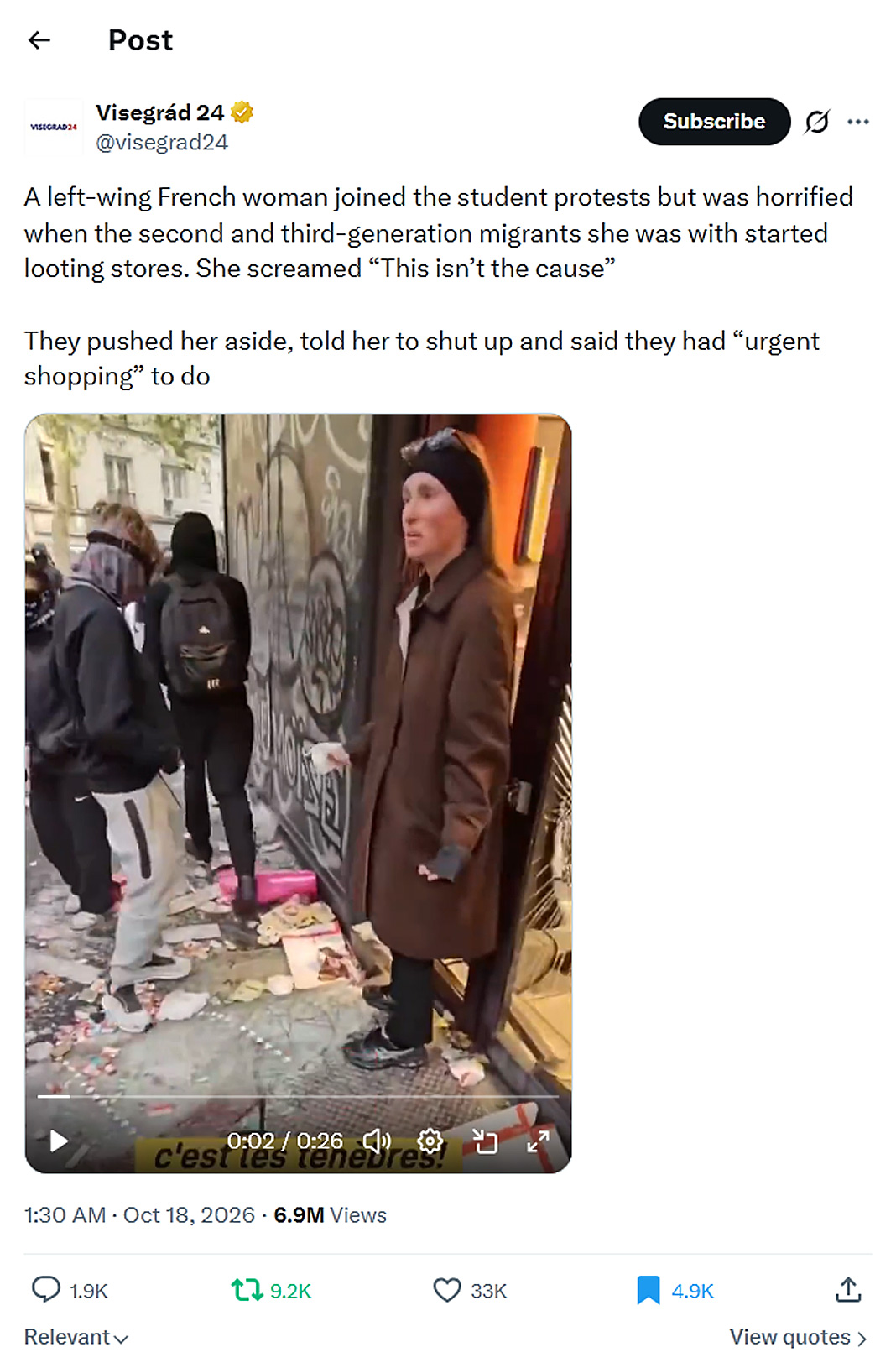 Visegrád 24-tweet-17October2026-LEFTIST KARMA
 Reverend Simon Sideways-tweet-19October2026-LEFTIST KARMA  Baba Booey-tweet-19October2026-KARMA-useful idiot  LEFTIST KARMA
 LEFTIST KARMA-useful idiot
Israel has been dealing with this
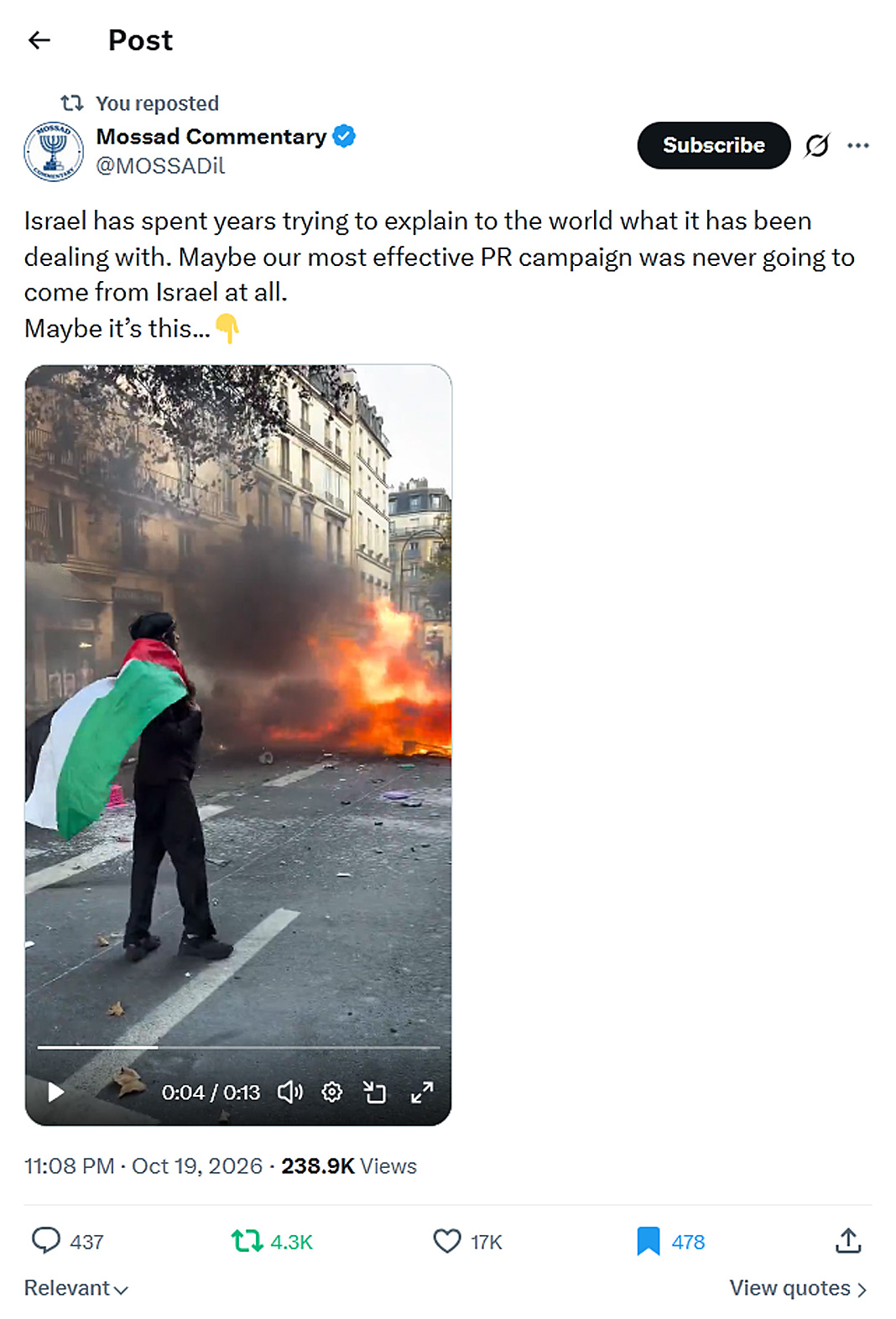 Mossad Commentary-tweet-19October2026-Israel has been dealing with this
|
|
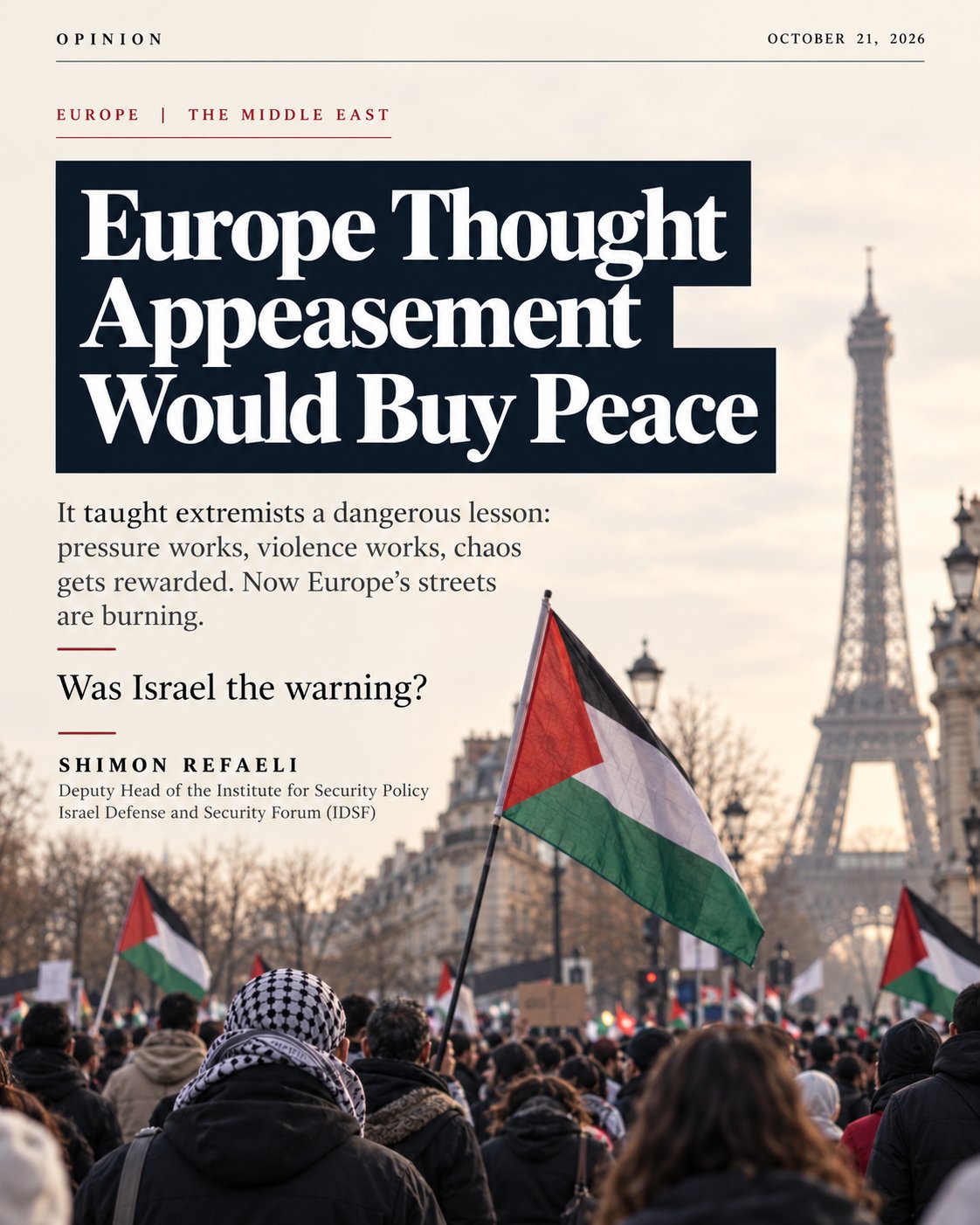 Europe Thought Appeasement Would Buy Peace  Israel Defense and Security Forum The Fire in Europe’s Streets Began in the Middle EastShimon Refaeli | October 21, 2026 | Op-Eds | Europe, The Middle East, https://idsf.org.il/en/opinion-en/the-fire-in-europes-streets-began-in-the-middle-east/ Shimon RefaeliDeputy Chairman of the Security Policy Institute of the IDSF
By Shimon Refaeli | Deputy Head of the Institute for Security Policy, Israel Defense and Security Forum (IDSF)
Many citizens around the world are watching with astonishment and concern the disturbing scenes unfolding in the streets of France, as well as in England, Spain, Ireland, and Italy. The reality emerging through the smoke of burning tires and shattered windows is generally portrayed in the media as an authentic social protest against the rising cost of living, energy prices, or the economic hardships weighing on the middle class.
However, a clear-eyed analysis of what is happening quickly strips away this façade and reveals a much deeper truth. The riots sweeping European cities are not local, domestic, or fundamentally economic events. They are the eruption of a profound strategic process: the rotten fruits of the strategic and ideological alliance between radical Islam and the far left, what can be defined as the “Red-Green Alliance.”
An outside observer must ask a fundamental question: What is the connection between a protest over food prices and rent in France and the mass waving of Palestinian flags? Why, at the heart of a protest supposedly concerned with the welfare of the general public, are the French tricolor and the flags of European nation-states almost nowhere to be found, while symbols of a radical struggle overseas are waved passionately in their place?
The answer lies in the fact that, over the past several years, a number of European countries have chosen to grant unilateral recognition to a Palestinian state, while others have entertained the idea or demonstrated a hesitant and feeble position that failed to stand unequivocally alongside the State of Israel and the fundamental values of the West. In doing so, those countries sent an extraordinarily destructive message to all the forces of chaos and terror: that violence, terrorism, and the disruption of public order are effective tactics that produce results. In this way, several European countries, led by France, encouraged and incentivized systematic violence as a means of achieving objectives. The logic is simple: If radicalization produces results, why would radicals choose moderation?
Sir Winston Churchill sharply defined this when he described appeasers as those who feed a crocodile in the hope that it will become full or satisfied; in reality, however, this only makes it bigger, stronger, more demanding, and far more dangerous.
This is precisely the mechanism we are witnessing in practice today. The capitulation and appeasement of European capitals in the face of the very organizers of violent demonstrations since October 7, and their repeated criticism of Israel in its war against the Hamas terrorist organization, have neither brought stability nor produced a period of calm. On the contrary, they have incentivized violence, granted legitimacy to rioters, and demonstrated to them that the West is weak and in moral and ethical retreat. This is the central reason why these riots are erupting with such intensity precisely in countries such as France, Spain, Britain, and Ireland, and even in countries such as Italy, where some believed that neutrality or a hesitant position would protect them from the wave of destruction.
The State of Israel has served as the litmus test for Western civilization as a whole. The rioters setting streets ablaze in Paris and looting property in European cities do not hate only the Jewish state; for them, Israel is merely the forward outpost of Western civilization. These same forces seek to undermine the rule of law, individual freedom, tradition, and the liberal values that Europe has cultivated over centuries. The French president, who believed that wavering in his support for Israel would appease the extremists and calm tensions, is now discovering that the fire he sought to appease has reached his own doorstep.
And what we are witnessing in France today may be a preview of what awaits Western Europe and the democratic states across the United States as a whole. Surrendering to the forces of chaos, attempting to contain violence, or weakening the moral backbone will not guarantee the security of the West. The West must understand: The forces that justify terrorism against Israeli civilians in the name of a revolutionary ideology may tomorrow justify violence against their own citizens in the name of that same worldview. The only way to restore security, stability, and the rule of law to the streets is to stand firmly, resolutely, and uncompromisingly against radical Islam and its allies on the far left, while standing unequivocally for the shared values and heritage of free civilization. And just as Israel learned at the cost of bloodshed, Europe too must understand: Surrender to extremism does not buy peace. It only raises the price of the next confrontation.
|