This is how we vote in Israel
Click To Play 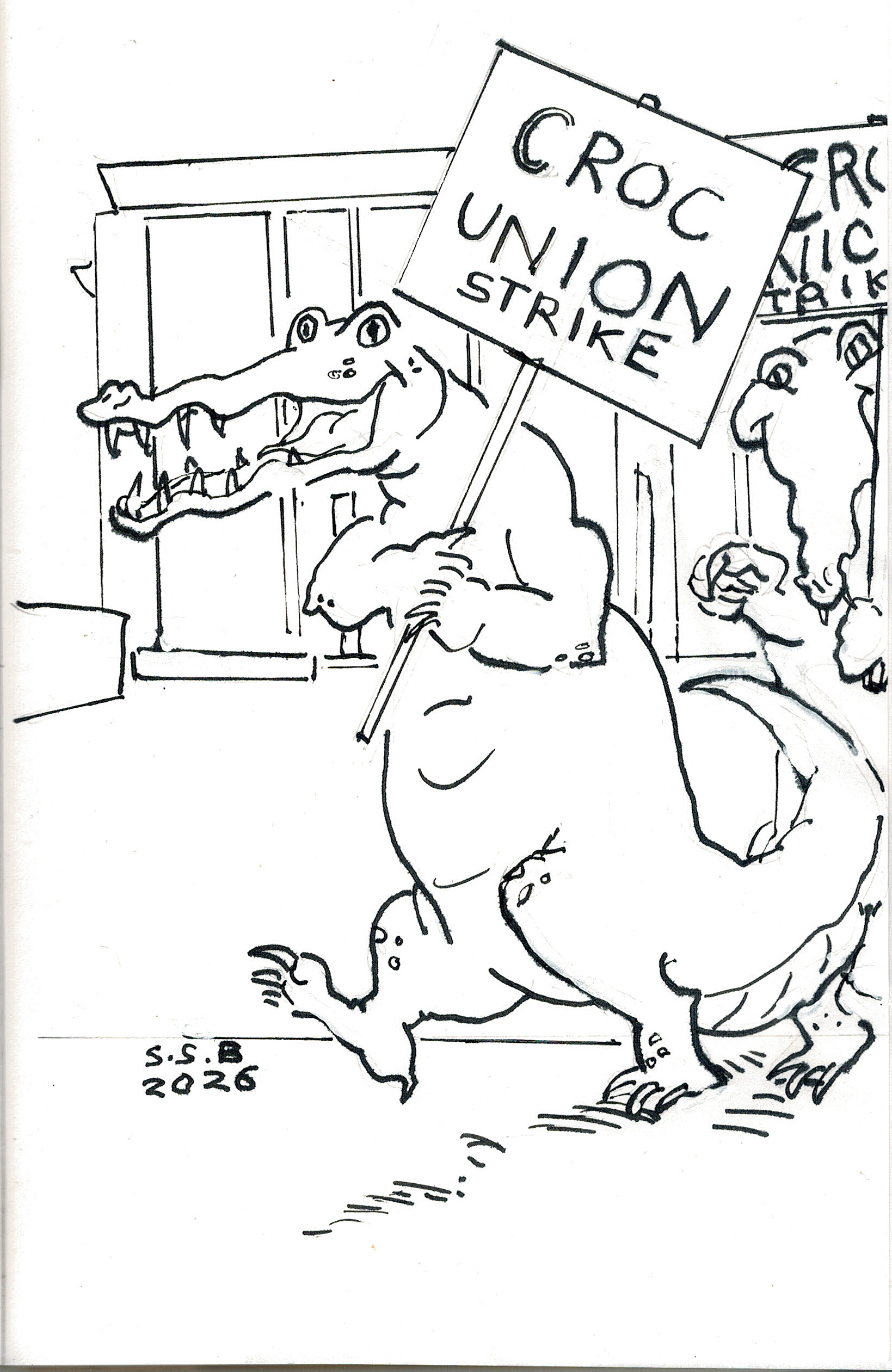 Copyright © 2026 Suzanne Schulman Butterfield |
|
 עָצְמָה יְהוּדִית, Otzma Yehudit
 Photos I am getting from soldiers and their parents-itamarbengvir-tweet-21October2026 |
|
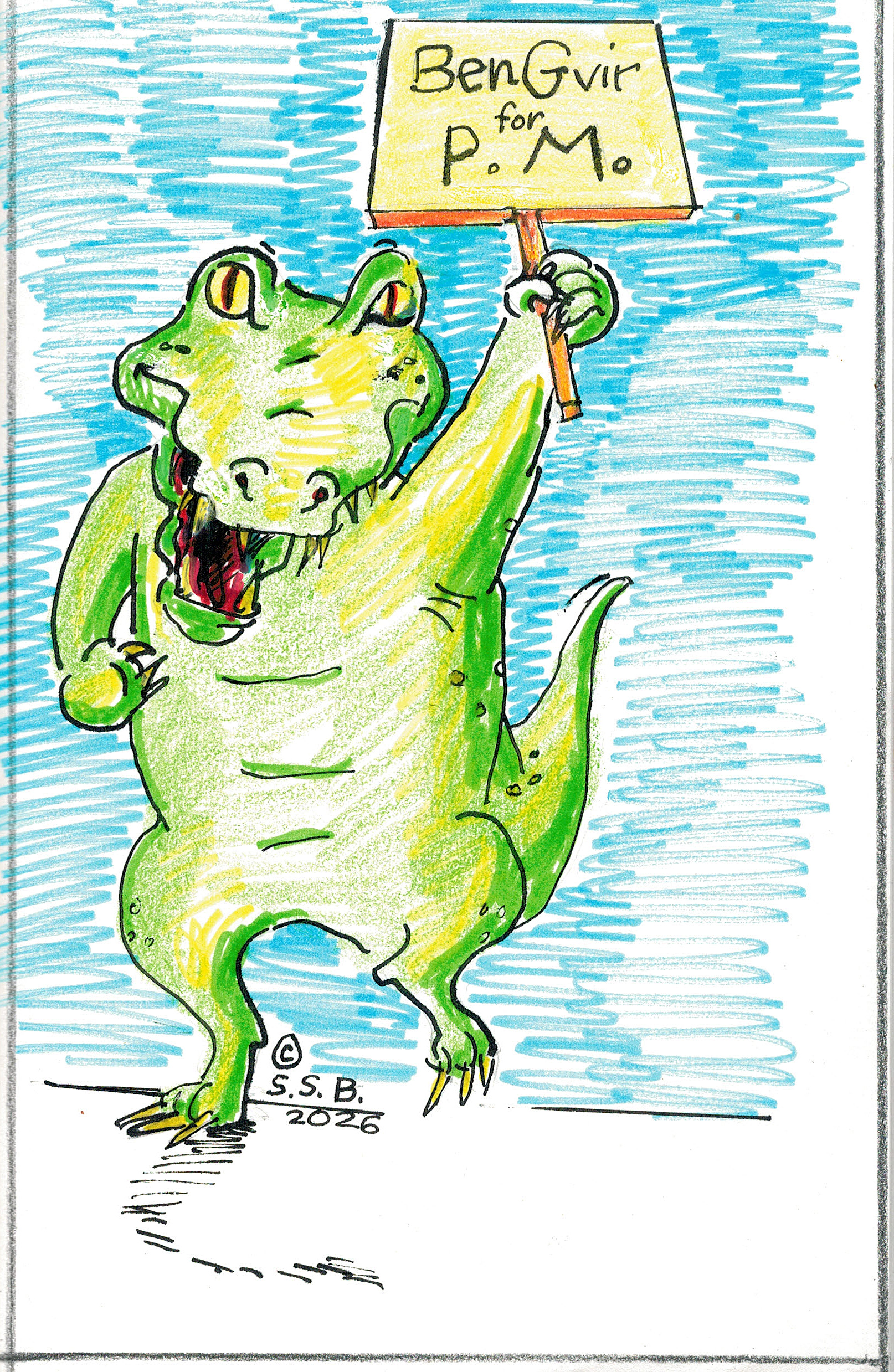 Copyright © 2026 Suzanne Schulman Butterfield
|
|
We promised – we delivered!
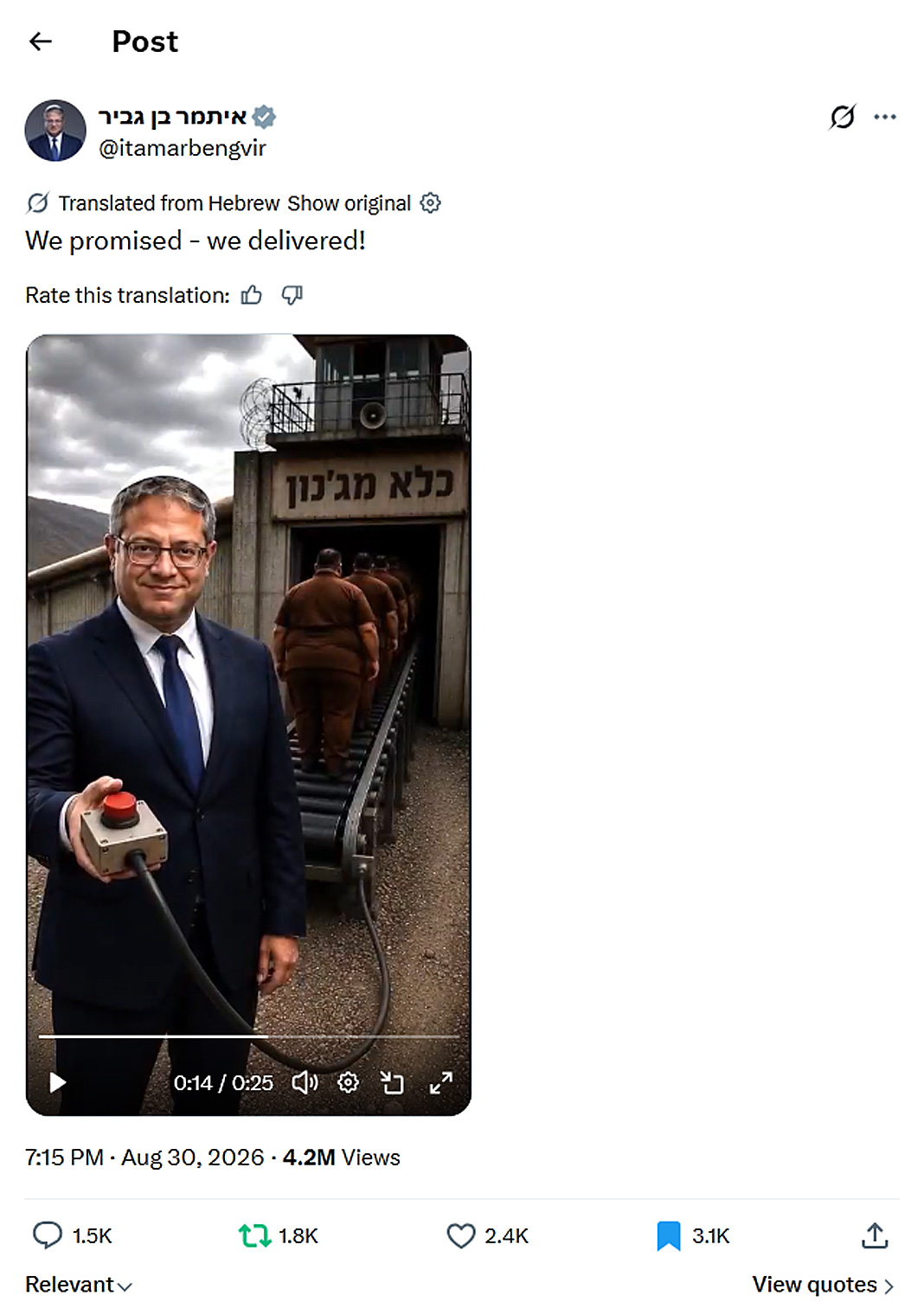 itamarbengvir-tweet-30August2026-We promised-we delivered
BACKGROUND: Nile Crocodiles to be stationed outside security prisons
The minister who didn’t stop
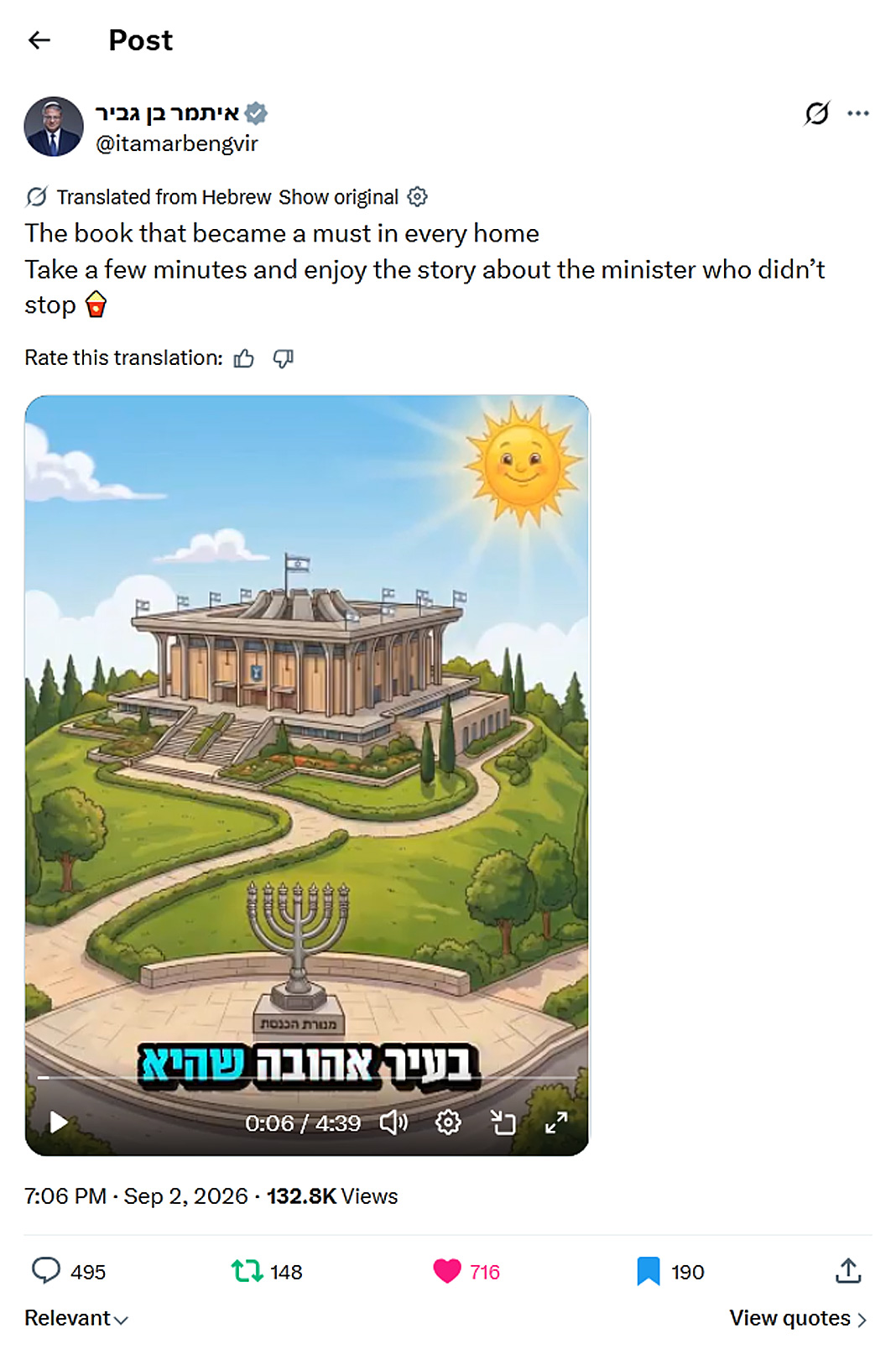 itamarbengvir-tweet-2September2026-the minister who didn’t stop
If only they had listened to me..
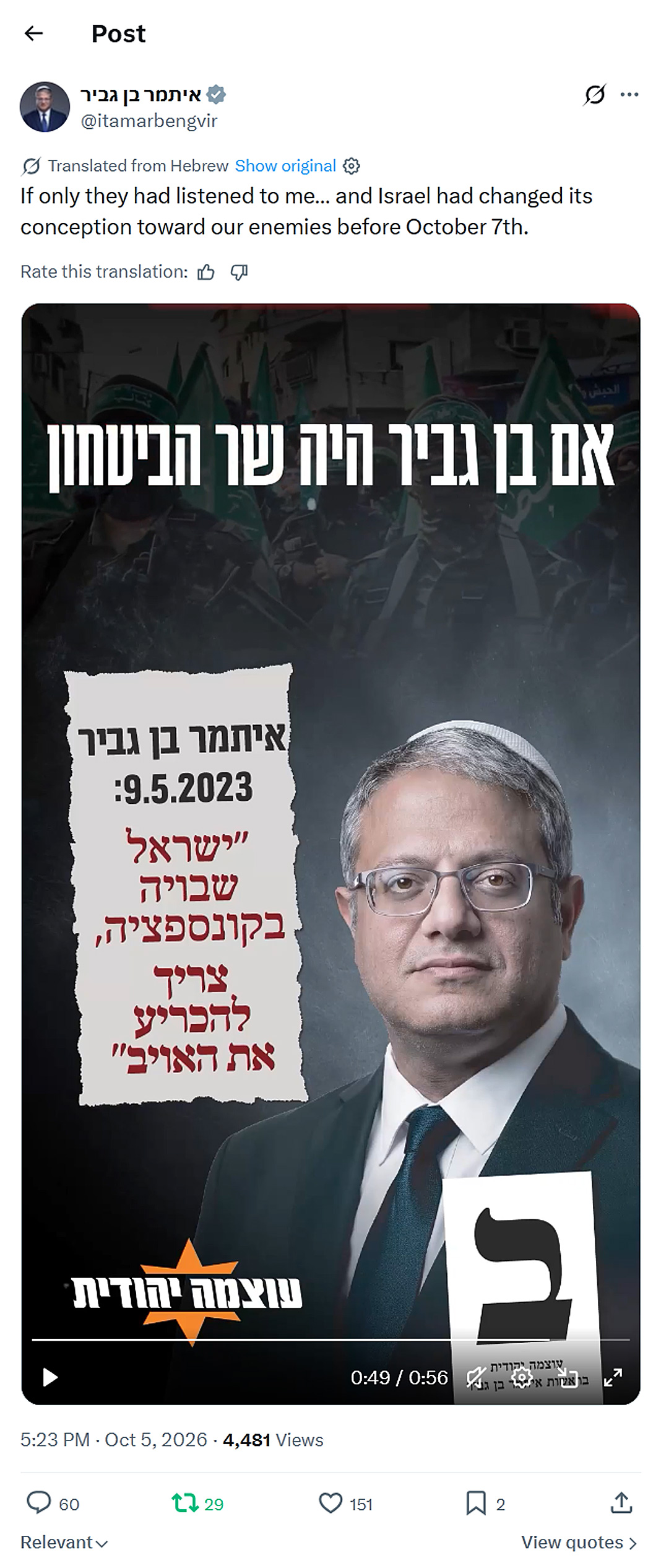 itamarbengvir-tweet-5October2026-If only they had listened to me
Photos I’m getting from soldiers and their parents
I promise you – as Minister of Defense, I will give you full backing, I will be your voice and I will take care of everything you need! Love you, heroes of Israel! We’re starting! 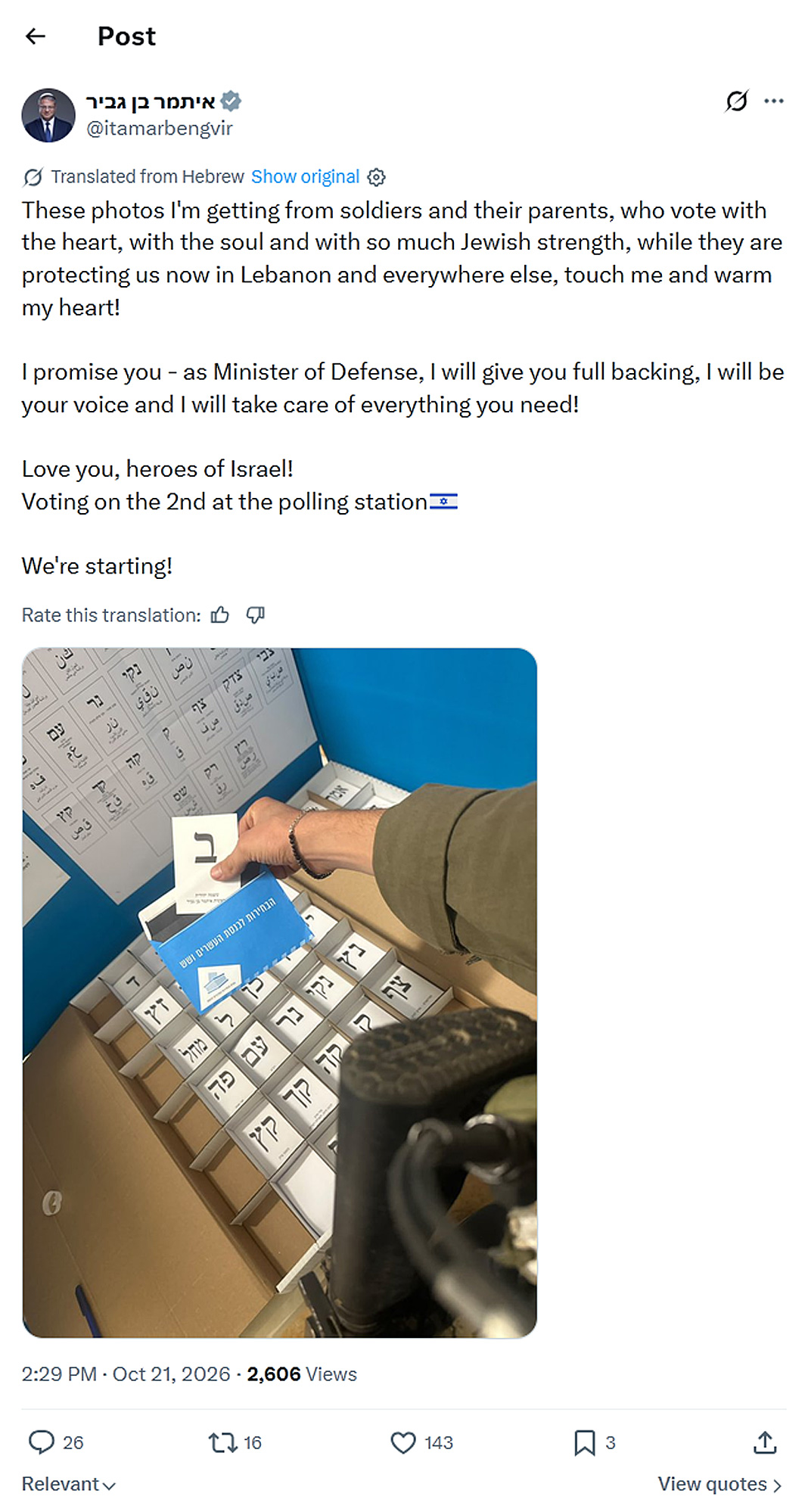 itamarbengvir-tweet-21October2026-Photos I am getting from soldiers and their parents
Thank You
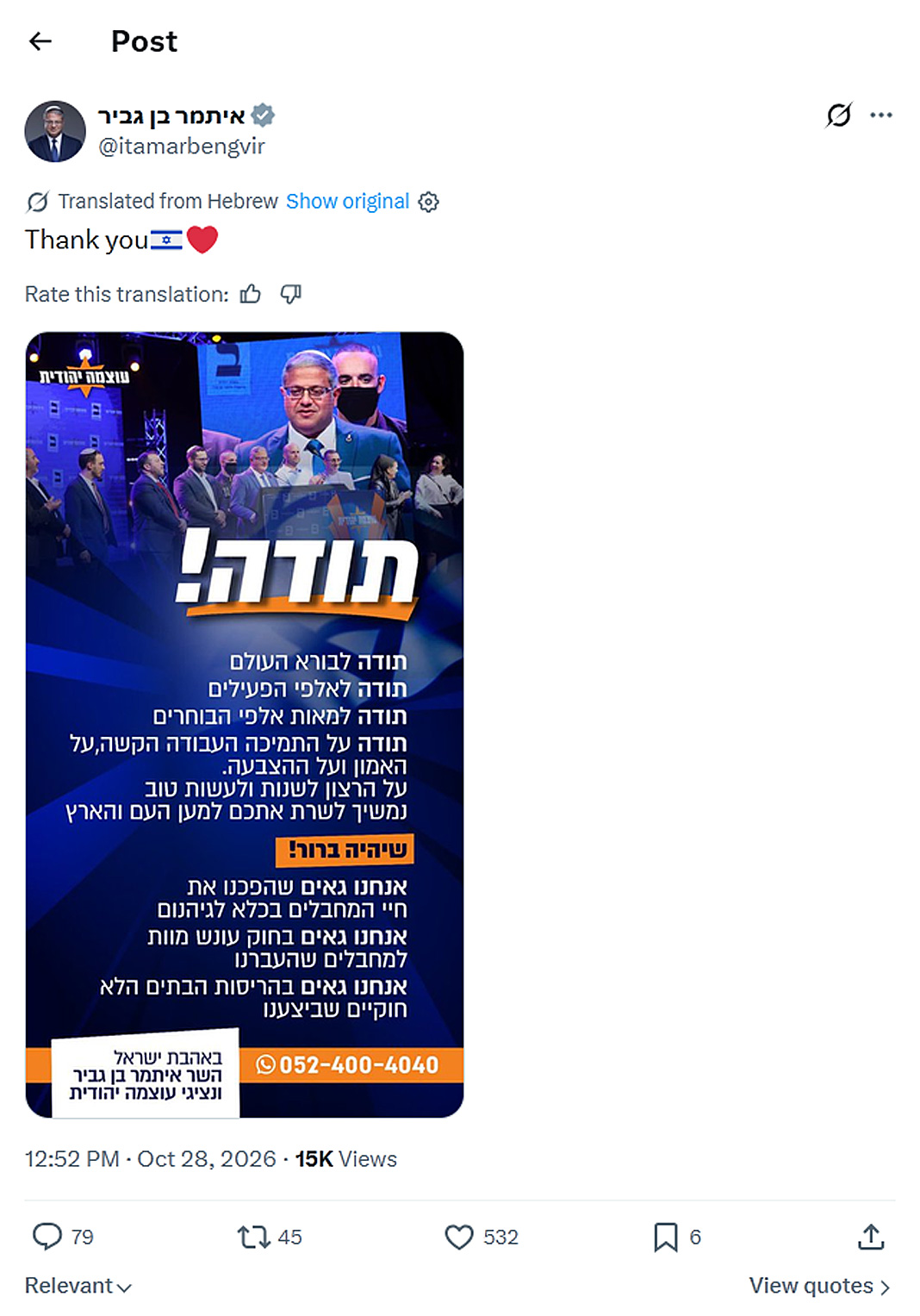 itamarbengvir-tweet-28October2026-Thank you
|
|
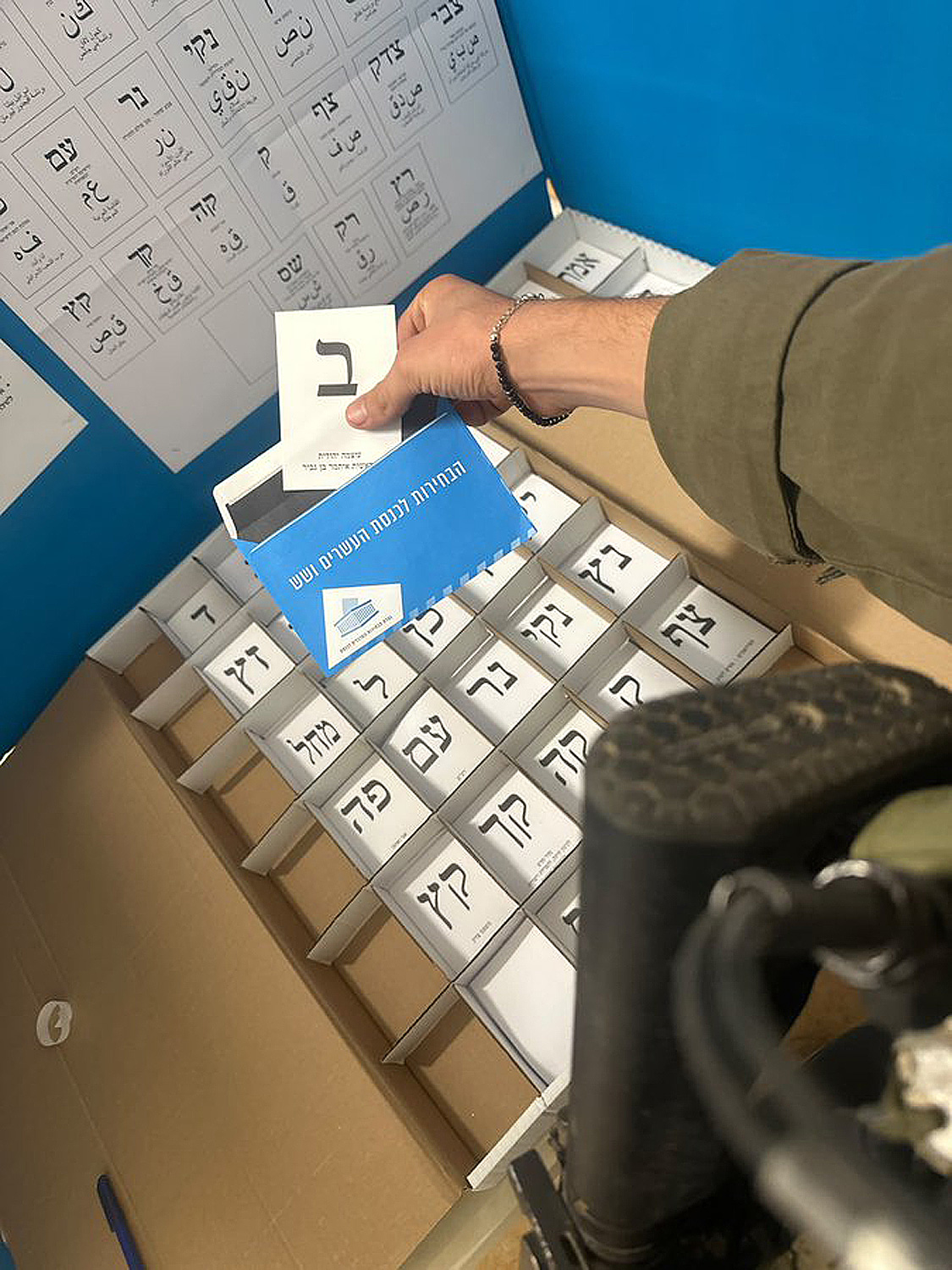
This is how we vote in Israel
No machines. Just place a paper slip in an envelope. No need to register. Every citizen 18+ is automatically assigned a polling place , by their address. Show your ID , step behind the blue cardboard, and participate in democracy. 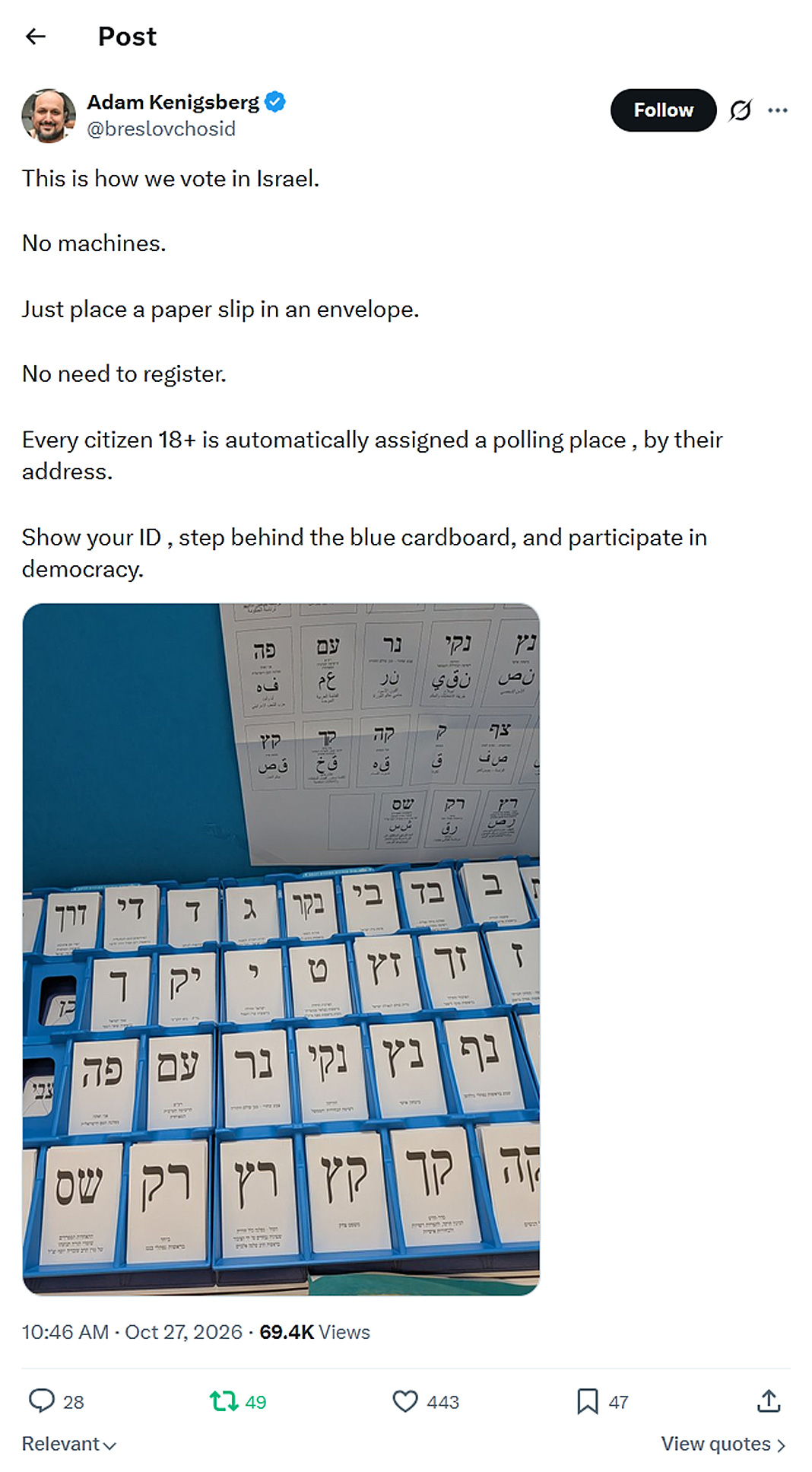 Adam Kenigsberg-tweet-27October2026-This is how we vote in Israel
A nation of immigrants
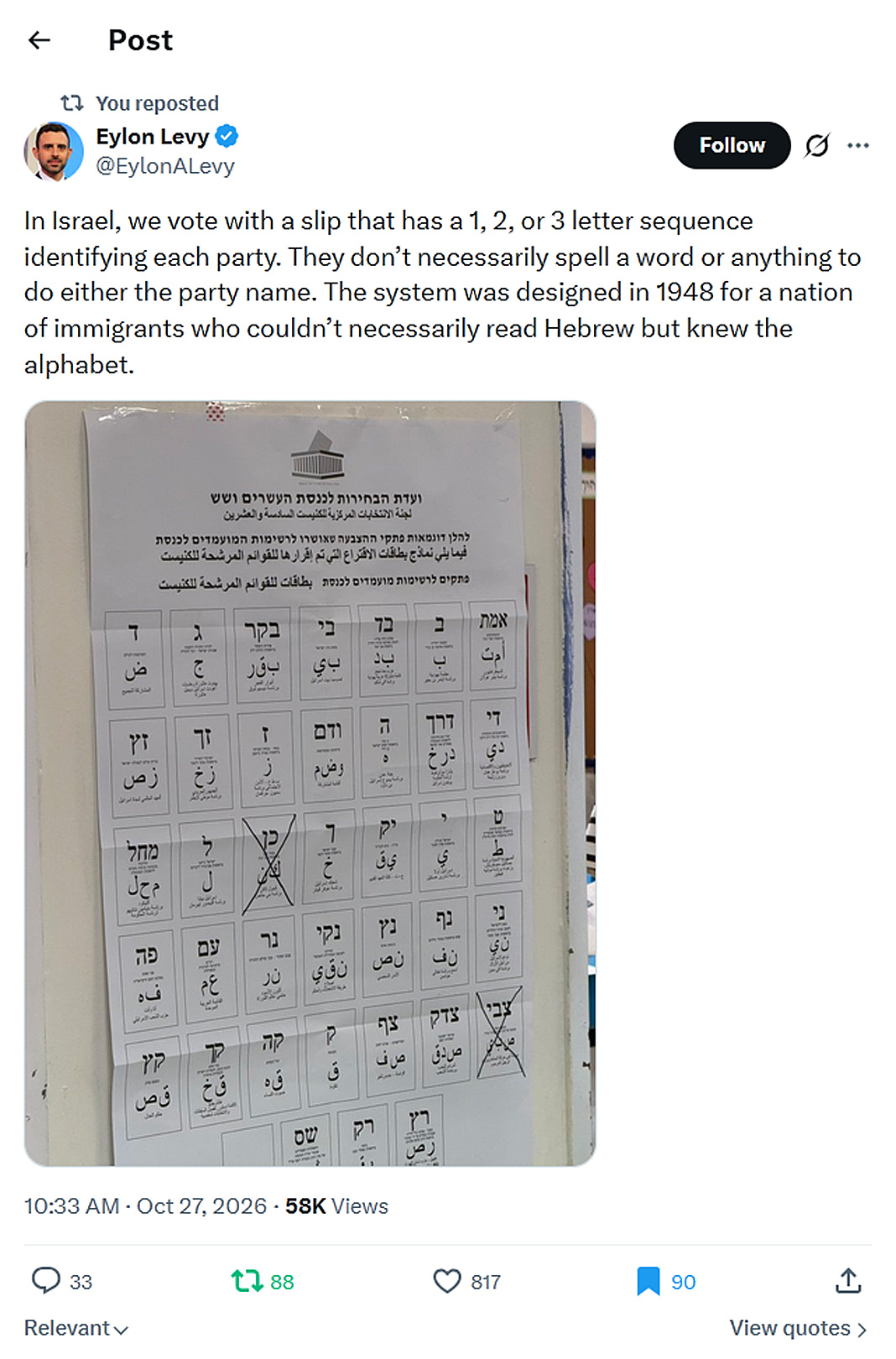 Eylon Levy-tweet-27October2026-A nation of immigrants
|
|
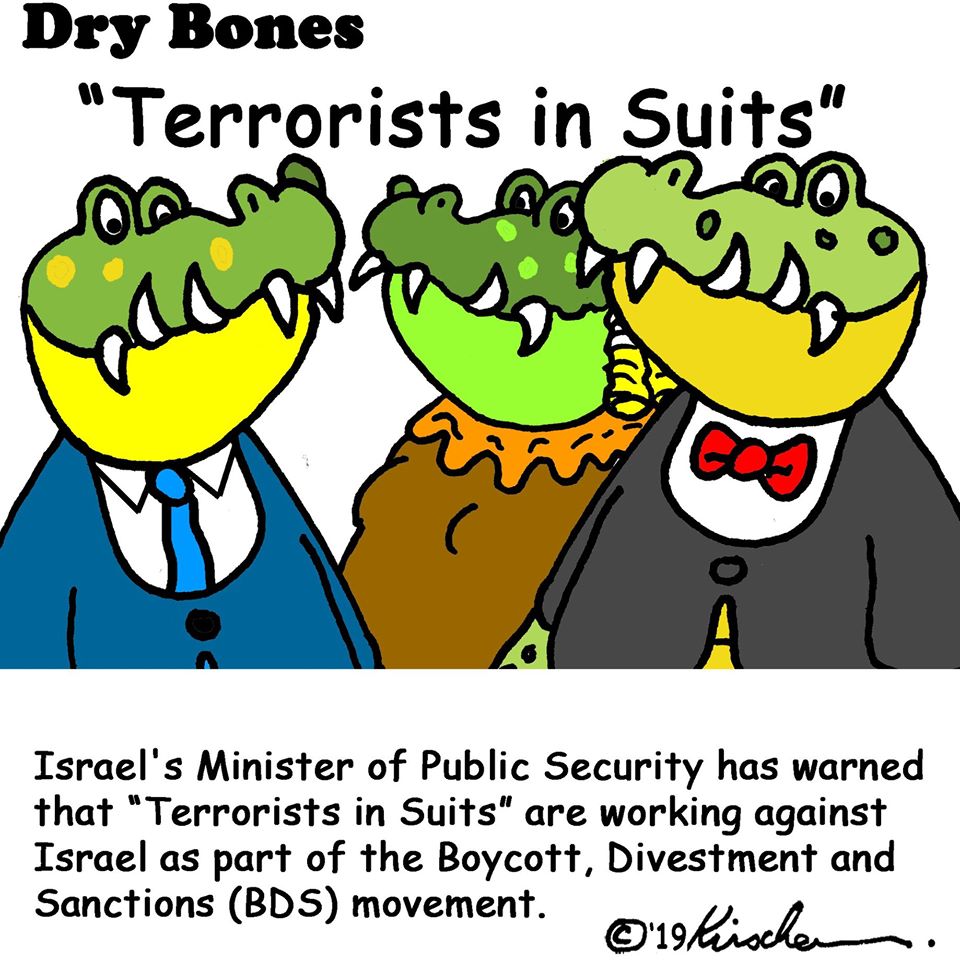
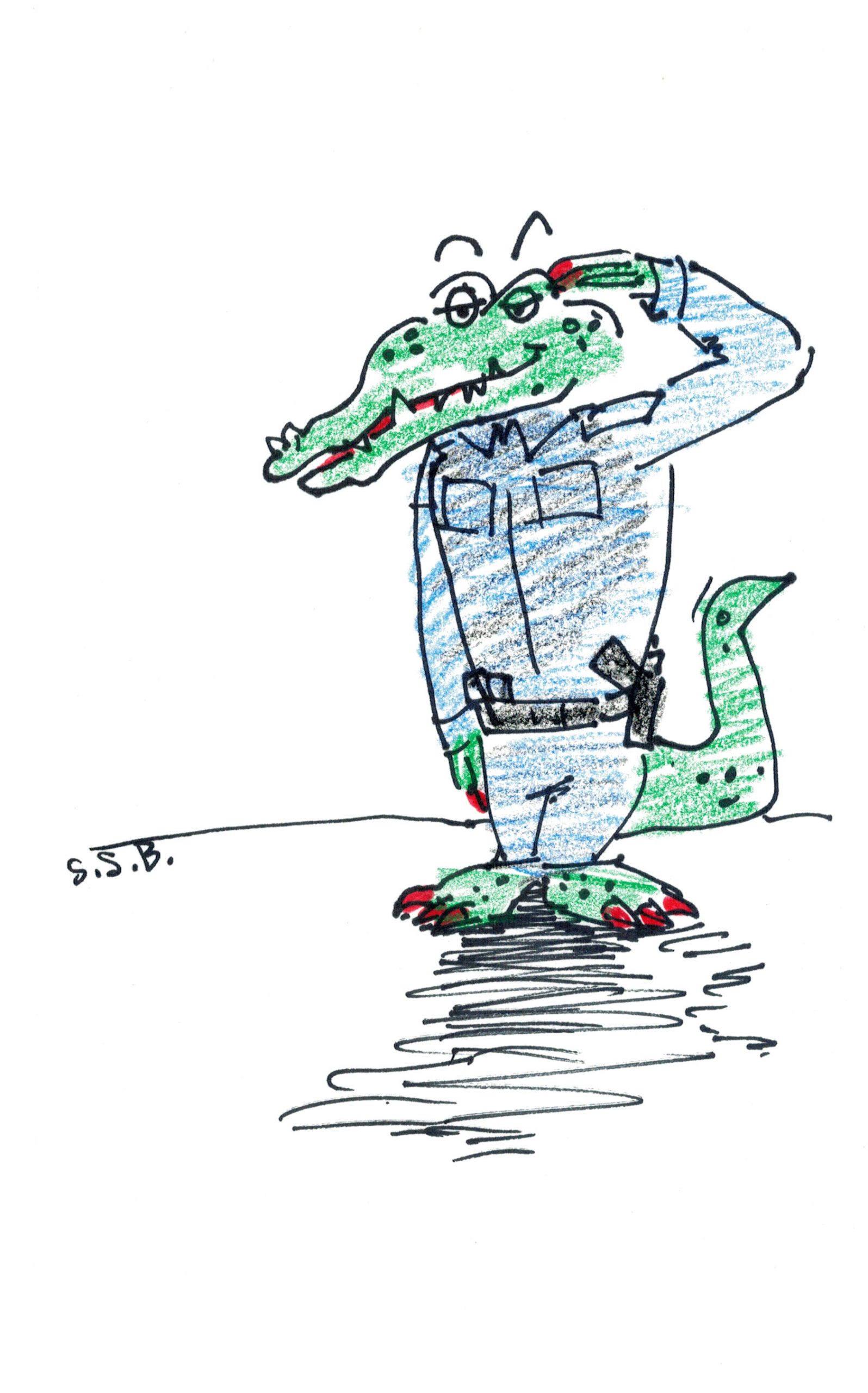 Crocodile Police Officer Copyright © 2026 Suzanne Schulman Butterfield |
|
A Song for the Leftist שְׂמָאלָנִיClick To Play 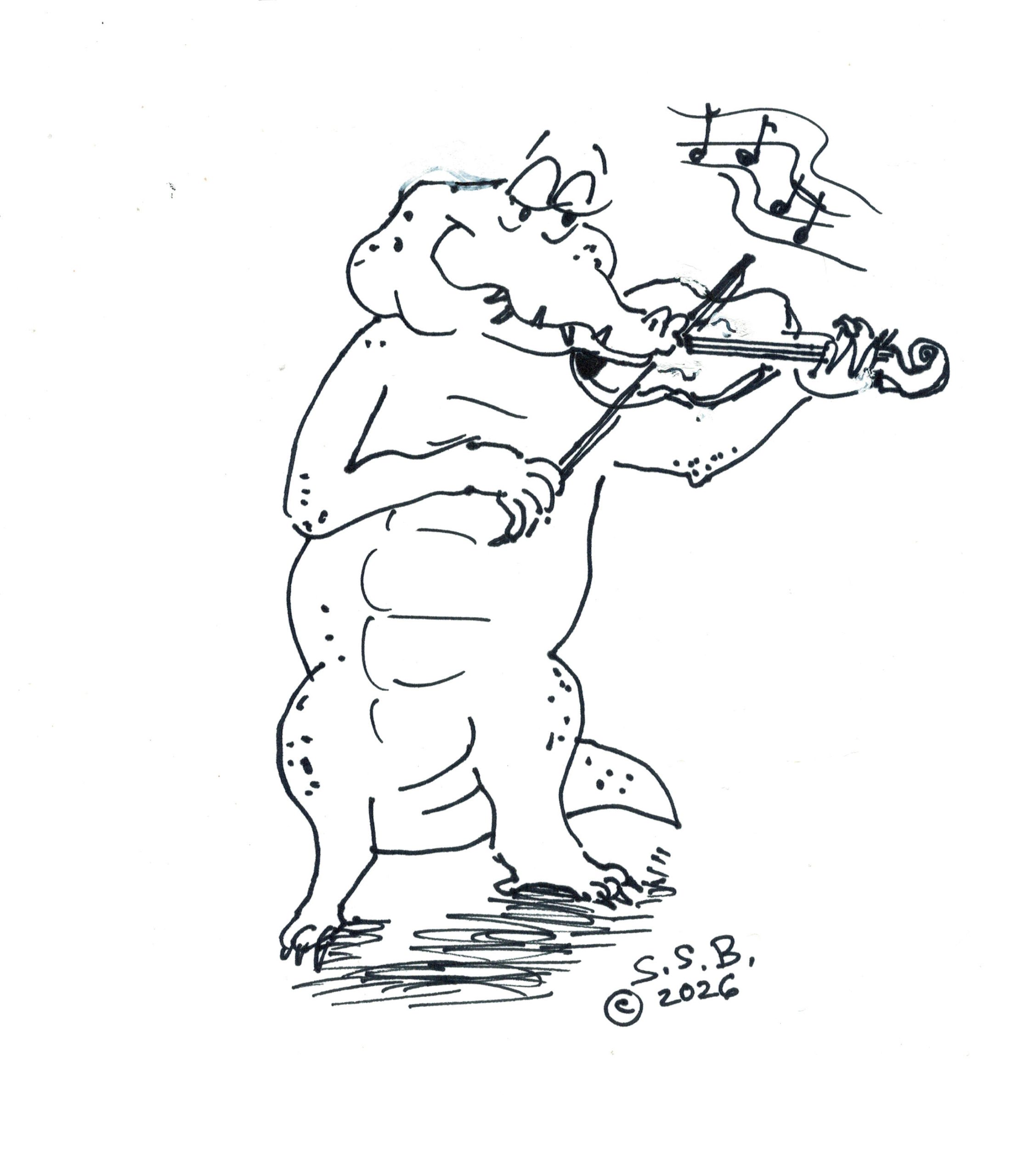 Crocodile Hearts and Flowers
|
|

Prominent Israeli newscaster resigns, citing left-wing bias11November2026 https://worldisraelnews.com/prominent-israeli-newscaster-resigns-citing-left-wing-bias/
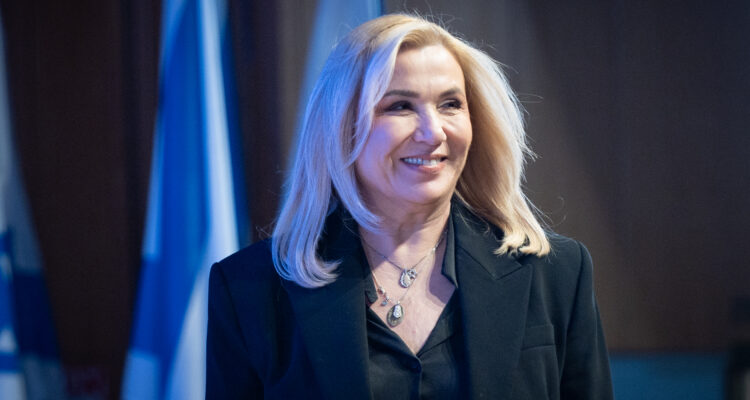 Israeli journalist Ayala Hasson attends a conference titled “Gaza: The Day After” at the Knesset, the Israeli parliament, in Jerusalem, on January 12, 2026. (Flash90/Yonatan Sindel)
In announcing her resignation, Ayala Hasson accused Kan of failing in its duty to represent diverse political opinions within Israeli society. By World Israel News Staff One of Israel’s best-known television journalists resigned from her position at the Kan public broadcaster on Tuesday, charging that the organization was attempting to silence her because her right-wing views do not align with its left-wing agenda.
Ayala Hasson, a veteran investigative reporter and broadcaster who joined Kan in 2023 after decades in the industry, has previously hinted that she was facing pressure from her bosses at the network to promote a more left-wing perspective.
Her resignation follows a recent dispute with her superiors over remarks she made criticizing the so-called change bloc of parties seeking to oust Prime Minister Benjamin Netanyahu.
Hasson apologized for the comments but refused to issue an on-air apology or comply with demands from the broadcaster’s management. In a subsequent post, she suggested that she was being unfairly penalized because of her political views.
“Until now, I remained at [Kan] out of a deep conviction regarding the importance of giving voice to a different perspective. I viewed this as a journalistic and public mission, especially within an institution whose duty it is to provide a platform for all segments of Israeli society,” Hasson wrote in her resignation announcement.
“Regrettably, over time, I have come to the realization that instead of safeguarding freedom of expression and a diversity of opinions, there are those within the corporation who seek to appease a specific camp, even at the cost of attempting to marginalize and silence other voices,” she added, identifying the attempt to force her to apologize on air as the point at which she could no longer remain.
The controversy stemmed from comments Hasson made about the Arab parties whose support is crucial to a coalition seeking to replace Netanyahu’s government.
“With whom is the ‘change’? With the Bedouin women in the Negev, with veils, whose husbands have several other wives like them, and most of whom are battered women?” Hasson asked.
She quickly apologized for the remarks, saying she was sorry “from the depths of my heart” to any woman who had been offended by her words.
|
The Truth Only איתמר בן גביר and Otzma Yehudit will say.
Recognition Hinged on Palestinian Elections. It Didn’t Happen. Why Trust Other PA Promises?Analysis: Palestinian statehood recognition was predicated on Abbas holding elections. Another delay shows that countries were scammed.By Michael Starr 22October2026 https://honestreporting.com/recognition-hinged-on-palestinian-elections-it-didnt-happen-why-trust-other-pa-promises/
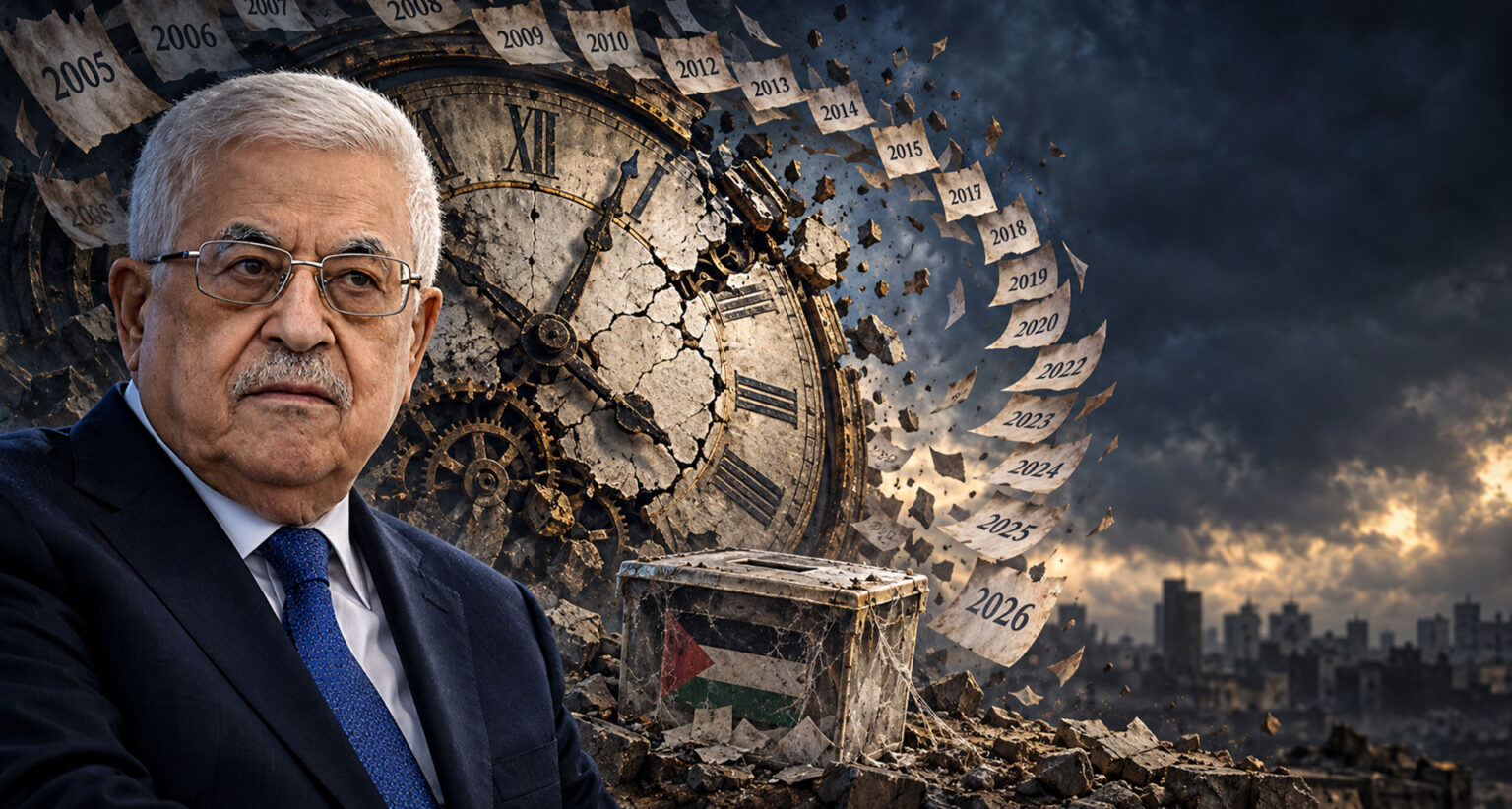 Mahmoud-Abbas-Delays-Elections Recognition Hinged on Palestinian Elections. It Didn’t Happen. Why Trust Other PA Promises? Key Takeaways:
The geo-political folly of states that recognized a Palestinian state was put on display last week when the Palestinian Authority (PA) delayed elections and demonstrated why the commitments made in exchange for statehood were worthless. Western countries were fooled into giving diplomatic prizes to the Palestinians for free, and effectively damaged prospects for peace by failing to establish expectations of the PA as preconditions.
Recognizing a Palestinian State for PeaceA diplomatic shockwave reverberated through the Middle East in September 2025, after countries including the United Kingdom, Australia, Canada, and France announced their recognition of a Palestinian state. Amidst the ongoing October 7 War and Gaza hostage crisis, the Western states asserted that the move would contribute to peace and a two-state solution.
Australian Prime Minister Anthony Albanese and Foreign Minister Penny Wong explained in a joint September 21 statement that the recognition was “part of a co-ordinated international effort to build new momentum for a two-state solution, starting with a ceasefire in Gaza and the release of the hostages taken in the atrocities of October 7, 2023.”
“The UK has formally recognised Palestine to protect the viability of a two-state solution and create a path towards lasting peace for the Israeli and Palestinian people,” began a corresponding UK Foreign, Commonwealth & Development Office statement.
Ultimately, the diplomatic move did not directly lead to a resolution of the Gaza conflict, and only with U.S. President Donald Trump’s Comprehensive Plan to End the Gaza Conflict were the remaining hostages returned and a lasting ceasefire implemented. The countries attempted to placate concerns about rewarding the Palestinians for militancy, and for the moral quandary of democratic states supporting an illiberal regime, by conditioning their diplomatic acknowledgment on reforms by the Palestinian Authority (PA).
The PA’s CommitmentsThe commitments included education, finance, and governance reforms, a demilitarized state, and rejection of hate speech, incitement and terrorism. The crown jewel of the conditions for statehood, which supposedly guaranteed the rest of the PA’s promises, was the commitment of democratic elections in 2026. According to Albanese and Wong, PA President Mahmoud Abbas had “given direct undertakings to Australia, including commitments to hold democratic elections and enact significant reform to finance, governance and education.”
Canadian Prime Minister Mark Carney related that his country was supposedly also given “direct commitments” by the PA, “including to fundamentally reform its governance, to hold general elections in 2026 in which Hamas can play no part, and to demilitarize the Palestinian state.”
The July 2025 United Nations New York Declaration, which was backed by 18 states, the European Union, and the Arab League, welcomed Abbas’ “commitment to holding democratic and transparent general and presidential elections throughout the Occupied Palestinian Territory, including East Jerusalem, within a year, under international auspices, enabling democratic competition between Palestinian actors committed to respect the PLO political platform, its international commitments and the relevant UN resolutions.”
Despite the applause for diplomatic boldness and political self-congratulation for ushering in a new era for the supposed state, the Palestinian leadership soon proved itself an untrustworthy vendor by failing to deliver the goods after payment had been made. On October 10, the PA delayed elections yet again, from November 28, 2026 to September 11, 2027. The deferment extended Abbas’ two decade-long rule for another year. The decree was ostensibly made in response to security and instability issues in Gaza and PA-governed territories.
Palestinian Elections DelayedAustralia, Canada, France and the United Kingdom responded with a joint statement on October 13, expressing deep “regret” about the postponement, explaining that “credible elections are an important element of the commitment that President Abbas and the Palestinian Authority made to reform, including democratic renewal and accountable governance, and are in line with the June 2025 New York Declaration.”
“As longstanding supporters of Palestinian self-determination, we call on the Palestinian Authority to reconsider the decision to postpone elections and to take the necessary steps to hold legislative and presidential elections, without further delay,” said the states. “We will continue to support efforts to deliver on these elections.”
There were no consequences for the PA’s failure to uphold its end of the agreement, and the only real demand was for Abbas to reconsider his decree. Without any repercussions, there is no incentive for Abbas to hold elections – particularly after he already got what he wanted from the exchange. Yet elections were not even the only commitments and conditions that the PA and its leader failed to meet. The New York Declaration noted that Abbas had also promised a commitment to “the peaceful settlement of the question of Palestine, and the continued rejection of violence and terrorism,” while French leaders detailed specific metrics.
“He [Abbas] confirmed the end of allowances for the families of prisoners convicted of terrorism offenses, announced a reform of school textbooks to remove all hate speech, committed to holding presidential and general elections in 2026, and accepted that the Palestinian State will be demilitarized,” French Minister for Europe and Foreign Affairs Jean-Noël Barrot said at a July UN conference on the Arab-Israeli conflict. “The conditions set down for the acceptance of a Palestinian State by Prime Minister Benjamin Netanyahu, in his 2009 Bar-Ilan speech, are met.”
Pay-for-slay ContinuedAccording to the U.S. State Department, the commitment to end allowances for the families of terrorists had not been met. In a January 2026 Palestinian Liberation Organization (PLO) Commitments Compliance Report, it was reported that payments were continuing under a new welfare program of a different name. A follow-up report in July detailed that in February 2026, PA Finance Minister Estephan Salameh pledged to continue the program known as “pay-for-slay,” and that same month a draft constitution article was proposed to enshrine allowances for the kin of convicted terrorists. Abbas reportedly complained about the pressure exerted on the program at a May Fatah conference. On September 16, the U.S. government leveled sanctions against PA officials for continuing “to pay stipends to terrorists and to glorify acts of terrorism and terrorists in public pronouncements and school textbooks.”
Failure to Reform Education SystemNew educational materials published in September 2025 – after the supposed commitments by the PA – incited antisemitism, violence, jihad, terrorism, and rejected peace and the two-state solution, according to a November 2025 review by the Institute for Monitoring Peace and Cultural Tolerance in School Education (IMPACT-se). Far from the promised reform, IMPACT-se assessed that the 2025-2026 PA national curriculum was only marginally modified from the 2020–2021 school year.
In an Arabic language class, a reading comprehension text extolled the supposed heroics of Coastal Road Massacre terrorist Dalal al-Mughrabi, who was involved in the murder of 38 Israeli civilians, including 13 children. An example of antisemitism highlighted by IMPACT-se was an 8th-grade teacher’s guide, which included a listening comprehension exercise on corruption, which featured a Jewish client trying to cheat a Muslim merchant with counterfeit money. The NGO also provided several examples from geography and social studies classes which depicted a Palestinian state from the Jordan River to the Mediterranean Sea. There were also irredentist claims to Israeli cities, and language in a text that implied that a two-state solution was undesirable.
Rejection of Terrorism and Financial TransparencySupport and incitement to violence and terrorism, which supporters of recognition touted as a commitment met by the PA, was not just relegated to school textbooks. The U.S. State Department compliance reports noted that the PA continued to post glorification of terrorism on social media. Fatah Parliamentarian Nasser Abu Bakr, within Abbas’ party, has repeatedly published fawning social media posts about terrorists. French President Emanual Macron noted in a September 2025 speech on Palestinian statehood recognition that Abbas “has strongly condemned the terrorist attacks of 7 October 2023,” yet according to the State Department, Abbas’ Advisor on Religious Affairs and Islamic Relations Mahmoud al-Habbash said in April that “when we come to judge October 7, resistance to the occupation in itself is a legal, even sacred thing. You will not find any Palestinian, Muslim, or even a normal person who can dispute this principle. Resistance to the occupation is legal.”
The PA also appears to have failed in the matter of finance reforms. Albanese and Wong said that Abbas pledged to “enact significant reform to finance,” and the New York Declaration reaffirmed the Palestinian leader’s “credible reform agenda” that included “good governance, transparency, fiscal sustainability.” Yet a 2026 U.S. State Department fiscal transparency report found that the PA did not publish a complete budget and did so within an unreasonable time period.
“The PA published monthly budget execution reports that provided a picture of revenues and expenditures. Information on debt obligations, including for PA-owned enterprises, was incomplete,” read the report.
Recognition as a Failed Strategy for PeaceThe extensive failures of the PA to meet the commitments that predicated state recognition show that geopolitical guarantees are worth nothing if a reward has already been given. It would be too politically fraught for the UK, Canada, France, and Australia to retract recognition of a Palestinian state, so there is no consequence. Since there is no consequence, all the factors that the recognizers have acknowledged as essential to peace will not be met without additional measures, carrots and sticks. One of the most influential tools, state recognition, has already been surrendered, making it more difficult to create these peace conditions. Any sense of pressure to engage in peace reforms has also been removed, as Palestinian leadership has likely learned it can promise and receive without great loss. The countries also created rifts between themselves and Israel, removing the possibility that they could serve as mediators in peace negotiations in the near future.
Most concerning is that if the PA is unwilling to meet its commitments regarding elections and other issues, it may be unwilling to meet other obligations. Some experts have expressed concern about the PA’s commitment to demilitarization. While the legitimacy of this problem remains unclear, the PA’s recent actions lend credence to fears of its growing forces. The PA has pledged to peace, a two-state solution, and other platitudes that charm Western leaders, but the trustworthiness of Palestinian leadership is brought into question when they can’t even hold elections.
France, the UK, Canada, and Australia made themselves the guarantors of Palestinian statehood and peace. Yet they may now find themselves paying a moral and diplomatic debt now that the principal debtor has failed to meet its contract. The price is peace, and the blunders have only compounded the ability to meet its requirements.
Liked this article? Follow HonestReporting on Twitter, Facebook, Instagram and TikTok to see even more posts and videos debunking news bias and smears, as well as other content explaining what’s really going on in Israel and the region. Get updates direct to your phone. Join our WhatsApp and Telegram channels!
© Divuach Ne’eman R”A, 2025
|

Just like he predicted
Just like he predicted, given the opportunity, the enemies of Israel who are lurking quietly amongst us will rise up and align with exactly those parties in Israel which want to destroy the Jewish state. His policies didn’t radicalize these pro-jihad ‘voters’. It exposed them. In the shadow of October 7th, this should be an eye opening moment for all patriotic Israelis. 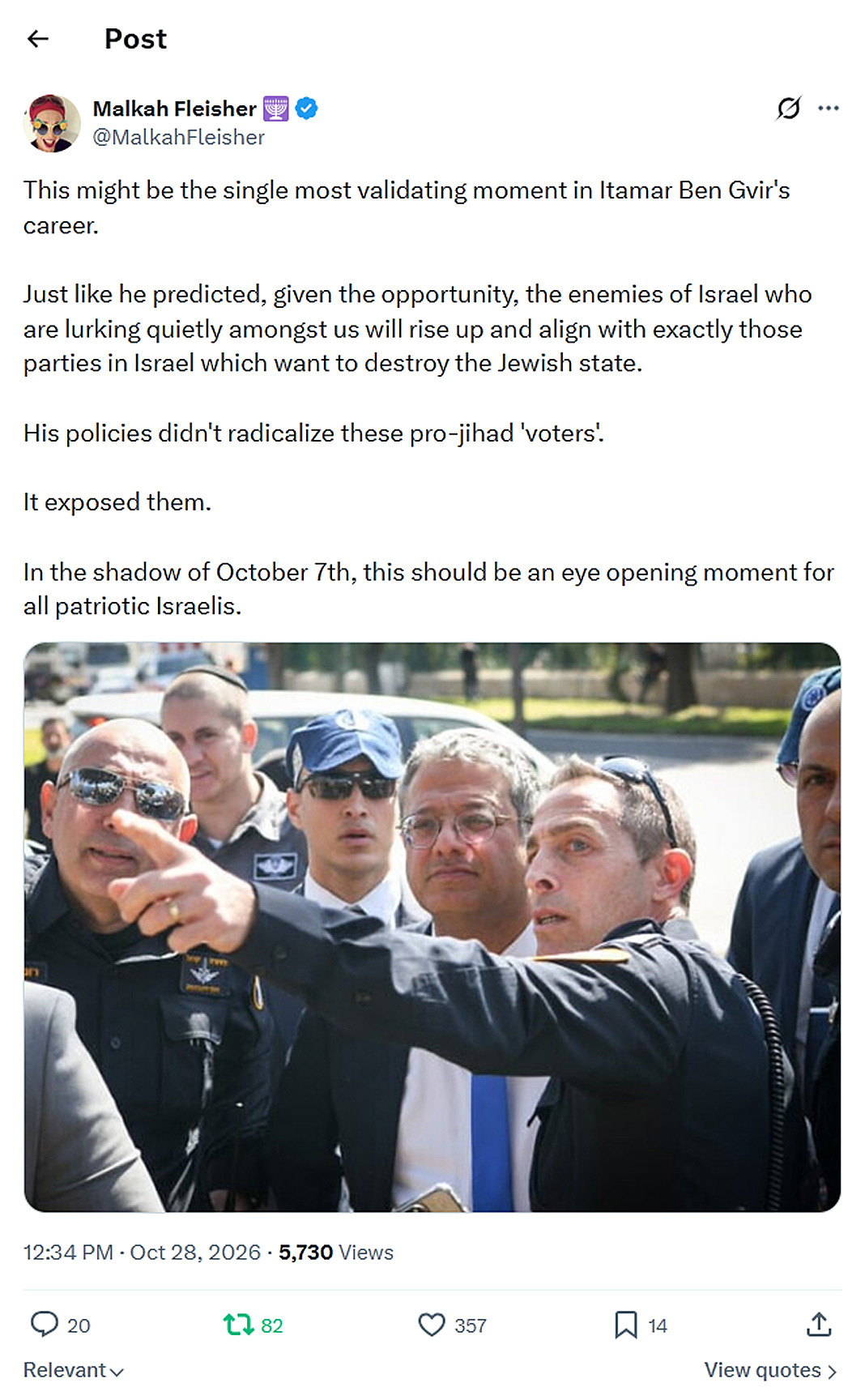 Malkah Fleisher-tweet-28October2026-Just like he predicted
|
|
THE ARROGANCE OF THE ANTI-BIBI MOVEMENT
There is a lesson from this election that goes far beyond Benjamin Netanyahu. For years, a large part of Israel’s opposition has built its political identity around one central objective: Bibi must go. That may be an effective slogan. It is not a governing philosophy. You cannot build an entire political movement around opposition to one man, spend an election telling voters primarily who they should reject, and then be surprised when millions of Israelis ask a very basic question: What exactly are you offering instead? That is where I believe the arrogance of the anti-Bibi movement became its greatest political weakness. It operated as though opposition to Netanyahu was itself enough to create a majority. As though the public’s concerns about security, Jewish identity, Iran, Judea & Samaria, the Palestinians and the future character of the state were secondary to the question of Netanyahu’s personality. But elections have a way of exposing political echo chambers. The counting is still underway, and the final coalition picture remains unresolved. Early results and exit polls have shown neither major bloc comfortably reaching the 61 seats required to govern on its own. Whatever the final numbers are, the political choices made after this election may matter almost as much as the results themselves. Because Netanyahu’s opponents now face a decision that voters will remember. Do they attempt to build a broad Zionist government with people they profoundly disagree with politically? Or does removing Netanyahu remain such an overriding objective that they would rather depend on parties outside the Zionist political consensus? That question became impossible to ignore last night. At Joint List headquarters, supporters were filmed singing “Biladi, Biladi,” the Palestinian national anthem. People can interpret that scene however they choose. But politically, opposition leaders should understand exactly how it will be viewed by a very large portion of the Israeli public. These are Israelis who serve in the IDF, send their children to reserve duty, bury friends and relatives, live through rockets and wars, and may disagree fiercely with Netanyahu. Many of them are not ideological Likud voters. Some are centrists. Some are traditional Labor voters. Some desperately want new leadership. But asking those voters to accept a government whose survival depends on parties whose supporters celebrate an election result by singing the Palestinian national anthem is not a minor political detail. It is a decision that will have to be defended. And there is now another issue hanging over the election. Police arrested three suspects in the Negev on suspicion of attempting to bribe voters to support Ra’am. Investigators say they discovered envelopes containing tens of thousands of shekels in cash and Ra’am ballot slips. That does not prove that Arab turnout was fraudulent. It does not prove a nationwide conspiracy. It certainly does not justify declaring the election stolen before investigators establish the facts. But it is serious. And every credible allegation should be investigated completely, wherever it leads. What opposition leaders do now will therefore be watched extremely closely. This is where political wisdom matters. There are enormous disagreements inside Israel’s Zionist majority. There are people on the center, right and left who disagree about Netanyahu, judicial reform, settlements, religion and state, the war and almost everything else. But they also share something fundamental: they see the continued existence and security of a Jewish and democratic State of Israel as the starting point of the political conversation. A responsible political system should be capable of finding cooperation somewhere inside that enormous spectrum.  Mossadil Commentary-tweet-28October2026-the arrogance of the anti-bibi movement
|
|
Concern over conflict of interest
#החדשות 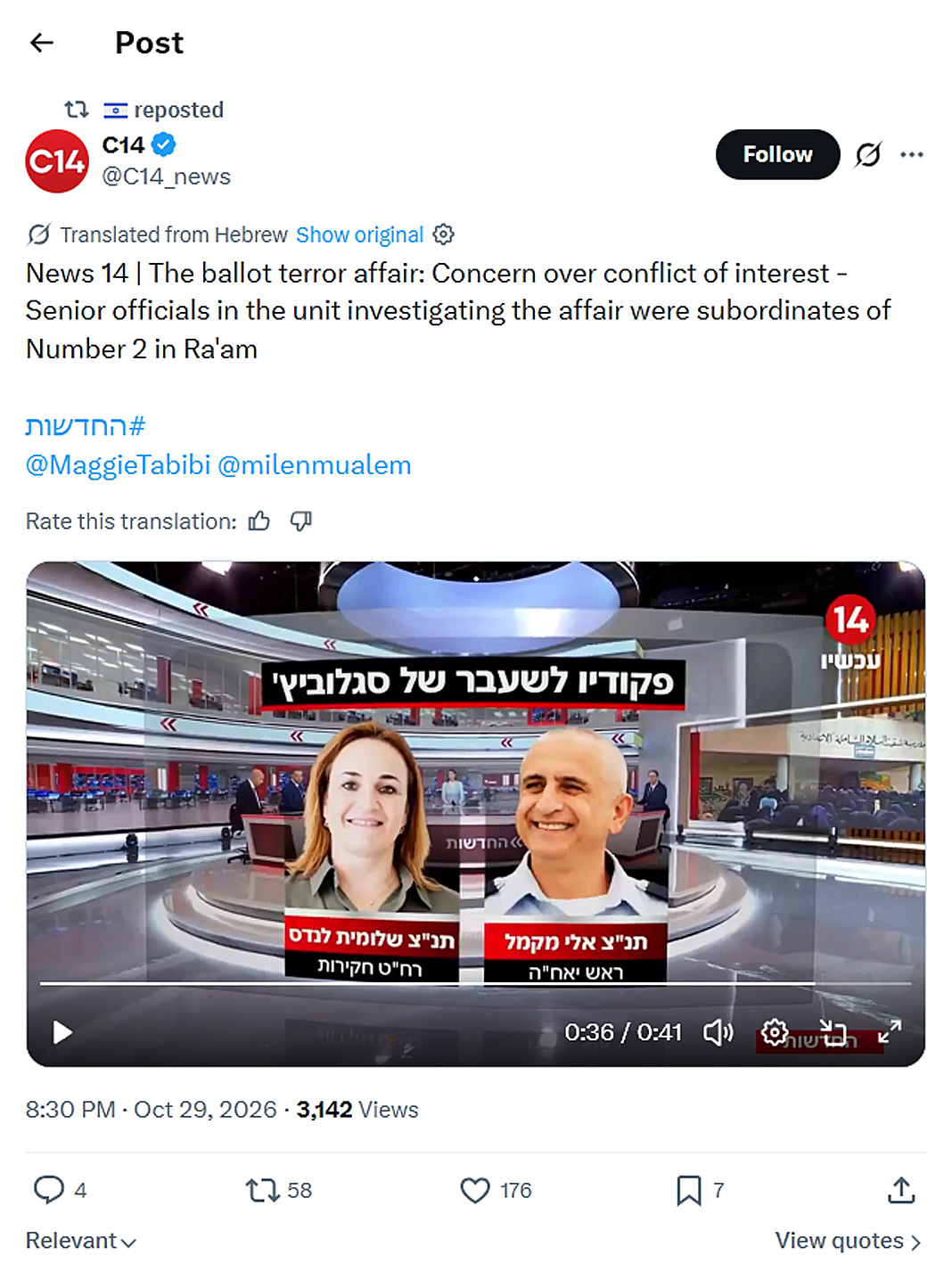 C14-tweet-29October2026-Concern over conflict of interest
|
|
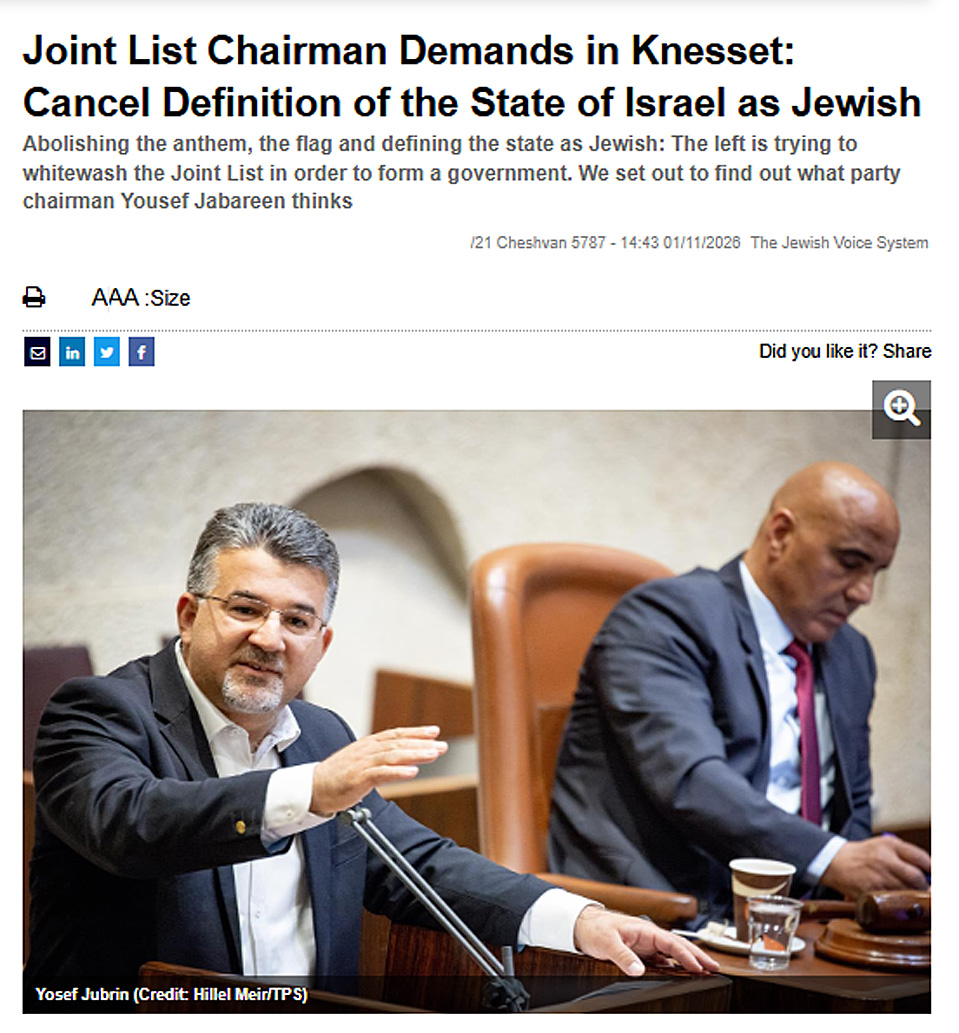
The Arab MKs walked out of the plenum before Hatikvah was sung.
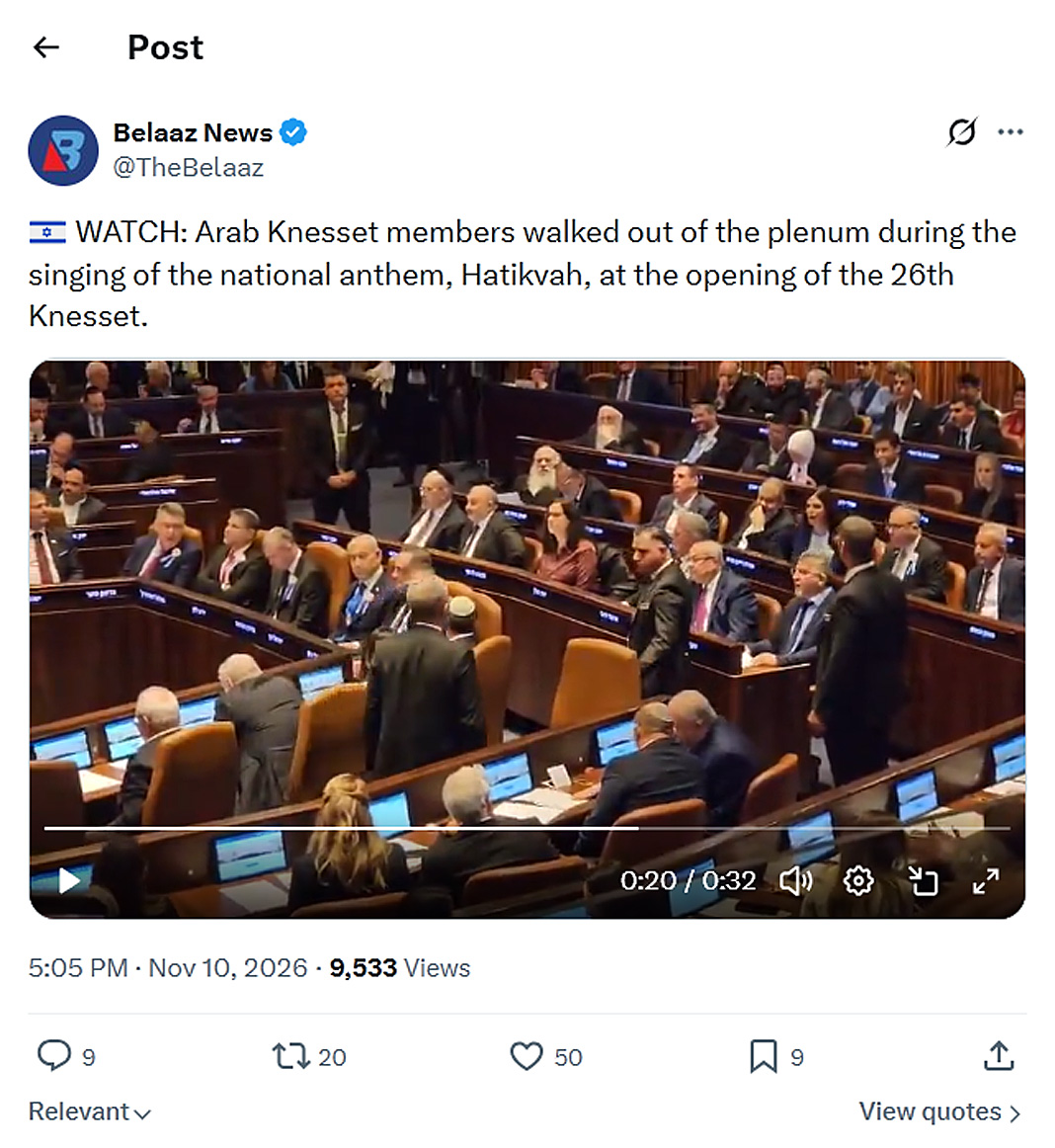 Belaaz News-tweet-10November2026-Arab MKs walked out before Hatikvah
A monster is taking shape before our eyes
Years of groveling, concessions, and preferential treatment have created a situation in which an entire sector of the public treats the law with contempt, scorns the symbols of the state, and refuses to recognize the founding ethos of 1948—a Jewish state in the Land of Israel. Massive foreign funding has manipulated public consciousness, torn us apart from within, and led to a hostile takeover of Israeli politics. It is time for the national camp to see and state the plain, unvarnished truth: whoever is not loyal to the State of Israel as a Jewish state cannot be a citizen of it. 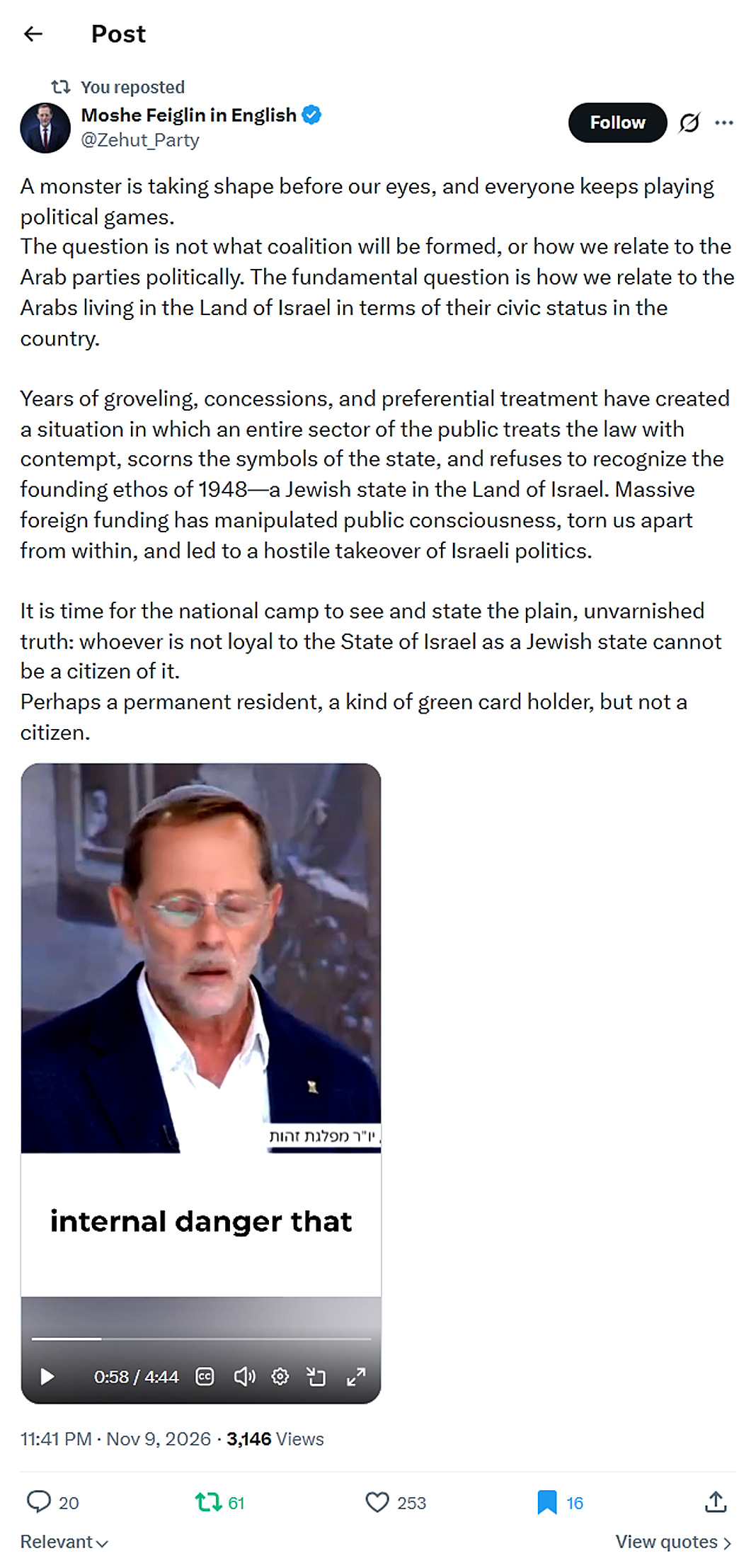 Moshe Feiglin in English-tweet-9November2026-monster before our eyes
|
The Rock of Israel
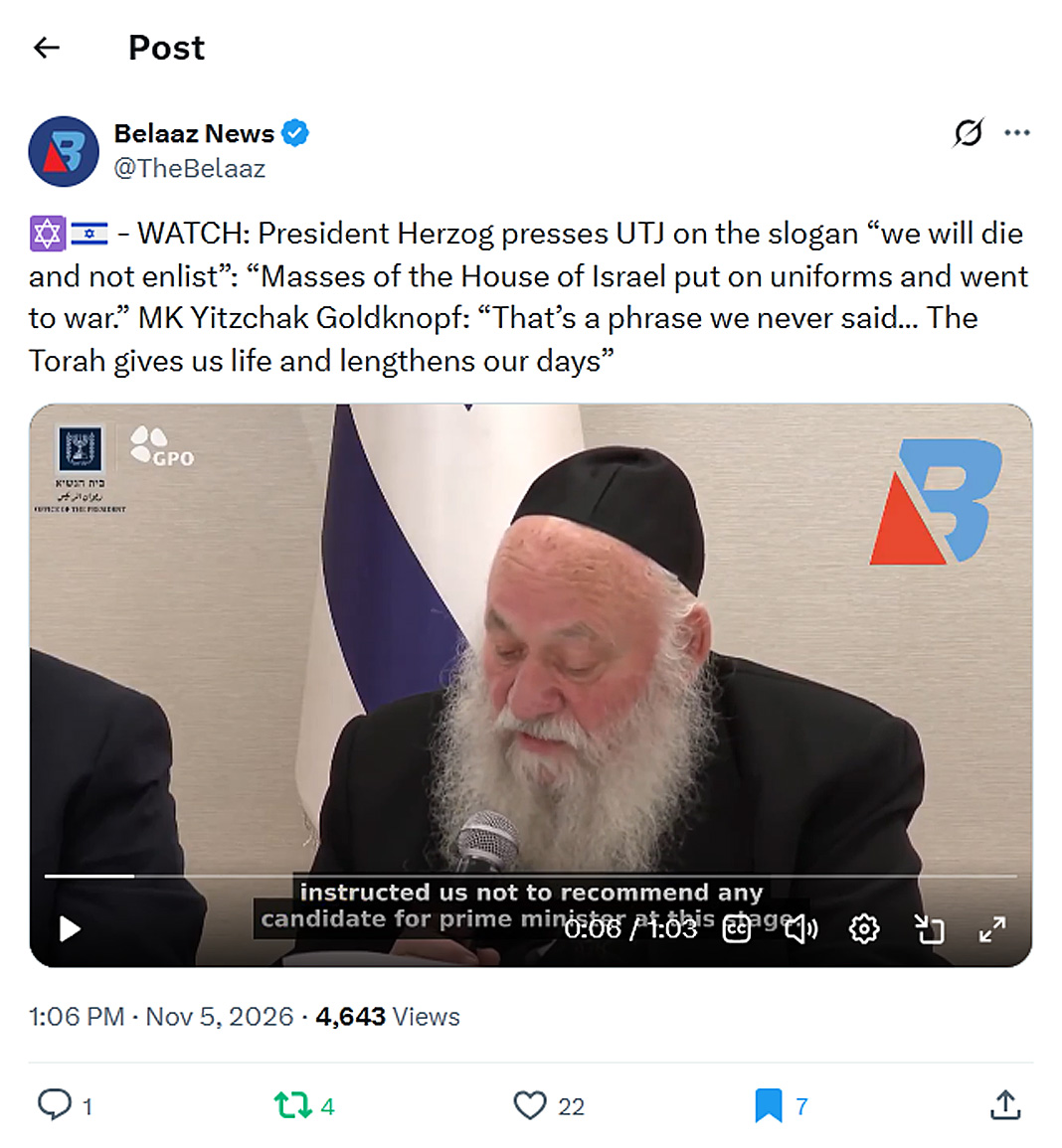 Belaaz News-tweet-5November2026-The Rock of Israel
|
|

Grab the Popcorn: Israel’s Post-Election Chaos Just Explodedwritten by Avi Abelow | 6November2026
If the Israeli election results have you feeling discouraged, grab some popcorn. Israeli politics is providing enough drama for an entire television season, and the coalition negotiations have barely begun.
First, there’s the celebrated “67-seat opposition majority that demands change.” Really? Sounds impressive, until you remember that 19 of those seats belong to anti-Israel Arab parties who consider Hamas a charity organization! Those are 19 seats in Israel’s parliament who support the Oct 7 massacre and the destruction of Israel! Even when asked today by President Herzog whether they will admit that Hamas is a terror organization, they said no!
Many voters for the opposition parties are internalizing that Eisenkot is seriously considering relying on these 19 votes to topple Netanyahu and set up an alternative government, and they are in shock and angry. They understand these 19 seats represent a fifth column of Israeli jihadi citizens. While these two anti-Israel Arab parties are celebrating their major electoral gains and their pivotal role in denying Netanyahu a majority, they will be shocked at the price they eventually pay when the Jews of Israel finally decide to deal with them as the fifth column of jihadis that they are, in the future.
Then comes my favorite plot twist: the ultra-Orthodox draft.
Remember the bitter, divisive election campaign that turned the ultra-Orthodox draft issue into a political litmus test, convincing even many right-wing voters to support opposition parties? Liberman declared there would be absolutely no compromise. Eisenkot insisted he would rather go to another election than back down. The message couldn’t have been clearer: No compromises. No exceptions. An absolute red line.
Guess what? Now Eisenkot and Liberman have announced they are willing to compromise on the ultra-orthodox draft issue in order to make a government! Many of their voters are furious.
Whether or not they succeed in forming a government, these two issues alone have killed their political credibility. Many voters will punish them for even considering to work with the anti-Israel Arab parties and betray their campaign promise on the ultra-Orthodox draft issue.
And then there’s the justice system.
Serious allegations of foreign interference, vote-buying and irregularities surrounding Arab-sector voting prompted a serious investigation by the intelligence services. Yet, the Attorney General is restricting the intelligence services from questioning Arab MKs and their aides allegedly connected with the fraud because “there is no evidence.” And this has only intensified the controversy making it look like a coverup.
Because in Netanyahu’s trial, the recent cross-examination of former Attorney General Mandelblit exposed irregular and even alleged illegal misconduct by the Attorney General’s office and police, exposing that there was no evidence to indict Netanyahu! Rather it was a blatant political witch hunt by the judicial system to topple Netanyahu!
So, to indict Netanyahu, the Attorney General’s office allegedly fabricated evidence. But to investigate what the intelligence services are calling an electoral Oct. 7 fraud by jihadi countries to influence Israeli elections, there is no evidence to question Arab MKs and their aides.
Their corruption is getting center stage for all of Israel to see. And more of the Israeli public is paying attention.
So don’t allow the headlines to consume you. Follow the facts, demand accountability, strengthen your faith and remember that the future of Israel is much bigger than any coalition negotiation.
And yes, keep the popcorn handy. This might just be the greatest political show on earth, as the political left red-green alliance and its allies in the unelected deep state establishment become so desperate to return to power that they seem determined to expose themselves for all to see, to stop Netanyahu from continuing as prime minister.
And through it all, I remain full of faith. The proud, strong Jewish people of Israel will prevail. There are tremendous challenges ahead, and nobody promised us a smooth road. But we have overcome far greater obstacles throughout our miraculous history. And we will model to the freedom-loving world how to overcome the red-green jihadi alliance out to destroy all of our countries.
With God’s help, and with more people waking up to reality, we will overcome these challenges too.
In the meantime, enjoy the show!
Am Yisrael Chai!!!
|
Jihadist Arab parties stole Israeli election
|
|
The elections in the State of Israel were stolen by Arab parties that support terrorism and the elimination of the Jewish state through serious criminal offenses of bribery, threats, violence, forgeries, and the use of prohibited software to mobilize voters. The Likud party is transferring to the police, the Shin Bet, and the Central Elections Committee hundreds of testimonies and pieces of evidence regarding election theft in many Arab polling stations—thousands of envelopes with cash and Ra’am slips, threats and violence against polling station members, multiple voting behind the curtain, voting with double identities, discrepancies between the number of envelopes and the number of voters, the use of prohibited mobilization software, and more. We demand from the police and the Shin Bet a thorough investigation into the election theft by the Arab parties and the full prosecution of the criminals. We demand from the Central Elections Committee an immediate response to investigate these criminal offenses that have severely damaged the integrity of the elections in Israel and the election results. This is a serious blow to Israeli democracy and the voting rights of Israeli citizens. The law enforcement agencies must act with an iron fist and in an immediate manner. 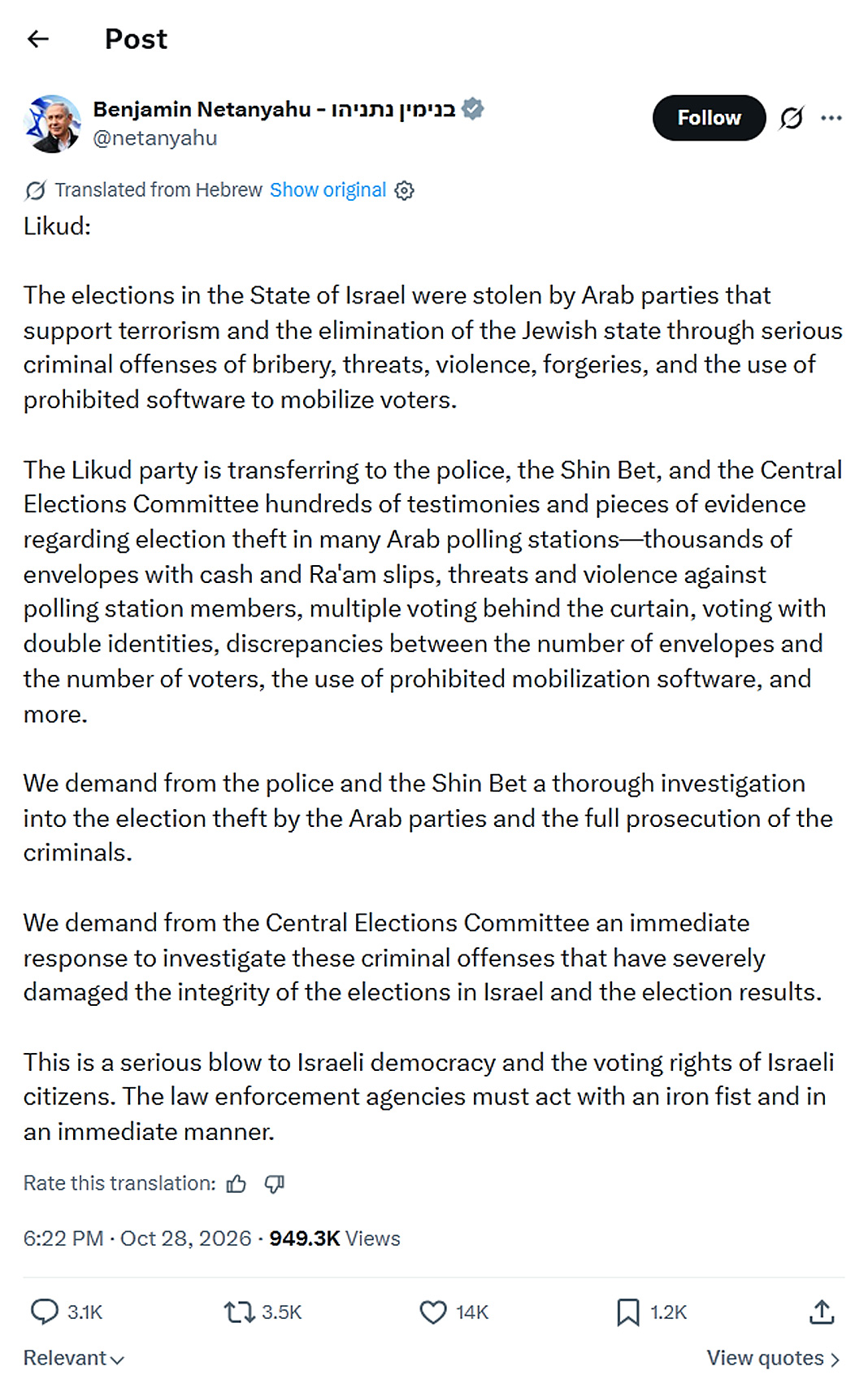 Benjamin Netanyahu-tweet-28October2026-Jihadist Arab parties stole Israeli election
|
|
The Ra’amgate affair is an earthquake
The Ra’amgate affair is an earthquake. They stole the elections in Israel! The judge Solberg’s statements about the involvement of foreign entities that interfered and bribed voters in favor of the Arab parties are an unprecedented shock. This is an attack on democracy whose purpose is to lead to a foreign takeover of the Knesset, the Islamization of Israel, and the overthrow of right-wing rule in order to lead to retreat and defeat of the IDF in all arenas – and primarily Iran. After it was revealed that foreign entities tried to take over the Knesset, it is clear that no Zionist party should cooperate with Ra’am and the Joint List, replace the Knesset Speaker through votes bought for cash, and form a government that is dangerous to Israel. We demand to act immediately and with all means available to the Shin Bet and the police to investigate these crimes. 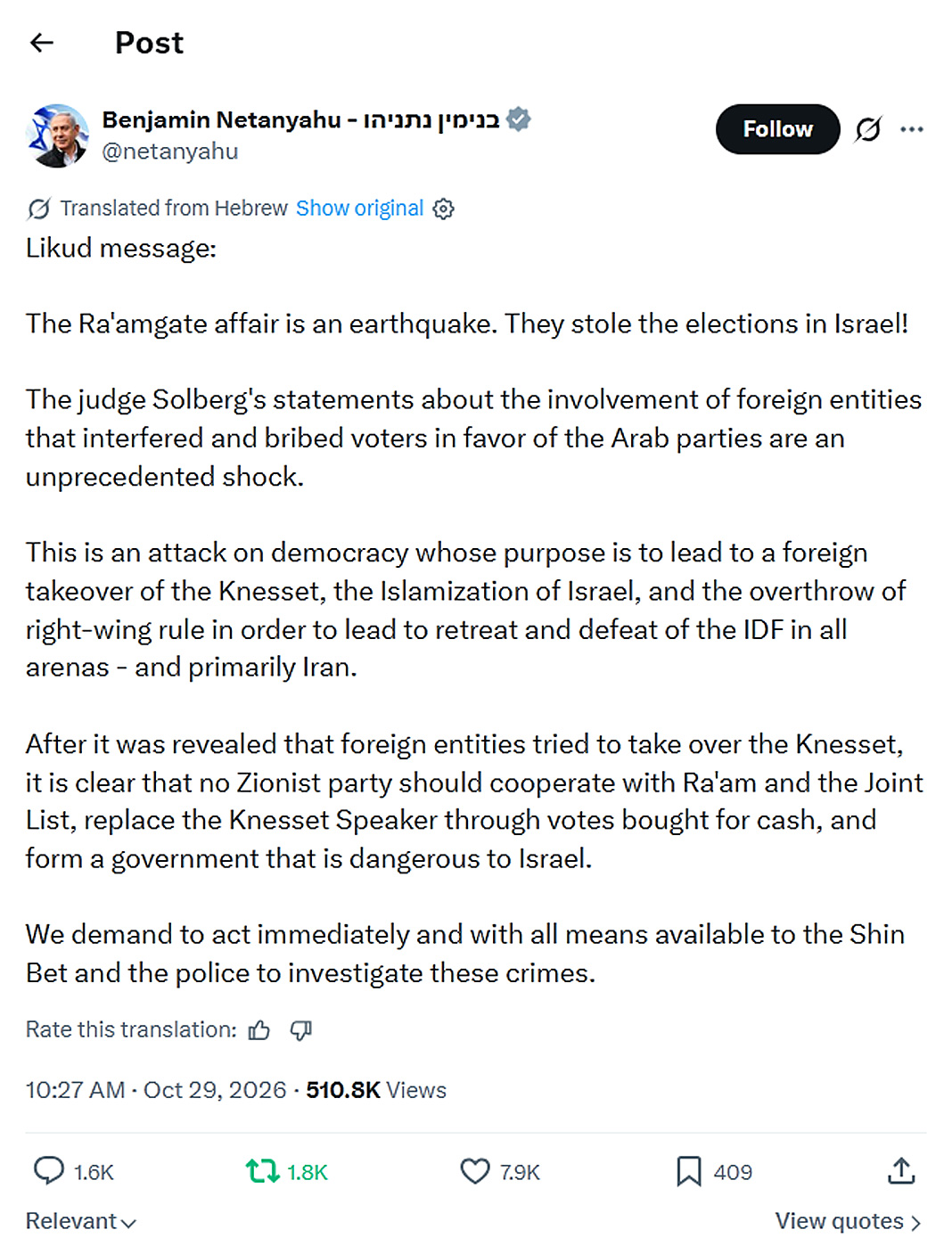 Benjamin Netanyahu-tweet-29October2026-The Ra’amgate affair is an earthquake
|
|
Whoever is not loyal to the State of Israel – it is forbidden to give him the right to vote
And let it be clear: I am proud that I turned the lives of the terrorists in prison into hell! I am proud that I enacted the death penalty law for terrorists! I am proud that I demolished 10,000 illegal homes in the Negev within a year and a half! I am proud that I created tremendous deterrence! I am proud that I armed the people of Israel against the enemy! 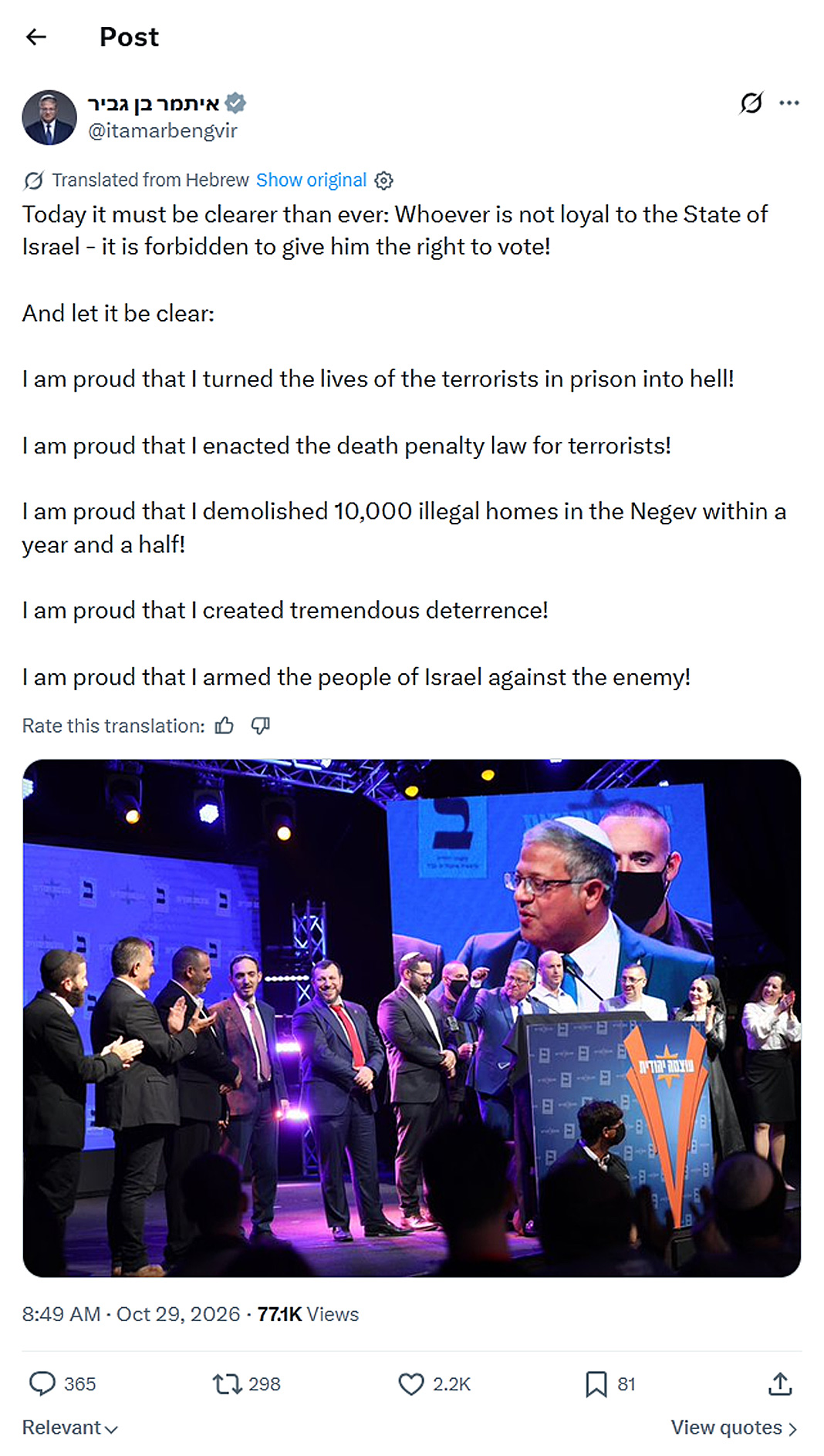 itamarbengvir-tweet-29October2026-Whoever is not loyal to the State of Israel
|
|
JEWISH POLLING WORKERS REPORTEDLY DRIVEN OUT OF ARAB ISRAELI TOWN
Two Jewish polling workers were reportedly attacked and forced out of Majd al-Krum by local residents and Arab political activists. But here’s another detail that should not go unnoticed: 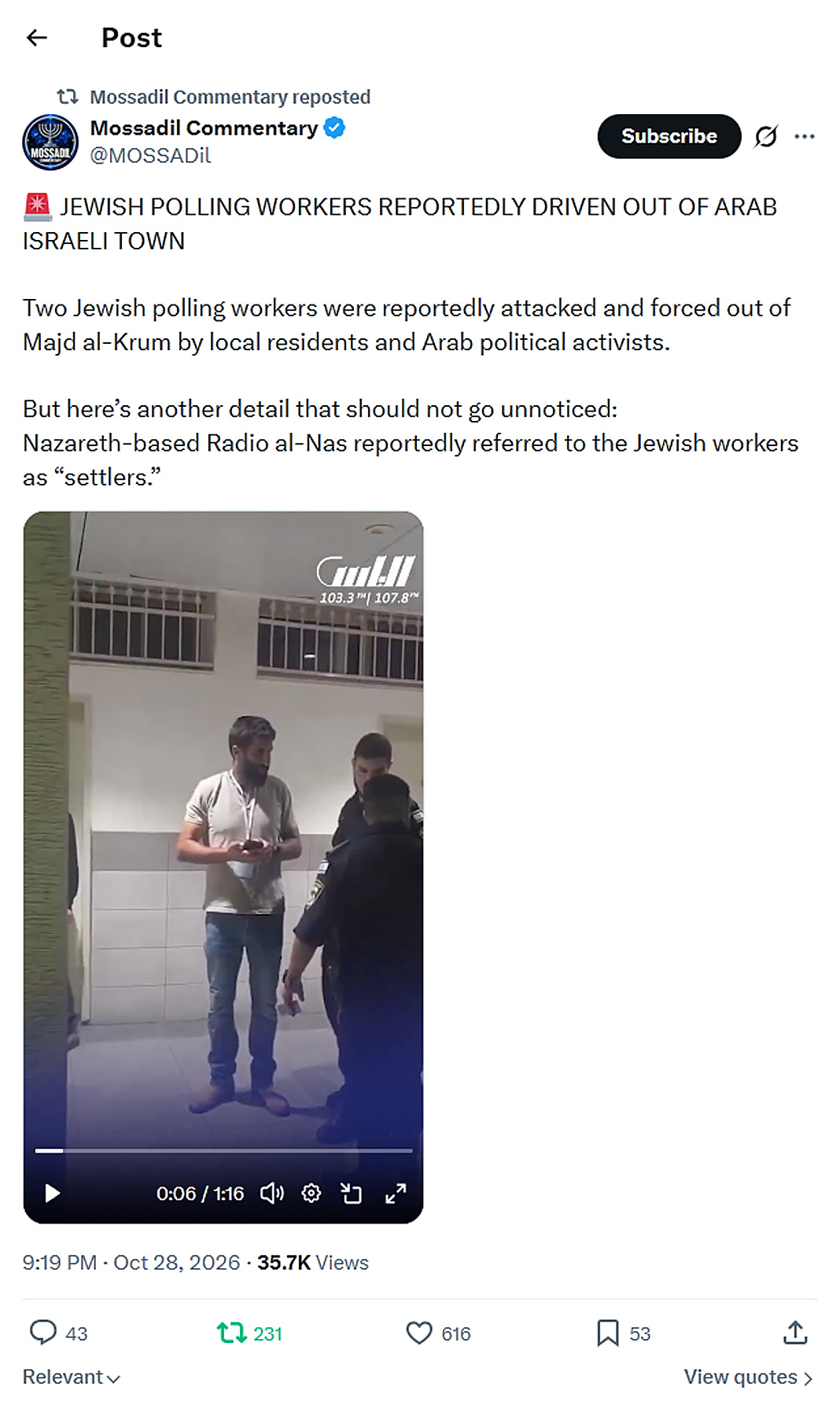 Mossadil Commentary-tweet-28October2026-jewish polling workers driven out of arab israeli town
|
|
🚨 7 ARRESTED IN ISRAELI ELECTION VOTER BRIBERY PROBE
Israeli police arrested seven suspects after cash-filled envelopes and Ra’am ballot slips were discovered in the Negev. The investigation has moved to Lahav 433. Residents also reported receiving fuel cards for voting. Their source remains unconfirmed. 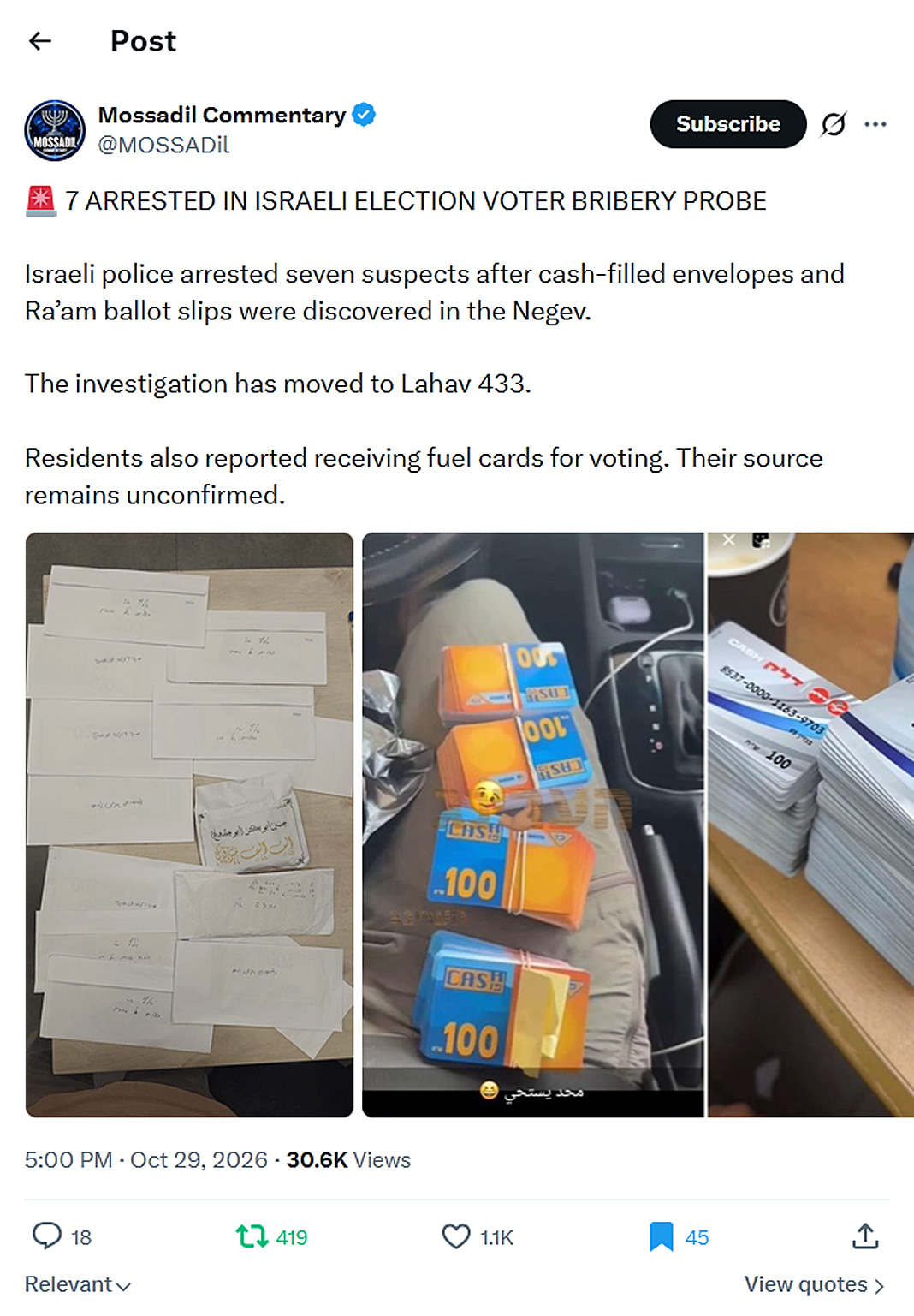 Mossadil Commentary-tweet-29October2026-7-arrested-in-israeli-election-voter-bribery-probe
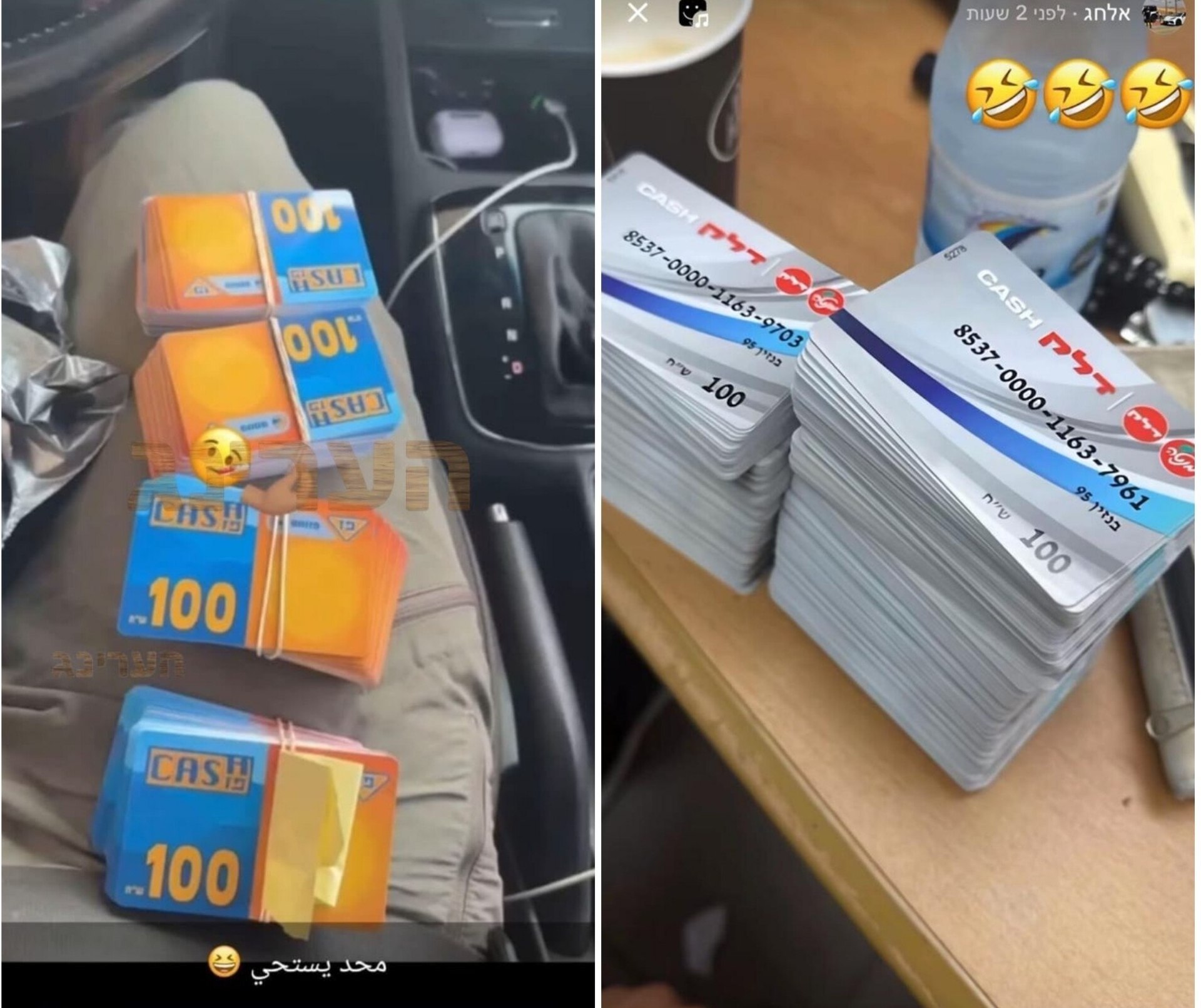 7 ARRESTED IN ISRAELI ELECTION VOTER BRIBERY PROBE
|
|
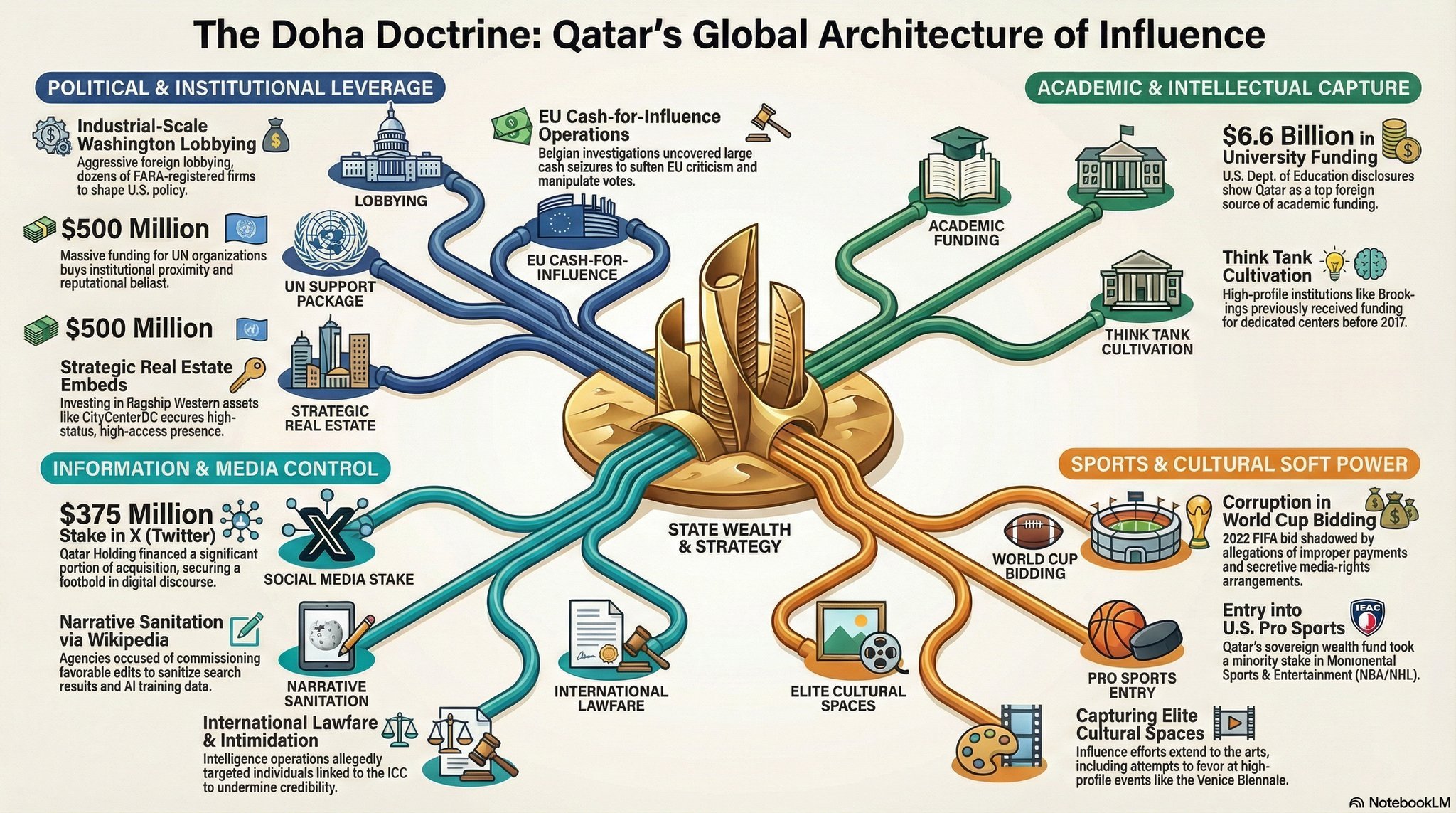 Qatar’s Global Architecture of Influence
Shin Bet investigates suspected Qatari funding to boost Arab sector turnoutCentral Elections Committee chairman Justice Noam Sohlberg ordered Shin Bet Director David Zini to investigate information on unlawful influence and election bribery by hostile actors, with suspicions tied to high voter turnout rates in the Arab sector.by Elinor Shirkani Kofman – Published on 10-29-2026 10:00 – Last modified: 10-29-2026 10:04 – https://www.israelhayom.com/2026/10/29/shin-bet-probes-qatar-funding-arab-sector-turnout/
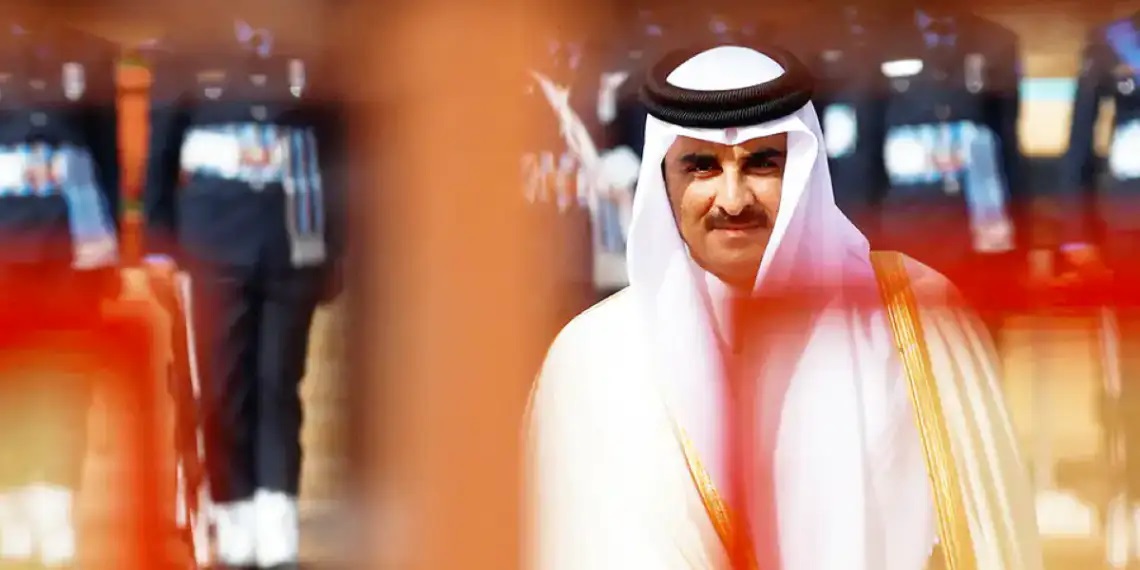 Emir of Qatar Sheikh Tamim bin Hamad Al Thani – Photo REUTERS
Following the information presented to him, Central Elections Committee chairman Justice Noam Sohlberg instructed Shin Bet Chief David Zini to investigate serious suspicions of foreign funding and election bribery. The suspicions under review involve the transfer of funds from Arab countries affiliated with the Muslim Brotherhood to encourage voter turnout in Arab society.
Sohlberg approached Zini following information presented to him regarding suspicions of unlawful influence on the elections through foreign funding and election bribery by foreign actors. He instructed Zini to investigate the suspicions and locate evidence that could either substantiate or refute them.
The suspicions are tied to the high voter turnout rates in the Arab sector in the Israeli elections for the 26th Knesset, which the Shin Bet has been examining for several weeks. Likud officials claim they submitted evidence that outside actors from Arab countries, such as Qatar and Turkey, transferred funds to encourage voters in Arab society to go to the polls. However, the initial information reached Sohlberg from the Shin Bet and did not necessarily rely on the materials submitted by Likud.
In his letter, Sohlberg wrote, “Serious suspicions have been brought before me of unlawful influence on the elections through foreign funding from outside parties working against the Israeli interest.” Alongside that, he clarified, “I cannot attest to the nature of these suspicions.”
Sohlberg asked Zini “to do everything in your power, to get to the bottom of these suspicions, and to use the General Security Service’s powers to locate evidence to substantiate these suspicions or refute them.” He added that they must be investigated “in order to preserve the integrity of the Knesset elections, and to prevent illegal activity aimed at undermining the foundations of the democratic regime.”
Due to the timelines for filing election appeals and publishing final results, Sohlberg asked to receive findings, to the extent there are any, “in the coming week.”
|
|
Three school principals arrested for fraud; no known connection to Qatari interferencePolice arrest four more suspects, including three school principals, in an alleged Ra’am election bribery scheme. Tens of thousands of shekels in cash were found in envelopes during searches.
Orly Harari / Published:
Police arrested four additional suspects Thursday morning in connection with an alleged attempt to bribe voters to encourage them to vote for the Ra’am party in the elections for the 26th Knesset.
Three of the four suspects arrested are school principals from the Negev communities of Tel Sheva and Segev Shalom.
The arrests follow the detention of three other suspects from southern Israel on election day, bringing the total number of suspects arrested in the case to seven.
The investigation has been transferred to the National Fraud Investigation Unit (NFU) at Lahav 433, where the suspects are being questioned.
The investigation began amid suspicions of an attempt to bribe citizens in exchange for votes for the Ra’am party.
During searches of the homes of the first suspects, police found envelopes containing tens of thousands of shekels in cash. Investigators suspect the money was intended to be used to bribe voters in exchange for votes for the party.
One of the suspects offered a different explanation, claiming that the money found in the envelopes was intended for distribution as donations to needy families on behalf of the Islamic Movement, rather than for election bribery.
Following developments in the investigation, authorities decided to transfer the case to Lahav 433. The four additional suspects, including the three school principals, were arrested Thursday morning.
The arrests come against the backdrop of a separate investigation by the Israel Security Agency (Shin Bet) into suspicions of foreign interference in the elections through the transfer of funds from sources outside Israel, including entities in Qatar and Turkey.
However, at this stage, no connection is known to exist between the election bribery investigation in southern Israel and the suspicions of Qatari interference in the elections.
|
|
The Knesset of Israel will not be established in sin
Immediately halt the publication and certification of the results until the Shin Bet investigation is concluded. We will not accept a fait accompli while an assault on Israeli sovereignty is under investigation, nor will we move on from 1,183 documented complaints of violence, fraud, and scandalous instructions from the CEO to “prevent overload” that shattered the identification mechanisms. If the suspicions are confirmed—we will not settle for disqualifying this or that polling station: we will annul the elections entirely and go to snap elections with strict and full oversight by the Border Guard and the police. The Knesset of Israel will not be established in sin. 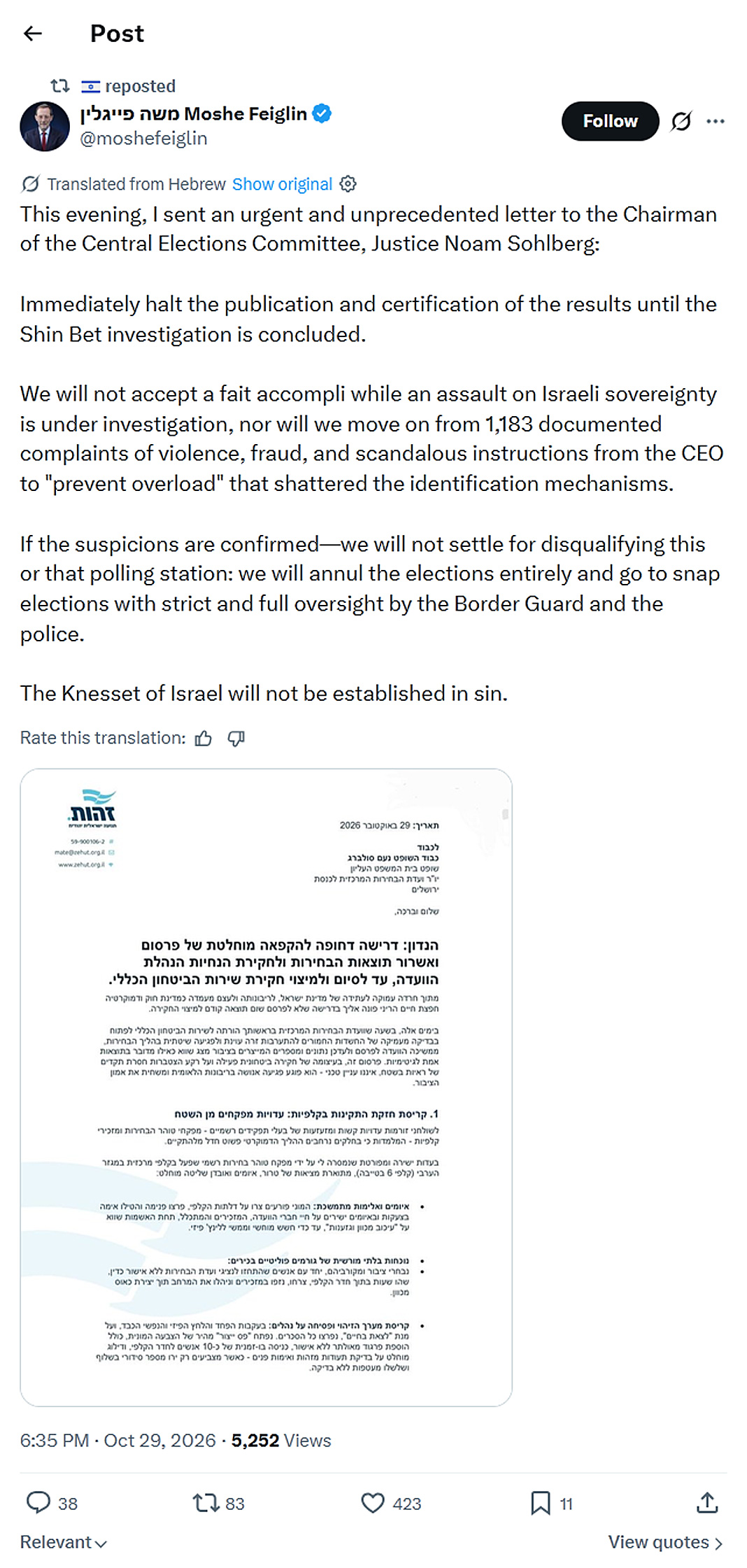 Moshe Feiglin-tweet-29October2026-Knesset of Israel will not be established in sin
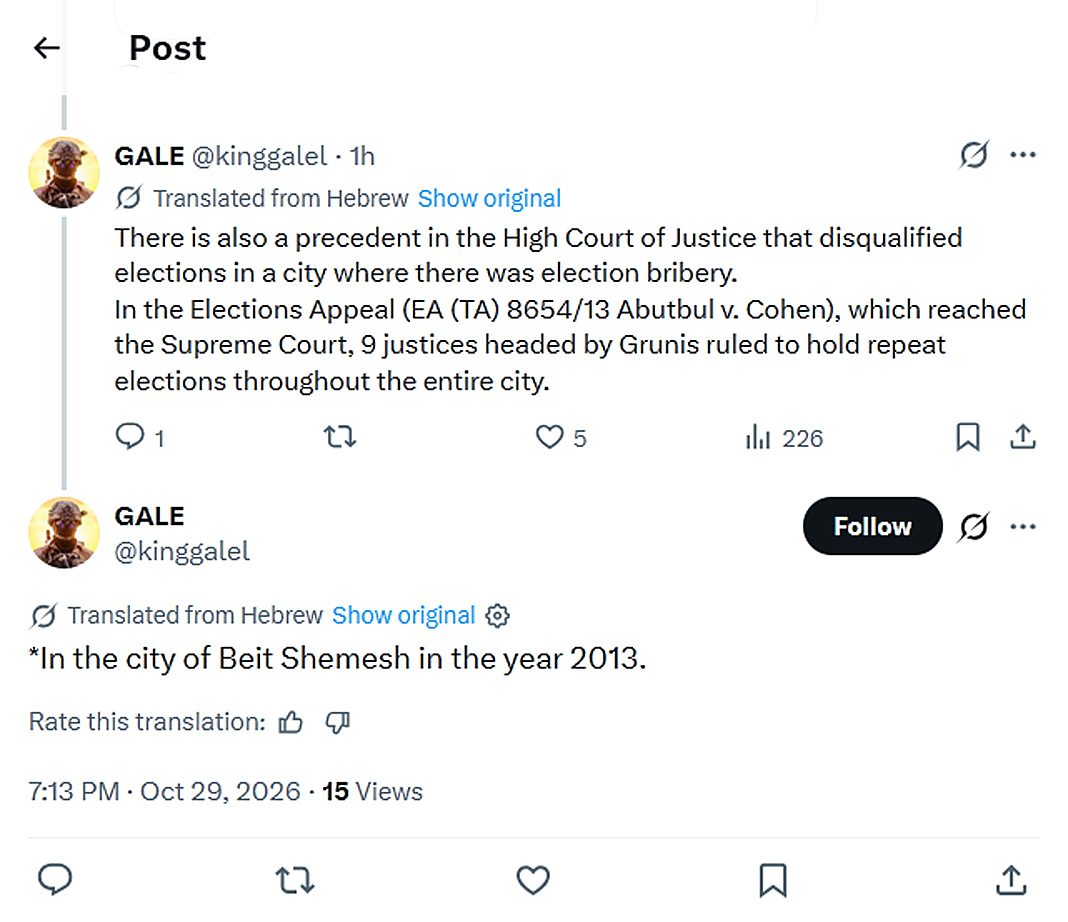 GALE-tweet-29October2026-There is also a precedent in the High Court
|
|

Netanyahu Abandons Unity Talks, Pushes for New ElectionsBy: Mati Tuchfeld
Prime Minister Benjamin Netanyahu has resolved to abandon coalition efforts—ruling out deals with Eisenkot, Bennett, or Liberman—and steer the country toward snap elections. Insiders say Netanyahu concluded that unity talks are completely futile and will campaign aggressively against any left-wing bloc reliant on Arab factions.Prime Minister Benjamin Netanyahu has decided at this stage to abandon efforts to assemble a governing coalition and instead actively pursue snap repeat elections, according to sources familiar with the matter. The strategic reassessment applies both to the prospect of establishing a broad national unity government and to exploratory alignments involving Naftali Bennett’s Together faction and Avigdor Liberman’s Yisrael Beytenu. According to informed officials, the decision crystallized after Netanyahu concluded that Yashar! Chairman Gadi Eisenkot would adamantly refuse to join a unity government under his leadership.
Insiders in the Prime Minister’s circle expressed mounting frustration over what they described as a deliberate pattern by Eisenkot to publicize every backchannel approach by intermediaries—whether dispatched directly by Netanyahu’s team or acting on personal initiative. Under these conditions, Netanyahu’s advisors determined that continuing outreach to the former chief of staff was entirely futile. Facing unyielding opposition and complex demands from potential right-wing partners, the Prime Minister’s Office concluded that the only remaining viable option is to return the mandate to the electorate. To lay the groundwork for a new election campaign, Netanyahu intends to roll out an intensive public messaging drive to delegitimize any alternative government that relies on Arab parliamentary factions.
The campaign’s core argument will be that an administration propped up directly or indirectly by Ra’am or the Joint List lacks national legitimacy during a period of acute security challenges, leaving repeat elections as the only responsible course for the state. Sources close to the deliberations said broader security events could also shape the public landscape. A military escalation in the region, should one erupt, could alter national priorities and complicate the opposition’s attempts to establish an alternative governing arrangement. Additionally, officials pointed to the ongoing Shin Bet investigation—which sources indicate is being conducted with operational assistance from the Mossad—into illicit foreign funding and voter bribery in the Arab sector. Political observers view developments in the inquiry as potentially reshaping public sentiment.
Nevertheless, insiders cautioned that Netanyahu maintains no control over the substantive findings or the timetable of these security and investigative tracks. Consequently, his core operational strategy remains focused on shaping public opinion and preparing the political apparatus for another electoral showdown.
|
|
Channel 14’s pollster-Arab parties STEALING 3-5 Knesset seats
📷 Yonatan Sindel/Flash90 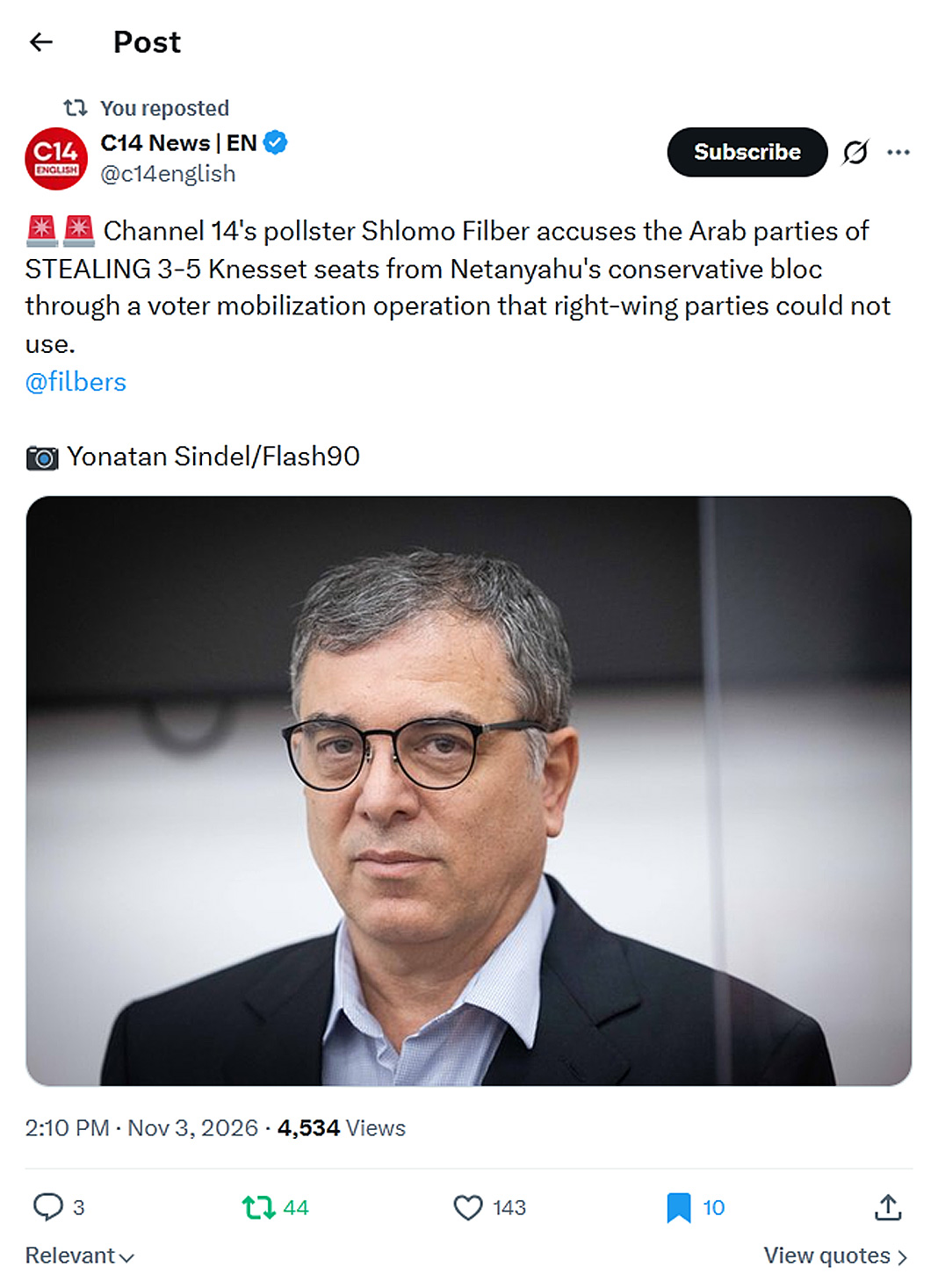 C14 News-EN-tweet-3November2026-Channel 14’s pollster-Arab parties STEALING 3-5 Knesset seats
|
|
‘Ad Kan’ probe alleges some 200,000 Israeli votes taintedAlthough the Central Elections Committee said its review found no evidence that the integrity of the election was compromised, hundreds of testimonies and records received by the organization raise suspicions of payments, fraud and threats at polling stations in the Arab sector.Netanel Frenkelhttps://www.jns.org/news/israel-news/ad-kan-probe-alleges-some-200-000-israeli-votes-tainted
(Nov. 4, 2026 / JNS) “Voters didn’t even go behind the voting booth. They got their ballot slip outside, walked up to the election committee, received an envelope, and put the slip right in. Someone takes a photo of them from outside, since phones aren’t allowed inside. So he stands 10 centimeters behind them, just past the doorway. Four hundred shekels, 500 shekels—whatever their budget is. Just like that, done.”
This is how Avihai Shorshan, CEO of Ad Kan, an Israeli nonprofit known for its undercover investigations of left-wing and Palestinian organizations, describes what he claims took place at polling stations in the Arab sector on Election Day for the 26th Knesset.
The allegations come as questions about possible election irregularities and foreign interference have drawn public attention since the Oct. 27 vote.
On Election Day, three suspects were arrested in the Negev after police searches uncovered envelopes containing cash and Ra’am ballot slips. Four additional suspects were arrested later that week.
By Tuesday, six of the seven had been released from police custody, although some remained under house arrest. The seventh suspect remained in custody pending a Wednesday hearing. The suspects have denied wrongdoing, with attorneys for some saying the money was intended for charitable purposes.
Meanwhile, Central Elections Committee Chairman and Supreme Court Justice Noam Sohlberg asked Shin Bet director David Zini to examine information regarding possible improper interference in the election through foreign funding from entities acting against Israeli interests. Police have said there is no connection between the two cases.
Threats were madeShorshan, whose organization has spent the past decade conducting investigations into left-wing and Palestinian groups, says the first reports came on Election Day itself from salaried polling-station officials.
“I’m an election observer at a certain polling station. I saw envelopes of cash. I saw fuel vouchers being handed out outside. Something smells fishy to me,” he quotes one as saying.
According to Shorshan, “After three such instances, a red light went off for us—that this wasn’t an isolated incident.”
Since then, he says, “hundreds of personal testimonies have accumulated, where someone comes forward and says, ‘My name is so-and-so, my ID number is such-and-such, and I served in such-and-such a role at this specific polling station.’”
“These aren’t rumors. It’s not like I just gathered posts from Facebook,” he added.
However, Shorshan declined to give an exact number and stressed that the investigation is still underway.
“This is research currently taking place,” he said. “If you had asked me to investigate something like this on a normal day, I’d tell you, ‘Let’s talk in four months.’ Here, we’re 72 hours in, including the weekend.”
According to Shorshan, the alleged method was consistent.
“The main headline here is certainly election bribery,” he said. “You vote for whoever I tell you to, and you prove to me that you voted. Usually, that means taking a photo of yourself and showing it to whoever needs to see it. Then you get money—or more often than not, a fuel voucher.”
Shorshan described tables set up outside polling stations and posts openly uploaded to social media.
“You have to look on Instagram and take a screenshot to record it before they delete it,” he said.
According to Shorshan, the alleged system was set up in advance.
“This is an operation that takes six months to a year of preparation. Hundreds of people are deployed in the field to execute it.”
In some cases, he said, those allegedly offering bribes did not even check whom they were approaching.
“There were places where the polling station secretaries didn’t look Jewish, so in their sheer stupidity, they’d approach them and say, ‘Do you want to vote for the Joint List? Do you want to vote for Ra’am? Come on, take 400 shekels, take 600 shekels.’ They didn’t realize they were talking to a Jew sent on behalf of a Zionist party.”
Alongside bribery, Shorshan said, there were also threats, “mostly verbal, but also physical.”
According to him, observers who tried to document such incidents felt they could not do so without putting themselves in danger.
An ‘unnatural’ gapAd Kan came to public attention on Oct. 29, two days after the election, when its chairman, Gilad Ach, released a video claiming that “there wasn’t a single polling station in the Arab sector without electoral bribery and fraud.”
He estimated that at least five Knesset seats were affected and called to “stop the vote count now, stop everything.”
What stands out in Shorshan’s remarks, however, is what he refrains from claiming. Contrary to public speculation linking alleged election interference to Qatari funding, he said: “I can’t answer whether it’s Qatar, Turkey, Hamas, or the Islamic Movement. I don’t know. I’m not investigating that either, because I don’t have the tools to do so.”
However, he estimated that the sums involved were “already in the millions, maybe even tens of millions.”
Shorshan also clarified that he is not seeking to challenge the overall election result.
“Any analysis shows that this wouldn’t change the outcome of the election,” he said.
He estimated the number of allegedly tainted votes at “around 200,000 to 220,000 votes, which equal about five Knesset seats.”
Shorshan based that estimate in part on what he described as an unusual increase in Arab voter turnout, saying: “In the previous election, voter turnout in the Arab sector was 53%, and in this election it reached 82%. Their highest turnout up until then was 64%. A jump from 53% to 64%, had it occurred now, would have been logical and natural. The gap between 64% and 82% that actually occurred is not natural.”
However, an Israel Democracy Institute analysis of polling-station data from Arab and Druze localities put turnout in Arab society in the 2026 election at approximately 77%. The institute noted that similarly high turnout was recorded in earlier elections, including 79.3% in 1996.
Turnout among Arab voters was 53.2% in the 2022 election and about 65% in 2020.
‘All it takes is the will’Shorshan is calling for a pause in coalition-building efforts. “What’s called a ‘timeout’ in sports,” he said. “Let’s give this situation 72 hours, a week, until we have a solid basis to understand where this is heading.”
In his view, party leaders across the political spectrum, “including Netanyahu, Eisenkot and Bennett,” should freeze government-formation efforts until authorities understand the full scope of the allegations.
“How can they rush to form a government based on numbers that might not even be valid?” he asked.
That demand runs counter to the findings announced by the Central Elections Committee on Wednesday following its review of the election results.
The committee said it had examined protocols from 9,069 polling stations and, where necessary, conducted more extensive checks of voting materials, including ballots and voter registries.
“The conclusion of the operation revealed no irregularities or findings that would suggest that the integrity of the elections had been compromised or that the results had been altered,” the committee said.
Acting Central Elections Committee Director-General Dean Livne said every inquiry received from political parties, candidate lists and members of the public had been examined individually, with corrections made where warranted by official records and voting materials.
The committee said the official results would be submitted to President Isaac Herzog on Wednesday as scheduled.
A separate Shin Bet investigation into suspicions of foreign interference in the election remains ongoing. Sohlberg has said the suspicions are serious and must be thoroughly investigated, while stressing that the information uncovered does not call the overall election results into question.
Shorshan, for his part, stressed that Ad Kan is not seeking to replace the official authorities.
“We are not a state authority; we aren’t coming to replace the police, Shin Bet, Mossad, the Elections Committee, or Judge Sohlberg,” he said.
In his view, investigating the allegations should be straightforward.
“A fuel card is like a credit card—someone purchased it. How hard is it to go to Delek, Paz, or Dor Alon?” he said. “All it takes is the will to do it.”
He placed the ultimate responsibility on the state.
“There is neglect here on the part of the State of Israel,” Shorshan said. “Not neglect of Arab society, but neglect of law enforcement. There is an entire community here that for decades no one has gotten their hands dirty dealing with. Today, it’s blowing up in our faces.”
|
|
Ra’am activists used illegal App to track voter turnout in real time
According to the forum, the system was set up about a month and a half before the elections and had more than 500 downloads The complaint also alleges involvement by individuals linked to the Palestinian Authority in developing the app, and calls for a criminal investigation to determine the identities of its operators and the information collected through it 📸: Flash 90 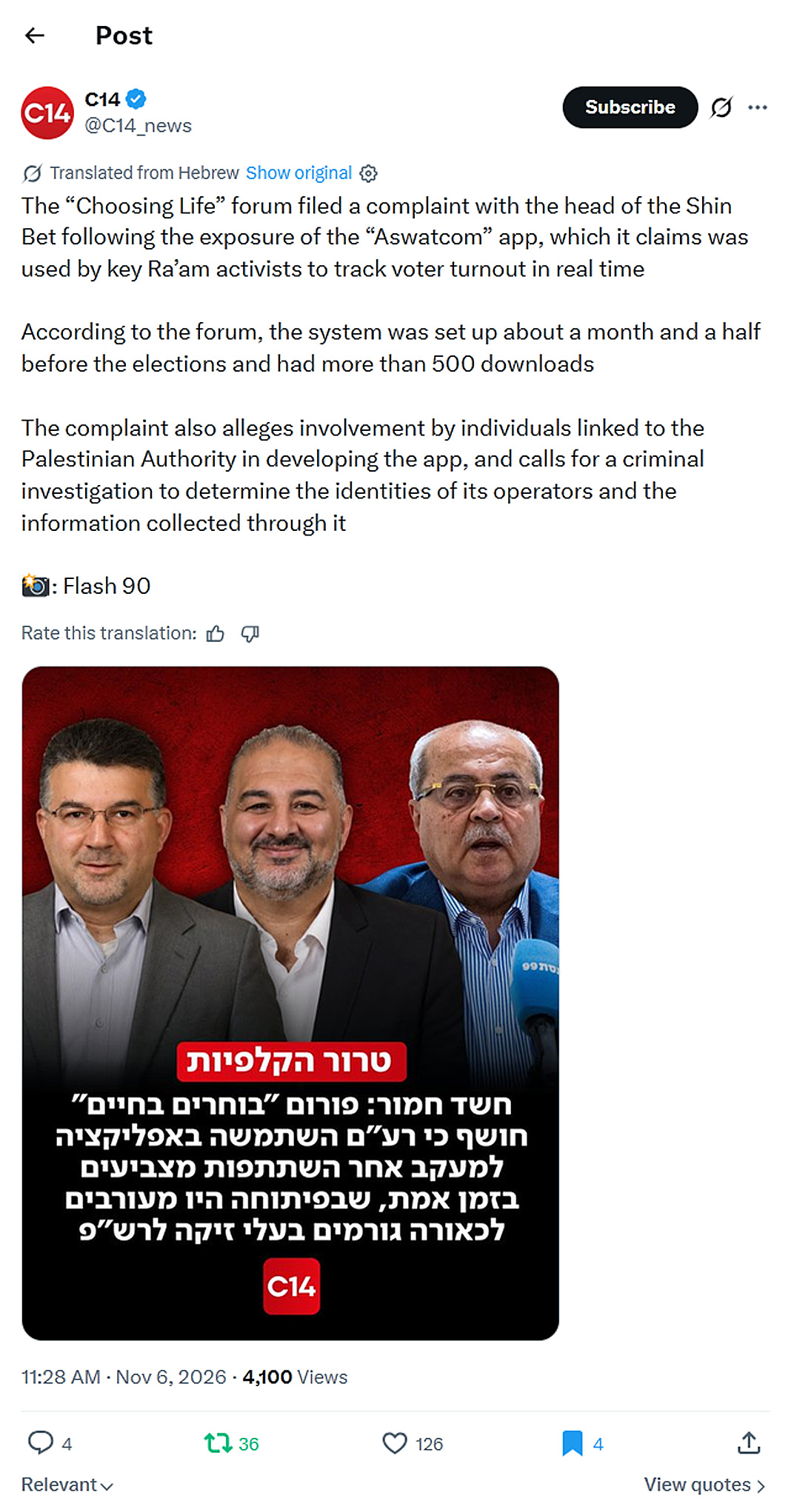 C14-tweet-6November2026-Ra’am activists used illegal App
|

THE DEEP STATE COVER UP
You were warned
|
|

Reports: Shin Bet Chief Zini Clashes With Officials Over Election-Funding ProbeWhat the sources say about the covert inquiry, the Shin Bet legal adviser at the center of the dispute and the Wednesday handoff to Herzog.3November2026 https://israfan.com/p/reports-shin-bet-chief-zini-clashes-with-officials-over
Shin Bet Director David Zini wants to dig deeper into suspected foreign funding in Israel’s October 27 election, and he is meeting resistance from inside his own agency and from its lawyers, according to reports in The Jerusalem Post and JNS.
Kan News reported Sunday that Zini clashed with three senior Shin Bet officials over the need to expand the tools used in the case, The Jerusalem Post reports. The three, including the head of a department involved in the investigation, argued that the suspicions were limited in scope and did not require those tools. A senior Shin Bet official told Kan that the measures Zini proposed would need special legal authorization, which may be hard to obtain. The Shin Bet told the Post that its internal discourse allows for a “wide range of different and diverse opinions in discussions,” and that it does not comment on closed meetings.
The case centers on money received by a Knesset member from the Joint List, which the party allegedly used during the elections, the Post reports. Investigators have yet to establish where the money came from, or whether it paid for illegal election activity. JNS reports that the suspicion so far is that Qatar and Turkey channeled tens of millions of shekels to bring out the Arab vote. Both countries deny any involvement.
Zini also has a complaint about the lawyers. Channel 14 reported that during a six-hour meeting on Sunday, Zini told Central Elections Committee chairman Justice Noam Sohlberg that the Shin Bet’s legal adviser, working closely with Attorney General Gali Baharav-Miara, was blocking his investigation, JNS reports. Prime Minister Benjamin Netanyahu posted a link to the report and wrote: “Shin Bet chief Zini complained to Sohlberg: Shin Bet’s legal adviser is tying my hands from investigating.”
Sohlberg says the probe goes on, but the vote stands. In a statement provided to JNS, he said “serious suspicions” had been raised about foreign funding meant to influence the elections. He added: “Our position is that even if the suspicions are substantiated, this would not undermine the integrity of the electoral process or the election results as a whole.” The official results go to President Isaac Herzog on Wednesday, when consultations on forming the next government begin, the Post reports.
What it means: in Sohlberg’s view, the results as a whole stand even if the suspicions are proven. The fight now is over how far the Shin Bet may dig into who paid for what, and who gets to say yes.
Sohlberg’s statement described the inquiry as covert, relying on classified intelligence and run by a joint team from the Shin Bet, police and prosecution under his supervision, The Jerusalem Post reports. He said the suspicions may involve a security dimension. Zini appeared in the video statement alongside Sohlberg, Attorney General Gali Baharav-Miara and acting Central Elections Committee director-general Dean Livne. In the statement provided to JNS, Sohlberg said: “This coming Wednesday, the official results will be published and submitted to the President of Israel, as they stand.” A law enforcement source involved in the case told Kan that uncertainty over where the money came from and how serious the suspected offenses are has created legal obstacles to approving certain investigative measures without more evidence, the Post reports.
The legal adviser Zini complained about has not been identified, for security reasons. Channel 14’s political correspondent Moti Kastel reported that the adviser is a holdover from the Ronen Bar era and has tried to block other sensitive investigations, according to JNS. Netanyahu fired Bar, the former Shin Bet chief, in March 2025, citing a growing lack of confidence in his ability to lead the agency. Israel’s right-wing parties have also protested the way the investigation is being handled, JNS reports.
Sources: The Jerusalem Post, JNS
|
|
Attorney General Gali Baharav-Miara thwarts investigations
Tonight’s publications are an earthquake for Israeli democracy. According to the publication in Haaretz, Miaara is preventing necessary investigations of Ahmed Tibi, Mansour Abbas, Sami Abu Shehadeh, and another MK suspected in the serious affair. In another publication, it was reported that Miaara is preventing the Shin Bet from employing investigative means for a security offense and wanted to hide from the public that it involves a security offense. Attorney Miaara is working to cover up and thwart the investigation into election contamination. This is what selective enforcement looks like. Justice Solberg and the Central Elections Committee are clearly obligated to ascertain the truth and provide answers to the public. 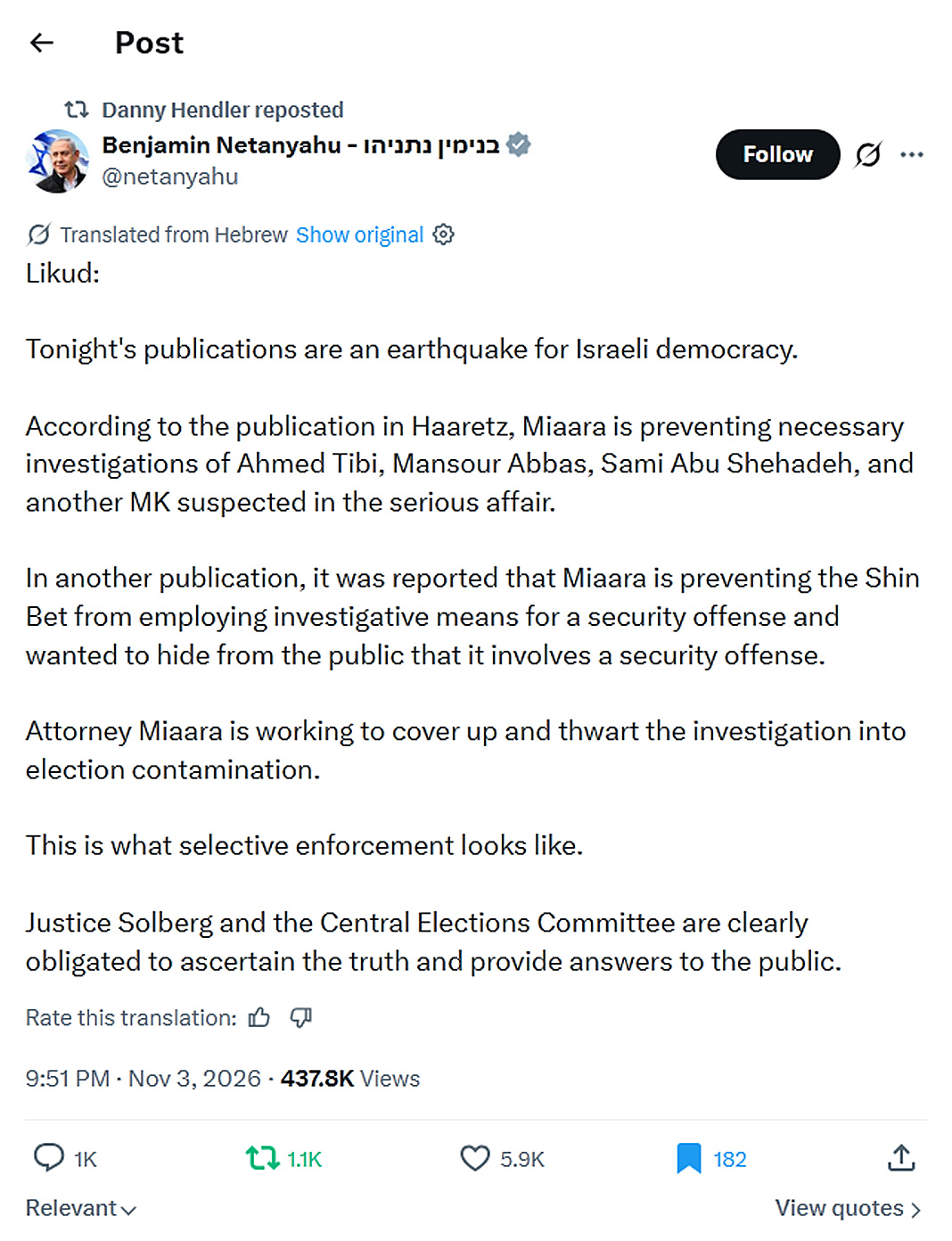 Benjamin Netanyahu-tweet-3November2026-Attorney General Gali Baharav-Miara thwarts investigations
|
|
Arrest all heads of the Arab parties
Yemina Yehudit chairman demands to immediately freeze the approval of the results and the formation of the government: “Elections were stolen here in the State of Israel, we must not stay silent” 📸: Noam Rabkin Fenton, Haim Goldberg, Avshalom Shoshoni, Flash 90 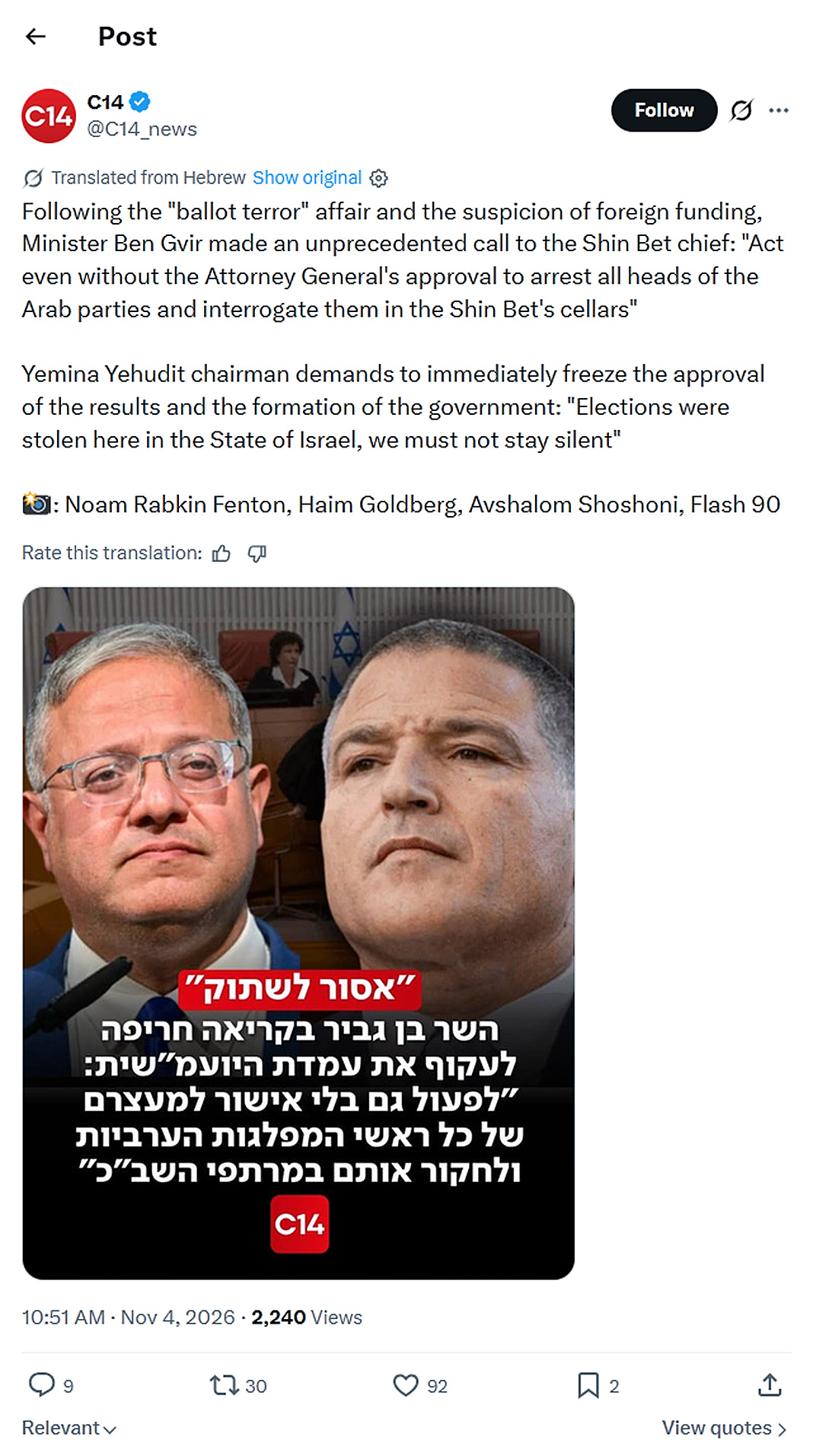 C14-tweet-4November2026-arrest all heads of the Arab parties
|
|
The Arab Parties support Hamas
Abbas’s answer: “You can’t put us to that test.” As we said during the election campaign: Abbas recommended Eisenkot for prime minister today because he has no government without the Arab parties. שווה גם להראות את הקטע שמנסור עבאס מדבר על חזונו – מדונה פלסטינית
It’s also worth showing the segment where Mansour Abbas talks about his vision – a Palestinian [State] 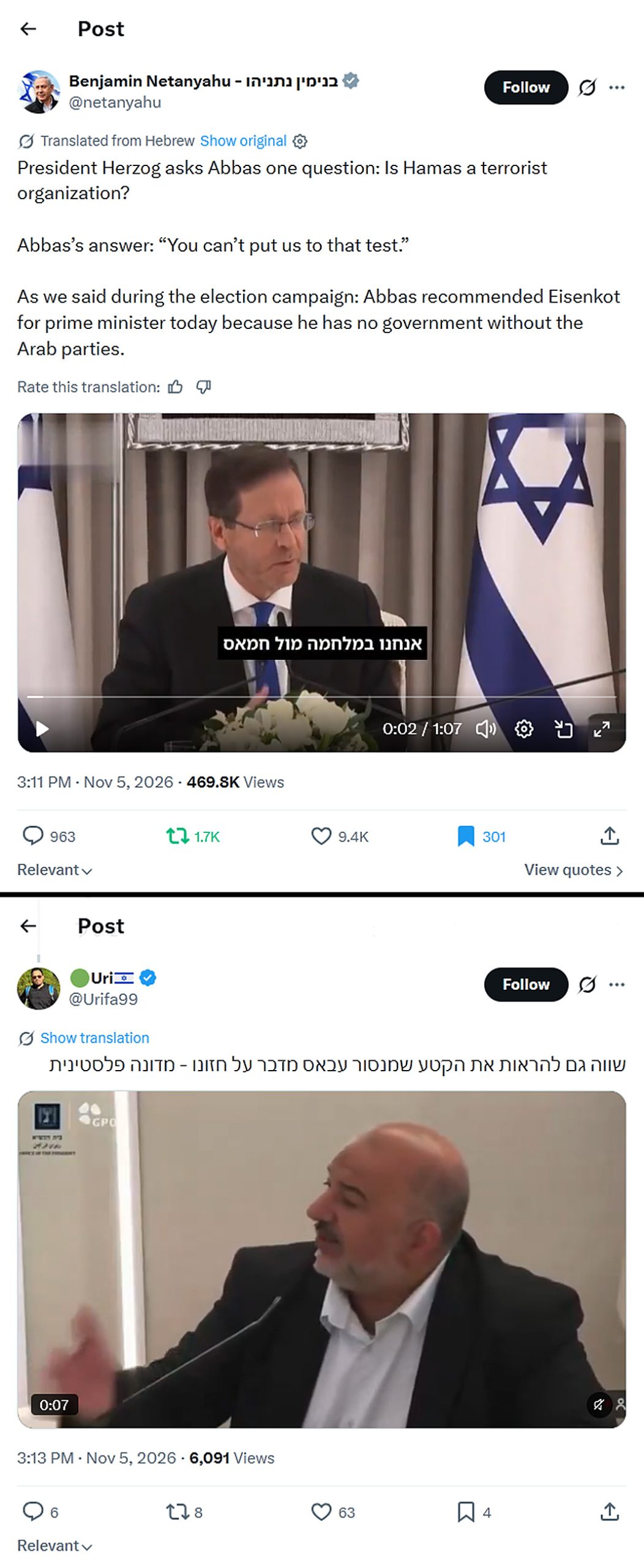 Benjamin Netanyahu-tweet-5November2026-The Arab Parties support Hamas
What the Arab Parties dream about.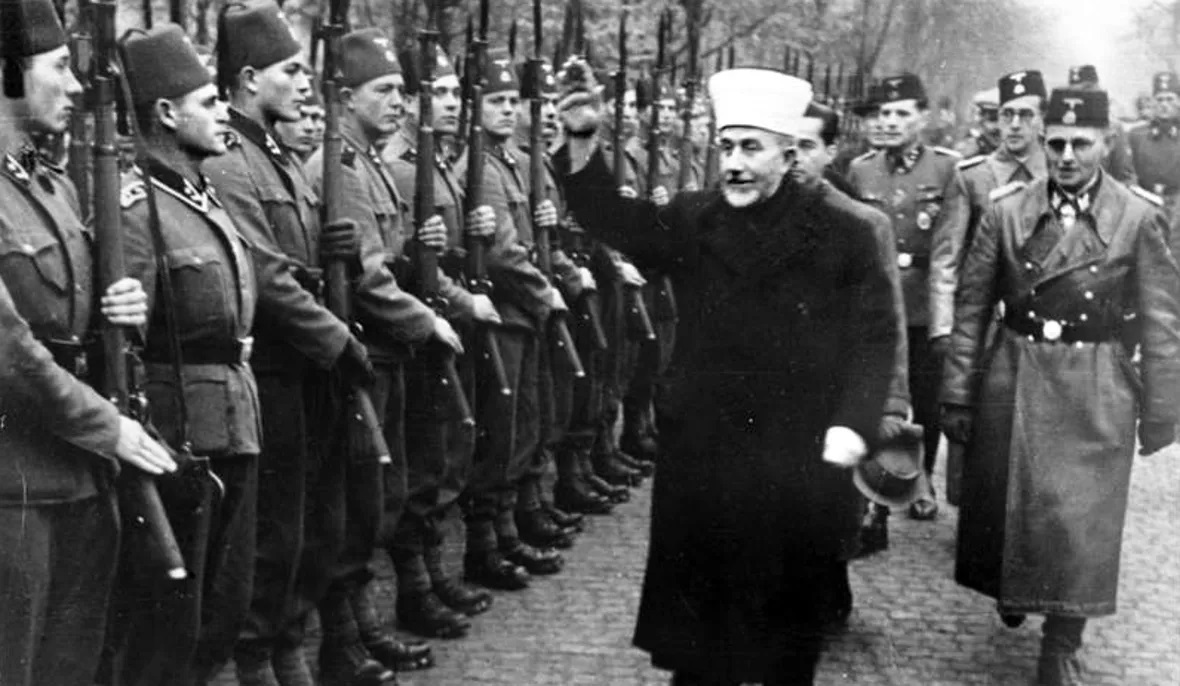 Haj Amin al-Husseini, the Grand Mufti of Jerusalem, greeting Muslim Waffen-SS volunteers with a Nazi salute, November 1943. Credit: Bundesarchiv / Wikimedia Commons |
|
What they got.
|
|

“Take 1,000 shekels – vote for the Ra’am”: What happened at the polling stations in the Arab sector | InvestigationThe case of suspected violations of the purity of the elections consists of a tangled web of connections, which is divided into three main strands: • The first – the suspicion that foreign elements illegally funneled millions of shekels to Arab parties, the second – hundreds of testimonies from members of polling stations across the country about serious offenses, the third – the arrest of key activists in the Arab League who were caughthttps://www.israelhayom.co.il/magazine/hashavua/article/21789511
“A woman about 60 years old called me into the yard and offered me 1,000 shekels in exchange for voting for the Ra’am,” describes Ch., 20, chairman of one of the polling stations in the Zemer local council, in an exclusive interview with “Israel This Week.” We will return to Ch., but first let’s try to sort out the backlog of events that cloud the cleanliness of the election process.Three different ends of a thread, not necessarily connected to the same knot, tarnish the purity of the electionsEach of them is an event in itself, but all three together become a suspicious nuisance. Those who care about democracy cannot ignore, minimize, and belittle it.
One – suspicion of the involvement of a foreign entity in the election rigging. This affair is garnering loud headlines about power struggles between the legal advisor to the government and the head of the Shin Bet, but there is still not enough meat to it. Why? Because under the cover of the smokescreen of the arm-twisting between Zini and Barrab-Miara, the concern with the compromise itself, which has not yet been investigated, has been abandoned.
How did the affair come about? The Authority for the Prohibition of Money Laundering and Terrorist Financing (a unit in the Ministry of Justice that works in collaboration with the Counter-Terrorism Headquarters in the Ministry of Defense, 11), which monitors unusual money transfers, identified a suspicious bank transfer of hundreds of thousands of shekels to a member of Knesset from the Joint List. The information was passed on to the head of the Shin Bet. The suspected member of Knesset, as Avishai Greenzig revealed on the i24NEWS channel, is Ayman Odeh, and the money was transferred from the Palestinian Authority.
As early as May 30, MK Amit Halevi (Likud) issued an official letter to the head of the Shin Bet under the title: “Demand for increased supervision and prevention of foreign interference in the election campaign.” Halevi, a member of the Central Elections Committee and the Foreign Affairs and Security Committee, wrote: “I am addressing you due to indications that have reached me.” In the letter, he asked for increased “monitoring of the flow of funds intended for party activities and political campaigns, which are transferred under the guise of civic activity.”
“I did not receive a response from the Shin Bet, but as was reported, in discussions in the Foreign Affairs and Security Committee, representatives of the Intelligence Agency claimed that Qatar, Turkey and Iran are not trying to influence the results of the elections, but only to increase the division in Israeli society,” Halevi said this week. “The security agencies, whose job it is to thwart such things, fell asleep on guard, just like before October 7. If the Money Laundering Prohibition Authority had not passed the information to Zini, above the heads of the professional ranks, the IDF and Shin Bet would have continued to turn a blind eye to everything wrapped in a civilian envelope, even though our enemies use non-profit organizations and civilian actions to achieve their goals.”
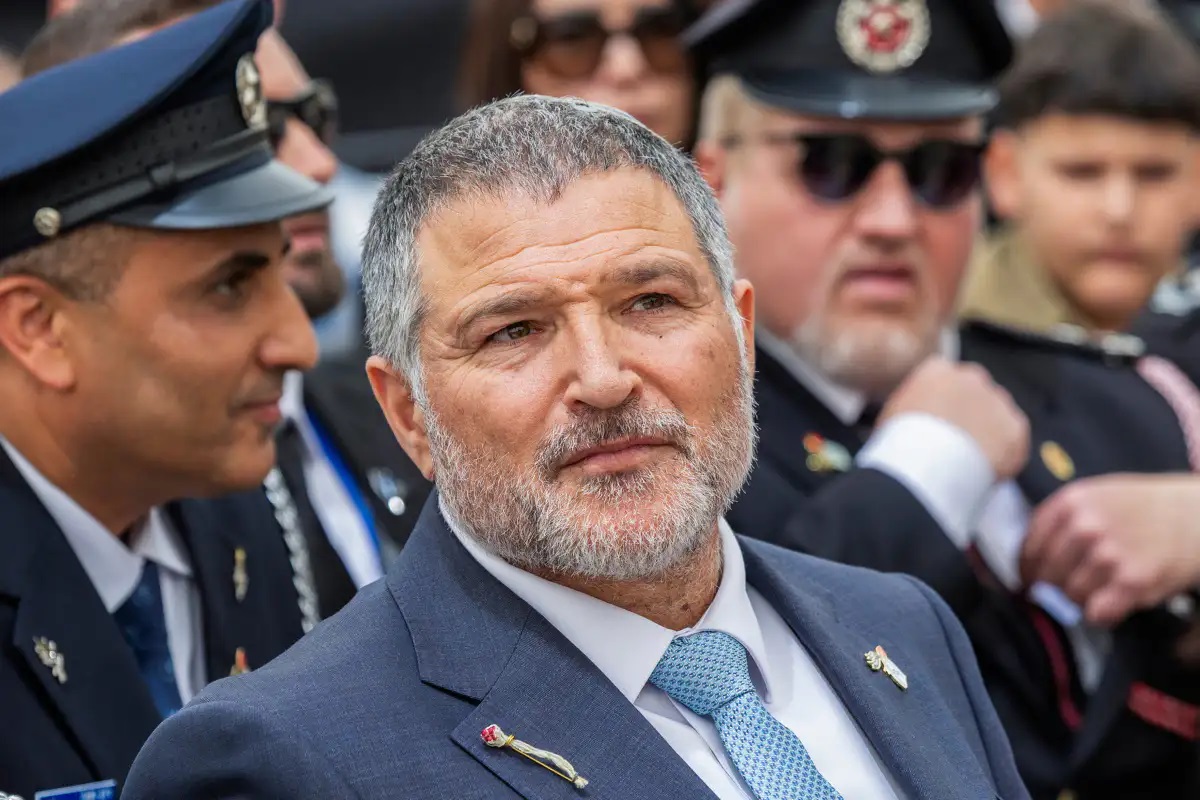 Had the Anti-Money Laundering Authority not passed the information to Zini—bypassing the professional ranks—the IDF and the Shin Bet would have continued to operate in the dark. Photo: Dor Pazuelo/Flash90
On Wednesday, the chairman of the Elections Committee, Judge Noam Solberg, published the election results in Reshumot, in accordance with the committee’s legal duty, and at the same time made it clear that the investigation would continue. Appeals to the election results, if any, are supposed by law to be heard in the Jerusalem District Administrative Court. On that day, it appeared that the Shin Bet had begun to wake up and issued an update to the members of the Elections Committee, in which it allegedly pointed out widespread phenomena of huge sums of money being funneled into Israel from foreign countries through approximately 1,000 people, originating from those with hidden and hostile interests, intended to promote foreign influence and requiring in-depth intelligence and investigation.
The Shin Bet announcement does not necessarily indicate contamination of the electoral process in Israel, but it should concern every citizen who does not want a seat in the Israeli Knesset to be purchased with the help of hostile elements.
“They offered me a bribe”The other end of the cocoon is a disturbing collection of testimonies from members of polling stations in many localities, including bribery offers, distribution of money and gas cards, real-time mass voter monitoring from inside polling stations in violation of the High Court ruling and the Elections Committee’s decision, and more. Approximately 1,500 complaints and testimonies were compiled and examined by the research department of “Ad Kan” and by the Likud’s election purity coordinator, Sagi Keizler. They were later sifted through and approximately 700 complaints about irregularities were filed by attorney Ilan Bombach, who represents the Likud.
The raw materials of the complaints have reached us. We contacted seven members of the polling stations, whom we ourselves selected from lists of hundreds, and spoke with them personally. After identifying the individuals, we respect those who wished to remain anonymous.
7 ARRESTED IN ISRAELI ELECTION VOTER BRIBERY PROBE
We will start in the central region, in the town of Zemer, where 4,530 people voted. The voter turnout in the Arab local council jumped from 56% in the previous elections to 81% in the current elections. We will focus on one of the polling stations. Ch., a young man of about 20, was the chairman of the Likud polling station committee. He is speaking here for the first time.
“I arrived in the morning. People arrived at a crazy pace, in an abnormal way. At first I said: ‘Okay, these are fateful elections, so everyone wants to vote.’ There was not a moment’s rest. Over time, I noticed what was happening inside and outside the polling station. There was a point where, because there was no attendant, people came in, raided the table and played with the envelopes. We wanted to sign new envelopes as defined by law, so they started shouting, cursing and threatening us.”
Did you document?“We were warned not to take pictures, because then we would be forcibly removed from the polling station. The one who recorded was the supervisor, but she didn’t always record what we asked for. I reported the incident at 12:42. Later, I started seeing RAAM ballots circulating outside the polling station and envelopes with green Arabic writing. When I checked with friends at other polling stations, I realized that these were envelopes that contained money or gas cards. I didn’t see any money myself,” he admits, “but I saw envelopes being passed around along with RAAM ballots, and I saw such envelopes torn in the trash at the polling station.
“The head of the place entered the polling station without any authorization, and at a certain point became the unofficial usher. He used an app. I recognized him from photos sent by friends from other polling stations. He stood with his phone at the entrance, and told each person who entered their serial number. He made sure, based on the app, to bring in those who didn’t vote, or someone who looked like someone who didn’t vote. We had no way of verifying whether it was indeed the person.”
“In the evening, a woman about 60 years old came out of the polling station. She talked to a few men, then called me to the garden courtyard. It was after 7 and there was less traffic at the polling station, so we could get some air. I went out to her,” describes Ch. “I didn’t understand all of what she was saying. I understand a little Arabic and she also spoke a little Hebrew. She offered me 1,000 shekels to vote for the R.A.M. I refused immediately. I didn’t want to get involved in a criminal incident. I went to the side, there were police officers there, I told them: ‘They offered me a bribe. I’ll leave it to you, I have to get back to work at the polling station.’ They turned to the woman, and after a while they came back and said that she said she wouldn’t do it again. I insisted on recording the incident in the minutes and reported it at 7:34 p.m. Ch. gave us three messages in which he reported irregularities.”
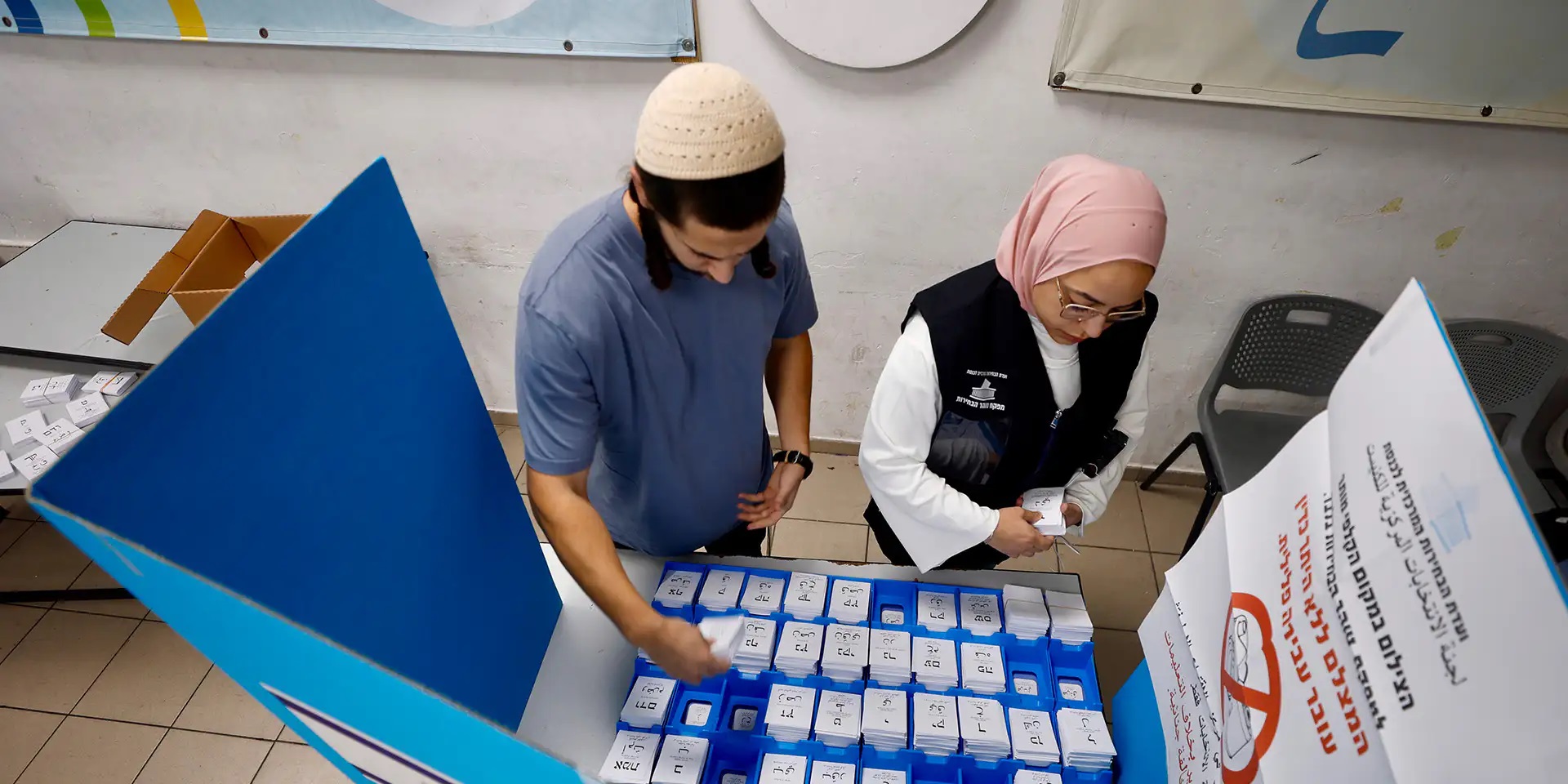 Election integrity inspectors organize the ballot box (the individuals pictured are unrelated to the content of the report). Photo: EPA
In Tira in the Triangle, 17,007 people voted. An increase in voting rates from 62% to 81%. This is how Yair Sagiv, 19, a member of polling station committee number 28 in Tira, describes it: “There was an observer from one of the Arab parties who reported in the app in real time from the polling station the serial numbers of the people who voted. I didn’t see the app itself.
She tried to hide the phone under the table, pressed it to her stomach so we wouldn’t see what she was typing. But there was no doubt that she was typing voters’ serial numbers. After a while, we stopped the voting. We called the election integrity officer who was hanging around there and filled out a form reporting the incident. At first she refused to come out. They yelled at her, then she left but continued to report who voted outside the polling station. Another observer came in instead and she was fine. We reported the incident.”
Yelling and threatsVows to the local council of Hura, northeast of Beersheba. 9,216 people voted there. The voter turnout in Hura increased from 49% to 80%. “I worked at the polling station at the Al-Atauna school. I was the deputy chairman of the polling station on behalf of Religious Zionism,” describes Elnatan Gross, 22. “We had a committee member from the joint Al-Atauna tribe, and also an observer from the Ra’am.
The representative of the joint, who of course knows the whole clan, asked everyone who came out from behind the curtain to take the ballot out of the envelope, he took a picture and sent it to his people outside. Only after the picture was taken did the voter put the ballot back into the envelope and drop it into the ballot box. I tried to prevent this, I shouted that it was forbidden, most of them ignored me. I asked the inspector of election purity to stay at the polling station the whole time, but they arranged a coffee corner for him outside the polling station, which was a waste of time, so he sat there most of the day.
“When less educated voters arrived, mainly old people and women, the committee member from the joint party shouted at them the letters of the ballots they should choose. There were men who tried to enter with women behind the curtain. I really fought about it and managed to prevent most of the cases. The committee member from the joint party constantly tried to get to the lists to find out what the voting rates were at the polling station. I insisted that it was illegal. He threatened: ‘If you don’t let me look, I’ll keep you here until 3 a.m. counting the votes.’ I replied: ‘Soul, I’ll happily stay with you.’ He got angry and brought two elderly sheikhs who shouted at me. I insisted. I held the dam.”
Elnatan, who heard about the fuel cards being distributed to voters, began talking about it with the joint representative and the RAAM observer. “I said to them: ‘What, because of fuel cards you’ll be able to convince someone to vote?’ Then the RAAM observer laughed and said: ‘I work at the Menta Fuel in Beer Sheva near Soroka, and I know they printed a lot of 100 shekel cards to distribute to voters.’ I was shocked, but I didn’t show it.
I said to them: ‘Do you think it works? That it succeeds?’ So the representative of the joint venture told me: ‘There are people who have an ideology, and there are those who don’t care and they don’t come to vote. We give them a 100 shekel gas ticket, and that’s how everyone comes. And to prove that they did come, we take pictures of what they voted.’
“They weren’t ashamed to tell it. They photographed dozens of people. I reported it through Religious Zionism, they sent an undercover police investigator, who took testimony from me, but they didn’t do anything about it. It was submitted as an official complaint to the Elections Committee.”
“I would have been a girl,” says Yaakov Etzion, 49. “That means I was responsible for seven polling stations in two schools. In the courtyard of the Al-Atauna school, I saw two people passing a stack of voting cards from one to the other. I told the election purity inspectors to pay attention and take pictures if they saw such cards. One of the secretaries told me that he saw a dispatcher handing out voting cards, after he had taken a picture of someone with a Joint List ticket.”
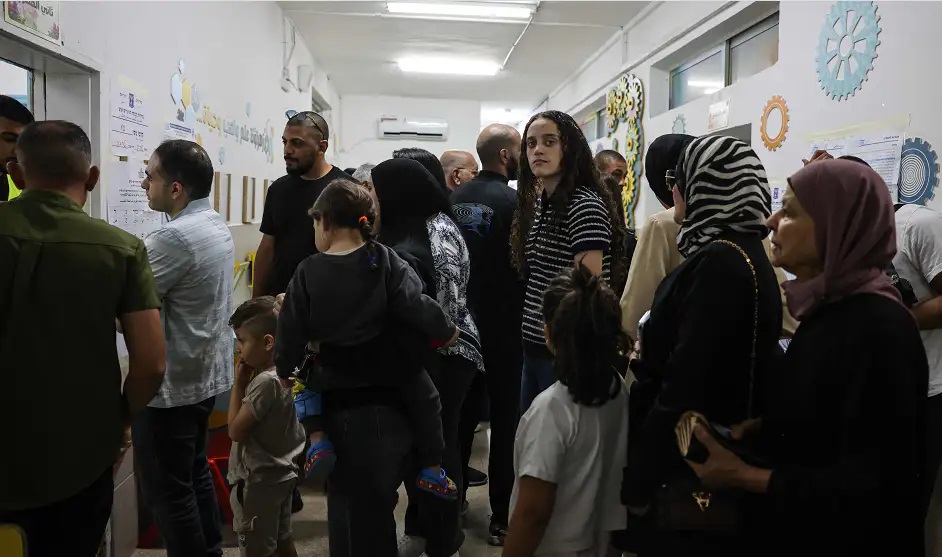 Voters at a polling station in Tayibe on the day of the 26th Knesset elections. Photo: AFP
“It was around 3:30 p.m. The secretary reported this in the election protocol. This information was passed on to the Election Committee. That polling secretary is afraid to be interviewed,” says Etzion. “Besides, they used data from the polling stations. There were constant attempts to extract information about the people who voted. The secretaries should have prevented the sheets from being photocopied. I entered the polling station and saw a Bedouin observer writing down the serial numbers of the voters. He already had two sheets full. I explained that this was forbidden. He argued, but it was stopped.”
“There was a table inside the school, near one of the classrooms that didn’t have a ballot box, and there was a constant commotion. The head of the council hung around there all day, and people were conducting voter registration. People were sitting there with computers. They used an app in Arabic with a green screen. Everyone who came told them their ID number, and they told them what their serial number was on the ballot box. It streamlined the work. They probably used the app to find out who hadn’t voted yet. I can’t say for sure.”
Incriminating recording“There were a lot of violations,” describes D., 20, who was the chairman of a committee at another polling station in Chura. “People entering the polling station even though they weren’t allowed to, a dispatcher instructing people behind the barrier on what to vote for, an Arab observer taking out RAAM ballots so that people would know what to vote for. People were freely filming their votes. I couldn’t prevent that. After I heard that gas cards were being distributed, I decided to talk to the dispatcher about the matter. I talked to him like a friend, but I recorded the conversation. He confessed to me about a bribery incident.”
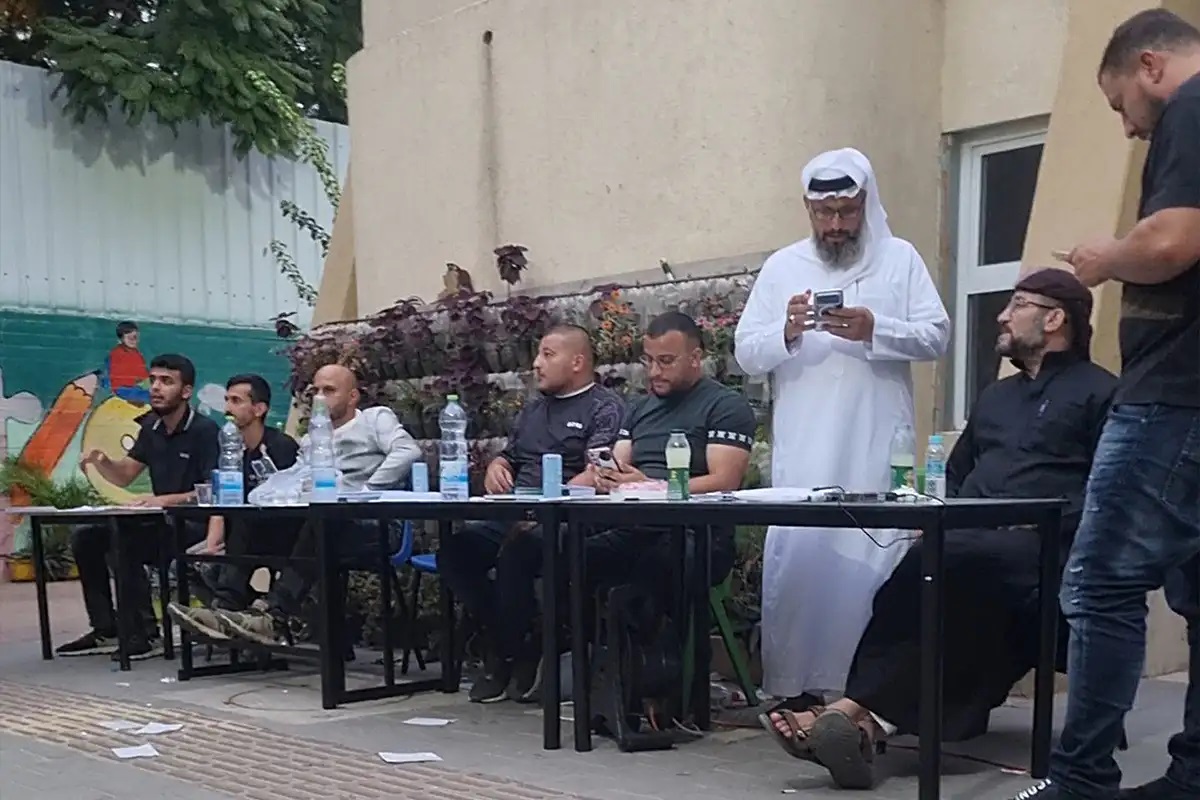 A table outside a polling station in Rahat. Photo: Courtesy of Ad Kan.
Part of the recording was published by “Ad Kan”, in which the conversation is heard, part of it is unclear. Here are excerpts from what we were able to decipher:
The usher : “It’s all a matter of budget. No problem. Do you want to go vote? How much does gas cost? A thousand shekels? He gives him a thousand shekels to vote for a person.”
D: “How did all these people come? Everyone who was here received vouchers.”
The usher : “No, it doesn’t work like that. In general, in the whole world, there is a person of principle and there is a person you can buy.”
D: “Are there any guys who are easy to buy?”
Dispatcher : “Exactly. And there’s no problem with that.”
The usher: “The partner. Yes. I distributed. Yesterday I distributed to people.”
“Ad Kan” found dozens of statuses on social media posted by Bedouins in the Negev with fuel cards intended for voters. Thrown fuel cards were documented at a gas station in Kiryat Gat, and a driver was documented driving with RAAM ballots and fuel cards. Another Bedouin went further and documented himself on Instagram with 100 shekels in his ballot box, and thanked RAAM MK Walid al-Huashla.
Under-the-table appWhat are the apps that are repeated in the descriptions? A screenshot of one of them, as recorded on election day at one of the polling stations, has reached us. It is an app called “Al-Mouwehda.” “Ad Kan” revealed that it ranked first in downloads in the “News” category near the elections. But we are publishing here for the first time that there was another app, called “Aswatcom,” which was used only by key activists in the GNA to manage votes and report on voters in real time.
The Google Store recorded more than 500 downloads of it. The app was created on September 15, about a month and a half before the elections, and it was updated up to two days before. The research department of the “Voters in Life” forum found that RAAM uses two apps. “Al-Muwaheda,” which is open to the general public, and in which it is apparently possible to find the serial number of voters, by entering an ID card, and the “Aswatcom” app (meaning: “Your Votes”) used by activists, which is adapted for monitoring millions of voters and was also developed with the help of the blue company, which has a branch in Ramallah.
This is how it is described: “This application is an internal tool that helps coordinators and those responsible at the election headquarters monitor the course of the elections and update the voting data of each voter, based on voter register data officially provided to the parties participating in the elections according to Israeli law. Legal clarification: This application does not represent a government entity […] This is an internal and private application of the RAAM Election Headquarters, used exclusively by the authorized work team.”
The use of the app is not prohibited per se, as long as it relies on monitoring information outside the polling stations. What was prohibited by the Elections Committee and upheld in the High Court ruling is reliance on data extracted by polling station workers. To what extent are these apps used illegally from inside the polling stations? The descriptions of attempts to actually extract data from inside the polling stations are intertwined with the complaints, but there is no way to verify the extent of the phenomenon.
The one who could supposedly check this is the Privacy Protection Authority at the Ministry of Justice, which announced that it would conduct an audit of surveillance application servers on election day, in order to enforce the ban on their use inside polling stations.
The third piece of the puzzle is the discovery of envelopes with tens of thousands of shekels, some with the Islamic Movement’s inscription, and RAAM envelopes and ballots, in the possession of party activists. Seven suspects were arrested in the case, all of whom were released, some with restrictions and some to house arrest. The main suspect’s detention was extended to eight days, and he was released on Wednesday afternoon. This is Ibrahim Al-Gharibi, the main suspect in the case, one of the two found in possession of RAAM banknotes, envelopes and ballots.
Al-Gharibi is already familiar to our devoted readers. He was featured in an article in “Israel This Week” published on Friday, four days before the elections. The person who interviewed him was Itay Illanai, who was sent to survey the Bedouin stronghold in the Negev. “Most of the signs here are green and white – the color of the United Arab List, RAAM,” Illanai describes. “The person who put up these signs is Ibrahim Al-Gharibi, 42, a father of four and the owner of the A.K.S. Traveling bus company. We meet him in his impressive office in Segev Shalom’s bustling industrial zone, and he pours us coffee in the best of tradition. He was born and lives in the unrecognized village of As-Sar […] Segev Shalom founded his business.”
Illanai describes that Al-Gharibi did not sleep in the months before the elections because he worked two jobs, as the manager of the bus company and as the election coordinator for the Ra’am in Segev Shalom and the surrounding area. Al-Gharibi told Illanai with a smile: “We intend to make it easier for people in the unrecognized villages to get to the polls. Here they will flock to the polls.” Days before the elections, Al-Gharibi was convinced that the voting rates in the Bedouin sector of the Negev would skyrocket, aiming for 90%. According to him, what motivates the people is the demolition of illegal structures without regulation, along with the failure to address crime in the Arab sector. Al-Gharibi described his assistance to the campaign of Mansour Abbas, who comes to the area almost every week. “He sat in the chair you are sitting in now,” he proudly told Illanai.
Terrorism under the auspices of charityMedia figures Raviv Drucker and Josh Breiner tried to downplay the status of the suspects in the affair and wrote that they were junior activists. RAAM itself, in a statement issued on election day, reported the arrest of three of its most prominent activists in the Negev. Al-Gharibi, the man in whose office Mansour Abbas sat, is not a junior activist. So is Dr. Saif Abu Riash. Anyone who tried to portray the doctor as a normative and innocent citizen made life easy for himself. Abu Riash is the deputy head of the Islamic Movement in Rahat and an ardent Islamist.
The research department of “Choose Life” found photos and videos on his Facebook and Instagram alongside Mansour Abbas, Yoav Segalovich, and MK Walid al-Huashla, the Bedouin representative in the RAAM. The doctor is not a junior. Moreover, Abu Riash was a major fundraiser for the “Aid 48” association, a subsidiary of the RAAM that was dissolved in 2025 by the Registrar of Associations following support for terrorist organizations and serious irregularities. We have previously published investigations on this association, whose annual activity reached tens of millions of shekels, showing how it collaborated with organizations that were defined as terrorist organizations, under the guise of humanitarian activity.
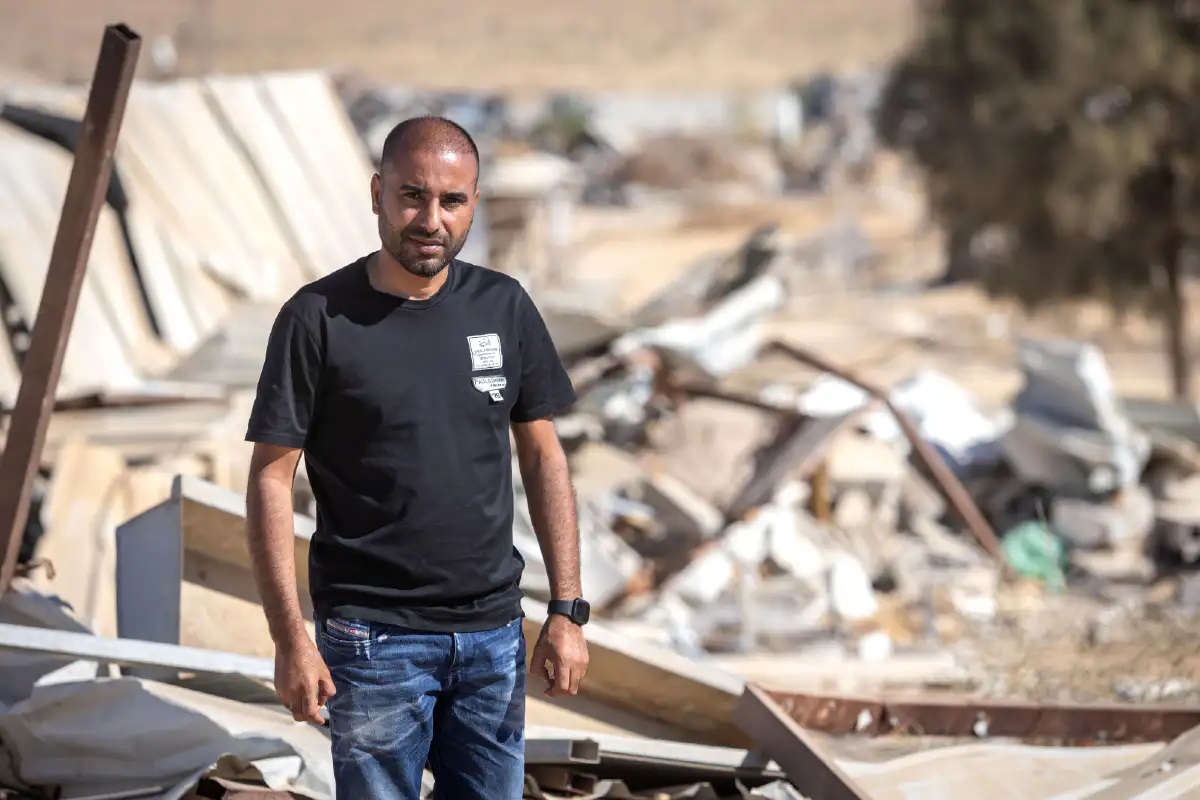 Ibrahim Al-Garibi in Segev Shalom, Photo: Arik Sultan
On Abu Riash’s Facebook, you can find posts supporting Hamas, such as a picture of Ismail Haniyeh, and a host of photos of banknotes and financial transfers for humanitarian activities in Syria and Gaza. All under the symbols of the same organization that collaborated with organizations that were defined as supporters of terrorism – “Aid 48.”
And if we are talking about RAAM’s non-profit organizations, we will note another important detail in parentheses here. Another subsidiary of RAAM, which was closed and dissolved with the approval of the Supreme Court, is “Humanitarian Actions.” It also starred in the investigations we published. This is a non-profit organization that forged ties to Hamas and operated in enemy countries. Sheikh Abdel Karim Masri, number 8 on RAAM’s list and someone who will automatically be sworn into the Israeli Knesset, was the chairman of the non-profit organization’s executive committee.
Elhanan Gruner of “The Jewish Voice” published this week that in February 2023, Masri signed a cooperation agreement with the CEO of the Turkish association “Hayat Yolo”. The two are also photographed together. This is an association affiliated with the Turkish terrorist organization IHH, an association that in March 2026 was imposed with economic sanctions by the US Treasury Department, which determined that it was part of Hamas’s international financing network. An internal Hamas document also showed that “Hayat Yolo” transferred resources directly to Hamas. All, as is customary in the Islamic movement, under the guise of charitable activity.
The three subsidiary associations of RAAM and the Islamic Movement were closed thanks to our investigations, those of other media outlets, and the activities of the research departments of “Bochmar Hayyim” and “Ad Kan.” Sadly, the affair was not properly handled on the criminal level, but only under the Registrar of Associations at the Ministry of Justice. In the summer of 2025, it was announced that the Shin Bet and the police had opened a criminal investigation into the affair, but nothing has been published since then and no one has been arrested.
On the eve of the elections, the Israeli media obsessively covered expressions of support by Sami Abu Shehadeh, chairman of Balad, for the October 7 massacre. It was a great smokescreen for those from the Palestinian Authority who talk nicely, but behind the scenes supported their activities in Hamas. Now, in the absence of investigation and enforcement, the same elements who headed associations suspected of supporting terrorism are smiling all the way to the Knesset in Jerusalem. Close the parentheses and return to the money envelope affair.
Still Jewish and democratic?It is important to note that no envelopes of money were found in Dr. Abu Riash’s possession at the time of his arrest. He was released, with the restriction that he not speak to other suspects in the case. The lawyers for the detainees claimed in court that this was a political arrest, and that the funds found were intended for charity.
The RAAM also claims that the affair is an attempt at political persecution of the Prime Minister. What strengthens their claim is the crooked manner in which the affair began. As Guy Peleg published, the information about the presence of funds in the hands of RAAM activists was transferred from the Prime Minister’s Office directly to the Police Commissioner’s Office. The quick arrest, a search conducted without a warrant, along with the echo of the arrest on election day itself by the Prime Minister, have tainted public confidence in the investigation. As of now, the investigation has not been exhausted. The suspects’ phones and computers have been taken and are being examined by the police. The continuation of the investigation, as long as it is carried out professionally without attempts to inflate or bury, could shed light on the question of whether the funds found were intended for election bribery.
“The truth is starting to come out and it is already clear that this is one of the most serious cases in Israeli history,” says Herzl Hajjaj, one of the heads of the “Voters for Life” forum of bereaved families and victims of terrorism: “We demand a comprehensive investigation of this entire affair. When hostile elements from home and abroad work to corrupt the elections, a threat is created to Israel as a Jewish and democratic state. I hope that the head of the Shin Bet will work to clarify the truth, despite all the pressure being exerted on him.” “Since election day, we have collected about 400 testimonies from people who worked at the polling stations, and they all tell the same story,” says Avichai Shorshan, CEO of Ad Kan.
“The tables outside, the envelopes, the fuel cards and the use of the app. When you see all of these together, you realize that there was an organized method here, precise planning and lots and lots of money.”
Neither the RAAM nor the Joint List responded to the allegations.
|
|
Boaz Bilt has admitted everything
That the prosecution service is dysfunctional. In short, tonight Bilt could join Otzma Yehudit, Religious Zionism or Likud. And in a very high position on the list. He said, word for word, what we have all been saying for years. The thing is, he is on the inside. He is one of the heads of the system. He works directly with Meir, the system’s chief administrator, and he is considered a man of the utmost integrity. Without meaning to, tonight he has become a “state witness” against the most violent criminal organization in Israel, mistakenly called the “State Attorney’s Office,” but which should actually be called the “Prosecution Service of Crime, Evil and Chaos.” 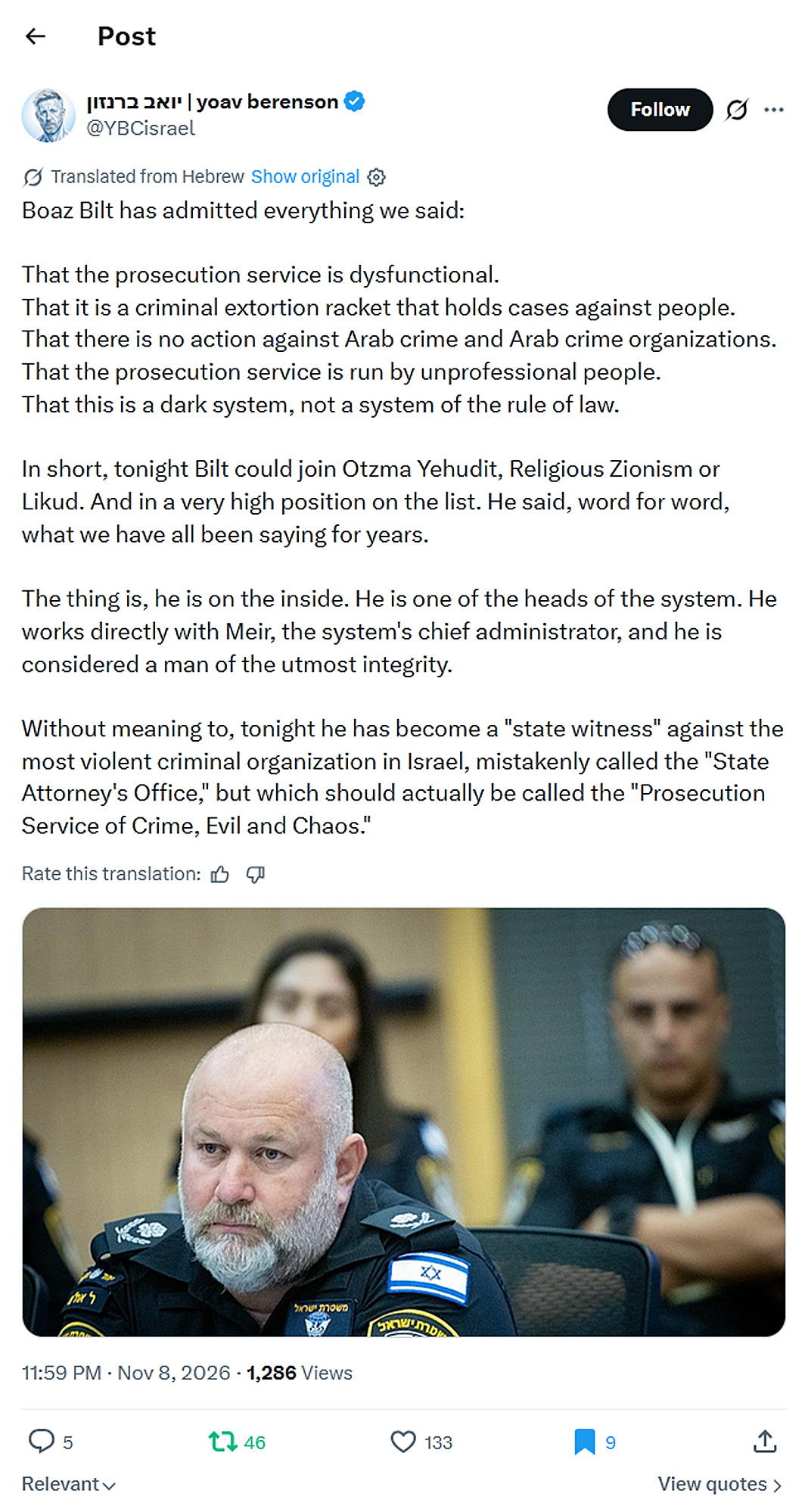 yoav berenson-tweet-8November2026-Boaz Bilt has admitted everything
News 14 | Cover-ups, obstruction and systematic concealment
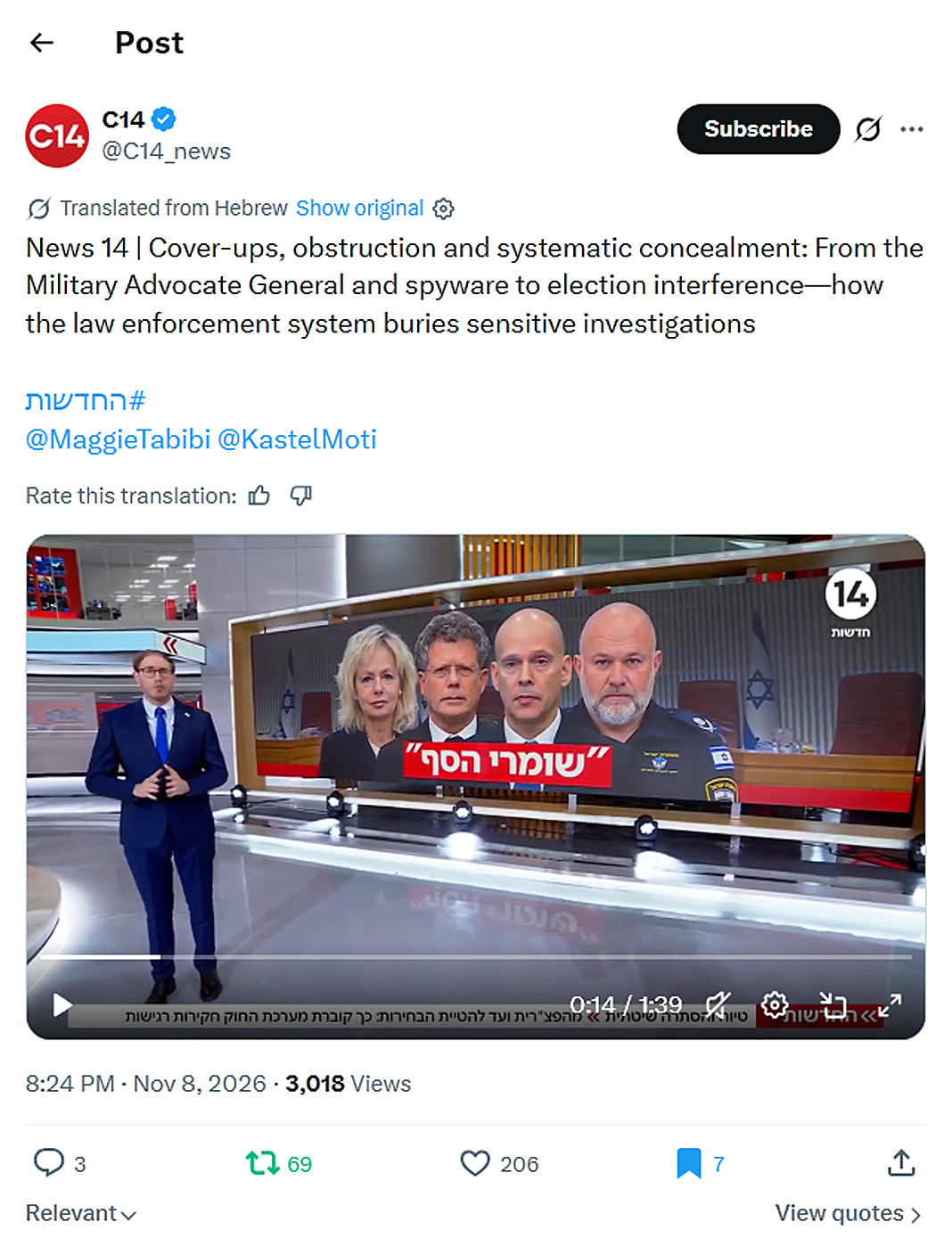 C14-tweet-8November2026-Cover-ups obstruction and systematic concealment
The State Attorney’s Office that Bilt describes belongs in East Germany’s Stasi
The disturbing recordings published by Amit Segal of the head of the Israel Police Investigations Division, Boaz Bilt, should keep every citizen in Israel awake at night. The head of the Investigations Division describes investigative methods that exist in dark regimes: “Any reasonable person understands that these are cases put on the shelf, pressure tactics used against people. You put them in a drawer and do nothing with them for a year, then after a year you take them out and conduct further investigation.” “The State Attorney’s Office in Israel deals with only one niche: public corruption. All the other things are as if they have nothing to do with them.” This is chilling testimony from within about the complete politicization of the law enforcement system. The supposedly “public corruption” cases are opened with great fanfare only against the right-wing camp, and then fall apart, as in the case of Prime Minister Netanyahu. The State Attorney’s Office keeps these cases to exert pressure and silence officials when necessary, in order to advance the deep state’s overarching goal—to bring down the right-wing government. The State Attorney’s Office that Bilt describes belongs in East Germany’s Stasi, not in the State of Israel, where there must be full equality before the rule of law. The State of Israel needs a thorough overhaul of the State Attorney’s Office and the police. Those who seek to repeal the reforms we have made are the ones helping to completely undermine Israeli democracy. 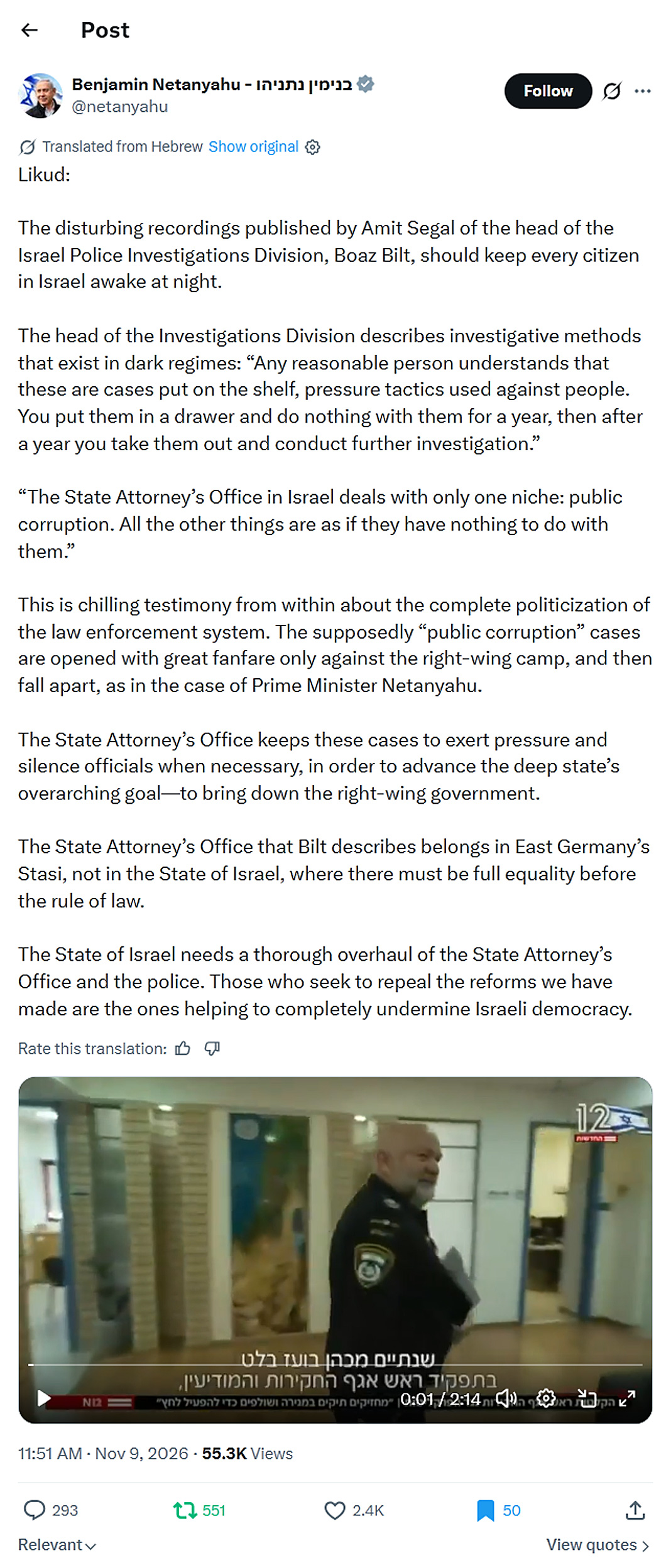 Benjamin Netanyahu-tweet-9November2026-state-attorney-stasi
|
|
Gali Baharav-Miara and the State Attorney’s Office are the poison pill that was introduced into Israeli democracy
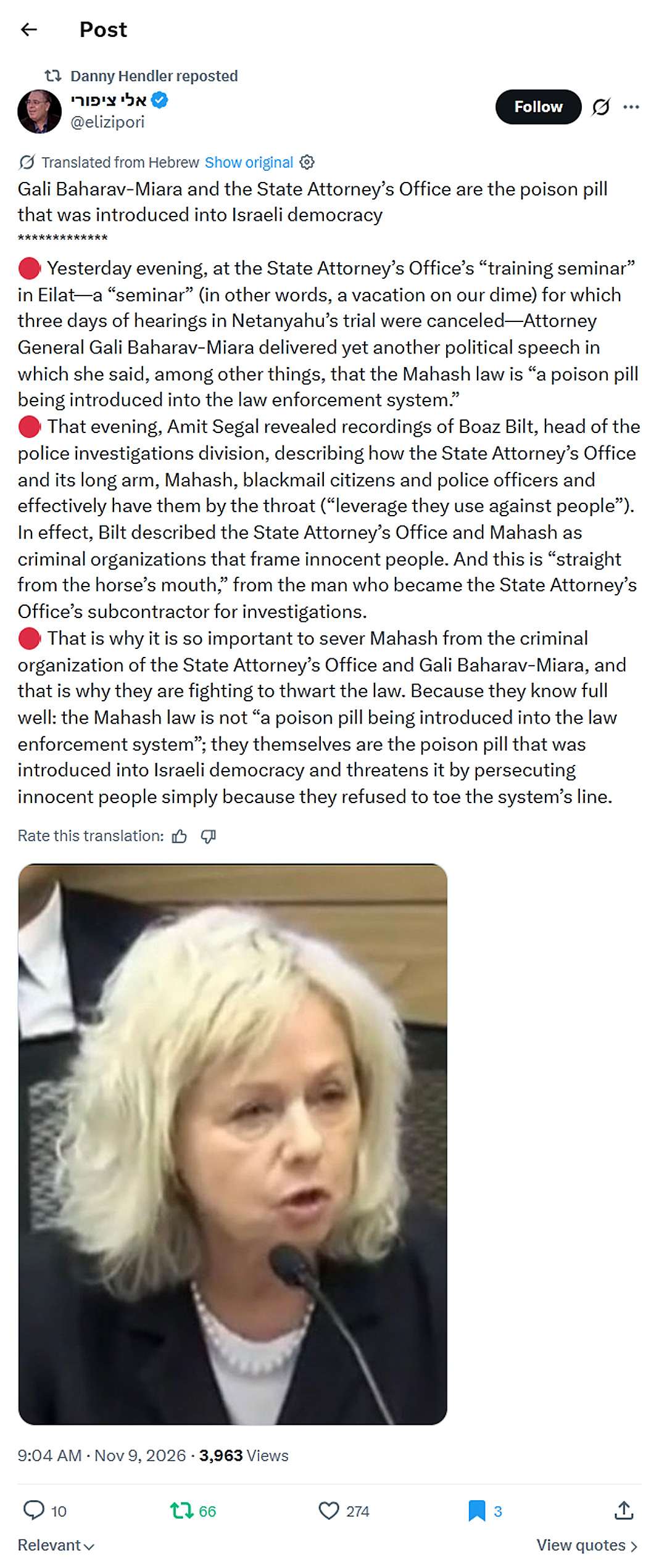 elizipori-tweet-9November2026-The poison pill of Israeli democracy
|