This post is about Israel’s Frenemies constantly complaining about Jerusalem, The “Two State Solution” and Whatever.Compare the size of New York City to Jerusalem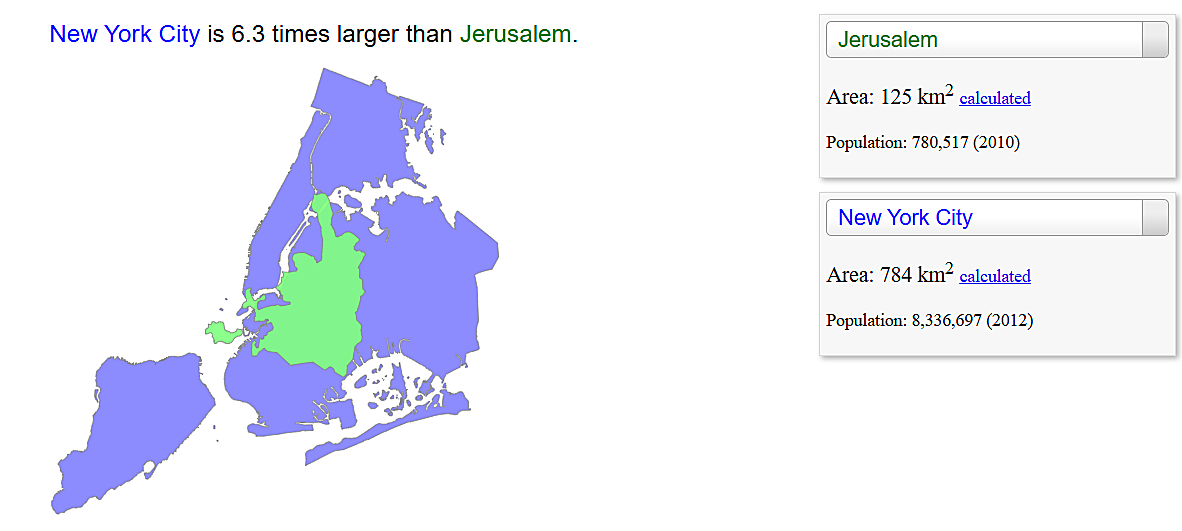 Compare the size of New York City to Jerusalem |
|
Israel’s Frenemies constantly complaining
|
Israel is at war
|
You know who Doesn’t Accuse Israel of Colonialism? ARCHAEOLOGISTS
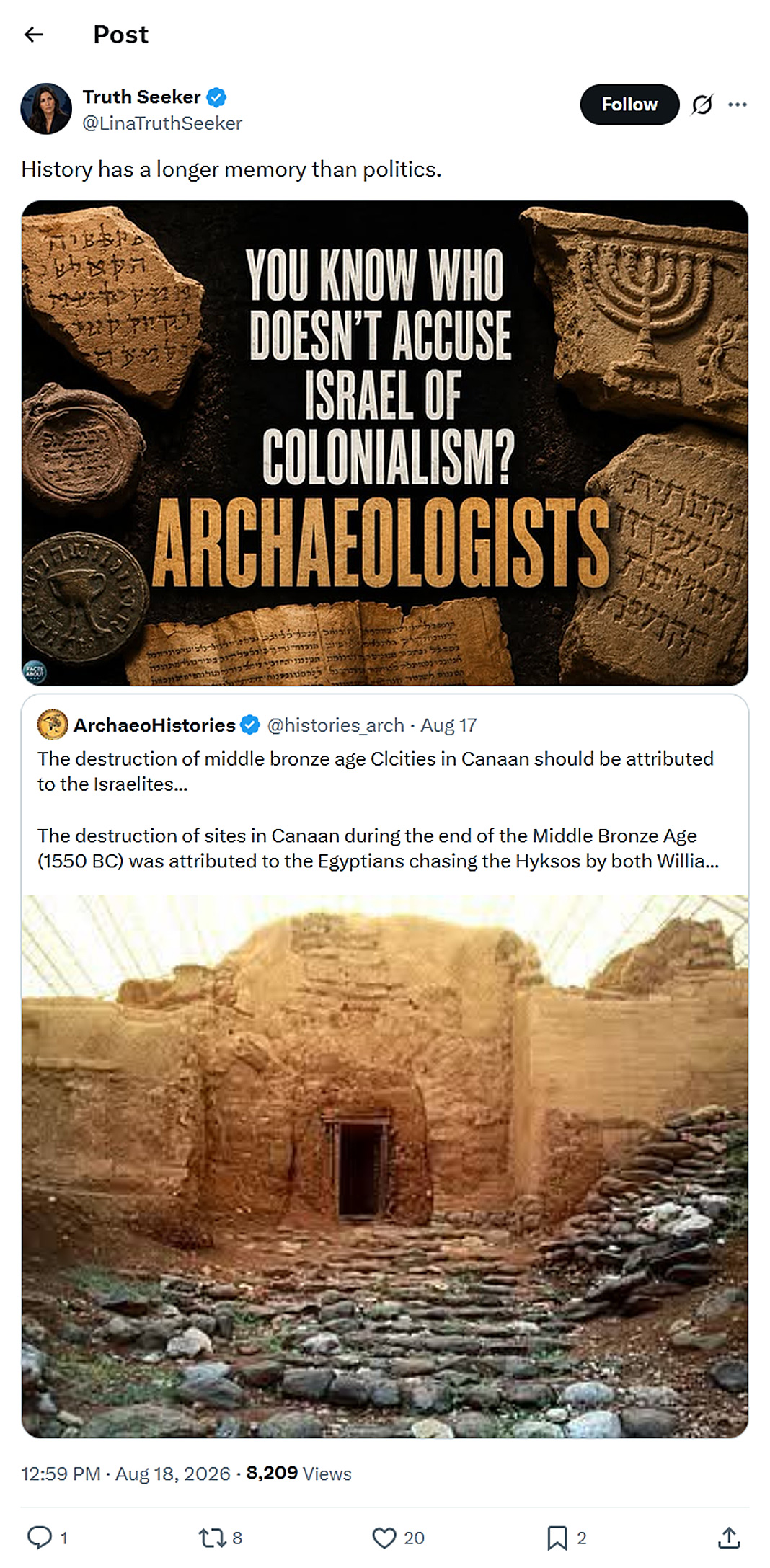 Truth Seeker-tweet-18August2026-ARCHAEOLOGISTS-know the Truth
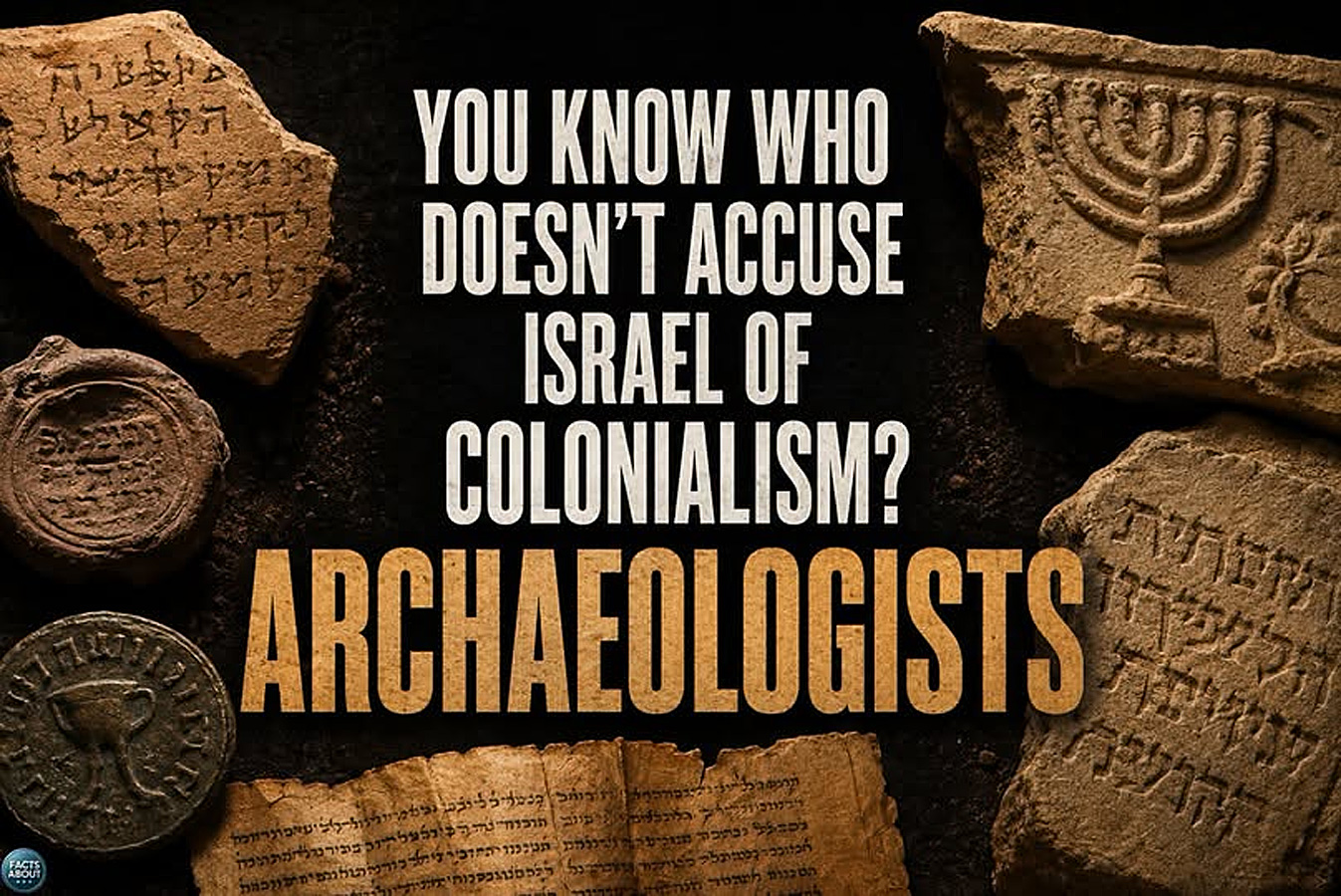 You know who Doesn’t Accuse Israel of Colonialism? ARCHAEOLOGISTS
|
|
Jerusalem and EI area boundaries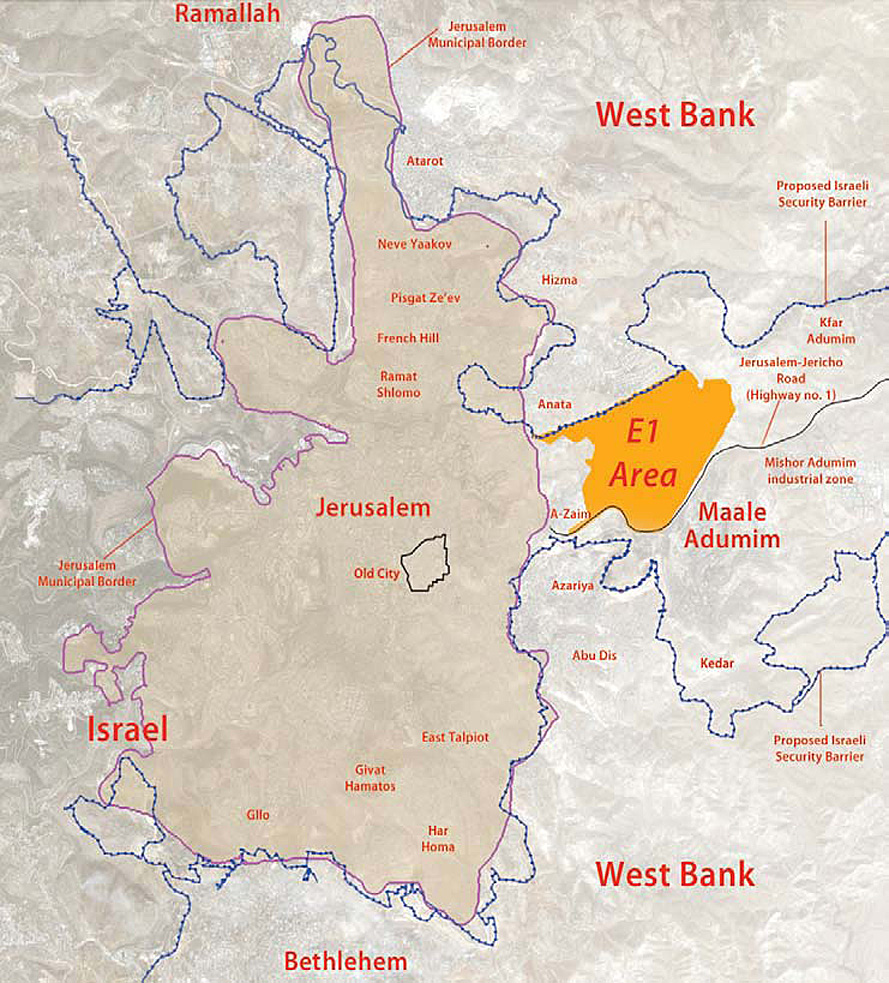 Jerusalem and EI area boundaries |
|
Israel’s Frenemies tried a Jerusalem building Freeze Jerusalem Center for Security and Foreign Affairs https://jcfa.org The End of Building Freezes in the Jerusalem AreaConstruction plans approved in E-1 and Givat Hamatos areasNadav Shragai 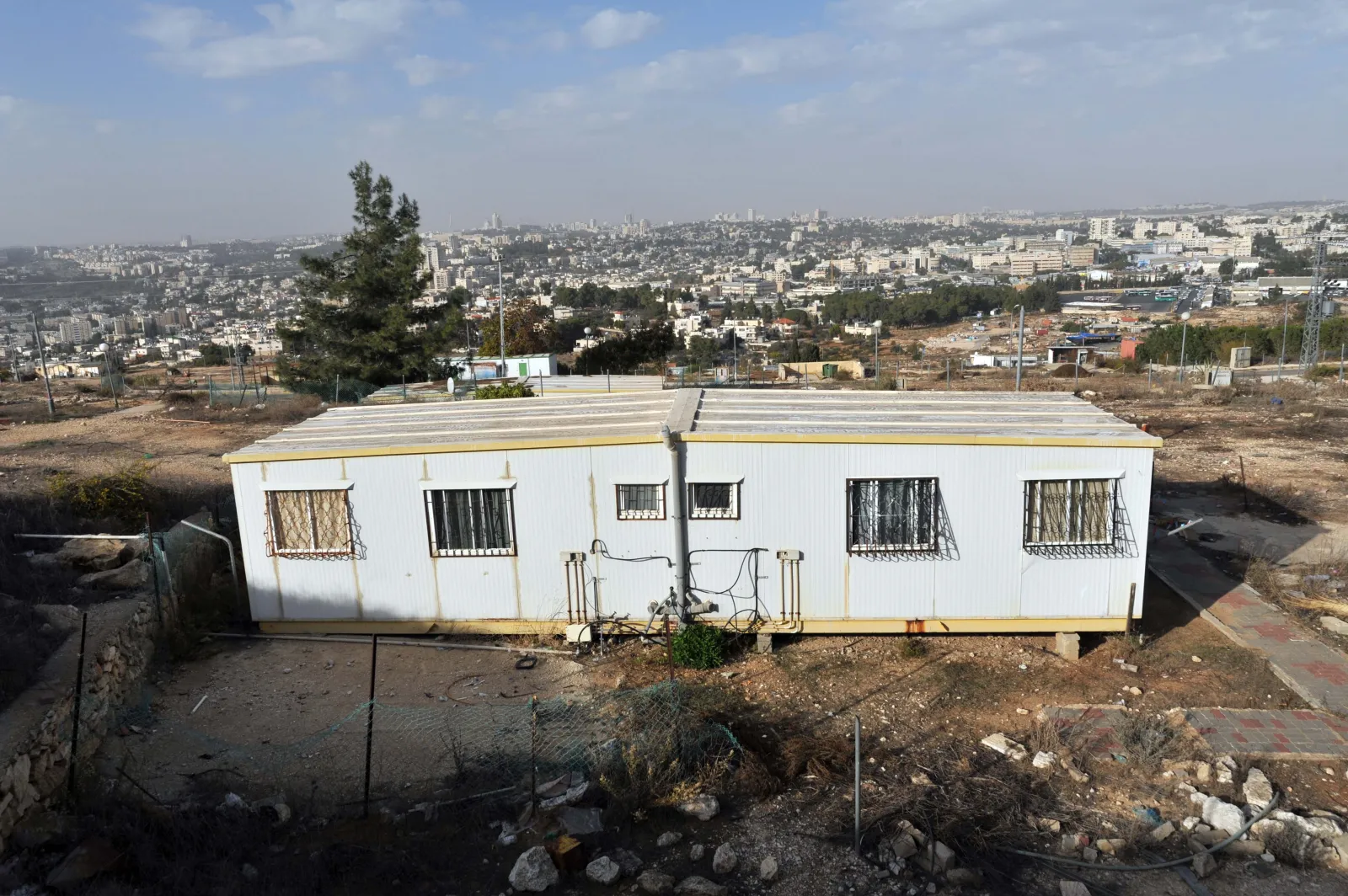 Givat Hamatos (The Israel Project, CC-BY-SA-2.0) There are two strategic building plans for Jerusalem. Givat Hamatos, which is only 300 meters from the Green Line, will prevent the possibility of a wedge dividing Jerusalem from the south.
E-1, between Maaleh Adumim and Jerusalem and as part of Greater Jerusalem, will strengthen the Israeli-planned east-west contiguity to the Dead Sea and perhaps stymie north-south Palestinian territorial contiguity.
Good News for JerusalemJust days before Israel’s latest elections, Prime Minister Benjamin Netanyahu decided to end the construction freeze on two neighborhoods of strategic importance to Jerusalem, where construction was frozen for many years. The first is in Givat Hamatos, where tenders for the construction of 1,077 housing units were issued on February 24, 2020, by the Israel Land Authority. Construction in Givat Hamatos has been frozen for seven years. The second neighborhood is the “E-1” neighborhood, between Maaleh Adumim and Jerusalem, where Prime Minister Netanyahu announced that a plan to build 3,500 housing units would be issued for public review. E-1 construction has been frozen for 15 years. These are two brand new neighborhoods. In Givat Hamatos, a trailer site had been built for new immigrants from Ethiopia. Infrastructure has already been established in E-1: roads, sewage system, water, electricity, and a police station.
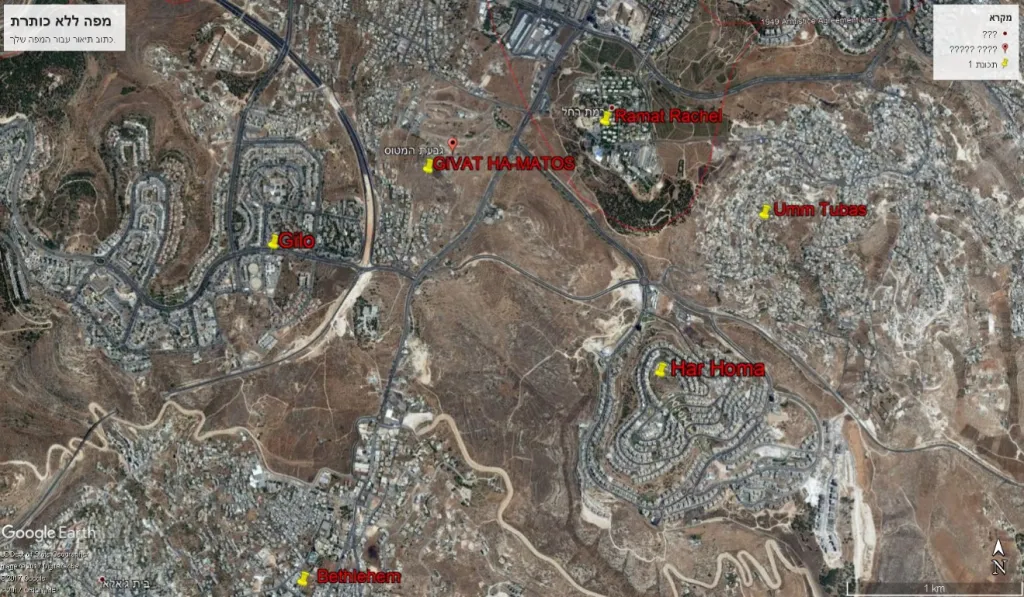 Note Givat Hamatos’ undeveloped location between the Israeli neighborhoods of Gilo, Har Homa, and Ramat Rachel. (Google Earth) Note Givat Hamatos’ undeveloped location between the Israeli neighborhoods of Gilo, Har Homa, and Ramat Rachel. (Google Earth) Construction Freeze during the Obama EraThe plan for the construction in southern Jerusalem of the Jewish residential neighborhood in Givat Hamatos was approved by the District Planning and Building Committee of the Jerusalem Area as already in 2014 but has since been frozen. Pressured by the United States, Germany, and other countries in the EU, the publication of tenders for construction has been delayed time and time again. This is a strategically significant construction program, which lies along the Green Line (but outside it), 300 meters from the Talpiot industrial area and adjacent to Hebron Road, a major traffic artery in what the world calls: “West Jerusalem.”
From the Israeli point of view, the construction of Givat Hamatos is one of the keys to preventing the division of Jerusalem from the south, which will prevent a Palestinian wedge that will block the long-planned Israeli contiguity between the Gilo and Har Homa neighborhoods on the southern border of Jerusalem. [See map 1.] In October 2017, a drilling operation for sampling the land began on the site, with the intention of starting and implementing the construction plans, but under pressure from the United States (during the Obama administration) and Germany, the move was frozen again.
From the Palestinian perspective, the construction freeze on Givat Hamatos is the key to preserving the option of an urban connection, and in the future, a political one, between Bethlehem and Beit Safafa, an Arab neighborhood in south Jerusalem. According to the Palestinians, such contiguity will form part of the Palestinian urban fabric, which in the future will form the territories of East Jerusalem, “the future Palestinian state capital.”
At the Annapolis Conference (2007), the Palestinians proposed an exchange of land with Israel, which included the continued existence of all major Jewish neighborhoods in east Jerusalem, including the Jewish Quarter, except for Har Homa and Givat Hamatos, which they demanded Israel evacuate.
Givat Hamatos is one of the last land reserves (apart from Atarot) available for construction for Jews under Jerusalem jurisdiction. Some 2,610 housing units are planned for the Jewish population.
Nearby, at Beit Safafa, increased density of built-up areas on private land was approved for the Arab neighborhood, (600-900 housing units), mainly by increasing the percentage of construction on the site instead of crowding in more buildings. This area, too – according to Prime Minister Netanyahu’s announcement – is now permitted for construction.
The plan for the construction of the Jewish neighborhood of Givat Hamatos is a direct continuation of the establishment of 12 large Jewish neighborhoods built since 1967 in the territories attached to united Jerusalem. The establishment of these neighborhoods is aimed at preventing the city’s division again while simultaneously preserving the Jewish majority in Jerusalem. The establishment of Jewish neighborhoods in the many empty areas annexed to Jerusalem, neighborhoods where today there are approximately 215,000 Jews, is intended to secure, both by territory and demography, the Jewish majority in Jerusalem and prevent the possibility of re-division.
E1: Part of “Greater Jerusalem”The “E-1” construction building plan is also very important for Jerusalem. 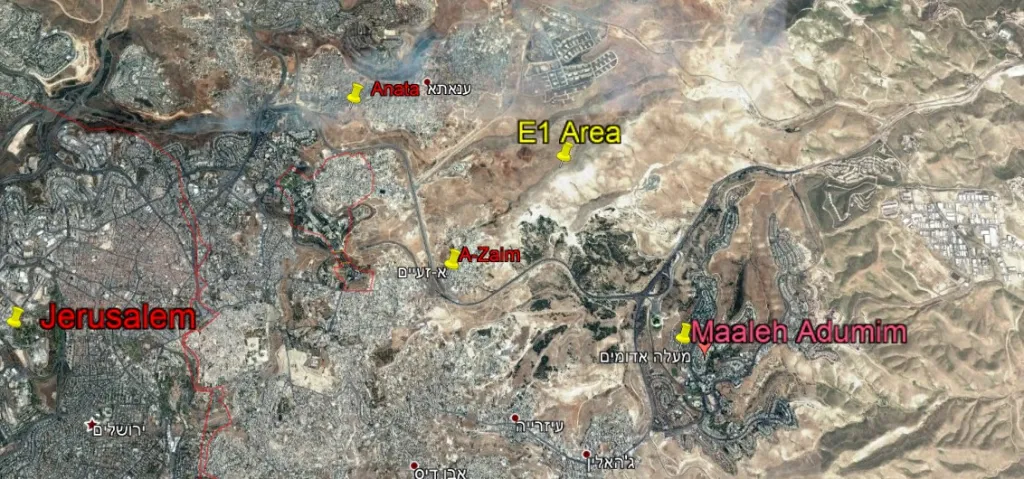 The “E-1” construction building plan Area Map
It covers an area of about 12,000 dunams, mostly state land, north and west of the Jerusalem-Maaleh Adumim road. The planners, based in the planning offices of the Israeli Ministry of Housing, sought to connect Maaleh Adumim – a city that was established east of Jerusalem some 45 years ago, which now has about 48,000 residents – with the Mount Scopus neighborhood under Jerusalem jurisdiction. All Israeli governments, from the time of Yitzhak Rabin to today, have supported the plan, with the understanding that Israeli urban contiguity between Maaleh Adumim and Jerusalem must be sought. This concept is part of the view of Jerusalem and its surrounding Jewish communities as one metropolitan area, known as “Greater Jerusalem.” The center of the E-1 plan is the construction of 3,500 housing units, a commercial area, and a hotel area.
For years, the plan has been severely disputed by the Palestinians’ position, which seeks to prevent what they call “dismemberment of the West Bank and the prevention of Palestinian and urban sovereign contiguity between northern and southern West Bank.” During the Obama administration, the United States sided with the Palestinian position and prevented Israel from building on the site, as long as a final settlement was not formulated.
Contest for ContiguityThe Israeli interest is to establish E-1, while the international community, and in particular, the EU, all seek to block it. They seek free north-south passage for the Palestinians. Israel seeks to create contiguity between the west (Jerusalem) and the east (Maaleh Adumim on the way to the Dead Sea) as part of a Jewish security belt around Jerusalem. Israel is very concerned about Palestinian attempts to impose a separation between Maaleh Adumim and Jerusalem. The concern also extends to a Palestinian construction belt surrounding Jerusalem from the east from which they could launch attacks against Jerusalem; this would return Jerusalem to a state of a “city on the border” (as it was on the eve of the Six-Day War) in a way that would block the possibility of the city’s development eastward. This would create a threat to the Jerusalem-Jericho Road, where Palestinian construction is already encroaching. This road is a major artery of paramount strategic security importance for Israel to transport troops east to the Jordan Valley and then north in the event of war. 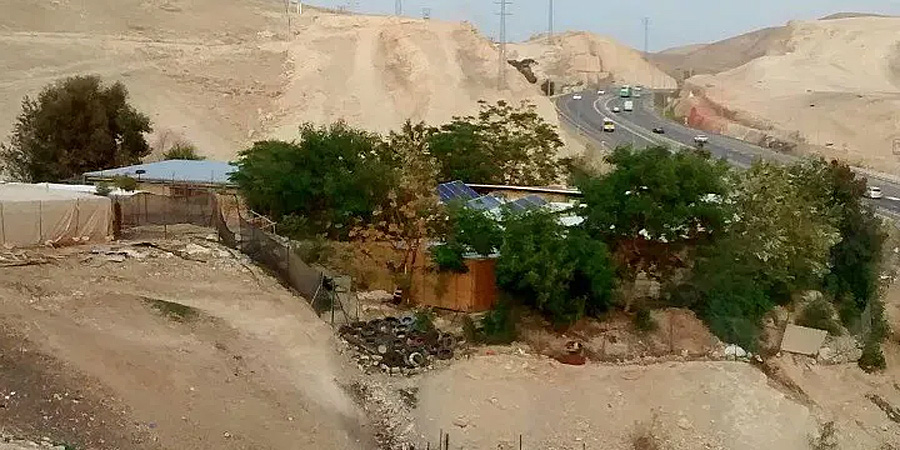 Illegal buildings in Khan al-Ahmar along the east-west road to the Jordan Valley. (Wikimedia Commons)
In Israel, there has been an almost total consensus for years about the need to connect Maaleh Adumim to Jerusalem through the construction of E-1 and, in the future, to apply Israeli sovereignty to this area as part of Israel’s permanent borders. Six prime ministers, from Rabin to Olmert, have publicly pledged to build E-1, but with the exception of the construction of the District Police Station in this area, the building has not begun, due to U.S. resistance.
The years that have passed since the initial stages of the program were approved (23 years ago) have resulted in its collapse. Migrant Bedouin tribes and illegal Palestinian construction have reduced the area available for construction. This phenomenon also narrowed the corridor towards Jerusalem, where the main arterial road passes between Jerusalem and Maaleh Adumim and the Jordan Valley. The corridor, originally about two kilometers wide, has been reduced to only one kilometer wide. The route of the separation fence in the Jerusalem area includes Area E-1.
Maaleh Adumim and E-1: The Heart of the Israeli ConsensusA study published in 2009 by the Jerusalem Center for Public Affairs on the importance and implications of the E-1 plan, written by this author, included statements by Israeli public figures showing just how broad the consensus was on this building plan. Here are some of the statements:
In a video by the municipality of Maaleh Adumim, key personalities have been recorded over the years as they declare allegiance to Maaleh Adumim and to E-1 and explained its importance: Among the speakers:
|
|

Revealed Preference: Countries Accusing Israel of Genocide Don’t Believe It — They’re Helping Israeli Arms Sales Break RecordsStates accusing Israel of genocide continue to entrust their own national security to Israeli weapons, revealing their preferences and true beliefs.By Ben M. Freeman 31August2026 https://honestreporting.com/revealed-preference-countries-accusing-israel-of-genocide-dont-believe-it-theyre-helping-israeli-arms-sales-break-records/  HonestReporting-The-Governments-Condemning-Israel-Are-Buying-Its-Weapons
Key Takeaways
This week, Greece signed the largest defense export contract in Israel’s history. The deal is worth $3.6 billion. It buys Greece an air defense network built by Rafael and Israel Aerospace Industries: David’s Sling to stop ballistic missiles, mobile SPYDER batteries to be stationed on the Greek islands, the Barak MX system, and a national command center modeled on Israel’s own. The Greeks have given it a name. They are calling it Achilles’ Shield.
Five months earlier, Greece bought $750 million of Elbit rocket artillery, and at the time that was the largest deal Israel had ever signed. It held the record until this week.
In between those two signatures, the Greek Prime Minister stood at the United Nations General Assembly and said that no military target, however valuable, could justify the death of thousands of children and the forced displacement of a million Palestinians. Greece sat on the Security Council and put its name to a statement declaring that the use of starvation as a weapon of war is prohibited under international humanitarian law. Greek officials briefed their own press that the Israeli contracts were being slowed down because of how they looked while Gaza burned. Then they signed them.
These purchases show a revealed preference, indicating that the rhetoric about “genocide” isn’t believed by the politicians that utter the accusations. Buying weapons from a state one publicly brands as criminal or atrocious is not how governments behave when they actually believe the charge. If they actually believed the allegations, they would not support the Israeli defense industry. The trust that they place in Israel is indicative of a belief that the state is not actually immoral or criminal.
The ArrangementAcross Europe and Latin America, government after government has accused Israel of genocide, or of war crimes, or of crimes against humanity. Some have gone to the International Court of Justice. Some have severed relations. Some have passed laws with the word “genocide” written into the title. And in the same months, in some cases in the same weeks, those same governments have been buying Israeli weapons.
Israeli defense exports reached a record $19.2 billion in 2025. That was the fifth consecutive record year. It happened during the period of maximum condemnation, when Israel was being called a genocidal state in parliaments across the democratic world. Europe took the largest share of those exports: thirty-six percent.
FinlandTwo days ago, Finland’s public broadcaster revealed that the Finnish Ministry of Defense had quietly locked in a decade of military cooperation with Israel. Finland proposed the extension itself, in early 2024, and asked for ten years rather than the customary five. It runs to 2034. It covers research, development ,and the procurement of defense materiel. The ministry never announced it. It was approved by written exchange, and unlike the previous renewal it was not sent to the Foreign Ministry for assessment.
Early 2024 is after October 7th, after the invasion of Gaza began, after South Africa had filed at the International Court of Justice, and in the months when the accusation of genocide had become a defining feature of European politics.
Finland bought the David’s Sling system in a contract signed on 12 November 2023, five weeks into the war, for around €317 million. Finland was the first export customer for that system in the world. Over the past decade the Finns have bought more than €800 million of Israeli equipment, and this May they hosted thirty-two Israeli defense companies at a seminar in Helsinki. When the Finnish parliament was handed a citizens’ initiative signed by more than fifty thousand people, asking only that Finnish arms purchases be assessed against international humanitarian law, the defense committee recommended rejection and the parliament followed suit. Last week Finland announced it is ending its funding for UNRWA.
And what does Finland say about Israel? The Foreign Minister, Elina Valtonen, was asked on live television what Israel’s conduct in Gaza could be if not genocide. She answered: “Well, quite so.” She has said, of allegations of Israeli forces killing Palestinians seeking food, that if this is not a war crime she does not know what is. The President has called Gaza a man-made famine and that it was shameful.
Her government has never made allegations of genocide its official position. The Finnish cabinet has not said the word. What the Finnish cabinet has done is say everything short of it, in public, repeatedly, while doubling the length of its arms relationship with Israel in private.
The Finnish Defense Minister’s explanation, when the story broke, was that Finland has cooperation documents with forty countries and Israel has long been one of them. Nothing dramatic. Standard practice.
SpainSpain is the case where the contradiction is written into law. In September 2025 Pedro Sánchez announced a package of measures and his own office titled the announcement “measures against the genocide in Gaza.” The decree that followed carries the word genocidio in its statutory title. It bans the export, import and transit of defense material to and from Israel. Spain had already intervened at the International Court of Justice.
Six months later, a Spanish audit found that not a single contract awarded to an Israeli company or its Spanish subsidiaries had actually been canceled, and that €1.208 billion of them remained in force. The ministry had deleted thirty-five contract announcements from its website. Deleting the announcement is not canceling the contract. The decree itself contains a clause permitting the cabinet to authorize transfers anyway, where a ban would harm the general national interest.<
So the Spanish position, stated plainly, is this: Israel is committing genocide, this is the gravest crime in the international legal order, and Spain will continue to buy Israeli missiles where the national interest requires it.
The OthersColombia’s President Gustavo Petro did not merely criticize Israel’s conduct in Gaza. His government intervened in South Africa’s genocide case at the International Court of Justice, and on 1 May 2024 he announced that Colombia would sever diplomatic relations with Israel, describing its government as genocidal. Nine months later, his air force signed a renewed contract with Israel Aerospace Industries to maintain its Kfir fighter fleet, confirmed on the record by the air force chief. Colombia’s jets are Israeli. They do not fly without Israeli engineers. The government was prepared to break relations with Israel over genocide, but not to let its own air force lose the Israeli support on which it depended.
Denmark’s Prime Minister Mette Frederiksen said in June 2025 that Israel had crossed a line in Gaza and backed sanctions against it. By September, Denmark was telling the Security Council of starving children, famine and suffering on an “unprecedented scale,” while insisting that Israel comply with international humanitarian law. Yet that same month Denmark approved another 1.5 billion kroner to bring its Israeli-supplied rocket artillery to full operational capability. The government was arguing that Israel should face international pressure for the way it was waging war while spending another 1.5 billion kroner on Israeli technology to strengthen Denmark’s ability to wage one.
Belgium went further still. In December 2025, it formally intervened in South Africa’s genocide case against Israel at the International Court of Justice. Its army had already bought, after October 2023, more than a hundred tonnes of ammunition from an Elbit-owned manufacturer, along with components from Rafael and maintenance from Israel Aerospace Industries. Belgium’s Defense Minister explained the contradiction with a candor his colleagues elsewhere lack. There are no sanctions against Israel, he said. Israel is a very important trading partner.
What the Purchases Prove?These arrangements are fundamentally built on trust. When Greece puts Israeli interceptors on its islands and an Israeli-modeled command center at the top of its military, it is handing the lives of Greek citizens to Israeli engineering, Israeli software, Israeli spare parts and an Israeli supply chain that has to hold in a crisis. Finland did the same thing while sharing a border of more than thirteen hundred kilometers with Russia. That is not a transaction you enter into with a state you believe to be exterminating a people. It is a transaction you enter into with a state you trust more than almost any other, and whose competence you rate above the alternatives.
The comparison that makes it most clear is Russia. When Europe concluded that Russia was a criminal state, Europe did not wait for a ruling from The Hague. It sanctioned, expelled, seized, rearmed, and closed its borders. Finland shut its frontier. Nobody in Helsinki argued that the Foreign Ministry should decline to characterize the invasion of Ukraine until a court had pronounced. And no European government has spent the years since asking Russia to sell its interceptors.
What it Costs?My objection is what the double posture does to the word. “Genocide” is not a rhetorical intensifier. It was built during the Shoah to name the worst thing human beings do to one another, and it was built substantially by a Jewish lawyer who lost his family to it. When a government uses that word, or stands beside it, or lets its parliament and its press carry it, and then signs a decade-long arms partnership with the accused, it tells us the word was never a finding. It was a tool. It cost nothing to pick up, it bought a week of domestic peace, and it was put down when a contract needed signing.
The accusation does not evaporate when the trade press moves on. It settles into the culture. It has become the common sense of the age. It is repeated in lecture halls and on placards and outside synagogues, by people who did not read the decree and do not know about the Kfir maintenance contract, and who have simply been told by their own leaders that the Jewish state is genocidal. Jews in Helsinki, Madrid, Athens and Brussels are then made to answer for it, in their streets, at their workplaces, at the doors of their own communal buildings. They are asked to answer for a charge their governments do not believe strongly enough to forgo an air defense system.
This is not an argument against criticism of Israel. Criticism of any government is legitimate, and Israel’s is no exception. Israelis themselves do it more fiercely than any foreign ministry. The point is that the gravest accusation in international law has been taken up by governments that do not act as though they believe it. They know Israel is not committing genocide. They are betting their cities on it.
Liked this article? Follow HonestReporting on Twitter, Facebook, Instagram and TikTok to see even more posts and videos debunking news bias and smears, as well as other content explaining what’s really going on in Israel and the region. Get updates direct to your phone. Join our WhatsApp and Telegram channels!
© Divuach Ne’eman R”A, 2025
|
|
Who Pays the Price for the UK’s Potential Settlement Trade Ban?The UK might impose a trade ban on goods produced in Israeli settlements, but the consequences would go beyond its intended target.By Sharon Levy 02September2026 https://honestreporting.com/who-pays-the-price-for-the-uks-potential-settlement-trade-ban/
Key Takeaways:
When UK Foreign Secretary Ed Miliband announced a “comprehensive reset” of the UK’s approach on Israeli settlements in the West Bank, the decision came amid growing international attention over the zoning tender for the E1 area of the West Bank, which moved forward a long-delayed plan for construction between Jerusalem and Ma’ale Adumim. Among the measures the UK is looking to impose is implementing a ban on trade in goods produced in Israeli settlements.
The international community, and the activists who call themselves pro-Palestinian, celebrated the potential of the new policies to supposedly disrupt the process of building on E1 and, in turn, advance the prospects of a two-state solution.
The question of who these new measures would actually help or harm has been almost entirely left out of the picture. Such blanket bans on trade with Israeli settlements could have consequences extending well beyond the settlements themselves.
Against a UK Israeli Settlement Boycott: Recommended Reading
Within Israel, products are not explicitly labeled as to whether they are sourced from the West Bank or a community elsewhere in Israel, meaning that blanket restrictions on goods specifically produced in settlements are almost impossible to execute. A product manufactured in an Israeli settlement can enter the same domestic supply chains as a product manufactured elsewhere in Israel, with both ultimately being exported through the same ports, distributors and retailers.
Some products have warehouses or offices in both the West Bank and within Israel’s internationally recognized borders, making the process all the more complicated. In this case, boycotting an office or warehouse exclusively in the West Bank cannot be implemented without impacting the second office elsewhere in Israel.
In practice, this might mean Israel in its entirety could be subject to UK trade restrictions, as neither Israel nor the UK would be identifying which products come from where.
Beyond the challenges of singling out goods from the West Bank for boycott, it is impossible to ignore who would be negatively impacted by such a trade ban. Prior to October 7, 2023, roughly 165,000 Palestinians worked in Israel and the West Bank. While that number has decreased in the years following, a trade ban would have significant potential negative ramifications on Palestinian workers.
This isn’t purely theoretical. When, in 2014, SodaStream was boycotted for the location of its manufacturing plant in the community of Ma’ale Adumim in the West Bank, the vast majority of those impacted were Palestinian employees. After the production plant was moved to the Negev desert following international pressure, 500 Palestinian workers lost their jobs – jobs which provide higher wages than average in the West Bank alongside employment benefits.
But the potential consequences do not end within the borders of Israel. A settlement trade ban could also have implications for British Jews, particularly if restrictions on settlement goods contribute to a broader environment in which Israeli products, businesses or institutions become increasingly subject to boycotts.
We share concerns about settler violence and extremism. However, there is a deeply troubling question of why Israel is being singled out for this form of economic action. If the government proceeds with this approach, it would be the latest in a series of punitive acts taken towards a supposed ally of this country. The harsh reality is none of these actions have had any influence on the situation on the ground. As Israel approaches pivotal elections on 27th October, we urge the government to carefully consider that the only impact of further interventions will be to embolden extremist factions within Israel. We also urge the government to consider the unintended consequences for our community of the proposals that are being considered. These include the risk of harming the legitimate connection between British Jews and places of great religious, cultural and historic significance, including the Western Wall, Judaism’s holiest site. Broad, untargeted measures may inadvertently become a wider boycott of Israel, giving legitimacy to those who reject Israel’s very existence, and placing increased scrutiny on British Jews at a time when antisemitism in the UK is more prevalent and more violent than ever. 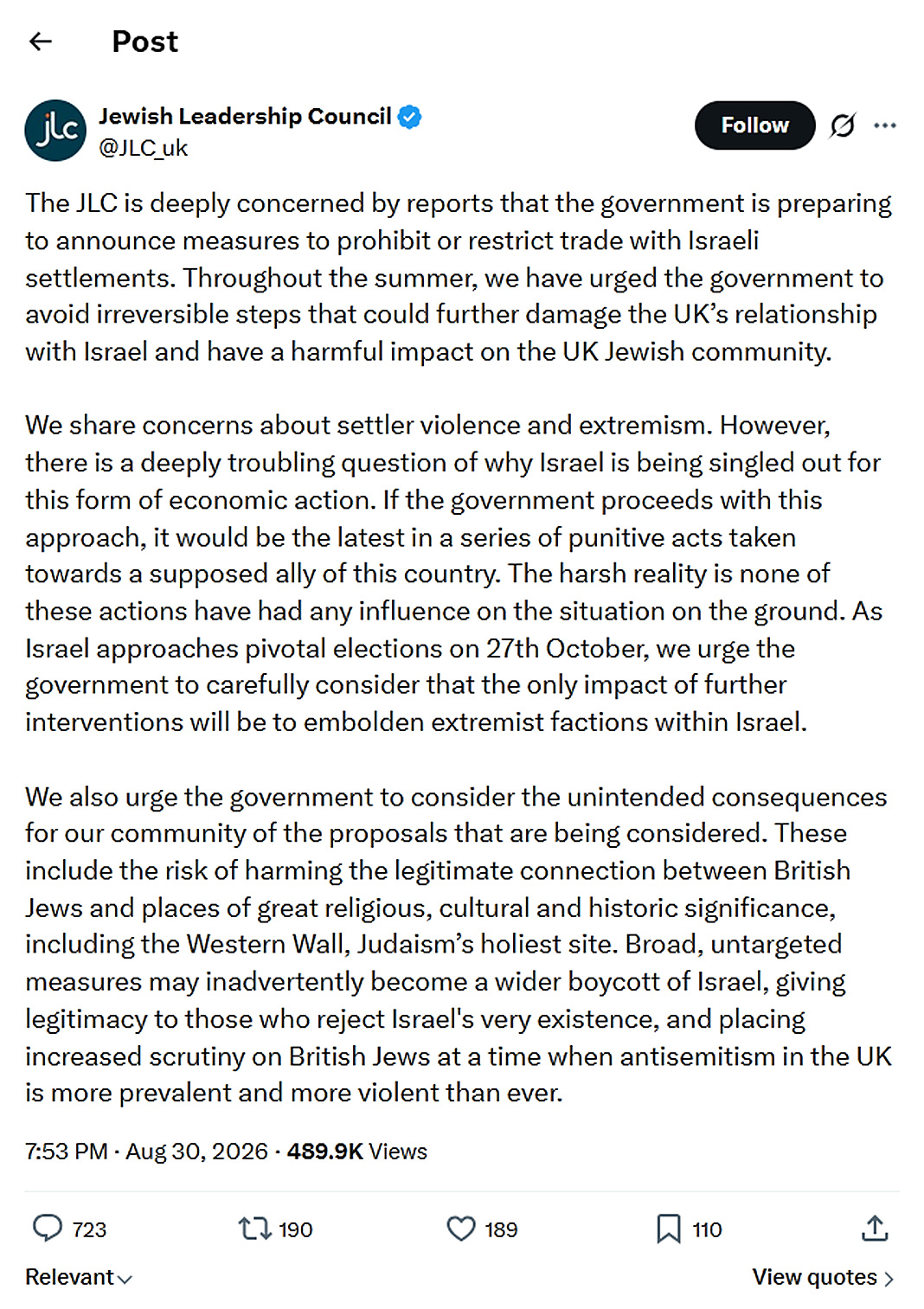 Jewish Leadership Council-tweet-30August2026-The JLC is deeply concerned
The Board of Deputies of British Jews and the Jewish Leadership Council warned that such a boycott could further damage UK-Israel relations and risk creating an even more hostile environment towards British Jews.
If a ban on trade in Israeli settlements goes through, the consequences will undoubtedly be far-reaching. From impacting the very people that the ban is supposedly meant to help, to hurting Jews outside of Israel, the ban would prove to do more harm than good.
These results are not difficult to foresee, making the decision to pursue it driven by policies of activism and double standards. A policy this disingenuous doesn’t advance peace, but it does advance the warped anti-Israel hatred that has too frequently presented itself as genuine concern for Palestinian rights.
Liked this article? Follow HonestReporting on Twitter, Facebook, Instagram and TikTok to see even more posts and videos debunking news bias and smears, as well as other content explaining what’s really going on in Israel and the region. Get updates direct to your phone. Join our WhatsApp and Telegram channels!
© Divuach Ne’eman R”A, 2025
|
|

European powers condemn Israel’s E1 construction plans in Judea, UK threatens sanctionsAll Israel News Staff | Published: 21August2026
France, the United Kingdom, Italy and Germany on Thursday jointly condemned the Israeli government’s plans to advance construction in the E1 area of Judea and Samaria, internationally known as the West Bank.
“The decision by the Israeli government to publish bid offers for construction projects within the framework of the E1 settlers’ project is unacceptable,” the four European powers said in a joint statement. The condemnation came after Israel announced plans to market the first 1,400 of 3,412 planned housing units in the Samaria.
The four European governments, like much of the international community, oppose Jewish communities in Judea and Samaria, which they consider “occupied territory” and therefore a violation of international law. Israel rejects that legal position, arguing that Judea and Samaria are disputed rather than occupied.
The British government went further in its condemnation of Israel, with Foreign Secretary Ed Miliband announcing that Britain would prepare new targeted sanctions against Israelis involved in what it described as “illegal settlement expansion” in Gaza and the West Bank.
“The Israeli Government’s launch of tenders for the E1 settlement project is unacceptable and destructive. Britain will not stand back and accept the destruction of the two state solution,” British Foreign Secretary Ed Miliband wrote on 𝕏.
The E1 area is considered strategically sensitive because of its location between Jerusalem and the Jewish city of Ma’aleh Adumim, which much of the international community considers an “illegal settlement.”
Critics of Israeli construction in E1 have argued that development there would undermine the geographic continuity of a future Palestinian state. However, even if Israel proceeds with construction in the area, Palestinian Authority-controlled territory would retain geographic continuity east of E1.
From an Israeli perspective, the E1 area is strategically important for strengthening Israel’s control of the Jerusalem area, which Israel considers its undivided capital.
Israeli Foreign Minister Gideon Sa’ar responded to Miliband’s criticism by saying he “rejected outright the statement of the UK Foreign Secretary and the patronizing tone of his words.”
“The Jewish people have the right to live throughout the Land of Israel, just as the British have the right to live in London and throughout the United Kingdom,” Sa’ar added.
The Israeli foreign minister also accused the British government of hypocrisy in its criticism of Israel.
“Britain itself still controls colonial territories thousands of miles from its shores. It is absurd for Britain to lecture the Jewish people about where they may live in their historic tiny homeland, when the Jewish people’s connection and right to this land is the most extensively documented of any people in human history,” Sa’ar argued.
Israeli National Security Minister Itamar Ben Gvir went further in his criticism of Miliband.
“Someone should update Ed that the British Mandate for the Land of Israel ended in 1948 and that Israel is an independent state,” Ben Gvir wrote on 𝕏.
“Perhaps instead of playing make-believe about the Mandate era, he ought to look out of the window at his London, which is rapidly turning into an Islamic Caliphate,” he added, referring to the large-scale immigration from Muslim-majority countries to the UK and other Western countries.
Last month, newly elected British Prime Minister Andy Burnham vowed to take a tougher stance against Israel amid growing diplomatic tensions concerning the Middle East conflict.
|
|
Joint Statement UK-EU-Canada Jerusalem E1 and reactions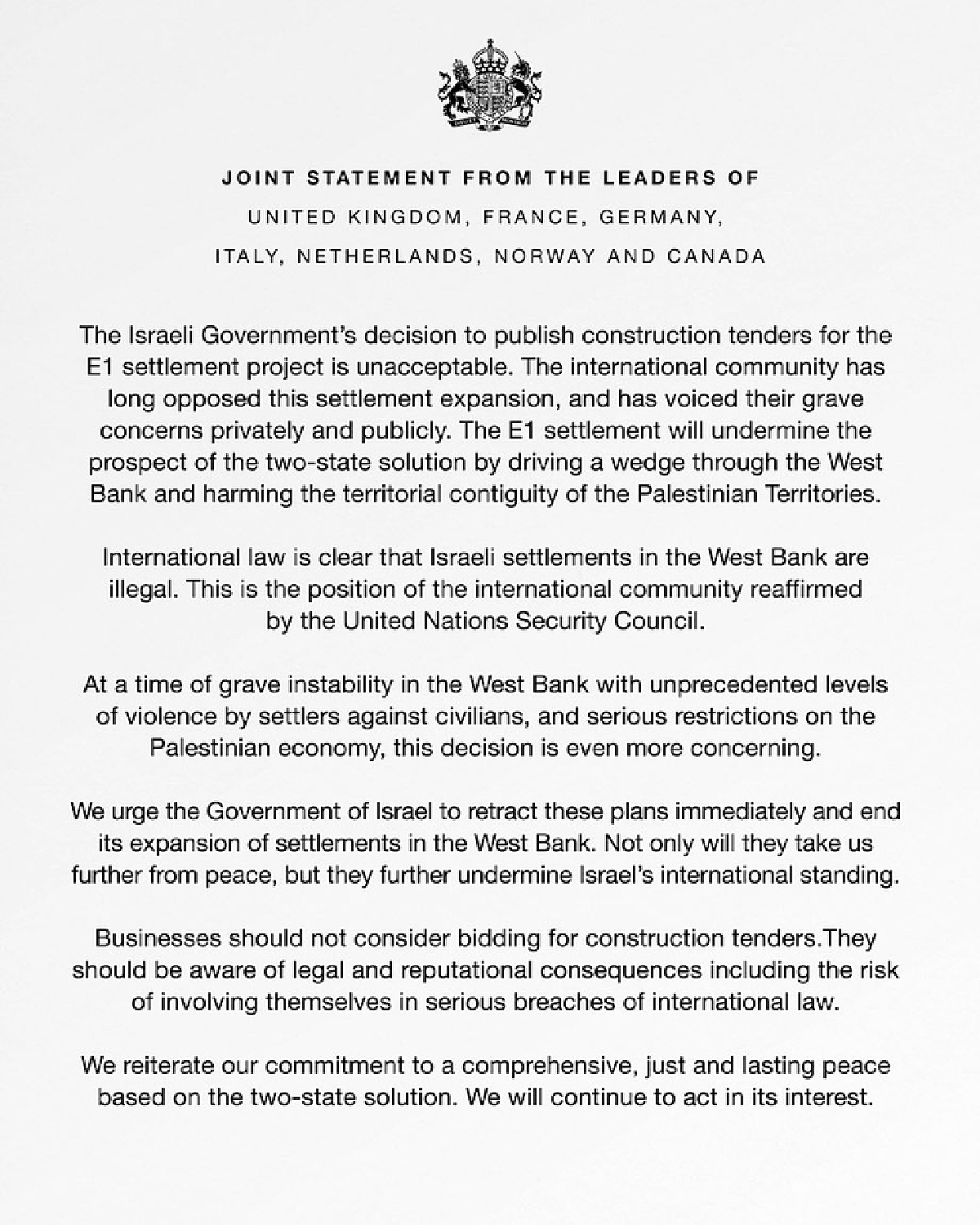 Joint Statement UK-EU-Canada Jerusalem E1 REACTIONS:“Anyone boycotts Israel is boycotted by Florida”35 states have have similar anti-BDS legislation that will bankrupt British Business
It would also end any British business participating in that boycott from doing any business in Florida if it needed any official interaction with state or local government to operate (permits, tax collection). Florida is one of Britain’s largest trading partners. They should understand that their vanity project in support of Muslim terror could cost them billions of dollars. And for those who doubt the power of this policy, it was this same law that broke Airbnb’s misguided effort to boycott portions of Israel in 2019. They realized that this law would have bankrupted their company. Florida has made it clear. Any company — or nation — that boycotts Israel is boycotted by Florida 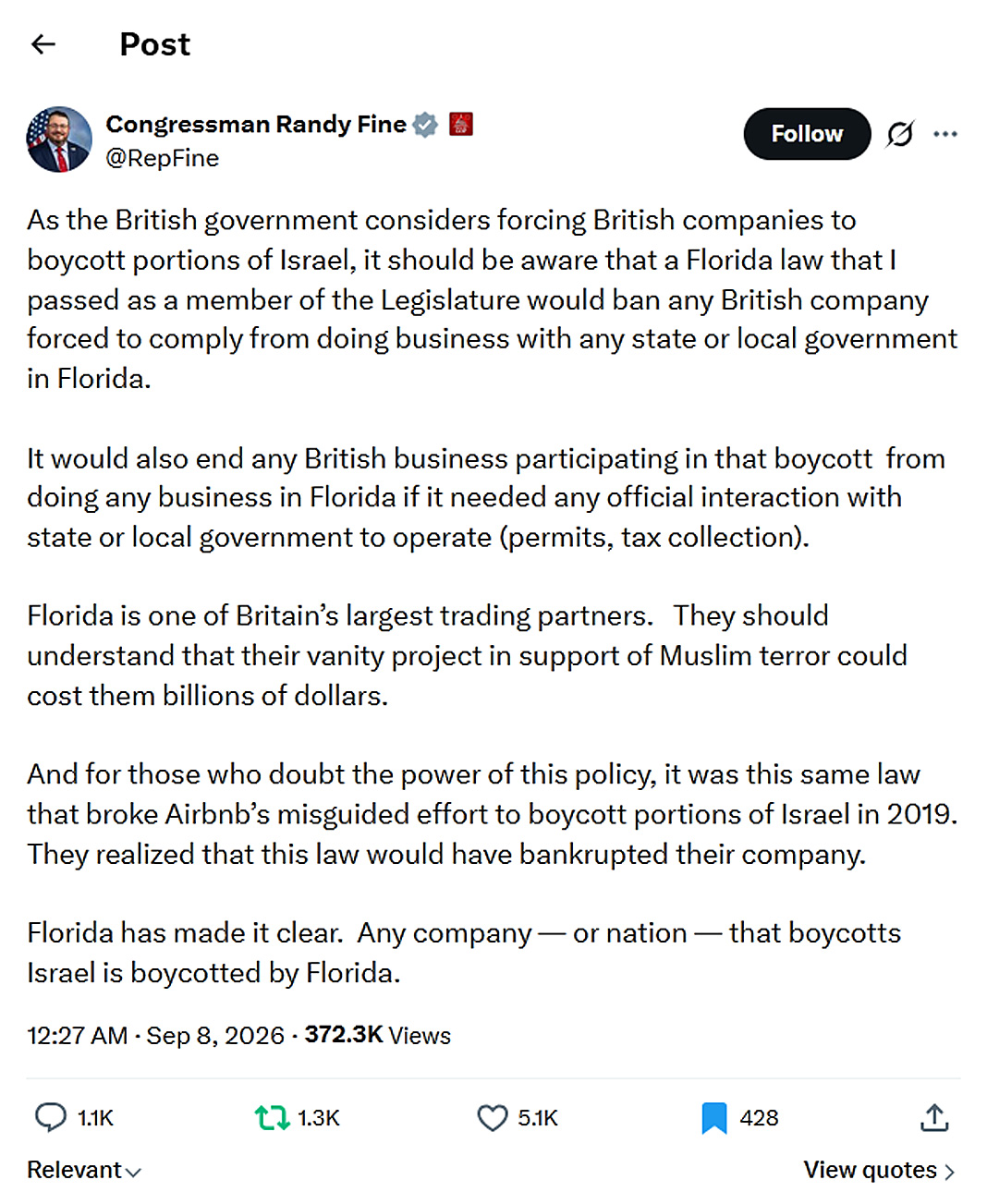 Congressman Randy Fine-tweet-7September2026-Anyone boycotts Israel is boycotted by Florida
UK to be added to the US IRS international boycott list26 U.S. Code § 999 – Reports by taxpayers; determinations
The United States must make clear that joining this effort comes with consequences. Today, I urged @USTreasury Secretary Bessent to review these boycott measures under Section 999 and add every qualifying country to the international boycott list without delay!
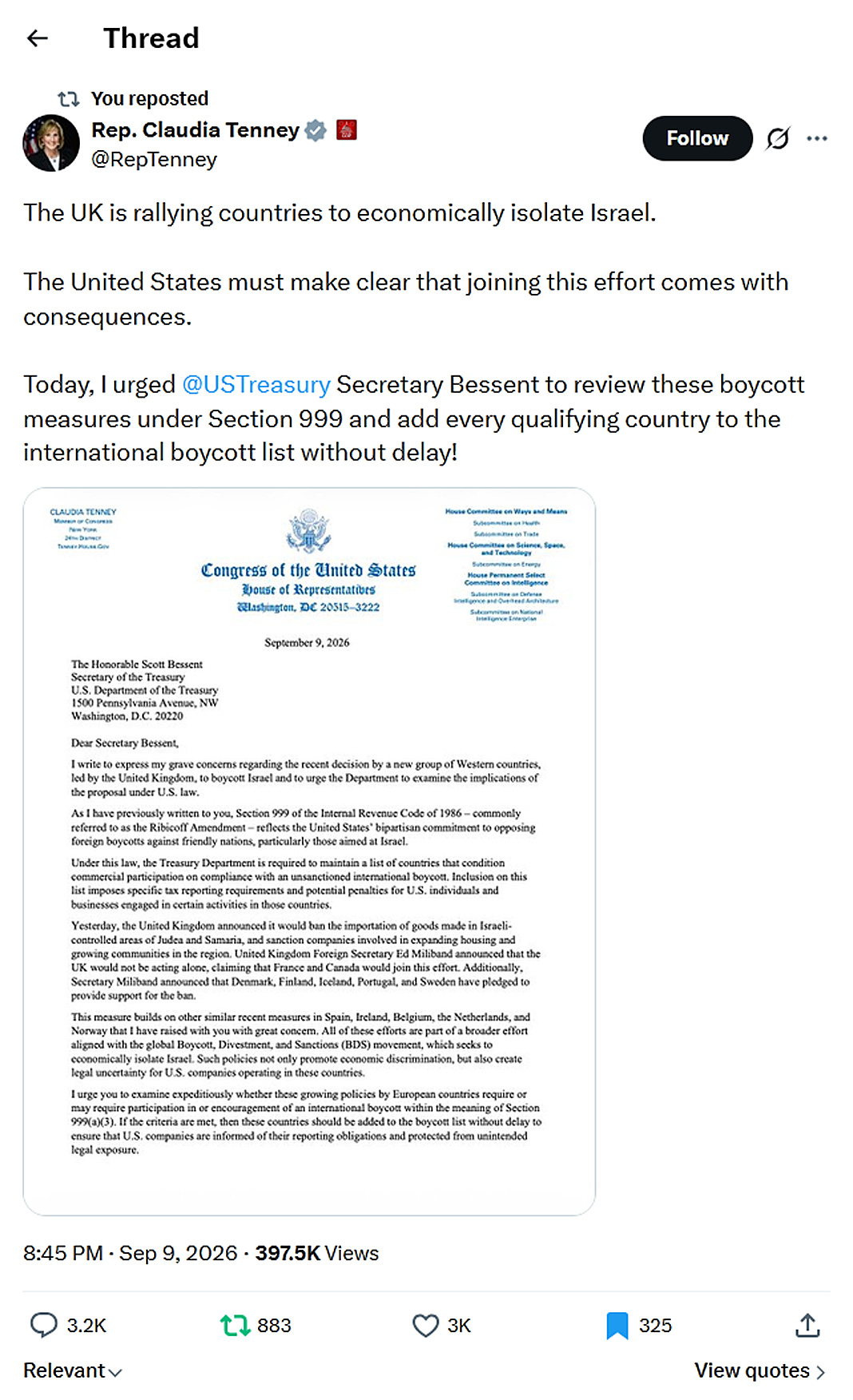 Rep. Claudia Tenney-tweet-9September2026-international boycott list
Seven Western governments are warning Israel over E1 construction, accusing Jerusalem of undermining a future Palestinian state and even cautioning businesses against participating. Meanwhile, those same European governments are struggling with the consequences of their own border and migration policies — policies that have transformed their societies and fueled intense debates over security, sovereignty and national identity. Europe lectures Israel about preserving the possibility of another state. Israel might reasonably ask Europe a question in return: Who is protecting the future of your own? 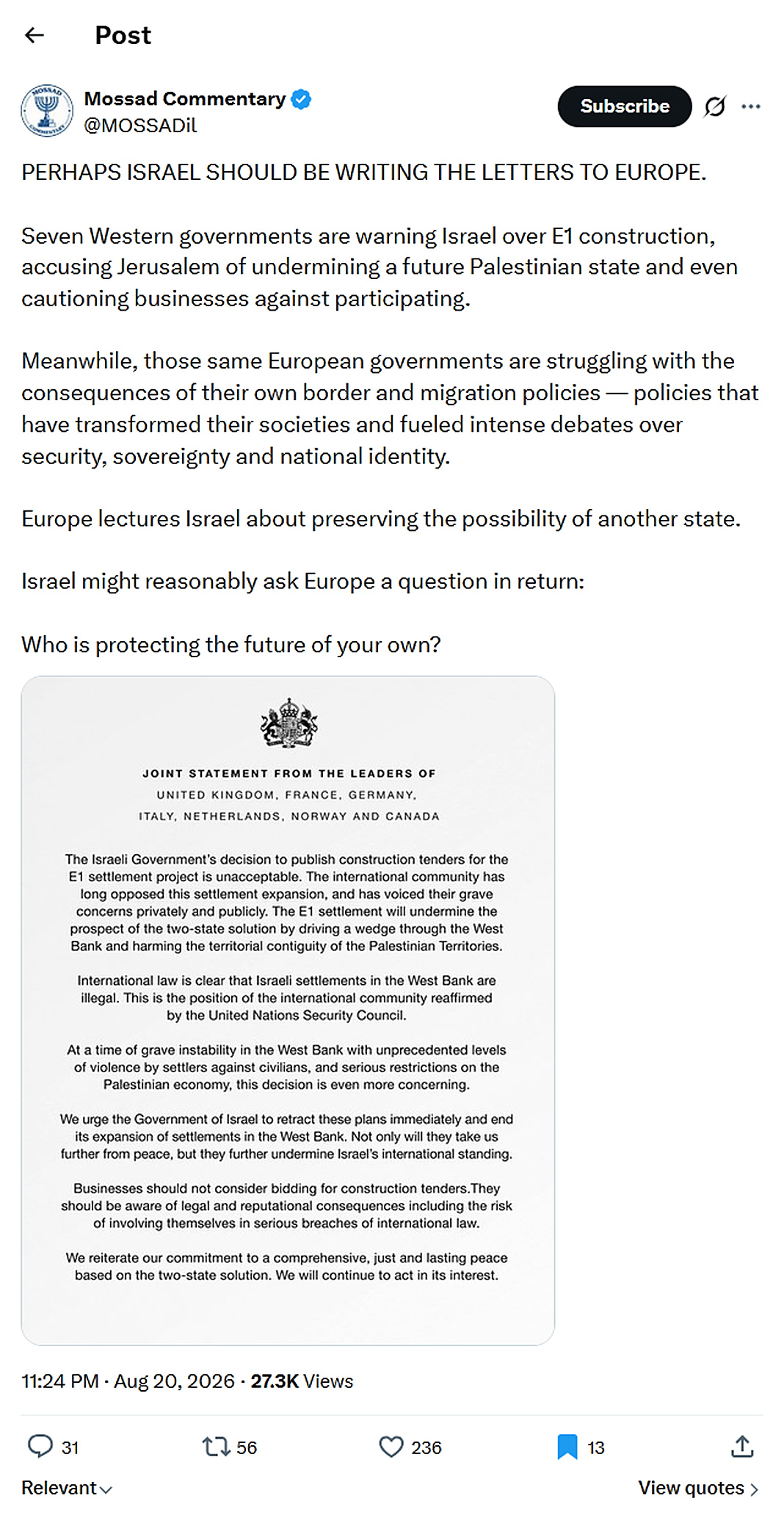 Mossad Commentary-tweet-20August2026-israel should be writing the letters
The EU is reportedly preparing sanctions if Israel begins construction in the E1 area, including labeling products from Israel, scaling back academic ties, and halting some security and diplomatic cooperation. Smotrich says he won’t accept “dictates from foreign countries,” while Ben Gvir told Ed Miliband: “someone should update Ed that the British Mandate for the Land of Israel ended in 1948 and that Israel is an independent state.” Smotrich and Gvir are right. 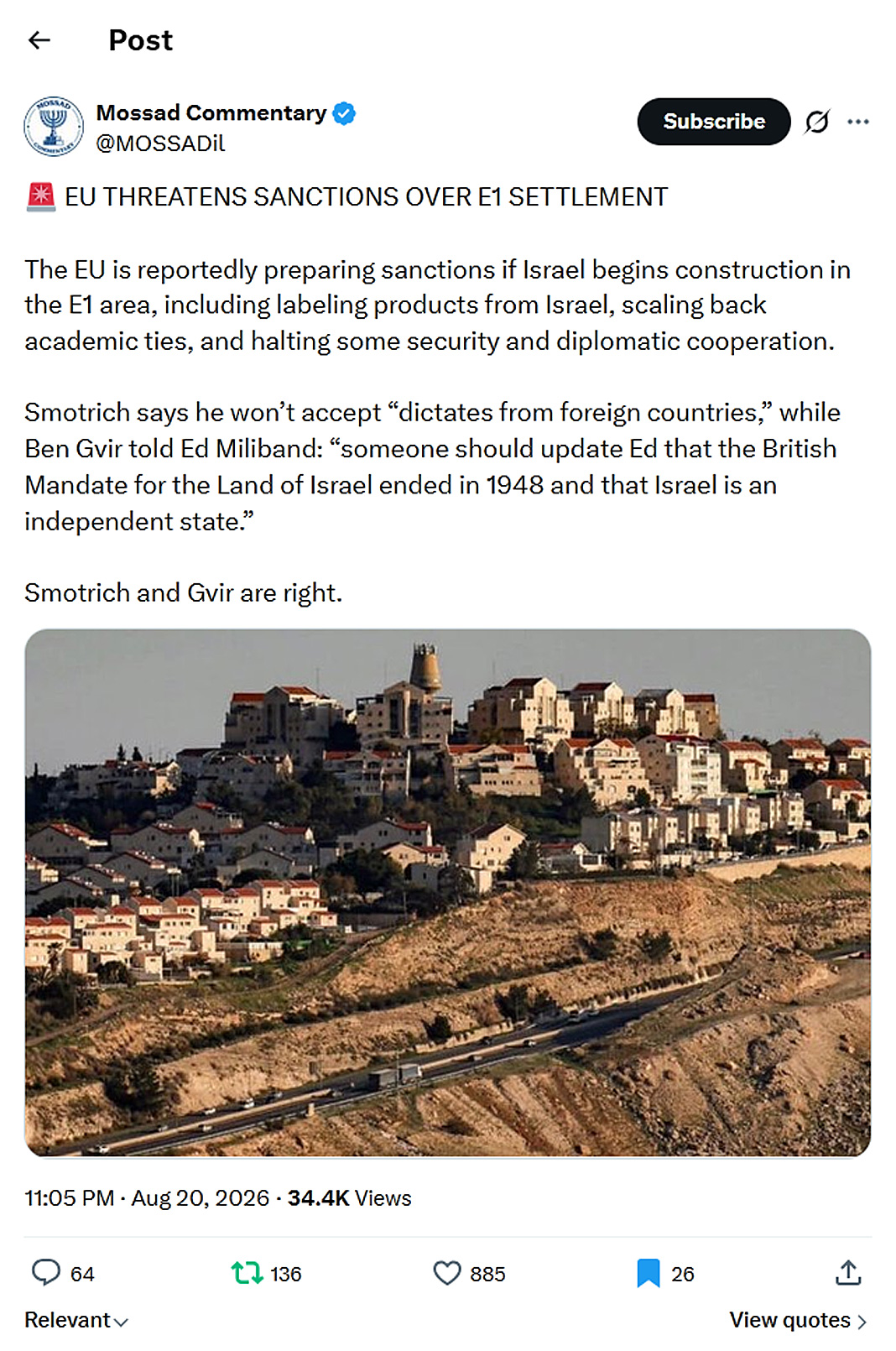 Mossad Commentary-tweet-20August2026-reaction to Joint Statement UK-EU-Canada Jerusalem E1
💡MOSSADIL COMMENTARY: Reports say the EU is preparing sanctions against Israel if construction moves forward in E1, between Jerusalem and Ma’ale Adumim. Israel should look very carefully at Europe’s trajectory before allowing these threats to dictate Israeli policy. Anyone who believes that cancelling E1 will suddenly restore some permanent European-Israeli alliance is fooling themselves. Today it is E1. Tomorrow it will be another neighborhood, another security measure, another military operation, another Israeli government decision. The pressure will not disappear. The demand will simply move. Europe itself is struggling with uncontrolled borders, political radicalization, social fragmentation and increasingly aggressive extremist movements—and yet its governments presume to dictate where Jews may build and what Israel’s future borders should look like. Israel cannot formulate national policy around winning temporary approval from governments that may look very different a decade from now. We are not Europe First. We are not Palestinian First. We are Israel First. We have stood alone before. If necessary, we will stand alone again. Israel’s borders, security and future will be decided in Jerusalem—not Brussels, London or Paris. 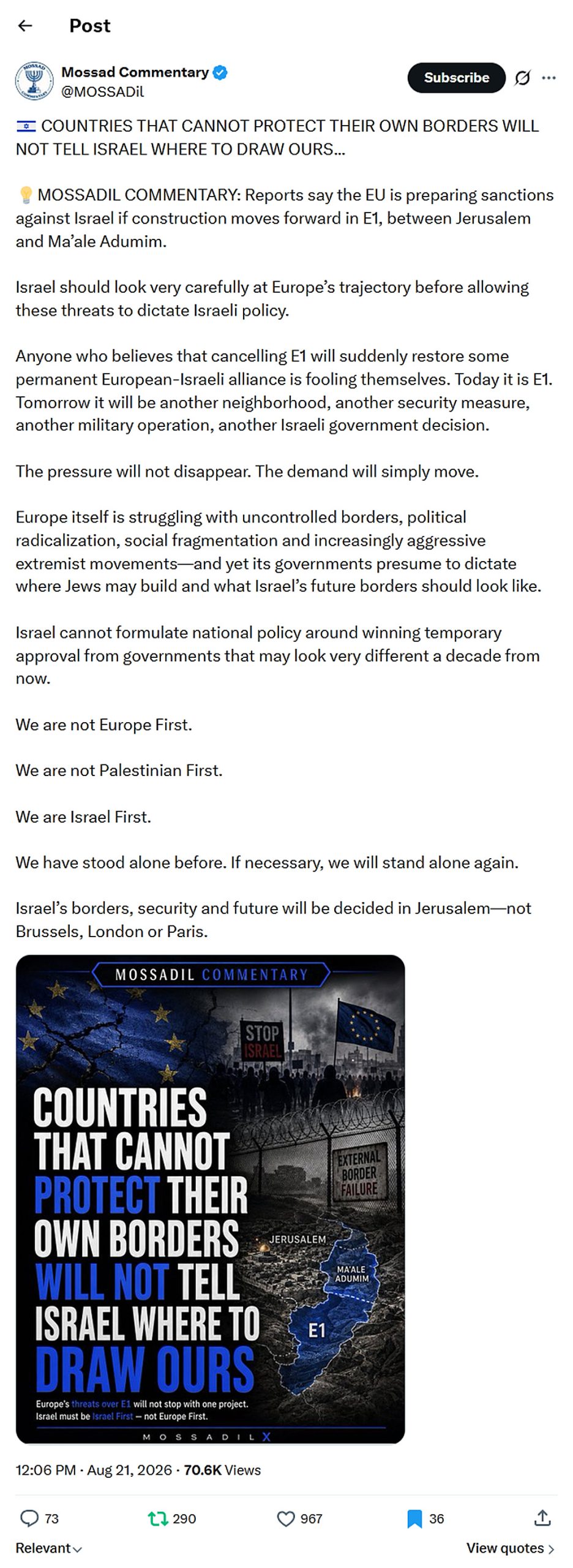 Mossad Commentary-tweet-21August2026-Commentary-Joint Statement EU-UK-Canada Jerusalem E1
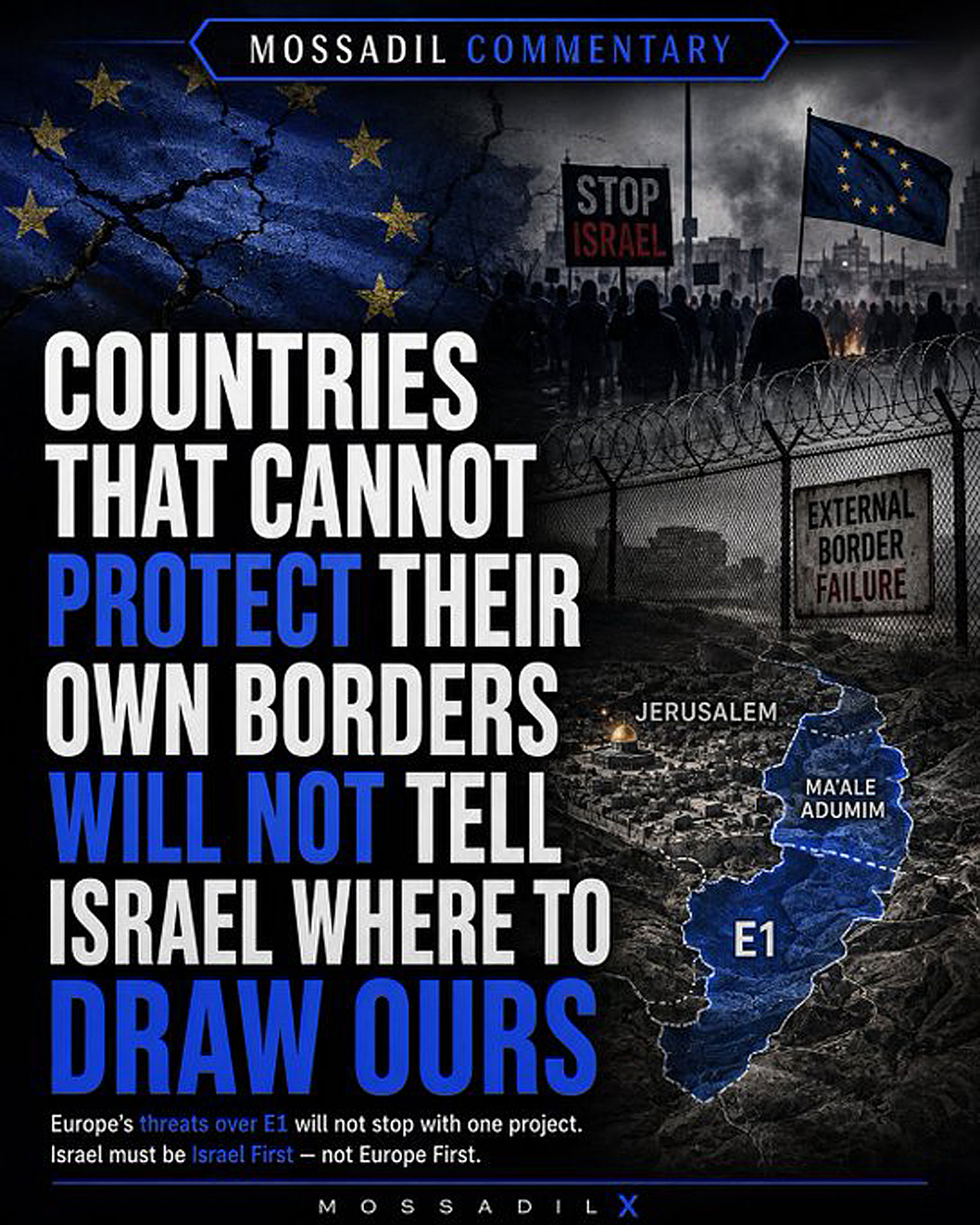 Countries that cannot protect their own borders will not tell Israel where to Draw ours
|
|
Statement-on Israeli-Jerusalem-E1 Project-Ed Miliband UK Foreign Secretary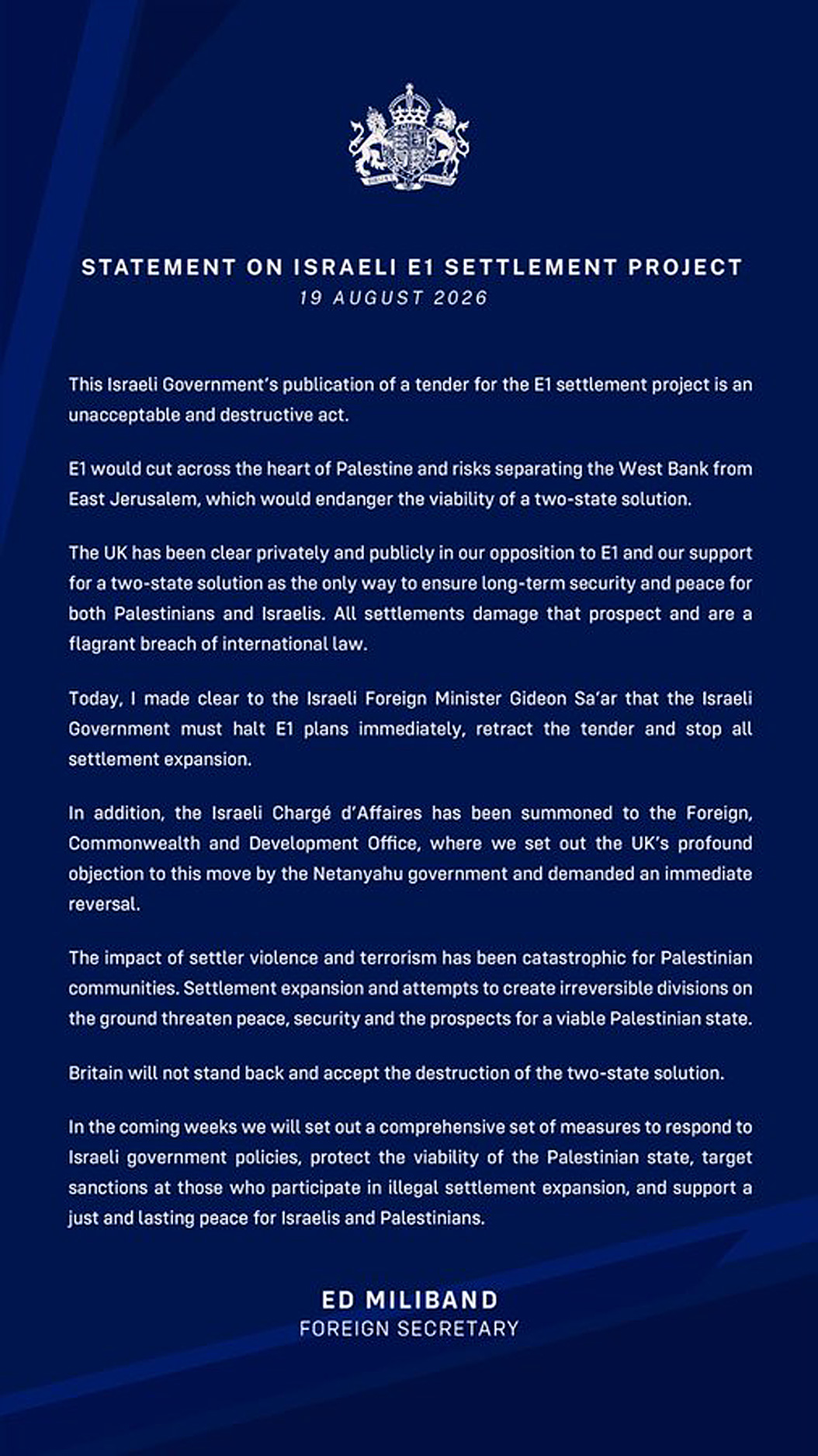 Statement-on Israeli-Jerusalem-E1 Project-Ed Miliband UK Foreign Secretary
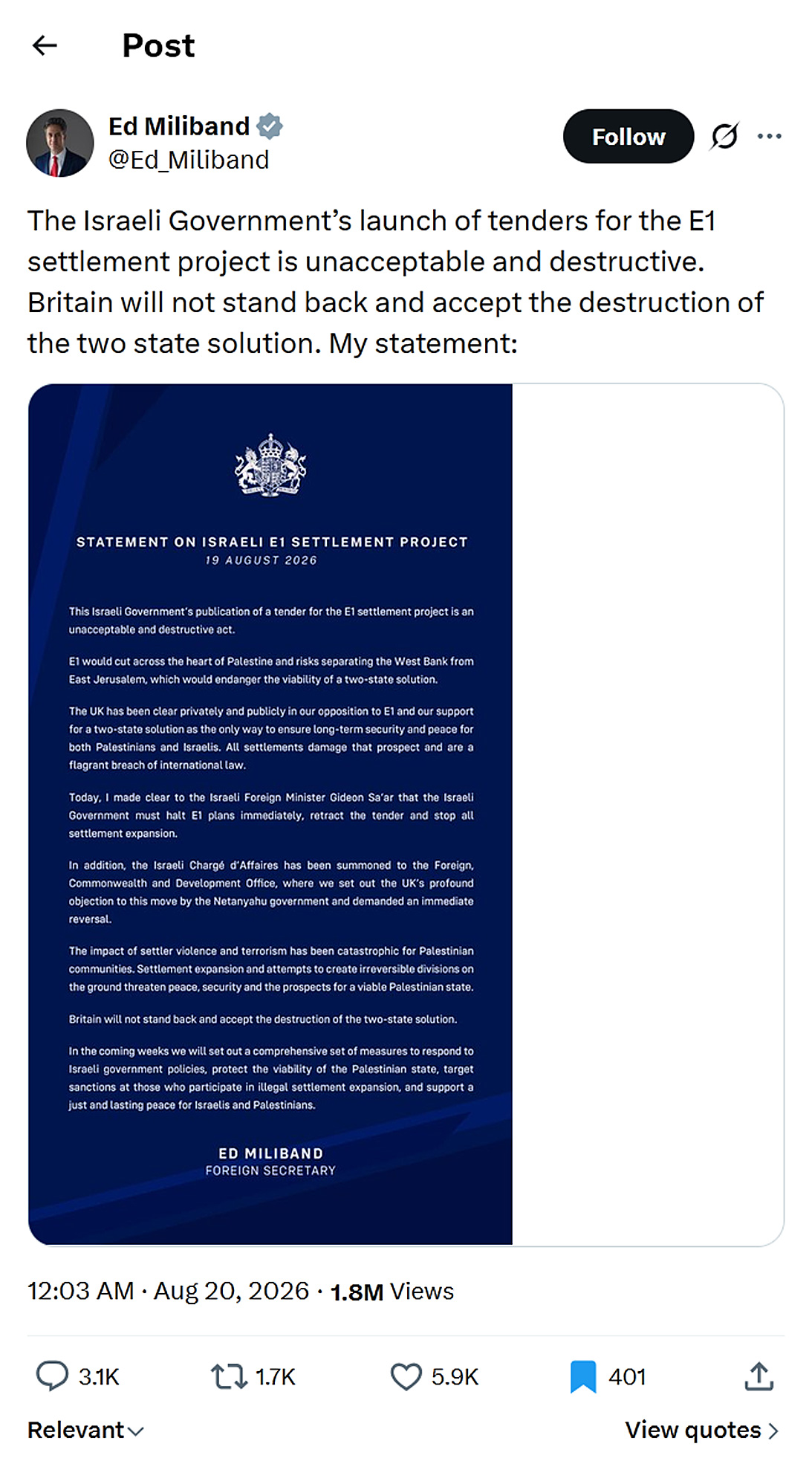 Ed Miliband-tweet-19August2026-statemen
Britain closed the Gates to Israel in 1939 condemning million of Jews to death
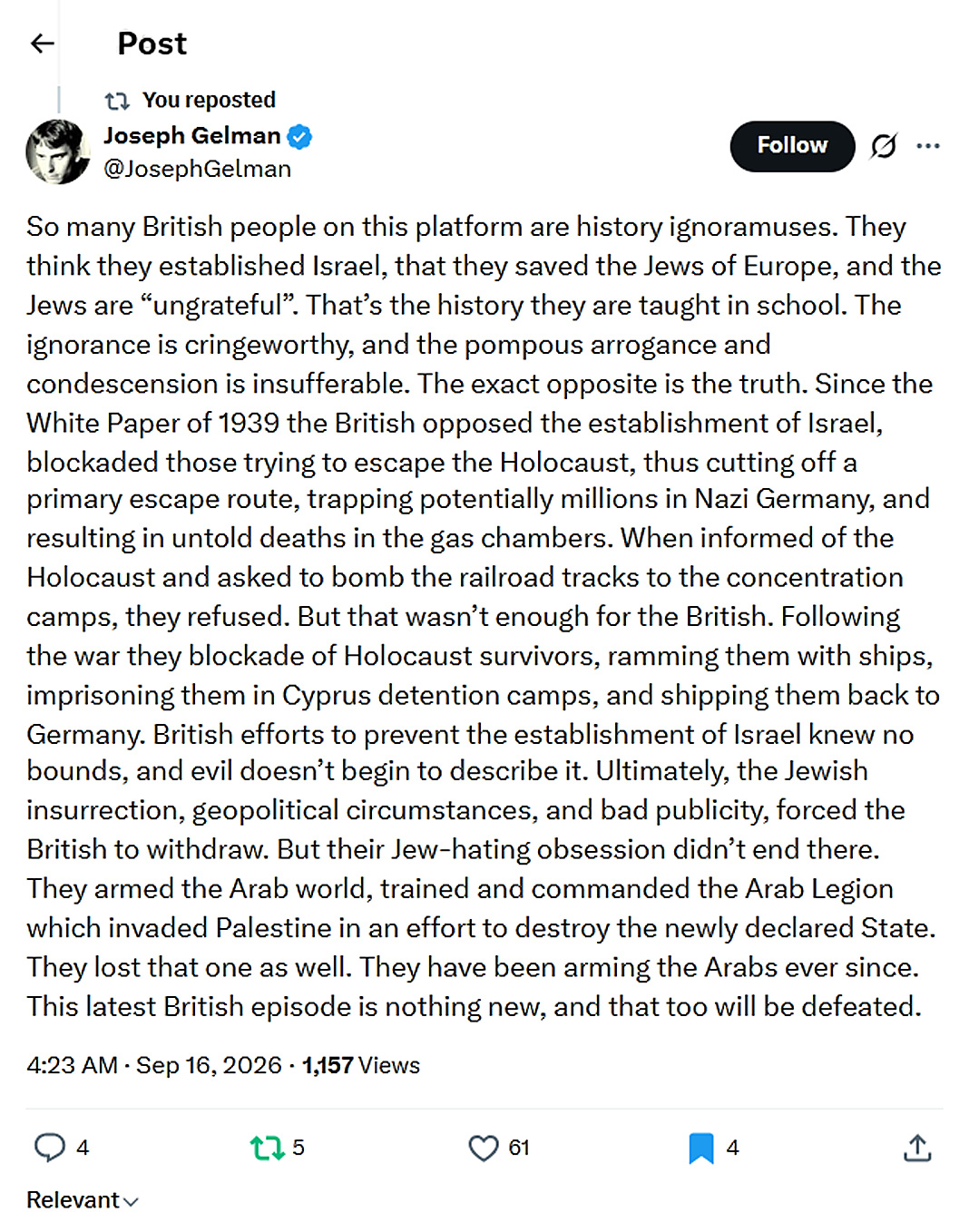 Joseph Gelman-tweet-16September2026-Britain closed the Gates to Israel
|
|

The Globalist Axis: How Canada and the UK Betray HistoryHarry Liberman 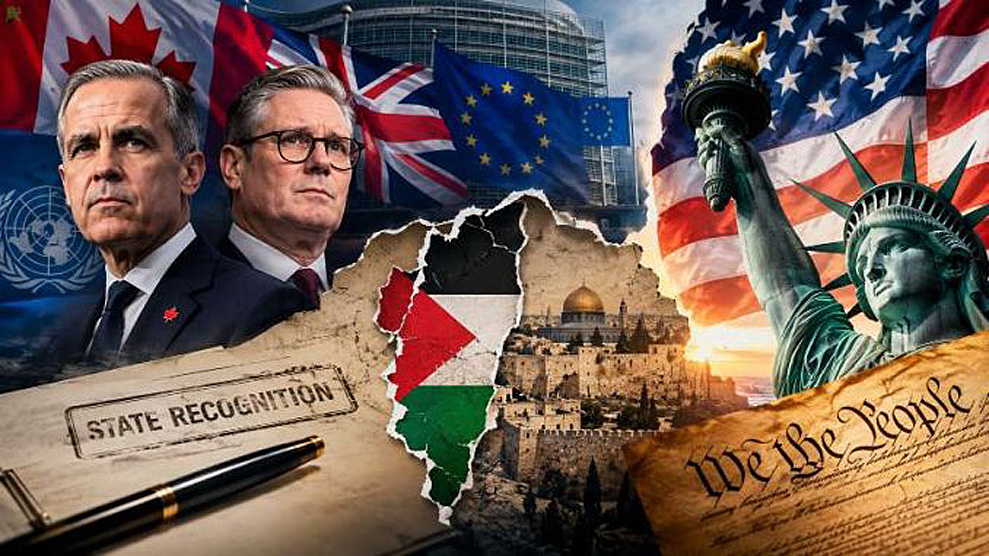 The Globalist Axis: How Canada and the UK Betray History
The puzzle pieces of the new globalist alignment have finally snapped into place, revealing a deeply unsettling picture.
Once you understand that the political establishments in Ottawa and London have abandoned the principles of national sovereignty in favor of subservience to unelected transnational bodies, their broader foreign policy makes perfect sense.
The very same top-down, technocratic overreach that drives Canadian Prime Minister Mark Carney to bypass his own citizens and tether Canada to the European Union regulatory machine is exactly what drove Canada and the United Kingdom to formally recognize a fictitious Palestinian state.
This is the ultimate triumph of historical illiteracy over civilizational truth.
In a coordinated, back-door diplomatic maneuver at the United Nations General Assembly, Mark Carney and UK Prime Minister Keir Starmer unilaterally granted statehood to a political entity that has never existed as an independent nation at any point in human history. By inventing a country with the stroke of a pen, these leaders have chosen to demonize and delegitimize Israel—a Jewish state with an unbroken, indigenous, and archaeologically verifiable connection to the land dating back over 3,000 years. The connection between Canada’s domestic surrender to Brussels and its foreign policy betrayal in the Middle East is undeniable: both stem from an elite, leftist worldview that despises historical legacy, constitutional republics, and the concept of true, localized freedom.
Rewarding Terror, Erasing HistoryThe timing and nature of this diplomatic assault reveal its sheer hypocrisy. For decades, Western foreign policy dictated that a Palestinian state could only be realized through direct, bilateral negotiations that guaranteed Israel’s security. Yet, in a shocking display of weakness, the UK and Canada bypassed the democratic process entirely to award unilateral recognition. To the globalist left ruling Ottawa and London, historical facts are irrelevant. It matters not to them that the term “Palestine” was merely a regional name imposed by the Roman Empire to erase Jewish identity, nor does it matter that there was never a sovereign Palestinian king, parliament, or currency.
Instead, Carney and Starmer have chosen to validate a corrupt, unelected Palestinian Authority under a paper promise of “future democratic reforms” and an elusive pledge to sideline Hamas by 2026.
In reality, this recognition serves as an unprecedented historical insult: it penalizes a democratic ally fighting for its survival while effectively rewarding the geopolitical forces of terrorism.
This coordinated attack on the Jewish state exposes the fundamental difference between the socialist, bureaucratic mindsets of the Canada-EU-UK axis and the exceptional foundational principles of the United States.
In the European and Canadian models, globalist elites believe they possess the supreme authority to dictate reality—whether that means forcing Canadian citizens into a European regulatory straightjacket without a vote, or arbitrarily manufacturing a Middle Eastern state to appease a leftist voting base.
They trust only the state, and they use transnational institutions to enforce their will over the heads of the populace.
America was built to be the antidote to this exact brand of authoritarian overreach.
The U.S. Constitution anchors power in popular sovereignty and the rule of law, ensuring that sweeping, radical redefinitions of national sovereignty or international alliances cannot be executed by a single, unchecked leader.
The tragic irony is that while Canada and the UK willingly dilute their own sovereignty to become vassals of a broader, unelected globalist empire, they are simultaneously trying to dismantle the ancient, sovereign right of the Jewish people to exist safely in their ancestral homeland.
It is a shameful chapter in Western history, proving once again that when governments abandon the foundational truths of freedom, history, and accountability, they inevitably sleepwalk into tyranny.
The Illusion of Freedom—Why the EU-Canada Alliance Proves Only America Safeguards True LibertyThe recent spectacle of Canadian Prime Minister Mark Carney unilaterally tethering his country to the European Union’s regulatory regime exposes a profound truth that the globalist left desperately tries to hide: Canada and the EU are not true representative democracies. They are top-down, technocratic systems designed to suppress the popular will. In stark contrast stands the United States of America—a constitutional republic whose foundational blueprint was engineered precisely to stop this brand of executive tyranny in its tracks.
The differences in freedom between the Canada-EU axis and the United States are not subtle; they are vast, irreconcilable, and boil down to a simple choice: democratic capitalism versus socialist bureaucratic control. This institutional divergence highlights how executive-led alignments can bypass the public entirely, standardizing state control over market competition.
The Shield of the U.S. Constitution vs. Canada’s Crown Tyranny
If U.S. President Trump attempted to quietly bind America to European regulations on artificial intelligence, defense, and critical minerals, the American system would choke the effort instantly.
Under Article II, Section 2 of the U.S. Constitution, the executive branch cannot unilaterally commit the nation to international treaties; it requires the advice and consent of the Senate, demanding a two-thirds supermajority. Furthermore, any international regulatory alignment that impacts domestic commerce must pass through Congress. Power in America is structurally anchored in the hands of elected representatives accountable to the people.
Canada possesses no such safeguards.
Operating under the archaic framework of the Westminster system, the Canadian executive wields “Crown prerogative.” This allows a Prime Minister to bypass Parliament entirely to sign sweeping international pacts. No referendum, no public debate, no vote. Carney’s rush to embrace an EU “associate membership”—a second-tier status rejected even by war-torn Ukraine—proves that the Canadian system treats its citizens not as self-governing individuals, but as subjects to be managed.
The Tyranny of the Unaccountable: The Canada-EU ModelThe European Union represents the final evolution of this anti-democratic philosophy.
The EU is governed by the European Commission, a body of unelected bureaucrats who dictate laws to hundreds of millions of people.
When European citizens vote, they vote for a toothless parliament, while the real power remains insulated in Brussels.
By aligning Canada with this monolith, the Carney government is importing European-style socialism—a system where state control, heavy regulation, and collective compliance supersede individual liberty. True freedom is not found in the welfare-state mandates of Brussels or Ottawa, where speech is regulated and economic output is stifled by red tape. True freedom is American capitalism, which celebrates individual sovereignty, rewards innovation, and limits the overreach of the state.
A Shameful War on the RepublicWhat we are witnessing is nothing short of an ideological war waged on America by the Canadian and European political establishments. Jealous of American prosperity and threatened by a robust republic that still values borders, free markets, and constitutional rights, these globalist elites seek to build a counter-bloc.
It is a shameful display, driven by leftist factions in Canada and Europe who are economically and historically illiterate.
They willingly trade their own national sovereignty for a seat at the globalist table, blind to the fact that they are turning their nations into vassals of a transnational regulatory empire.
The crisis of Canada’s EU alignment should serve as a warning to the world. It proves that without the ironclad protections of a constitutional republic like America, “democracy” is nothing more than a cosmetic mask for authoritarian control.
America remains the exceptional beacon of true liberty, precisely because its system trusts the people—while Canada and the EU trust only the state.
|
|
England is Israel’s first West European enemy state
England will become, in the coming months, an overt enemy state of Israel. It will be the first West European country in the modern era to initiate a full economic confrontation with the State of Israel and adopt an explicitly pro-Hamas stance. Assuming the right-wing bloc wins power, England will launch a long series of extensive economic sanctions on the entire Israeli economy with the aim of collapsing it. This is the explicit and declared English plan. England’s goal is to encourage the selection of the Eisenkot-Hamas bloc or, alternatively, to pressure Netanyahu (in the event he wins the elections) to prefer forming a unity government with the left over joining the deep right-wing bloc. This battle is going to be ugly. England is a pro-Hamas and pro-Islamic terror state. It will never again be an ally of Israel. Those days are over. 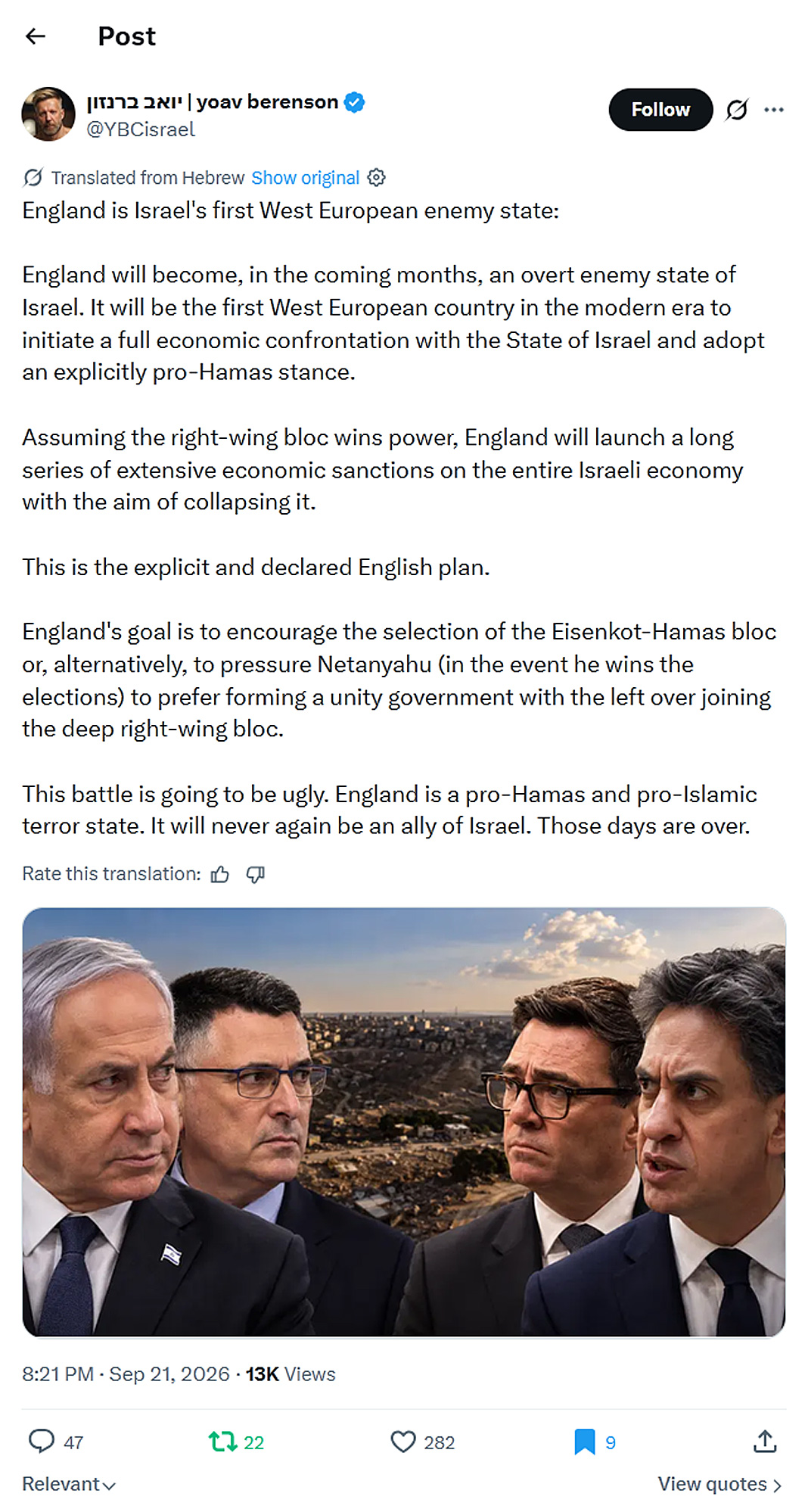 yoav berenson-tweet-21September2026-England is Israel’s first West European enemy state
|
|

UKLFI warns over proposed settlement trade ban22August2026 / https://www.uklfi.com/uklfi-warns-over-proposed-settlement-trade-ban UK Lawyers for Israel (UKLFI) has warned the UK Government that introducing a ban on trade between the UK and Israeli settlement in East Jerusalem and the West Bank would breach several binding international obligations. 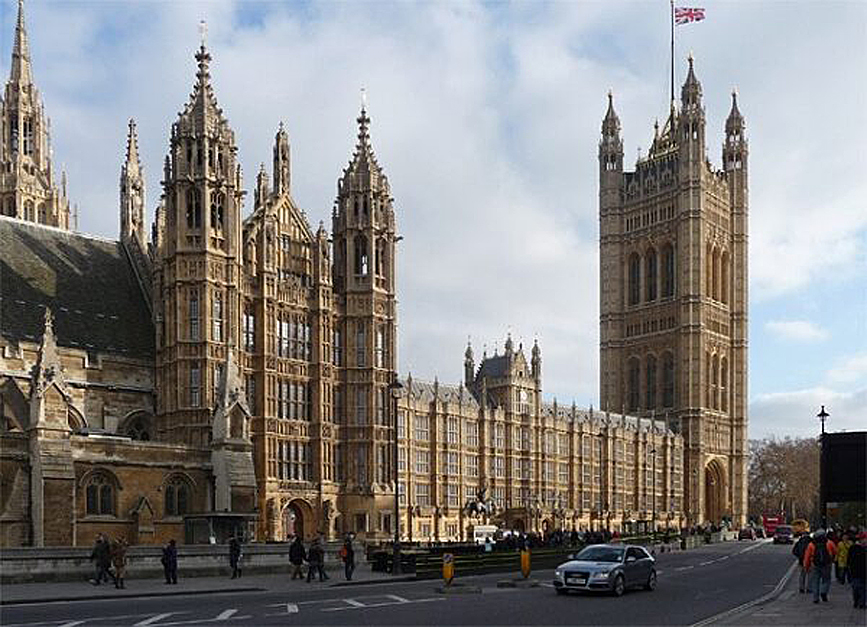 UK House of parliament
The UK Government is actively considering banning trade in goods and services between the UK and areas of Israeli settlement in East Jerusalem, Judea and Samaria (the West Bank). It says it has an obligation under international law to impose this ban.
UKLFI has sent a Briefing Paper to the UK’s Foreign Secretary and the Legal Adviser to the UK’s Foreign Office, challenging that position.
The Paper disputes the claim that the UK has a legal obligation to impose a general ban on such trade and argues that, on the contrary, such a ban would contravene the UK’s legal obligations under the UK-Israel TPA, the GATT, the GATS, and (if applied to Northern Ireland) the Protocol on Ireland/Northern Ireland to the Brexit Agreement.
At the same time, by harming Israeli businesses in the West Bank that employ Palestinian staff, such a ban would undermine the Palestinian economy and the prospect of a two-State solution.
In addition, such a ban might discourage US investment in the UK, since companies operating in the UK that comply with it would be exposed to potential sanctions under US Federal and State laws.
It would also have the effect of further promoting antisemitism in the UK.
Jonathan Turner, Chief Executive of UKLFI, commented: “Statements made on behalf of the UK Government appear to be the opposite of the correct analysis. There is no international legal obligation requiring the UK to impose a blanket ban on trade with Israeli businesses in East Jerusalem, Judea and Samaria. On the contrary, our analysis shows that imposing such a ban could itself put the UK in breach of several binding international obligations, including the UK-Israel Trade and Partnership Agreement, the GATT and the GATS and, if the ban extends to Northern Ireland, the Protocol on Ireland/Northern Ireland to the Brexit Agreement.”
|
|
Israel’s Reaction🇮🇱 SMOTRICH: “WE ARE DONE BEING PASSIVE ACTORS”
Finance Minister Bezalel Smotrich says Israel is preparing “very painful responses” against countries threatening sanctions. “Nobody can try and force us to commit suicide through sanctions and economic pressure.” “We are done being passive actors.” 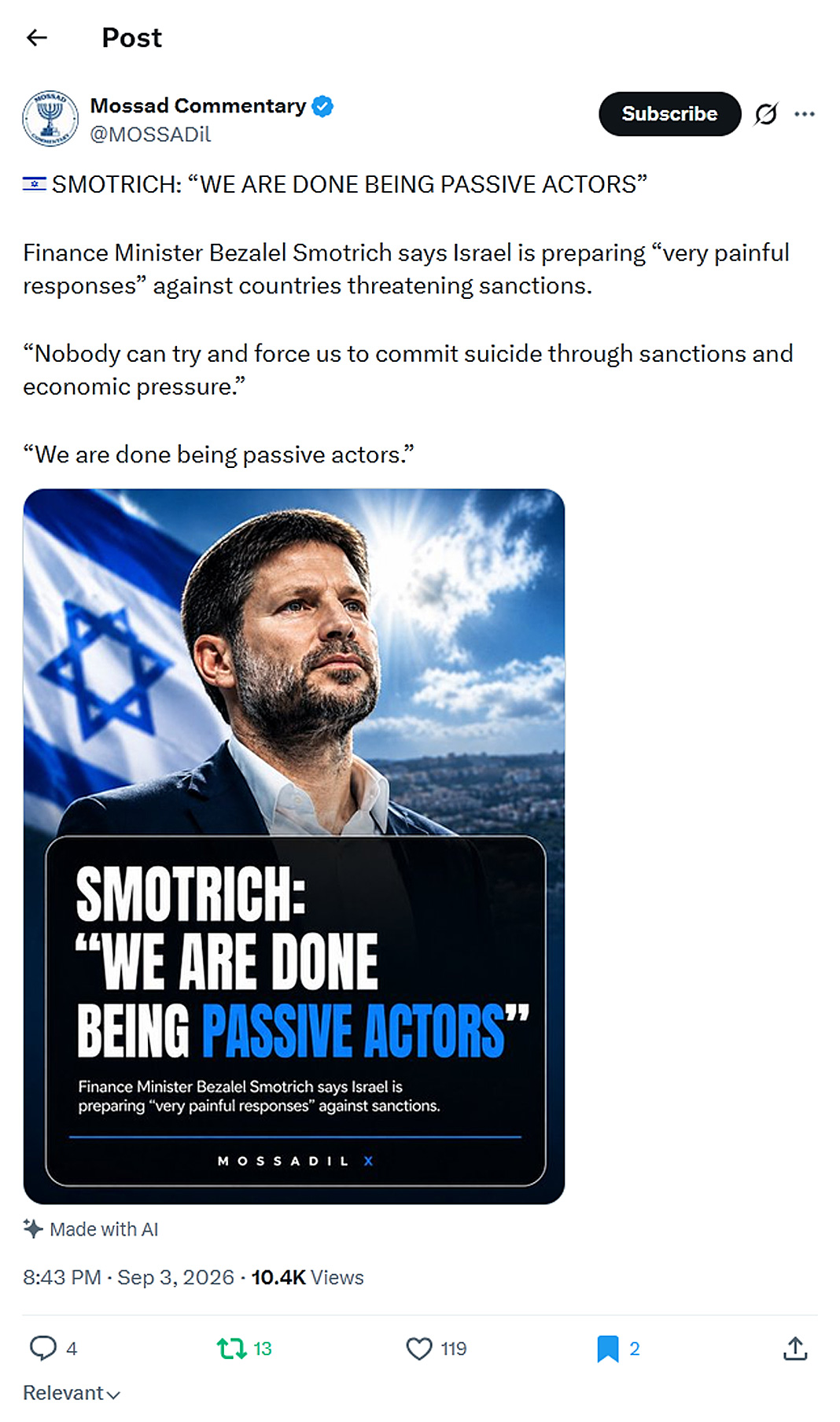 Mossad Commentary-tweet-3September2026-Smotrich-We are done being passive actors
 Smotrich-We are done being passive actors
JerusalemCats Comments: Minister Itamar Ben Gvir’s Statement on moving the Gaza Population can be done in Judea and Sumeria, Same Terrorist & their Supporters.
They haven’t even read the full plan to encourage migration from Gaza, and they’re already saying it won’t happen. Well, fine, they said that about the gun reform too, about the prison reform, about the emergency squads and the National Guard that I established, and also about the death penalty law for terrorists. So what if they said it?! I’m attaching the full plan for you: “Disengagement 710” – a plan that will encourage the voluntary migration of 1.86 million Gazans within seven years. We stopped dealing with the problem. We decided to solve it. For the full plan – 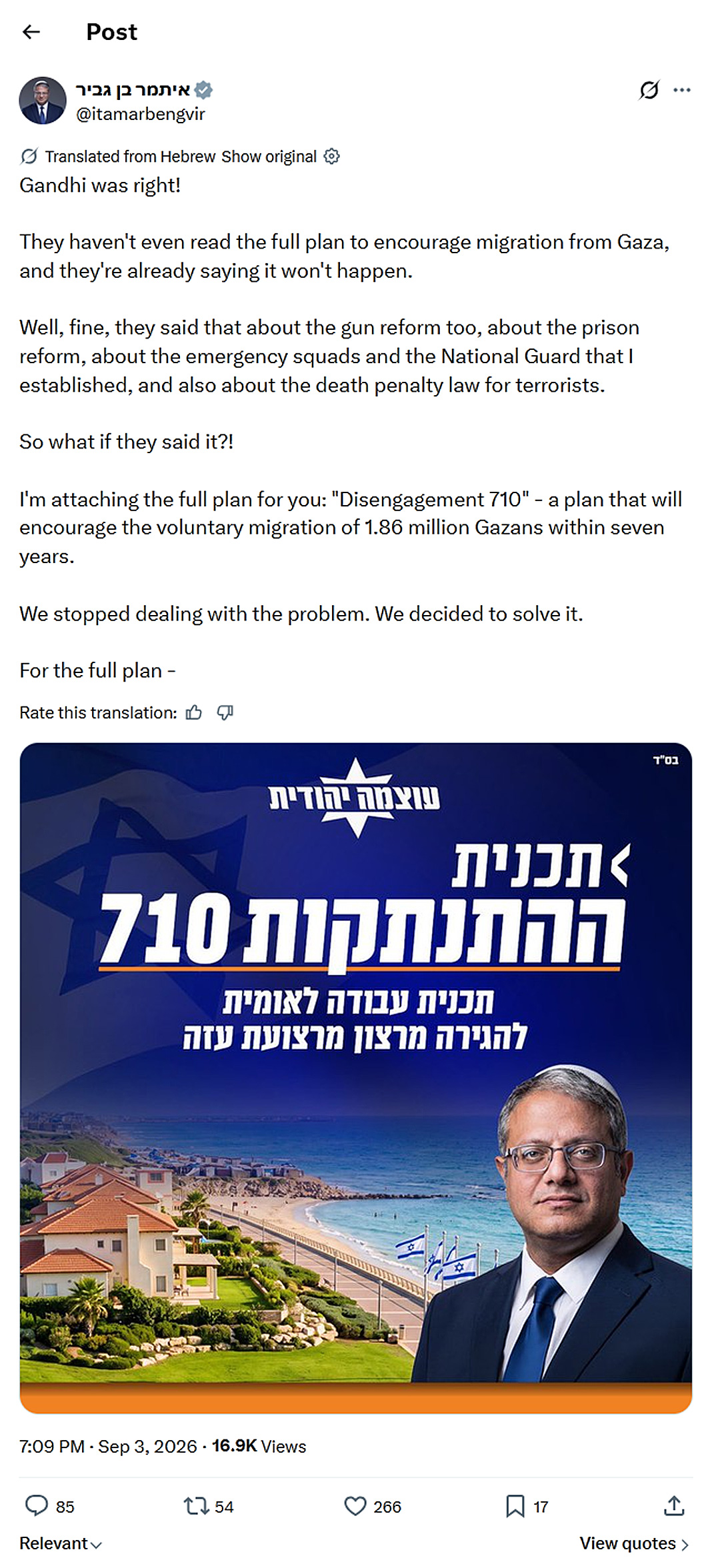 itamarbengvir-tweet-3September2026-We decided to solve it
|
|

Israel’s response to UK – closing British Consulate in JerusalemForeign Minister Sa’ar announces closure of British Consulate in Jerusalem and other countermeasures against UK sanctions.Yitz Goldberg / Published:8September2026, 5:44 PM (GMT+3) / https://www.israelnationalnews.com/news/432903
Foreign Minister Gideon Sa’ar announced on Tuesday that Israel will close the British Consulate in Jerusalem and take a series of additional countermeasures in response to new sanctions announced by British Foreign Secretary Ed Miliband.
Sa’ar said the measures were decided upon with the agreement of Prime Minister Benjamin Netanyahu and follow what he described as a series of anti-Israel decisions by Britain’s Labour Government.
Under the measures, Israel will close the British Consulate in Jerusalem, remove British representatives from the International Gaza Support Center in Kiryat Gat, terminate British activities training Palestinian Authority forces in Judea and Samaria under the “British Support Team in Ramallah,” and deny entry to Israel to 12 British elected representatives and other British nationals involved in antisemitic and anti-Israel activity or who deny Israel’s existence.
“Unfortunately, a hostile Labour Government is in office, systematically acting against the State of Israel, and it has left us with no choice but to finally respond to its hostile actions,” Sa’ar stated.
The announcement came after Miliband unveiled a series of measures targeting Israeli communities in Judea and Samaria.
Miliband announced that Britain would move to ban trade in goods produced in Israeli communities in Judea and Samaria and impose restrictions on companies and individuals providing services, including construction and financing, for settlement expansion. He also announced further restrictions on arms exports to Israel.
“For a long time, the British government has said such settlements are illegal,” Miliband told the House of Commons. “Today I announce the official view of the British government is that the occupation is unlawful.”
France and Canada joined Britain in announcing that they would introduce national measures banning trade in goods from Israeli communities in Judea and Samaria.
Miliband also criticized Israel’s decision to publish construction tenders for the E1 area and said the British government agrees with the UN definition of ethnic cleansing and believes ethnic cleansing is taking place in parts of Judea and Samaria.
Sa’ar rejected the British accusations and criticized the timing and substance of the measures.
“The accusations made today by the Foreign Secretary of the Labour Government in the British Parliament were outrageous lies,” he said.
“The British move is morally distorted and constitutes blatant interference in the affairs of a sovereign state and in its electoral process,” Sa’ar added.
He also rejected the claims regarding construction in E1, saying that no new decisions had been made on development in the area.
“Contrary to the false claims of the Labour Government, no new decisions have been made regarding development in E1. The decision was taken more than a year ago, and the tender process has been underway for many months,” he stated.
Sa’ar said the Israeli government’s decision included plans for two roads, Road 80 between the Bethlehem and Ramallah areas and the “Fabric of Life” Road between a-Za’im and al-Ezariya, and rejected claims that the plans would sever Palestinian territorial contiguity.
The Foreign Minister also accused the British government of applying a one-sided policy toward Israel while failing to take measures against the Palestinian Authority over its payments to terrorists.
“This conflict will not be resolved through declarations from London or Paris, and a one-sided, anti-Israel approach only pushes the possibility of reaching a solution further away rather than bringing it closer,” he said.
Sa’ar listed a series of measures taken by Britain’s Labour Government since it came to power in July 2024, including its recognition of a Palestinian state, resumption of funding for UNRWA, restrictions on defense exports to Israel, sanctions on Israeli ministers and other Israelis, suspension of negotiations on a free trade agreement, and restrictions on military and security cooperation.
Sa’ar announced that the following UK elected representatives and British nationals will be denied entry to Israel: Jeremy Corbyn MP; Zarah Sultana MP; Fahad Ansari, Director of Riverway to the Sea; Naz Shah MP; Diane Abbott MP; Hannah Spencer MP; Carla Denyer MP; Sian Berry MP; Ellie Chowns MP; John McDonnell MP; Richard Burgon MP and Adrian Ramsay MP.
Announcing the closure of the British Consulate, Sa’ar stressed Israel’s sovereignty over its capital.
“United Jerusalem is the capital of Israel and is under its full sovereignty. Any activity by a foreign state within it must be carried out with the consent of the State of Israel,” he stated.
Sa’ar warned that Israel could take similar steps against other countries that act against it.
“Britain initiated and led the current move. But we will also take countermeasures, at our discretion, against other countries that act or will act against Israel,” he said.
“The message to every government that harms us is clear: whoever acts against Israel, Israel will act against them, and they will lose their influence and relevance in the region.”
“Measures against Israel will not go unanswered,” Sa’ar concluded.
|
|
ADDENDUM
UK refuses to close Jerusalem consulate, renames it ‘UK Mission’British Foreign Secretary Ed Miliband announces that the British Consulate General in Jerusalem will remain open under a new name following talks with Israel,Israel National News 8October2026, 9:32 AM (GMT+3) https://www.israelnationalnews.com/news/434286
British Foreign Secretary Ed Miliband announced that the British Consulate General in Jerusalem will remain open under the new name “UK Mission, Jerusalem,” following discussions with the Israeli government.
In a statement, Miliband said that Britain does not recognize Israel’s legal authority to close the diplomatic facility, which he noted has operated in Jerusalem for nearly 200 years.
“We have been clear that we do not accept that the Government of Israel has the legal right to close the British Consulate General in Jerusalem, which has been there for nearly 200 years,” Miliband stated.
“The UK government reiterates its long-standing view that East Jerusalem is occupied territory.”
Miliband said that following discussions with Israel, the building would remain open, although the diplomatic mission would operate under a different name.
“Following discussions with the Government of Israel, our Consulate General building will not be closing, and will be known as the UK Mission, Jerusalem from today,” he announced.
“The UK Mission, Jerusalem is independent, operational, and will continue to deliver vital services and our work with the Palestinian people.” According to Miliband, the arrangement will allow Britain to maintain its longstanding diplomatic presence in Jerusalem while continuing to promote the establishment of a Palestinian state.
“This will ensure that we maintain our longstanding British presence and the UK’s role in support of two-state solution,” he said.
The Foreign Secretary also revealed that Britain had temporarily withdrawn several staff members and their families because of concerns over their safety.
“Without an understanding, we would not have the necessary assurances for the security and protections of our staff and premises. Accordingly, the UK has temporarily withdrawn a number of staff and families to ensure their safety and security,” he explained.
Miliband said Britain intends to restore its diplomatic staffing levels in the coming months and will refrain from retaliatory measures against Israel while discussions continue.
“We will work in the coming months to build back up our presence, and we will not take reciprocal action while such discussions are underway and credible,” he stated.
The Foreign Secretary concluded by reaffirming Britain’s commitment to measures adopted on September 8 in coordination with the international community, which he described as intended to advance a two-state solution.
“The UK stands steadfast by the measures we took on 8 September, in concert with the international community, in support of a two-state solution to deliver peace and security for the people of Israel and Palestine,” Miliband said.
Plausible deniability
AM ISRAEL CHAI. 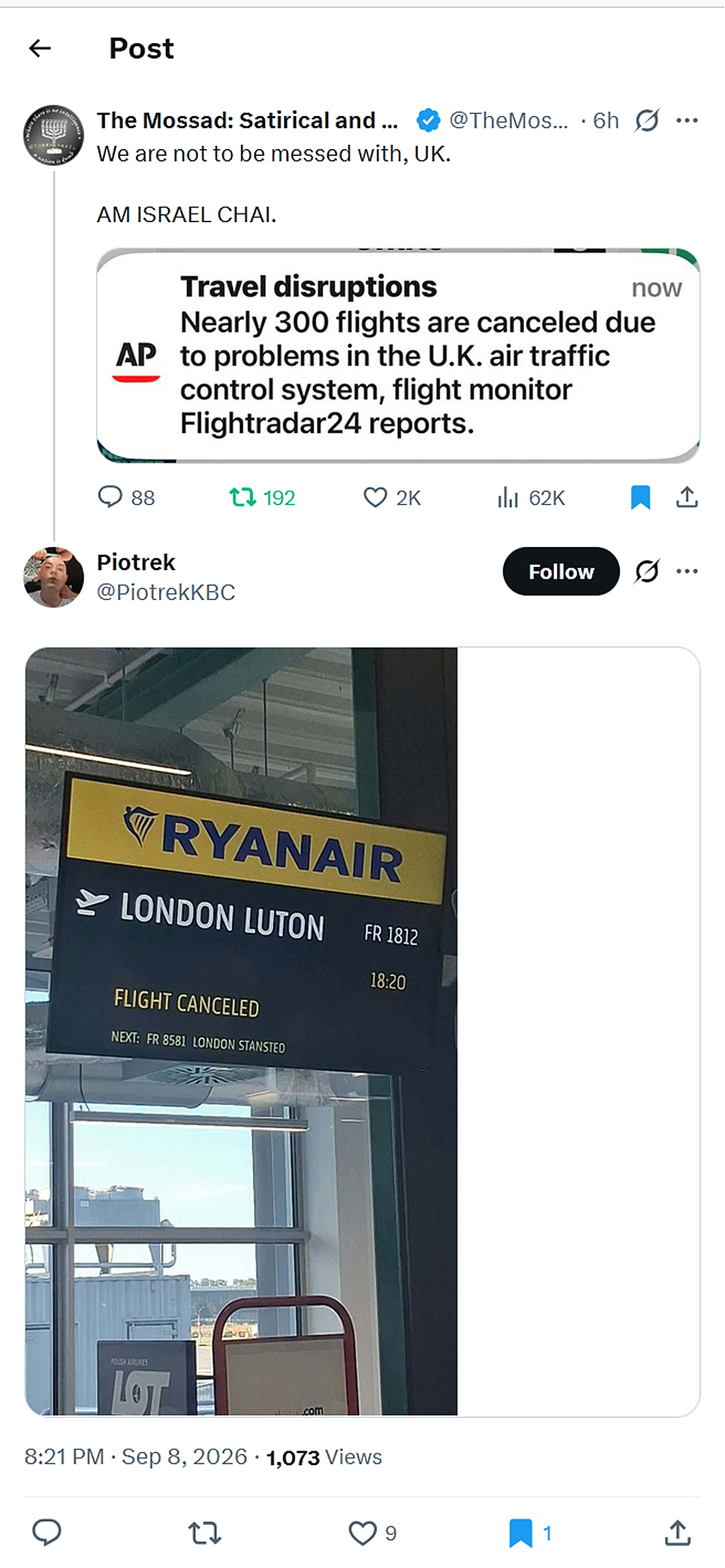 The Mossad Satirical and Awesome-tweet-8September2026-We are not to be messed with, UK
|
|
JerusalemCats Comment: Let the British guess what Israel will do. We will be glad to provide them with Nightmares.
Israel ready to pull investments from UK, says ex-minister‘UK cannot expect business as usual’ after imposing sanctions, says former deputy foreign minister Sharren Haskel resigned in July in protest at government policy on conscription Credit: Eyal Warshavsky for The Telegraph Tony Diver
Israel could end investments in Britain because of Ed Miliband’s sanctions on West Bank settlements, a former senior Israeli foreign minister has said.
Sharren Haskel, who was Israel’s deputy foreign minister until July, said Israel would be weighing up “additional measures” against Britain, including trading restrictions and the withdrawal of investments.
Writing for The Telegraph, she accused Mr Miliband, the Foreign Secretary, and Andy Burnham, the Prime Minister, of “surrendering to radicals within their own party” and of “election interference” before Israel’s legislative elections on Oct 27.
On Tuesday, Mr Miliband announced a trade ban on goods from Israeli settlements in the West Bank, accusing “terrorist” settlers of “ethnic cleansing” Palestinians.
The sanctions – the lowest point in diplomatic relations between the UK and Israel for decades – were met with retaliatory measures by Benjamin Netanyahu’s government.
Israel closed Britain’s consulate in Jerusalem and imposed travel bans on 12 pro-Gaza MPs.
Senior Whitehall sources confirmed to The Telegraph that Mr Miliband had been warned Israel’s response would be severe because of the elections next month, in which Mr Netanyahu could be deposed.
Civil servants in the Foreign Office advised that imposing sanctions shortly before an election would damage relations with Israel far more than if Britain waited until November.
Officials had also told Yvette Cooper, Mr Miliband’s predecessor, that sanctions might not be effective because British importers would struggle to distinguish between settlement goods and those produced within Israel’s pre-1967 borders.
The Jerusalem consulate is used as Britain’s de facto mission to the Palestinian territories, and to evacuate diplomats from Tel Aviv when the embassy there is closed because of Iranian bombing.
Ms Haskel said Britain and Israel were engaged in a “diplomatic tit-for-tat” that could escalate, with further sanctions from both sides possible.
She said: “Make no mistake, the UK cannot expect things to be business as usual. This week’s announcement represents a crossing of the red line. The Israeli public regard this as a betrayal from a country we once considered one of our closest and most important allies.”
Ms Haskel noted that Israel had backed Britain in the Chagos Islands dispute at the UN, and had provided military equipment to British forces operating in the Middle East.
Mr Miliband, she said, had presided over a “betrayal that has wiped out decades of goodwill”.
She added: “Faced with the extreme steps of the British Government, Israel has no alternative but to consider what our future relationship will look like and will be seriously weighing up additional measures, including withdrawal of investments in the UK and our own trading restrictions.”
Official figures published by the Government in July showed Israel was the eighth largest source of foreign direct investment in the UK, with 16 separate projects. Total bilateral trade between the UK and Israel was worth almost £6bn last year.
Ms Haskel was considered a key ally of Gideon Sa’ar, the Israeli foreign minister, and became his deputy when he signed an agreement to join Mr Netanyahu’s government in November 2024.
She resigned in July over plans to stop arresting ultra-orthodox Jews who refused to serve in the Israel Defense Forces, arguing that it would harm “the security of the country during wartime”.
Mr Miliband’s decision to impose sanctions came after the Israeli government announced plans for the E1 project, a development in the West Bank that will link Jerusalem with the Ma’ale Adumim settlement, almost cutting off Palestinian East Jerusalem from the rest of the territory.
Mr Miliband said on Tuesday that the E1 project had crossed a “long-standing red line” in August, when Israeli ministers issued their tender for 1,200 new homes on Israeli-settled land.
He added that the project was designed to create “a set of facts on the ground to make the two-state solution unviable” and accused Israeli settlers of “ethnic cleansing”.
Mr Miliband also called Israeli occupation of Palestinian territory “unlawful” for the first time – a significant hardening of Britain’s diplomatic position – and accused Israel of trying to make the two-state solution unviable.
A Foreign Office spokesman said: “We do not comment on internal advice, but we always carefully consider a range of options before major announcements – we have been clear that we had to act now in defence of the two-state solution.
“As the Foreign Secretary has said, we knew that Israeli retaliation was a possibility and weighed up the costs and the benefits in advance as part of our planning.”
|
|
Scottish, Welsh and Northern Irish leaders meet to plan break-up of United Kingdom
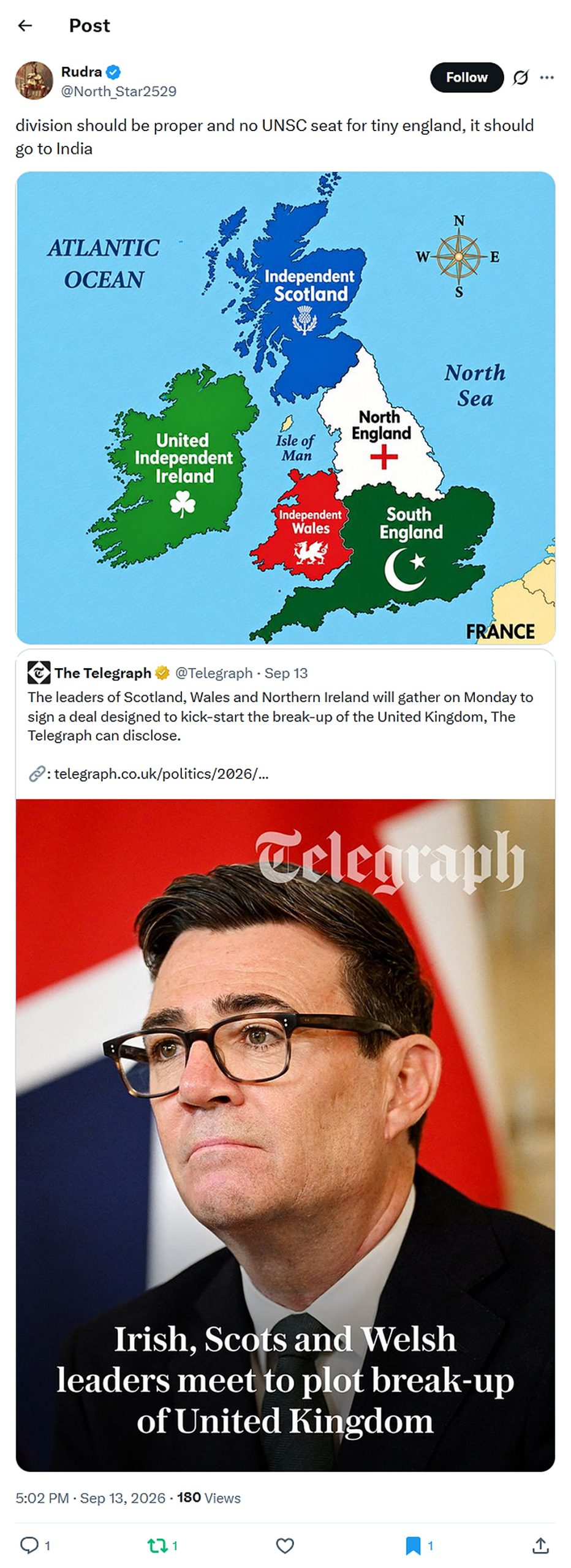 Rudra-tweet-13September2026-irish-scots-and-welsh-leaders-meet-to-plot-break-up-uk
|
|
Close the French consulate in Jerusalem
Now, Regavim and 5 leading organizations sent a letter to @netanyahu @EmmanuelMacron 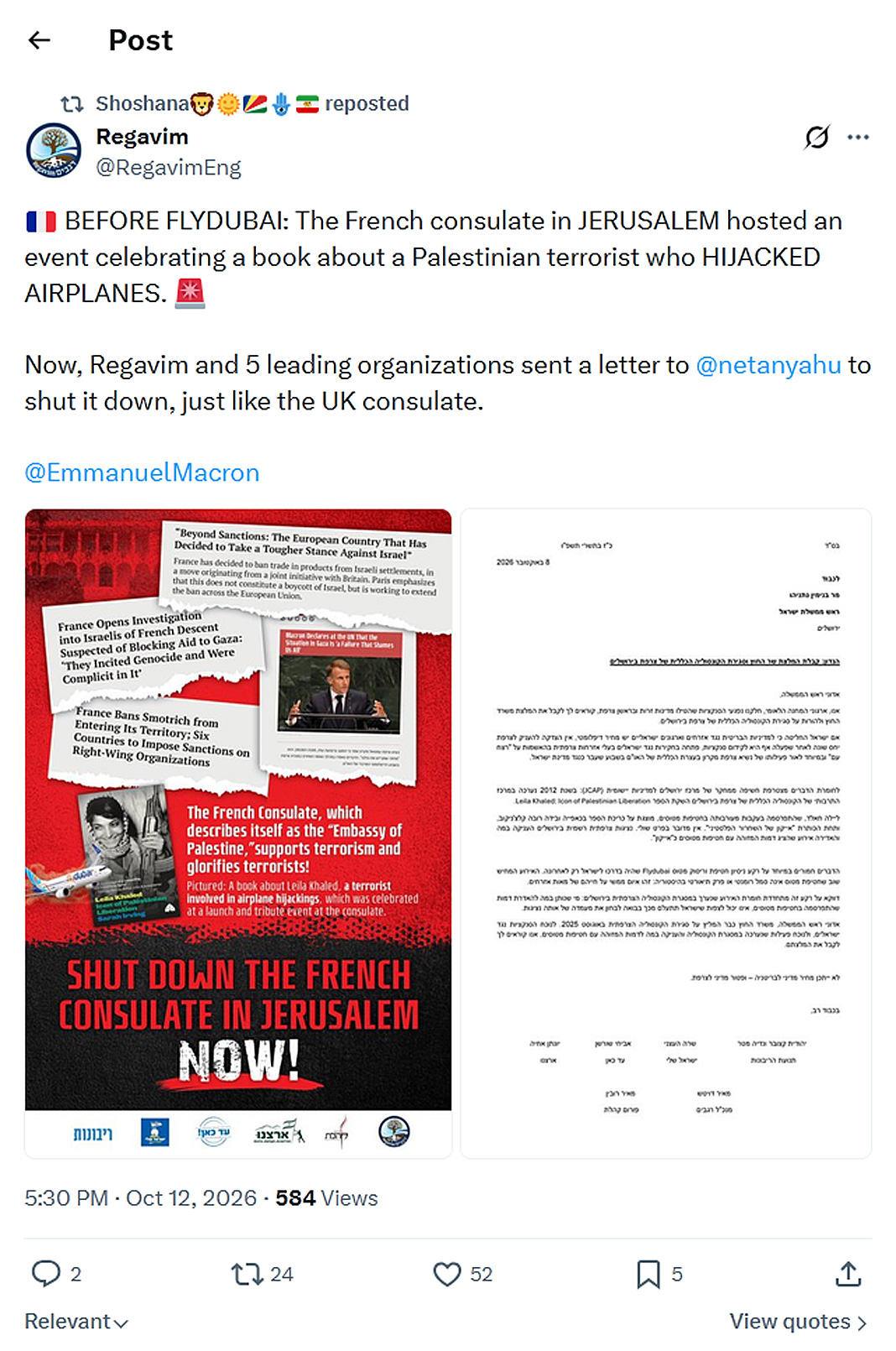 Regavim-tweet-12October2026-Close the French consulate in Jerusalem
 Shut Down the French Consulate in Jerusalem NOW!
|
|


|
Jerusalem Center for Security and Foreign Affairs https://jcfa.org Understanding Israeli Interests in the E1 Area: Contiguity, Security, and Jerusalemhttps://jcpa.org/understanding-israeli-interests-in-the-e1-area/
Jerusalem and EI area boundaries Why This Study Was WrittenThe Israeli building program known as E1 (East-1), situated between Jerusalem and Maale Adumim, has been on the Israeli and world agenda for twenty years. It is subject to a severe Israeli-Palestinian dispute and prompts strong international opposition. As a result, it has yet to be implemented.
On November 30, 2012, after long years in which Israel had almost completely frozen the program, a scaled-down forum of nine ministers of the Israeli government met and decided to renew the planning, approval, and construction processes in the E1 area. This decision was part of Israel’s reaction to the UN General Assembly resolution on recognizing the State of Palestine as an observer state that is not a full member of the United Nations.
Many countries displayed a total lack of understanding for Israel’s decision and condemned it, sometimes harshly. The White House spokesman, for example, said the program contravened U.S. policy and damaged the chances for a two-state solution. The Israeli ambassadors in Britain, France, Sweden, Spain, and Denmark were summoned for reprimands.1 In addition, fourteen of the fifteen members of the UN Security Council declared that the organization opposed Israel’s plans to build in E1. UN Secretary-General Ban Ki-moon said Israel had taken a “dangerous path.”2
At the beginning of January 2013, a group of Palestinians, with the backing of the Palestinian Authority, set up a protest encampment in E1. Israel waited a few days and then, with Supreme Court approval, evacuated it.
The Israeli government and Prime Minister Benjamin Netanyahu rejected the criticism over the decision to build in E1. The Prime Minister’s Office affirmed that Israel would “continue to act in accordance with the vital interests of the State of Israel even in the face of international pressures, and there will be no change in the decision that has been taken.” Israel’s decision was also taken in light of the fact that, according to every past Israeli government, Maale Adumim must be retained by Israel, and the Palestinians have agreed to this in past negotiations. Therefore, the connection of Maale Adumim to Jerusalem needs to be addressed when planning the future of the area.
At the beginning of December 2012, the Supreme Planning Council for Judea and Samaria, part of the Civil Administration, began to implement the government’s decision. It decided to deposit the construction plans for two of the E1 residential neighborhoods for public approval, a significant stage in the succession of approvals that still await the plan. At the last minute, however, an order by the Prime Minister’s Office put a halt to this procedure, and so far the plan has not been deposited for public approval.
This study discusses the E1 plan, its great importance for the State of Israel, and its vicissitudes over the years. It refutes the claim that the plan would hinder the two-state solution, or prevent linkage between the populations of the northern and southern West Bank. It describes the longstanding consensus in Israel about the future of Maale Adumim and the vital link between Jerusalem and Maale Adumim, of which the E1 plan is an integral aspect; the place of the Adumim bloc in the concept of metropolitan Jerusalem; and the place of that concept in Israel’s approach to security and settlement.
The study also explains why avoiding building in E1 is dangerous to Israel’s interests, and likely to result in Maale Adumim and Jerusalem being severed from each other. At the same time, the report strongly criticizes the Israeli authorities’ failure over the years to eradicate the phenomenon of illegal Palestinian building in the area between Maale Adumim and Jerusalem. While this stems from concern for the reaction of the international community, it is gradually constricting Israel’s options in an area so vital for its future integrity.
As the study shows, the E1 area is located in Area C, the portion of the West Bank in which Israel has the powers of zoning and planning according to the Oslo II Interim Agreement. In the last year, the Palestinian Authority has nonetheless undertaken development projects in Area C, some with EU financing. Thus the situation on the ground is not static, and Israel will have to find a way to protect its vital interests, especially in this sensitive area, to the east of its capital. The Essential Points
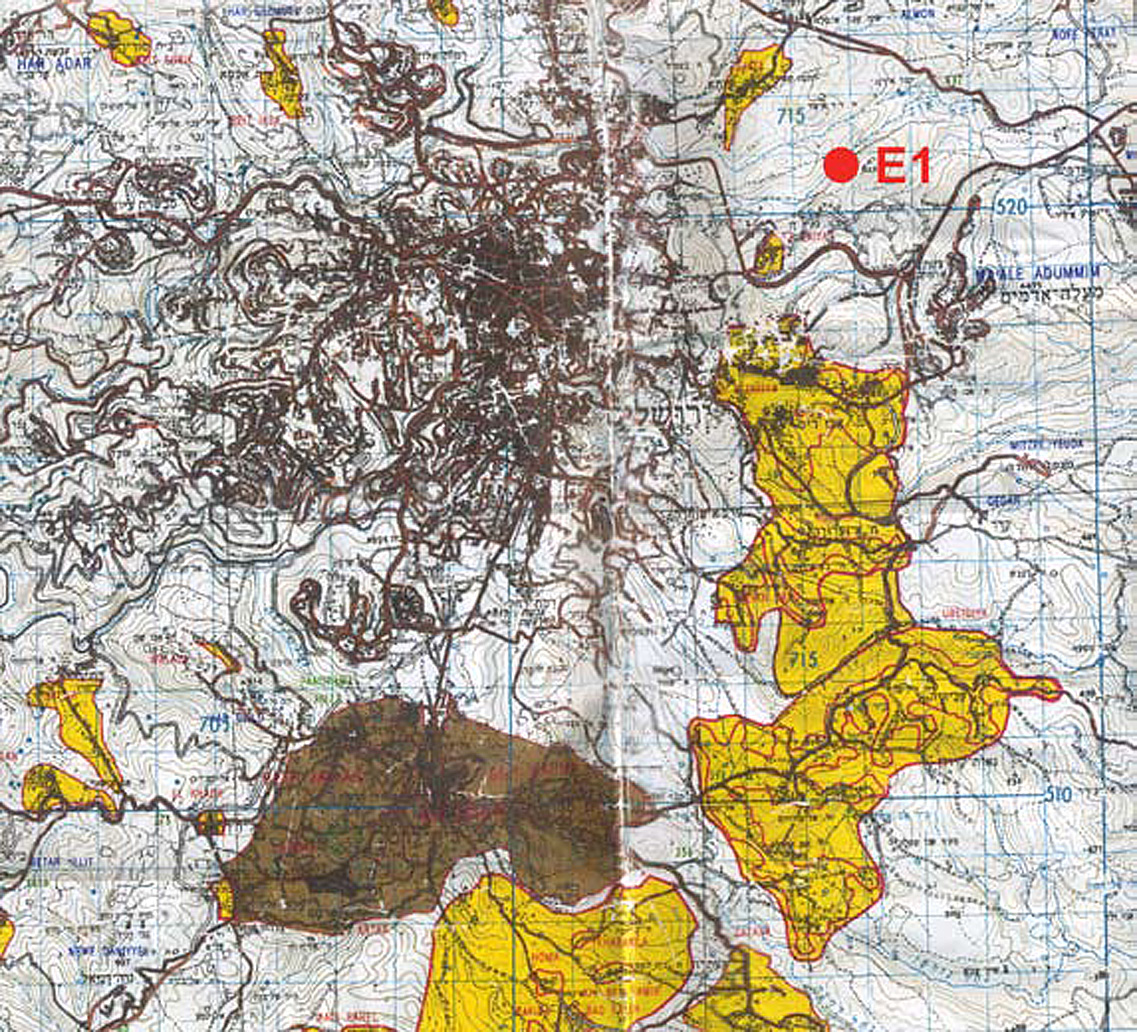 Map of 1995 Oslo II Interim Agreement showing eastern approaches to Jerusalem. Areas marked in yellow are “Area B” where the Palestinian Authority has full civilian jurisdiction including zoning and planning authority. White areas in the West Bank are “Area C” where Israel has full security responsibility and civilian authority over zoning and planning. The main connection between Jerusalem and Maale Adumim must clearly run north of Abu Dis and Azariya, which is precisely where E1 is located. Unfortunately, the Palestinians have been building illegally in Area C close to the main road connecting Jerusalem and Maale Adumim, thereby narrowing the corridor between them. If Israel fails to build in E1, the area will be taken over by Palestinian construction.
The Security Component of the Metropolitan Jerusalem ConceptFormer prime minister Yitzhak Rabin said that forgoing the construction of E1 would mean severing Maale Adumim from Jerusalem and probably changing Maale Adumim into what Mount Scopus was from 1948 to 1967. In those years Mount Scopus was an Israeli enclave in the heart of an Arab area. Only a narrow road provided access to it, and Israel was dependent on the mercies of the Jordanian regime and the United Nations to preserve even such a minimal connection. Rabin expressed apprehension that if Israel were to fail to link Jerusalem to Maale Adumim with a continuity of Jewish settlement, the latter city would indeed experience the same fate as Mount Scopus.10 Rabin was the first Israeli prime minister to promote the E1 plan, aimed at creating that very continuity.
In 1996, Shimon Peres, Rabin’s successor as prime minister, discussed with the head of the IDF Central Command, Gen. Ilan Biran, and chief of staff Gen. Amnon Lipkin-Shahak, the security-settlement concept regarding Jerusalem. Biran explained, “Without territorial continuity in the areas surrounding Jerusalem, it will be hard to ensure Israeli rule. Everything must be done to create a continuity of Jewish settlement between Maale Adumim to the east, Givat Zeev to the north, and Har Gilo to the south.”The Biran plan spoke, among other things, of paving roads and arteries between all the points of Jewish settlement, thereby creating continuity to the east between Maale Adumim and Mount Scopus (the E1 area), to the north between Givat Zeev and Neve Yaakov, and to the south between Har Gilo and Jerusalem. During the presentation, Biran emphasized that if such Jewish territorial continuity was not created, then the Arab settlement blocs surrounding the capital would create their own continuity and “strangle” Jerusalem.11
In essence, Biran outlined a minimal version of the “defensible borders” doctrine, which is a necessary condition for Israel’s security. A slightly more developed version was presented later by Gen. Yaakov Amidror, formerly head of the Research and Assessment Division of IDF Military Intelligence and currently Israel’s national security adviser.12 He, too, specified the area between Jerusalem and Maale Adumim as vital to defending the country.
In the early 2000s, an extra-governmental team of experts, composed mainly of professionals in the urban-planning and military fields, also recommended to the government that it design the borderline of Jerusalem in a way that would ensure the urban continuity of the Jewish neighborhoods. A secret document that the team submitted to the Sharon government, which at that time became a sort of political master plan for the Israeli leadership, stated:
The recommendations adopted by the political echelon also stated: “One must enable the Palestinian population to maintain a continuous transportation connection between Bethlehem and Ramallah outside the borders of Jerusalem. According to need, use should be made of bridges or tunnels without transferring ownership of the land above the tunnels or under the bridges.”This recommendation is of great importance; it touches directly on the claim that the E1 plan interrupts Palestinian continuity between the northern and southern West Bank, a subjected addressed at length below. Israel’s Need for Strategic DepthIsrael’s need for strategic depth as a component of defensible borders is endorsed today by most Israeli military and security professionals. This strategic depth must include sufficient combat space to deploy defensive forces that will be able to maneuver within it, a reserve force capable of mounting a counterattack if needed, and sufficient distance from the strategic home front.
The area between Maale Adumim and Jerusalem, along with the area to the east in the direction of the Dead Sea, is essential to providing Israel with strategic depth in case of the reemergence of threats to the east. In a time of regional instability marked by regime changes, but also in quieter periods, it is forbidden to dismiss the possibility of an eastern front that threatens Israel again taking shape. Hence, the strategic depth provided by the area from Jerusalem through Maale Adumim to the Dead Sea must be regarded as vital for defending the borders of the State of Israel.
In the 1980s, security officials noted that “the spatial dimension in the security context of defending Jerusalem must be such that it can make a contribution to military victory in time of need.”They further asserted:
Gen. Amidror has noted that, in case of a future war, Israel must ensure Jerusalem’s security in two regards:
The City of Maale AdumimMaale Adumim was established by a decision of the Israeli government in 1977. The cornerstone-laying ceremony for the first residential quarters was held two years later, and three years after that, in 1982, the first residents entered the new neighborhoods. In 1991, the state recognized Maale Adumim as a city, the first Israeli settlement in the West Bank to attain such status since Jewish construction there was renewed in the wake of the Six-Day War. Today Maale Adumim numbers about 40,000 residents. A revision of the city’s master plan carried out in recent years updated its aims. The new population target for the city is 103,000 residents, compared to the previous target of 70,000.
At the same time, because of political constraints and the resulting decrease in construction, the city’s rate of growth in recent years has been very modest. Instead of about 500 housing units per year, in recent years no more than a few dozen new units have been built annually. Location and NatureMaale Adumim is located on about seven square kilometers east of Jerusalem on the Jerusalem-Jericho road, close to the northern Jerusalem neighborhoods of Pisgat Zeev, French Hill, and Ramat Eshkol. The city’s buildings extend to the Judean Desert, 450 meters above sea level. Despite being situated at the edge of the desert, the city and its buildings do not have a desert-like nature. Instead, there are broad boulevards, squares, and numerous wide open public areas. Buildings are constructed in the stone-faced Jerusalem style. Maale Adumim’s dependence on Jerusalem for employment, commerce, culture, and education, and the lack of a significant urban center in the city, make Maale Adumim in many regards a suburb of Jerusalem. The Link between Jerusalem and Maale Adumim15Between Maale Adumim and Jerusalem lie a number of Arab villages: Abu Dis, Azariya, A-Zaim, and Isawiya. The road that connects Jerusalem and Maale Adumim is Highway 1, which ends at the entrance to Maale Adumim. Access to Highway 1 from Jerusalem is in the French Hill area and also via the newer Mount Scopus road. Using that road, one can get from Jerusalem to Maale Adumim in about five minutes. Despite their physical separation, the two cities’ geographic proximity makes them mutually visible. Maale Adumim can be seen clearly from Mount Scopus and the Mount of Olives. From Maale Adumim one can see Jerusalem with the three towers that adorn its skyline: the Hebrew University tower, the Augusta Victoria tower, and the tower of the church in A-Tur.
As noted, Maale Adumim does not provide all the public services that its residents need. There is no hospital in the city. Cultural amenities are relatively limited, and most of the public transportation from Maale Adumim goes to Jerusalem. Hence, Maale Adumim’s residents are to a large extent reliant on Jerusalem, which also contains many of the government offices that residents sometimes need.
In addition, 80 percent of the city’s manpower is employed in Jerusalem. There are, however, also a number of ways in which Maale Adumim serves or will serve the residents of Jerusalem. Among these are the Mishor Adumim industrial zone, where thousands are employed. The garbage dump for metropolitan Jerusalem is also located within Maale Adumim’s jurisdiction and is under its responsibility. This dump is now being shut down. The long-term plan for the area is to establish a center for service, employment, and business in the E1 area that will serve both Jerusalem and Maale Adumim residents. Other Attributes of Maale AdumimMaale Adumim’s jurisdiction extends over about 65,000 dunams. These include residential areas, afforestation areas, an industrial zone, leisure areas, and other locations. Much of the territory within the Maale Adumim master plan cannot be used for residential building. Some of this territory is used for IDF firing ranges; other parts are intended for roads and other public services.
Eighty-three percent of the residents are native Israelis; 81 percent are secular and traditional and 18 percent are religious. Some 8,300 children attend the city’s schools, and 2,000 are in its nursery schools and kindergartens. There are 9,000 residential units in the city.
E1 Area Connecting Jerusalem and Maale AdumimJerusalem and EI area boundaries The E1 AreaThe site known as E1 encompasses an area of about 12,100 dunams (4.6 sq. miles), most of it state land, to the north and west of the Jerusalem-Maale Adumim road. In 1991 during the Shamir government, then-defense minister Moshe Arens signed a document transferring part of this area to the Maale Adumim Local Council.16
In January 1994, the Settlement Subcommittee of the Supreme Planning Council for Judea and Samaria issued a new plan that widened the previous Maale Adumim master plan. This plan constituted the basis for the future E1 plan, and then-prime minister Rabin ordered his housing minister, Benjamin Ben-Eliezer, to begin planning a neighborhood to be situated in E1. Since then the planning procedures for the E1 neighborhood have advanced very slowly due to international and Palestinian opposition.
The E1 area extends over the hills between Maale Adumim and Jerusalem, which dominate the main roads in the area.17 E1 includes areas north of Highway 1 (the Jerusalem-Jericho road) and a small piece of land south of it. The boundaries of E1 (in the area designated for industry and commerce) verge on those of municipal Jerusalem. To the southeast, E1 is bordered by Highway 1, Azariya, Abu Dis, and lands of the Jahalin Bedouin tribe. To the west it is bordered by Issawiya, the eastern slopes of Mount Scopus, A-Zaim, and Anata. The northern boundary is Road 437 in the area of the Hizme checkpoint. 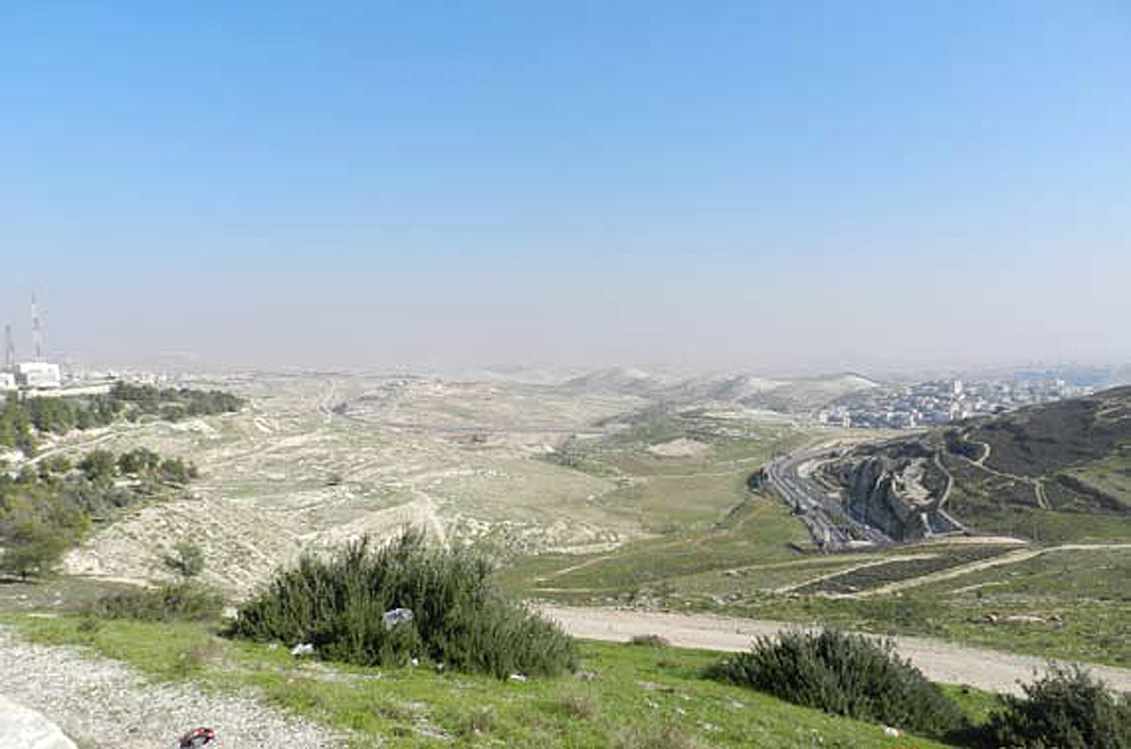 View of the E1 area and Maale Adumim (on right) as seen from Jerusalem (Mount Scopus).
Google Earth Map – View from Jerusalem to the Dead Sea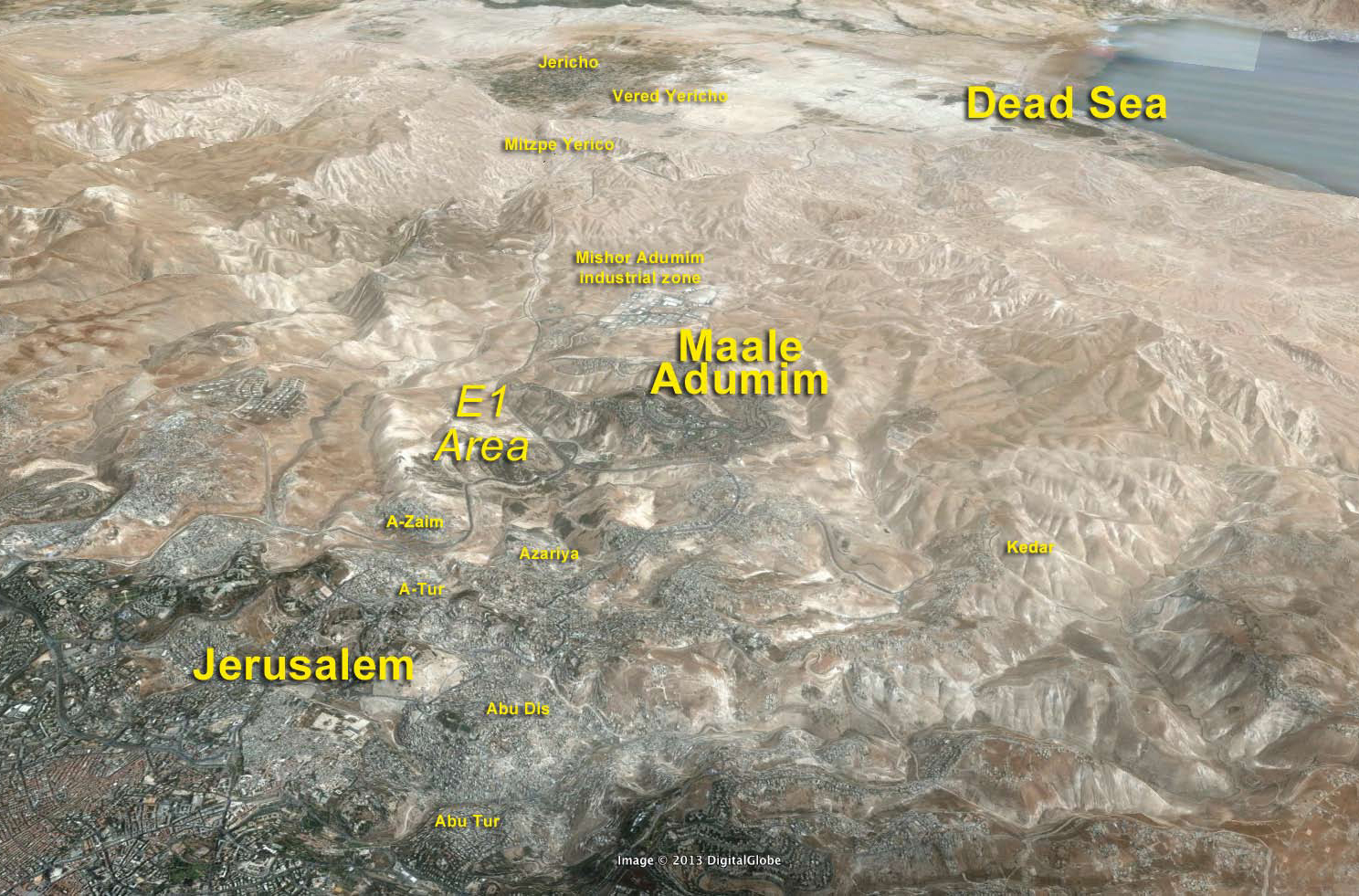 Google Earth Map – View from Jerusalem to the Dead Sea
The E1 plan has several parts, not all of which have been approved:
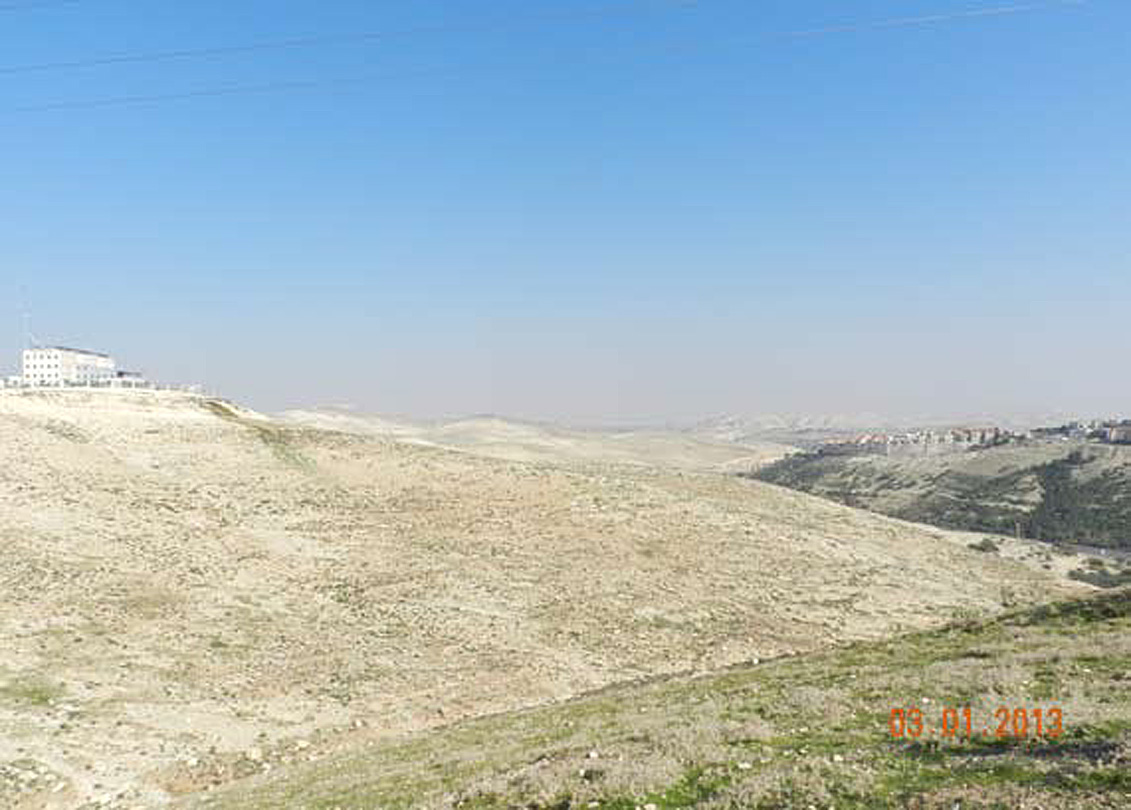 Maale Adumim (right) and the Israel Police station (left) in the E1 area. E1 is meant to connect Maale Adumim to Jerusalem. The Palestinian Bypass RoadThe main charge of the Palestinians and the international community against Israeli building in E1 is that it will prevent the state of Palestinian from having territorial continuity and a link between the northern and the southern West Bank, thereby thwarting any attempt to arrive at a permanent settlement.
Israel is offering a feasible solution to the problem in the form of a bypass road, which is already partially paved. The route of the completed road will run from north to south, between Jerusalem and the Adumim Bloc, linking the northern West Bank to the southern part as an alternative to other existing roads. The Palestinians reject this solution. 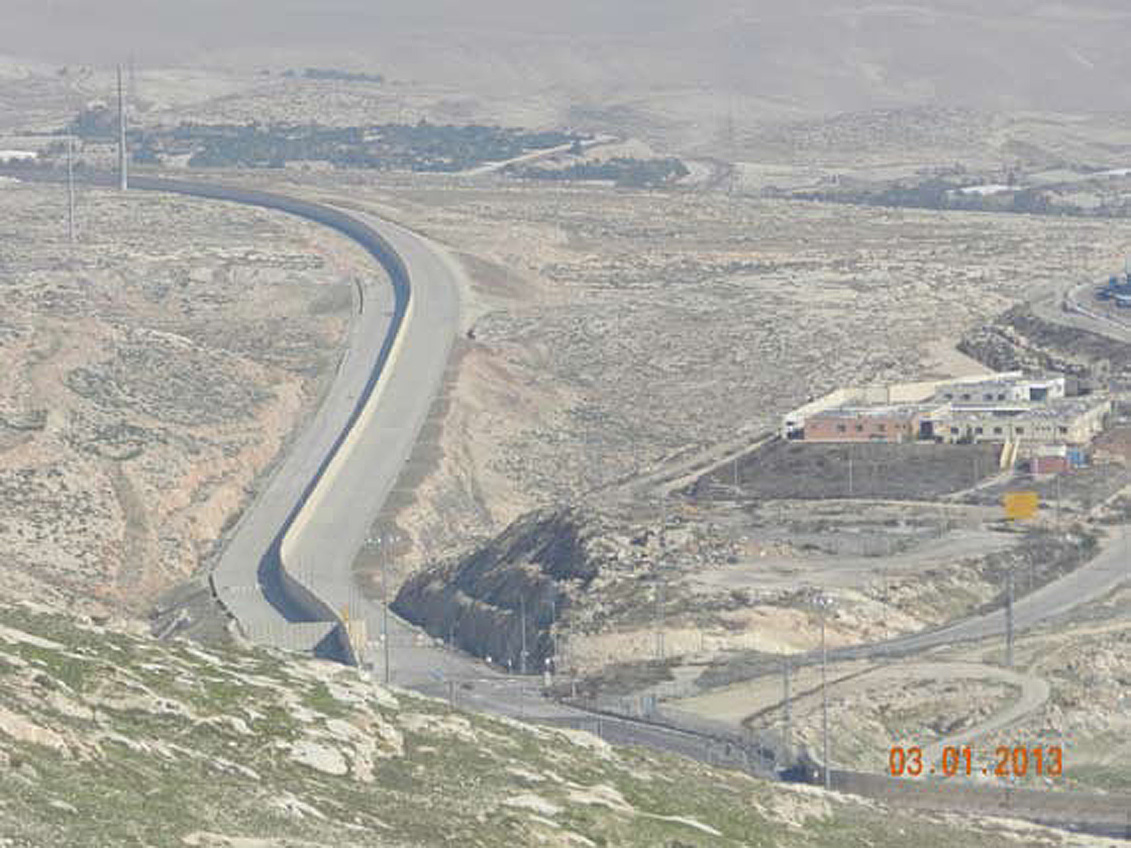 A completed section of the Palestinian bypass road. Its final completion will enable transportation continuity between the northern and southern West Bank, similar to other existing “fabric of life” roads built for the Palestinians.
In September 2007, Israel expropriated 1,408 dunams of the lands of Abu Dis, A-Sawahra a-Sarkia, Nebi Musa, and Khan al-Ahmar for the purpose of paving the bypass road to connect Ramallah to Bethlehem.19 The section of the road from Hizme to the A-Zaim checkpoint has already been paved, at a cost to Israel of close to NIS 300 million, passing through a tunnel under the Jerusalem-Maale Adumim road. Thus the Palestinians can have transportation continuity without breaking Israel’s link between Maale Adumim and Jerusalem.
The road has yet to be completed due to budgetary constraints and opposition by the United States and the Palestinians. The Palestinians fear that paving the road will vitiate their claim about the severance of the northern and southern West Bank, which is at the heart of their campaign against Israeli building in E1. Part of the already-existing bypass road is divided by a wall in the middle, separating Israeli and Palestinian traffic.
The bypass road, when completed, stands to provide a good and fair solution to the problem that the Palestinians raise. Israel cannot accept the opposition to the building of E1 and the bypass road for two main reasons:
In recent years, this has led to the creation of a number of roads that are either for Israeli or Palestinian traffic only. Palestinian communities that supposedly are severed from each other by the presence of Israeli communities are in fact linked by such roads, even if traffic is sometimes restricted for security reasons. Likewise, Jewish communities that seemingly are cut off from each other by existing Palestinian communities are, in fact, connected by roads. Even if this reality is not always convenient for the two sides, they accept it as an existing fact of life.
Linkages of this kind exist, for example, between Jewish communities such as Avnei Hefetz, Einav, and Kedumim; between Kedumim and Yitzhar; from Maale Ephraim and the Jordan Valley to the Tapuach Junction and Ariel; between Ateret, Ofra and Shiloh; between Tekoa and Efrat; between Telem and Adora; and between Gush Etzion and Kiryat Arba. The connection from Jerusalem south to Gush Etzion also passes through the “tunnel road,” part of which has become a transportation corridor through Palestinian communities. After the Oslo accords, numerous bypass roads were paved for the Jewish population. These circumvent Palestinian population concentrations and enable safer movement for Jews, even if, not infrequently, travel time has been lengthened.
Traffic between Palestinian communities and hubs of life and work are subject to security restrictions because of past acts of terror. It will be possible to ameliorate this situation in the future when the security situation permits doing so.
In any case, there is separate Palestinian traffic, for example, on the underpass road between Bidu and el-Jib in the Givat Zeev area. Road 443 between Jerusalem and Modiin, which mostly serves the Jewish population, is crossed by passageways that serve Palestinians only. The old Road 60, running north-south along the central mountain ridge from the Wadi Harima area southward to the Beit El and Ramallah areas, currently serves Palestinians only. The section of old Road 60 from Karmei Tzur in the direction of Halhoul also serves Palestinians only, as does the road eastward from Ofra through Taibe in the direction of Kochav Hashachar and Rimonim, and the passage through Beitin (between Ofra and Beit El). Nor, today, are Jews allowed to travel on the old Jerusalem-Hebron road that passes Solomon’s Pools and Deheishe; only Palestinians may use it.
It is important to emphasize that these separate roads are currently operating and are not “apartheid” roads. Rather, they provide direct and convenient transportation links that enable both Israelis and Palestinians to reach their desired destinations without having to unnecessarily pass through areas that would complicate and lengthen their travel time.
In recent years the IDF has formulated a plan for paving new roads for exclusive Palestinian use. The plan includes parallel roads and roads to replace those now blocked by the separation fence.20
These roads are considered bypass (“fabric of life”) roads. The website of the Military Advocate General’s Office, which frequently has to defend the roads in the Supreme Court, explains that the bypass roads are
A similar concept is embodied by the planned bypass road linking the northern and southern West Bank – the road whose completion the Palestinians now oppose.
It is important to recall that the basic principle of the road as a tool not only for transportation, but also for solving political problems, was initially accepted by the Palestinian Authority. In the framework of the Oslo accords, its representatives agreed to the creation of a “safe passage” between Gaza and the West Bank. That arrangement was not implemented, since Israeli-Palestinian negotiations ran aground. In principle, however, the sides agreed, and have not abjured this agreement, to a land passage from the West Bank to Gaza that would constitute a substitute for territorial continuity. (Although Israel and the Palestinians remain divided on the course and nature of the Israeli presence in the passage, agreement prevails regarding its creation as part of the permanent settlement.)
The bypass road that is planned to enable Palestinian traffic from north to south is not fundamentally different from the safe passage route between the West Bank and Gaza. These two areas of Palestinian settlement, which are relatively distant from each other, would be linked only by a road rather than have territorial continuity. On the safe passage between Gaza and the West Bank, the Palestinians and the Israelis compromised. The Palestinians gave up land continuity and settlement continuity between Gaza and the West Bank; the Israelis agreed to the creation of a passage that in some ways turned some of its territory into an ex-territory. A similar understanding could be reached regarding the link between the northern and the southern West Bank. The nature of the road, and the traffic arrangements on it, could be decided through negotiations.
Illegal Palestinian Building in the Maale Adumim AreaBy delaying its implementation of the decision to build E1, Israel incurs a double cost. First, the linking of Jerusalem and Maale Adumim, to ensure that this strategic area will remain part of Israel, is yet to be achieved. After years in which a consensus prevailed on keeping this an Israeli territory in the context of the permanent settlement, the delay erodes this national consensus. Second, Palestinian and Bedouin settlement is encroaching on this space all the time, the great majority of it illegal: that is, this Palestinian construction is executed without any building permit. According to the Oslo II Interim Agreement, the territory between Jerusalem and Maale Adumim has been designated as Area C, meaning that the powers of zoning and planning were retained here by Israel. Illegal Palestinian construction enables the takeover of vitally important land, some of it within the E1 area.
Palestinian Construction Encroaching on the Jerusalem-Maale Adumim Highway (1989 vs. 2012)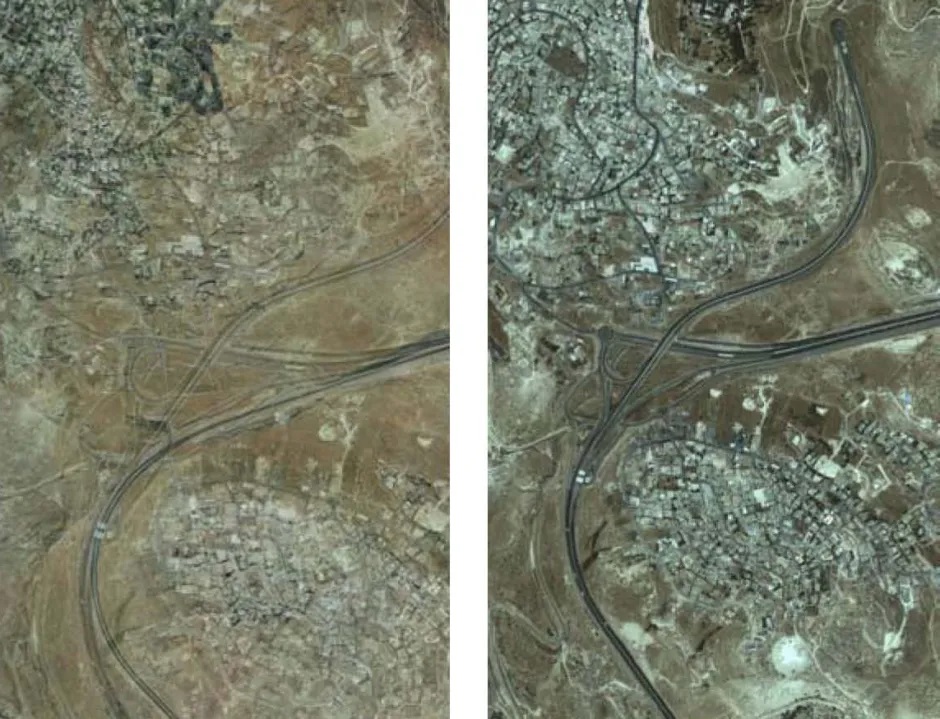 The West Bank town of A-Zaim (at bottom) and the Jerusalem neighborhood of A-Tur (at top) taken in 1989 (left) and in 2012 (right). The photos illustrate how the expansion of Palestinian construction over the years has constricted the area around the Jerusalem-Maale Adumim highway, effectively constricting the corridor connecting these two Israeli cities. This is precisely the challenge Israel faces all along this route including in the area of E-1. Israel has refrained from tackling this phenomenon, particularly because of international pressure and activity by leftist movements that provide support to this illegal settlement activity. Even Israel’s attempt to fulfill the letter of the law and settle the illegal interlopers, after evacuations, within permanent and legal settlement sites – such as the one set up at the end of the 1990s on the outskirts of Abu Dis – has not gone well. More recently, the Bedouins of the Jahalin tribe – who are under the sway of the Palestinian Authority and European organizations – rejected two further Israeli offers to create two additional permanent sites for their settlement, one south of Jericho and the other north of it (most of the Jahalin live in Jericho).
Moreover, some of the interlopers who in the past vacated lands in the area of Maale Adumim-Jerusalem and settled, in an arrangement with the state, at the permanent site in Abu Dis, sold their houses to others and went back to illegal building in their previous area of residence.21 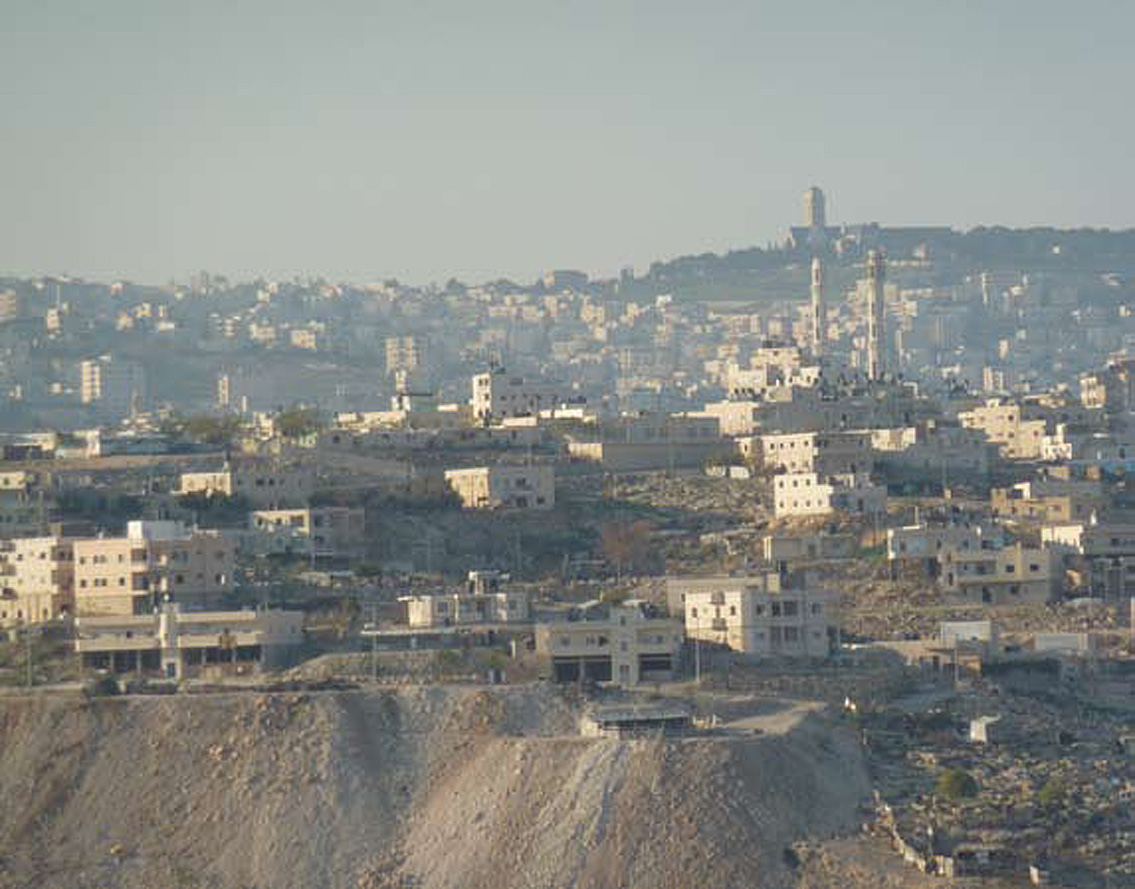 Israel built this permanent community for Bedouin on the outskirts of Abu Dis. Some sold their apartments and returned to illegal construction sites in the Adumim area.
A tour of the area to observe the illegal Palestinian settlement activity reveals the following picture: The Palestinians’ invasion and illegal construction begins within municipal Jerusalem north of Highway 1 at a site called Sha’ar Mizrach. This is mostly Jewish-owned territory occupying about 180 dunams in the Anata area. Although this tract of land has potential for linking Jerusalem to E1, currently the state is not allowing the land’s owners to exercise their ownership and also is not taking action against the illegal Palestinian building there.
A visit to the police station in the heart of E1, looking westward, reveals a further concentration of illegal Palestinian building, widely dispersed on rocky land. There are a hundred buildings made of iron, wood, blocks, and cement, with laundry lines hung between them. Some are covered with cloth, apparently for purposes of camouflage. Also visible are horses, goats, a water tank, and a mobile restroom. Not far away is a smaller cluster of more improvised and temporary structures made of tin, wood, and iron.
Such a “landscape” is typical of many of the dozens of illegal Bedouin-Palestinian outposts in the area. Such concentrations, each having individual structures sometimes numbering in the dozens, can also be found near the sewage purification plant south of Road 437 in E1, and also north of this road, as well as northwest of the Mahane Yishai junction, north of Highway 1.
Not all of these concentrations may be characterized as “spontaneous” building. Sometimes the building is supported by European organizations or by elements associated with the Palestinian Authority – and also, according to military sources, by the PA itself. Not infrequently in these clusters of illegal housing, new, cloth-covered structures appear. One also sees large water containers, and restroom structures of a kind not typical of Bedouin communities.
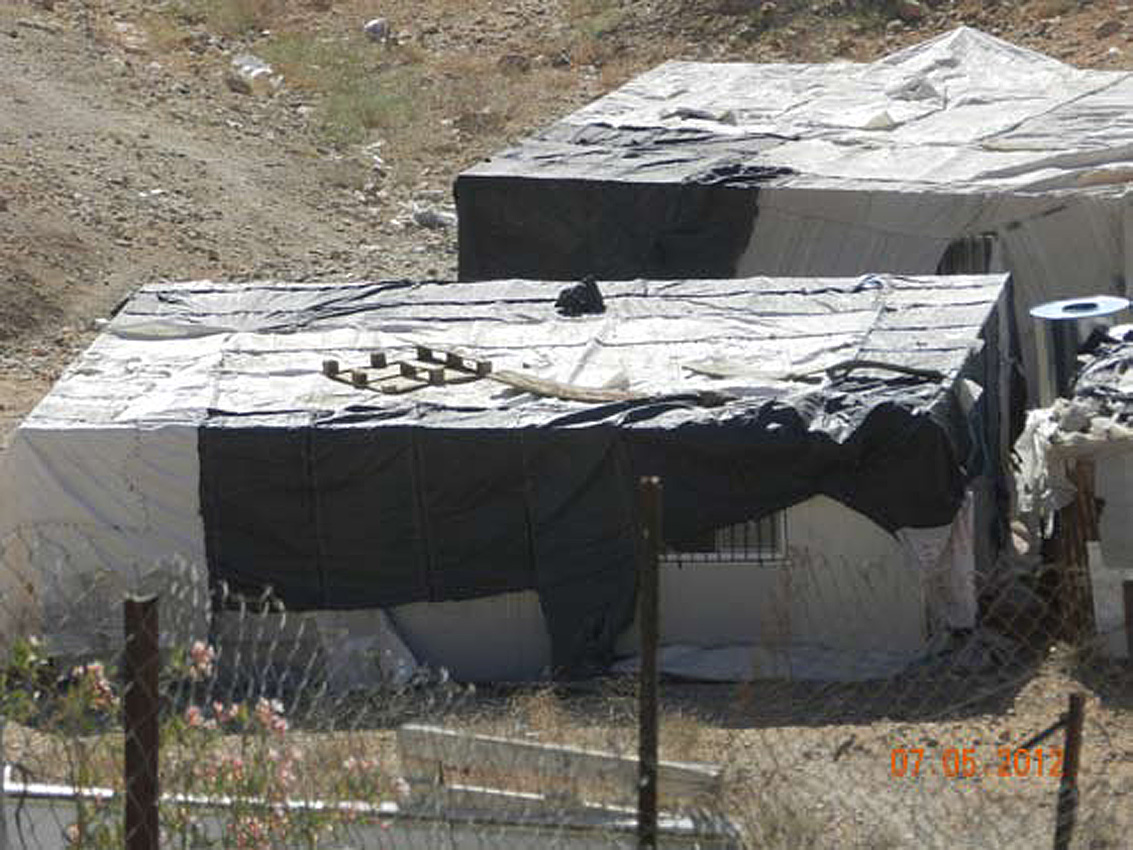 Prefab buildings br ought in without permits by Bedouin in the Mishor Adumim area, next to Route 1.
 A water meter installed by Mekorot, Israel’s national water company, next to an illegal Bedouin construction site near Nahal Og.
The areas that are attractive for illegal Palestinian settlement are those along Highway 1. Palestinians from Areas A and B can easily enter and build along this artery. The “magnet” is a spring that never runs dry: the pipeline of Mekorot, the Israeli water corporation. Many hundreds of pirate hookups have already been seen along this pipeline. Whoever travels on the road immediately grasps the situation: there are pick-up points for students and residents at every intersection, tractors that move at slow speed along a major highway, herds of goats crossing the road. The state and the Public Works Authority have invested many millions to build a road of the highest safety standards, a wide highway that connects Jerusalem to the Dead Sea area. Mountains were moved for this purpose; yet if the present process continues, soon this splendid road will wend its way through a large Bedouin village. The state is not dealing with the plague of pirate hookups and theft of water from the Mekorot pipeline; on the contrary, it is passively acquiescing. Recently, Mekorot installed a faucet with a meter, and the PA has been paying for the water that the Bedouins consume.
Another notable phenomenon is the Palestinians’ illegally accessing electricity by linking up to the street-lighting poles along the road, which has become widespread.
Also helping to entrench the illegal permanent presence of the Bedouin in the area is UNRWA (the United Nations Relief and Works Agency), which provides them with food and winter equipment while tending to their medical needs as if they are refugees. European organizations support the schools the Bedouin have set up and, with help from the PA, supply them with buildings and water containers. 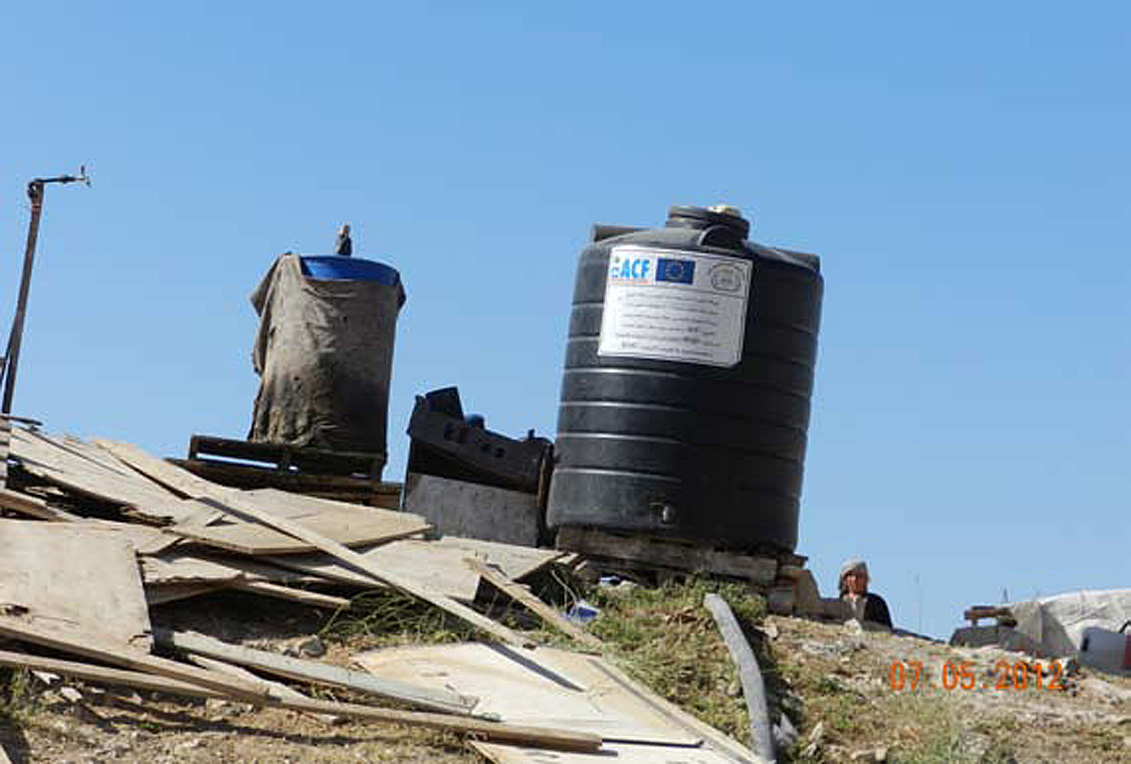 Water tanks at an illegal construction site in the Maale Adumim area, supplied by the humanitarian organization ACF and the European Union.
The Neglect of Illegal Palestinian BuildingThe state does not automatically open files on illegal building in the area. Occasionally it does so, and even issues demolition orders for buildings created without permits. The main problem is reluctance to implement these orders. In almost all cases the transgressors, with the help of various organizations, petition the Supreme Court against the Civil Administration, which issues the demolition and work-stoppage orders. The petitions present supposedly factual claims and various legal claims. The petitioners request that the demolition order be canceled, and succeed in delaying its implementation until the court rules on the petition. Because the demolition of a building is an extreme and irreversible step, the court usually accedes to the request. The judges issue an interim order until making a further ruling, and request the state’s response to the petition.
This is where the problem begins: the state submits repeated requests to defer the date and thereby drags out the case for years, until the patience of the court registrars runs out. The file is then canceled on grounds of inaction, and the interim order blocking demolition remains in force. Hence, in effect, the demolition orders that the Civil Administration issues are nullified, without serious discussion of the petitioners’ claims.
The Civil Administration’s Central Supervisory Unit became aware of this problem and reported in 2006:
The report of the Civil Administration Central Supervisory Unit for 2008 (published in 2009) made similar observations:
The report also states:
The State Attorney’s Office, in addressing these claims in the reports of the Civil Administration Central Supervisory Unit, stated that the policy of the Supreme Court Division reflected the general priorities for enforcement in this sphere.22 In other words, there apparently is no reason to pursue the case in court and have the petition rejected when, in any case, the enforcement authorities (that is, the Civil Administration) have no intention to demolish the buildings because of priorities related to a shortage of resources.
On May 1, 2011, the Supreme Court held a hearing on a petition (Supreme Court 9815/09) submitted by the Regavim movement, calling for the renewal of procedures on all the petitions of this kind that had been canceled or delayed because of inaction, while leaving the interim orders in force. (Regavim is a public movement that works for the preservation of state lands and assets and the prevention of their illegal takeover by various actors.) In the framework of this petition, the positions of the Civil Administration and the State Attorney’s Office were clarified. The discussion allowed the justices to hear the state’s defense against the charges, including an affidavit on the issue by the head of the infrastructures unit of the Civil Administration. The judges ruled that the phenomenon the petition called into question – the suspension of the cases – was no longer occurring and the petition was out of date.23
Yet a further inquiry, based on information obtained through the Freedom of Information Law, revealed that no significant change had occurred in the treatment of the demolition-order cases for illegal structures in the West Bank, in general, and the Maale Adumim area, in particular. According to an inquiry conducted in 2011,24 at that time, in the Supreme Court there were 162 petitions pending that had been submitted by Palestinians beginning in 2008, and on which interim orders had been issued forbidding the Civil Administration to demolish structures built in the West Bank without authorization.
In many cases, it turned out, more than ten consecutive requests had been submitted – in some of the cases, sixteen consecutive requests – to defer the date of the state’s response to the petition. In many instances the Supreme Court registrars had issued four or five warnings before cancellation on grounds of inaction, and in some cases seven such warnings had been issued. In these cases no discussion was held on the petition, the state having refrained from submitting its response to the petition and to the interim order. In such cases the interim order remains in force and, in effect, prevents the demolition. The upshot of these cases, like hundreds of others, is the effective cancellation of hundreds of demolition orders against illegal Palestinian building that have been issued in the West Bank, in general, and in the Maale Adumim area, in particular. 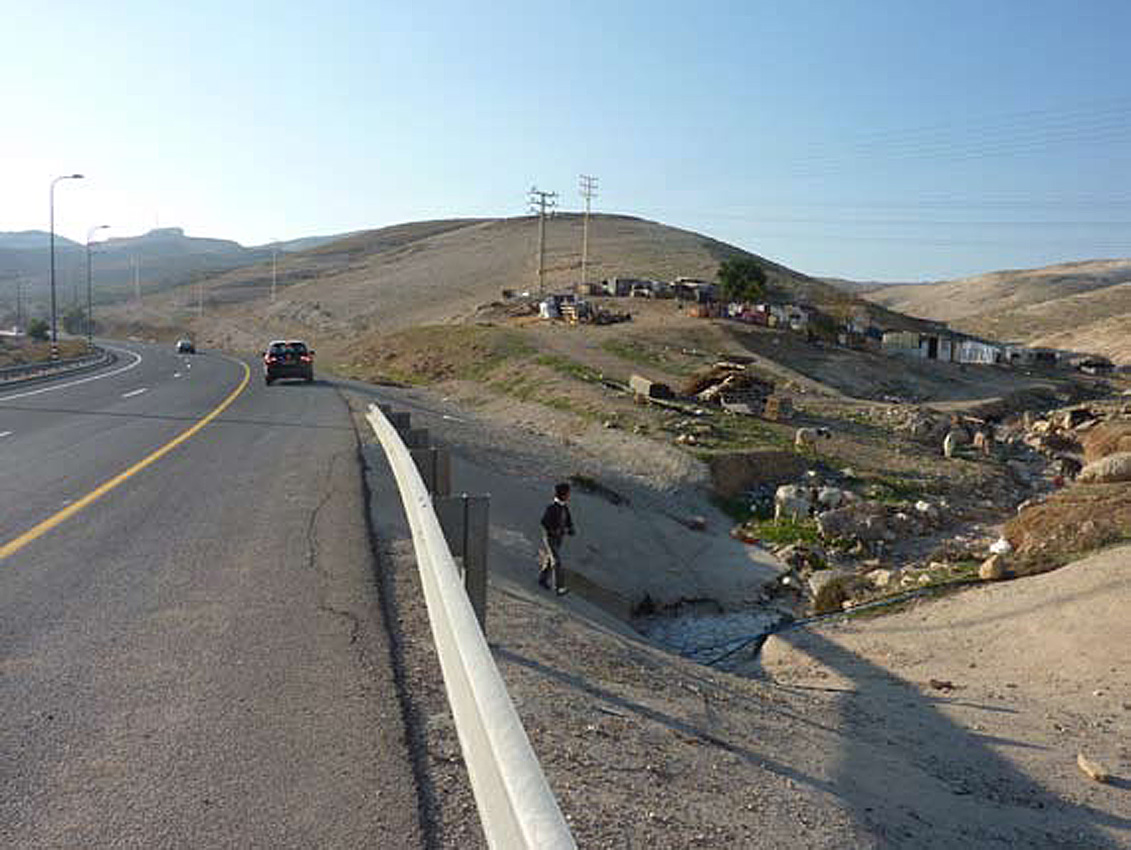 Illegal building by Bedouin next to Route 1
The Role of the State Attorney’s OfficeThe State Attorney’s Office is deliberately delaying action on these demolition orders. This behavior may be explained in statements by former Deputy Attorney General Malkiel Blass, written in the name of the attorney general, on April 11, 2009, in response to an earlier petition by the Regavim movement.
In his letter, the deputy attorney general writes that he has not found any problem in the state attorney’s conduct when declining to renew the procedures in the demolition cases for illegal Palestinian building. Blass explains that “in the area of planning and construction in Israel and the West Bank, there is a gap between the quantity of the demolition orders for structures that were not built according to the law, and the actual implementation of the demolitions,” and that “under these circumstances there is a need to determine orders of priority for carrying out the demolitions.” In the West Bank, he notes, “the considerations are quite complex….The attorneys are not the ones who set the priorities in carrying out
the demolition and many state authorities are involved in setting the order of priorities.” In sum, he states that “the issue requires the consideration of many other officials in the Israeli public administration and it is more complex than the consideration accorded by the attorneys in their handling of a certain case.”
A possible explanation is that political considerations are preventing the demolition of the illegal structures. Presumably, the root cause is pressure from the international community. In other words, Israel does not have the political latitude to demolish hundreds of illegal structures in the Adumim area and thousands more elsewhere in the West Bank. The Palestinian population is, of course, well aware of this reality, leading to still more illegal construction.
Because of pressure by groups like Regavim and various publications in the media, the state’s longstanding policy of avoiding demolition of illegal buildings has moderated somewhat in recent years. Yet the state is still far from dealing effectively with even half of these violations. On November 15, 2011, a meeting was held by the director of the Supreme Court Division of the State Attorney’s Office, attended by the head of the Civil Administration, the director of the Civil Administration Central Supervisory Unit, and representatives of the attorney general, to discuss the state’s position on cases (which were submitted to the Supreme Court) where work-stoppage and demolition orders were not implemented. It was decided that in such cases court injunctions should be issued “in accordance with the orders of priority of the responsible parties.”25
Nevertheless, in an event covered extensively in the media,26 when in January 2013 members of the Palestinian “Popular Committees” set up a protest encampment in E1, after the government’s decision to advance the planning processes for construction there, the state acted quickly, with the approval of the Supreme Court, to evacuate the encampment.
Over the years this situation, in which Israel has had difficulty coping with extensive illegal building, has reduced the width of the corridor between Jerusalem and Maale Adumim from about two kilometers approximately fifteen years ago to one kilometer and even less at present. This also constricts the possibilities for building in E1 and the adjacent areas.
Security officials, who concur with this assessment, warn that if Israel does not take significant steps to stop the Palestinian takeover of these areas, in the future it may be impossible to carry out the E1 plan as envisaged, particularly in the northwestern area that abuts Anata. Security officials believe that some of the Bedouin migration into the E1 area stems from fear of being left outside the route of the separation fence, which is intended to incorporate the Adumim bloc (including E1) into Israeli territory.
From an Israeli standpoint, then, the E1 building plan is virtually the only obstacle to the endeavor described in Nahal’s plan, since the international community does not allow Israel to act extensively and effectively against the illegal-building phenomenon. Over the years the Palestinians, for their part, have not concealed their goal of preventing Israeli building in E1. Faisal Husseini, the Jerusalem-based Palestinian leader who died in 2001, stated forthrightly that unauthorized building in the Jerusalem area was one of the Palestinians’ weapons in the struggle against Israel.27 As far back as 1993, Muhammad Nahal, an expert in urban planning at the Institute for Arab Studies that was part of Orient House, prepared a plan for the construction of three cities in the Jerusalem area that would surround the Jewish neighborhoods built in the Jerusalem area after 1967. One of the cities that Nahal planned was supposed to occupy lands of the villages of Azariya and Abu Dis, and its purpose was the encirclement of Jerusalem from the east.28
While Ehud Barak was prime minister, the Palestinians indeed formally requested that the E1 area be transferred to their control as part of Area B (where they have full civilian rule while security control remains in Israel’s hands). Their request was refused.29 At present, the Palestinian Authority provides support to illegal building, in general, and in the Maale Adumim area, in particular. In an event held at the illegal building site known as Khan al-Ahmar, Palestinian Prime Minister Salam Fayyad called the residents “the Bedouin land guardians.”30
After Israel evacuated the protest encampment at E1 in January 2013, the Fatah movement called this dismantlement a “crime” and averred that “this is not the end of the campaign to assert the Palestinian right to all of the Palestinian lands.”31
Maale Adumim and E1: The Heart of the Israeli ConsensusDuring a Knesset session on October 5, 1994, Prime Minister Yitzhak Rabin declared: “United Jerusalem would also encompass Maale Adumim as well as Givat Zeev as the capital of Israel under Israeli sovereignty.” Six months earlier, in April, it was Rabin who submitted the documents for the annexation of E1 to Maale Adumim Mayor Benny Kashriel.32 After Rabin’s assassination, Prime Minister Shimon Peres reaffirmed the government’s position that Israel would claim the application of Israeli sovereignty to Maale Adumim in the framework of a permanent settlement.33
At the beginning of April 2005, Prime Minister Ariel Sharon stated: “E1 is a plan ten years old, and the aim is to continue it.”34 Likewise, the defense minister in the Sharon government, Shaul Mofaz, said during a tour of E1 that he supported the plan to create Jewish continuity between Jerusalem and Maale Adumim.35 A public information video by the City of Maale Adumim36 shows major figures, over the past decade, affirming their belief in Maale Adumim and E1 and explaining their significance:
In past Israeli-Palestinian negotiations, the Israeli team insisted on Israel retaining E1 and the connection between Jerusalem and Maale Adumim. This was also part of the peace proposal made by former Prime Minister Ehud Olmert to Mahmoud Abbas.
Israeli Diplomatic Behavior on the E1 Issue: A Dual Message?Along with the frequent declarations of commitment to Maale Adumim and the E1 building plan, all recent prime ministers have acceded to requests by U.S. administrations and agreed to freeze, or to coordinate with the United States, the actual building in E1. Israeli leaders, too, after announcing that the planning processes for E1 would go forward, made clear that the plan had not yet reached the implementation stage.
This dual behavior pattern is marked by a built-in contradiction. On the one hand, domestic audiences hear the message that Israel is going to build E1, a location extremely vital to the country’s interests. On the other hand, world leaders receive another message through private diplomatic channels – that Israel will meanwhile heed the position of the international community. This behavior inevitably makes it very difficult for Israel to respond to international and Palestinian protests against the E1 plan.
The result on the ground is that the plan is not implemented, and despite the talk of “advancing” it, it has not even approached the implementation stage. Even after the December 2012 decision of the Supreme Planning Council for Judea and Samaria to deposit the plan for public approval (a decision not yet carried out), a long path still lies ahead. Many months must pass until the public-approval process is completed. The council then has to decide whether to accept all of the objections that are raised, reject all of them, or accept some of them. Assuming that the plan passes, the council then has to authorize it. Only then can the Housing Ministry prepare tenders for marketing the land for construction. Publication of the tenders also requires approval by the political echelon.
The Palestinian Decision to Fight over E1It was immediately after the Taba talks in January 2001 that the Palestinians decided to fight the E1 plan and recruit the world to the struggle. During the talks, Israel showed the Palestinian delegation a map of Maale Adumim that included the E1 area. Up to that time, the Palestinians had tended to agree to Israeli annexation of most of the settlement blocs, including Maale Adumim, in the context of territorial swaps. The Israeli assertion that the Maale Adumim bloc included E1, as well as land further east toward the Dead Sea, prompted a shift in the Palestinian position, and they retracted their prior agreement regarding Maale Adumim.37
The 2001 Taba talks, then, were the point at which E1 became a red flag for the Palestinians, even though previously they had not opposed it. And they indeed were able to harness the international community to their cause. Nevertheless, the dual message of the Israeli leadership – on the one hand, strong declarations on E1; on the other, delays and deference to the international community – has made it very hard to realize the supreme Israeli interest in building E1.
Already in Rabin’s day, Israel had refrained from carrying out the construction plans for the area because of an understanding with the Clinton administration that its fate would be determined in negotiations.38 Netanyahu, in his first term, tried to promote the plan and even initiated a decision to create a joint municipality for Jerusalem and the settlements surrounding it, but this too was stymied by U.S. opposition. Prime Minister Barak also spoke in favor of continuity and linking Jerusalem and Maale Adumim, but he allowed Israel’s negotiating team to discuss the future of this area in the framework of the permanent-settlement negotiations with the Palestinians.
The prime minister who succeeded Barak, Ariel Sharon, also supported continuity between Jerusalem and Maale Adumim and building in E1, but he, too, came up against U.S. opposition and in fact promised not to build there without coordinating with Washington. As his close adviser Dov Weisglass described it, there was never an Israeli commitment not to build, but it was agreed that such building would be announced in advance and carried out in coordination with the Americans.39
It was Sharon’s successor, Ehud Olmert, who gave the United States an explicit undertaking on this matter. In an interview to the Jerusalem Post in September 2005, Olmert publicly confirmed that Israel had promised the U.S. administration it would not build between Maale Adumim and Jerusalem. “The State of Israel made a commitment to freeze construction…therefore, we would be acting irresponsibly if we were to build there.” At the same time, Olmert, too, emphasized that this did not mean the plan had come to an end. He made similar statements to Mayor Kashriel of Maale Adumim in meetings held in recent years.
Conclusions
* * *
1. Barak Ravid and Natasha Mozgobia, “The United States Harshly Condemns the Intention to Build in E1,” Ha’aretz website, December 3, 2012 (in Hebrew). 2. “Catherine Ashton: ‘The Building around Jerusalem Is Unprecedented,’” Maariv-nrg website, December 20, 2012. 3. A dunam is equal to one thousand square meters, or roughly one-fourth of an acre. 4. See the video by the Jerusalem Center for Public Affairs, “Indivisible Jerusalem,” https://www.youtube.com/watch?feature=player_embedded&v=98DMPOC-dUQ. 5. Conference on settlement and security with the participation of members of the Settlement Division of the Jewish Agency, security officials, and those involved in the planning of settlements, held at the Jewish Agency at the end of the 1990s. 6. For elaboration on this concept, see the report “Metropolitan Jerusalem: Master Plan and Development,” prepared for the Ministry of Interior, the Ministry of Housing, the Israel Land Administration, and the City of Jerusalem, 1994 (in Hebrew). Research team headed by Shmarya Cohen and Adam Mazor in cooperation with the Jerusalem Institute for Israel Studies. Nadav Shragai, “Jerusalem: The Dangers of Division,” Jerusalem Center for Public Affairs, 2008, pp. 24-25. 7. Maia Hushan et al., “About Your Data,” Jerusalem Institute for Israel Studies, 2012, p. 7 (in Hebrew). 8. The data are based on the book by Aryeh Hess, Jerusalem and Her Daughters, self-published, 2009, pp. 28-30 (in Hebrew). However, the numbers were updated with the help of the database of the Interior Ministry and the relevant local and regional councils, and they are accurate as of the end of 2011. 9. Shragai, “Jerusalem,” pp. 24-25. 10. See, e.g., statement by former Knesset Speaker Reuven Rivlin on words in this spirit by Rabin and past leaders of the Labor Party, on the Megaphone site, article by Zvi Singer, “The Government Unanimously Rejected the UN General Assembly Resolution,” December 2, 2012 (in Hebrew). 11. Yossi Levy, “Gen. Biran: Only Territorial Continuity Surrounding Jerusalem Will Ensure Israeli Control,” Maariv, February 25, 1996, p. 15 (in Hebrew). 12. For elaboration on the issue of defensible borders in general and in the area east of Jerusalem in particular, see “Defensible Borders: A Necessary Condition for Israel’s Security,” Jerusalem Center for Public Affairs, 2005, article by Yaakov Amidror, “Israel’s Requirements for Defensible Borders,” and the appendix: “Military-Strategic Aspects of the Topography of Judea and Samaria for Israel’s Security” (in Hebrew; versions in English also available). 13. Appendix 7 of “Jerusalem: Links and Borders,” prepared by a professional team for the Ministerial Committee for Jerusalem Affairs during the 1980s (in Hebrew). 14. A lecture by Gen. Yaakov Amidror at the Lander Institute in 2007, at a conference on the unity of Jerusalem. 15. The facts presented at the beginning of this section are based on a survey prepared by the engineer of the Maale Adumim municipality, Gadi Brandeis. 16. Regulations Concerning Local Councils (Exchange of Maps) (Maale Adumim), 1991. Cited in Shmuel Berkovitz, The Wars over the Holy Places (Jerusalem: Jerusalem Institute and Hed Arzi, 2000), p. 171 (in Hebrew). 17. Map of the E1 plan. 18. From Protocol of the District Committee of Jerusalem No. 2011005, April 5, 2011 (in Hebrew). 19. Akiva Eldar, “Israel Expropriated Lands of Four Villages in the West Bank,” Ha’aretz, October 9, 2007 (in Hebrew); Aluf Benn, “The United States Demanded Clarifications on Israel’s Intention to Expropriate Palestinian Lands in E1,” Ha’aretz, October 14, 2007 (in Hebrew). 20. See “Paving Alternative Roads for Palestinians,” website of the B’Tselem organization, January 1, 2011 (in Hebrew). 21. Sources in the Civil Administration. 22. Response of the State Attorney’s Office, February 25, 2009, to the director of the Supreme Court Division (in Hebrew). 23. Ruling of Justices Beinisch, Grunis, and Hayut, Supreme Court 9815/09, January 5, 2011 (in Hebrew). 24. Letter by Amir Fisher, attorney for Regavim, to the director of the Supreme Court Division of the Justice Ministry, Attorney Osnat Mandel, December 25, 2011 (in Hebrew). 25. From the response of the State Attorney’s Office, December 18, 2011, to the request of the Regavim movement to participate in Supreme Court Case 9715/07 (in Hebrew). 26. See, e.g., Chaim Levinson, “The Police and the IDF Evacuated within Hours the Palestinian Encampment Set Up in E1,” Ha’aretz, January 14, 2013 (in Hebrew). 27. Husseini said at the time: “The most important Palestinian activity at this time is construction and even without a license.” See Nadav Shragai, “Jerusalem Is Not the Problem but the Solution,” in Moshe Amirav, ed., Mr. Prime Minister: Jerusalem (Carmel and the Floersheimer Institute, 2005) (in Hebrew). 28. A report in the local paper Jerusalem during that period. See also in Hagai Huberman, “The Battle forMevasseret Jerusalem,” Makor Rishon, December 14, 2007 (in Hebrew). 29. Huberman, ibid. 30. Yariv Mohar, “Palestinian-Bedouin Gesture in Appreciation of Human Rights Activists,” Mahlaka Rishona, May 16, 2011, https://www.news1.co.il/Archive/003-D-59703-00.html (in Hebrew). 31. “Fatah: Evacuation of the Outpost at E1 – A Crime,” website of Reshet Bet, Israel Radio, January 13, 2013 (in Hebrew). 32. Huberman, “Battle for Mevaserret Jerusalem.” 33. Protocol, meeting between Peres and Benny Kashriel, January 24, 1996 (in Hebrew). 34. Natan Guttman, “Sharon: We Will Continue the Project to Link Jerusalem to Maale Adumim,” Ha’aretz, April 5, 2005 (in Hebrew). 35. Nadav Shragai, “Mofaz: A Continuity of Settlement between Jerusalem and Maale Adumim,” Ha’aretz, March 3, 2003 (in Hebrew). 36. The video’s title translates to “Caution: They Want to Strangle Her.” 37. Ir Amim, position paper, December 2012, p. 4 (in Hebrew). 38. According to a minister in Rabin’s government. 39. Shomo Tzena, “Misunderstanding,” Israel Hayom, December 7, 2012 (in Hebrew)
|
|
E1, Jordan, PA (Fatah) & peaceJerusalemCats Comments: Will the PA-Fatah make peace? Jordan’s long-term stability cannot be taken for granted.
The E1 debate is not just about West Bank settlement construction – it’s about security – opinionUS policymakers should stop treating E1 as an Israeli-Palestinian real-estate dispute. It is about who controls the roads, high ground, and military corridors in Israel.By ERIC R. MANDEL 5SEPTEMBER2026 16:10
Twenty-nine Democratic senators have demanded that Israel halt proposed construction in the E1 area between Jerusalem and Ma’aleh Adumim, an Israeli city of 40,000 people.
E1 has long been a lightning rod for advocates of Palestinian statehood, who argue that Israeli construction would sever the Ramallah-Bethlehem corridor and destroy the contiguity of a future Palestinian state. But any viable Palestinian state would likely require tunnels, bridges, or dedicated roads to connect separated areas. Moreover, E1 lies in Area C, where Israel retains planning and zoning authority under the Oslo framework, despite international opposition.
Still, I believe building in E1 now is ill-timed. Israel’s most important ally, the United States, is already grappling with growing anti-Israel sentiment and antisemitic intimidation from the Democratic Left and the conspiratorial Tucker Carlson Right. Israel gains little by creating another unnecessary political confrontation with Washington at this time.
But Washington is asking the wrong question about E1.
The Democratic senators wrote, “The United States must remain committed to a two-state solution that delivers lasting peace and security for both the Jewish, democratic State of Israel and for a future Palestinian state.… development in E1 would seriously jeopardize the prospects for a Palestinian state.”
Their call for Israel’s security and a Palestinian state deserves more scrutiny.
Obstacles toward Palestinian stateThe obstacles to Palestinian statehood did not begin with E1. They began with the Arab rejection of two states in 1948 and their subsequent refusals for a state in 1967, 2000, 2001, and 2007-08, the last offered Palestinian sovereignty in Gaza and nearly all of the West Bank, with a Palestinian capital in east Jerusalem.
Underlying those failures is a question those American policymakers too often avoid: whether Palestinian society is prepared to accept a permanent Jewish state anywhere between “the river and the sea.”
After October 7, that question can no longer be treated as theoretical.
The real E1 debate should not be whether Israelis can build homes there. It should be whether Israel could ever safely relinquish security control of this strategically critical corridor.
Highway 1 runs east from Jerusalem, past Ma’aleh Adumim and E-1, toward the Jordan Valley. It is an essential artery connecting Israel’s major population centers on the coast with its eastern frontier, and provides a vital route for rapidly moving troops, weapons, and supplies toward Israel’s longest border with Jordan.
That matters because Jordan’s long-term stability cannot be taken for granted.
The Hashemite monarchy remains an important American and Israeli security partner, but Jordan is economically fragile and faces significant demographic and Islamist ideological pressures. American and Israeli strategists must contemplate the possibility that over the coming decade Jordan could face increased Sunni Islamist influence, Iranian destabilization efforts, or serious internal disorder.
If that happens, Israel’s eastern frontier could rapidly transform from one of its quietest borders into one of its most dangerous.
During visits with Israeli military personnel and intelligence officials, I saw firsthand the concern about weapons and narcotics smuggling across Israel’s eastern frontier. Weapons entering Judea and Samaria, the West Bank, can strengthen an already formidable Hamas and other armed groups’ presence, operating only miles from Israel’s major population centers.
Today, Israel is confronting increasing tensions inside the West Bank. Israeli security officials have warned repeatedly about the potential for significant escalation.
The Netanyahu government deserves criticism for failing to adequately restrain extremist Jewish violence. Those who attack Palestinians violate Israeli law and should be prosecuted. A future Israeli government should enforce the law aggressively.
But Jewish extremism is only one part of a much larger security problem. For decades, Palestinian Authority schools, official media, and religious institutions have promoted incitement and narratives that reject any Jewish sovereignty, while the PA’s notorious “pay for slay” system has financially rewarded terrorists and their families, incentivizing violence that makes territorial compromise increasingly dangerous.
This brings us back to E1.
There are actually two separate questions that Washington has mistakenly conflated.
The first is whether Israel should build in E1 today. I believe it should not. With an election approaching, beginning construction looks more like a political gesture to the Israeli Right than an urgent security requirement.
The second question is far more consequential: Should E1 ever come under Palestinian security control?
E1 sits alongside a vital corridor connecting Jerusalem and Israel’s coastal population centers with the Jordan Valley. The valley constitutes Israel’s eastern strategic barrier and could become dramatically more important if Jordan is destabilized.
October 7 fundamentally changed Israeli security doctrine. Israelis learned at catastrophic cost what happens when hostile armed organizations are allowed to build military infrastructure adjacent to Israeli communities. Israel cannot repeat that mistake on a vastly larger front.
American policymakers should stop treating E1 as an Israeli-Palestinian real-estate dispute. It is who controls the roads, high ground, and military corridors Israel will need in the next war to the east.
That makes E1 fundamentally a question of strategic depth, military mobility and Israel’s ability to defend its eastern frontier, not simply another argument about settlements.
The writer is the director of MEPIN, the Middle East Political Information Network, and is the senior security editor of The Jerusalem Report. He regularly briefs members of Congress, their foreign policy staffers, and the State Department.
|
|

USAID report finds more than 100 UNRWA employees participated in Hamas atrocities on Oct. 7The agency referred a former United Nations Relief and Works Agency for Palestine Refugees school teacher and Hamas operative for debarment for allegedly receiving and holding civilian hostages beginning on October 7, 2023.By Misty Severi Published: August 26, 2026 8:25pm https://justthenews.com/world/usaid-report-finds-more-100-unrwa-employees-participated-hamas-atrocities-oct-7
The United States’ Agency for International Development’s Inspector General’s office announced Wednesday that it has referred more than 100 current or former employees of a United Nations relief agency to the State Department over their participation in the October 7 terror attacks in Israel.
The referrals include three people they suggested be debarred by the department, including a former United Nations Relief and Works Agency for Palestine Refugees school teacher and Hamas operative who allegedly received and held civilian hostages beginning on October 7, 2023.
The agency did not give a full number of employees it referred, but said its investigation has resulted in one total debarment so far, after the individual was found to have coordinated communications with other suspected Hamas members during the terror attacks while serving as an UNRWA school principal.
Another individual was referred to the department for debarment, but records indicated the individual was deceased, and the proposal was withdrawn.
The new referrals come after the U.S. agency, which the Trump administration closed down last year, found in March that 14 UNRWA employees have been linked to Hamas.
More referrals to the State Department are expected, as well as potential criminal referrals to the Department of Justice.
Misty Severi is a news reporter for Just The News. You can follow her on X for more coverage.
 Office of Inspector General USAID logo.png INVESTIGATIVE SUMMARY: USAID OIG’s Ongoing Investigation Leads to Proposed Debarments of Two Former UNRWA Staff for Links to Hamas and One for Links to the Palestinian Islamic Jihad26August2026 https://oig.usaid.gov/node/8198
USAID OIG, a statutorily independent law enforcement and oversight entity, continues to investigate UNRWA staff linked to Hamas and other U.S. designated terrorist organizations. As part of this ongoing investigation, USAID OIG has referred over 100 current or former UNRWA staff for participation in the October 7 terrorist attacks in Israel and/or affiliation with Hamas to the U.S. Department of State for independent review of the evidence and consideration of suspension and/or debarment action. Of those referred, three have recently been proposed for debarment by the Department.
The individuals proposed for debarment include:
A fourth individual, Faisal Ali Al-Naami, was also proposed for debarment. However, records indicated the individual was deceased, and the proposal was terminated. Al-Naami was a former UNRWA social worker and Hamas military communications operative who allegedly participated in the kidnapping of a civilian from Kibbutz Be’eri on October 7, 2023.
This ongoing investigation has already resulted in the government wide debarment of Hafez Mousa Mohammed Mousa, an operative of the Hamas East Jabaliya Battalion, who was found to have coordinated communications with other suspected Hamas members during the October 7 attacks while serving as an UNRWA school principal. That action represented the first known debarment by the U.S. of a terrorist affiliated with a UN agency responsible for humanitarian assistance programming.
Additional referrals to the Department of State are expected, as well as potential criminal referrals to the Department of Justice.
It remains USAID OIG’s investigative priority to ensure that U.S.-funded humanitarian assistance does not fall into the hands of foreign terrorist organizations, depriving assistance from reaching civilians in need. In support of this effort, USAID OIG, with its unique global oversight capacity, has significant ongoing investigative work aimed at preventing the recirculation of terrorist-affiliated actors across U.S.-funded aid organizations, including UN entities.
For more on USAID OIG’s investigative results and ongoing work, please visit https://oig.usaid.gov/our-work/investigations.
To confidentially report fraud, corruption, or diversion of aid, please visit https://oig.usaid.gov/report-fraud.
|
|

Study: Academic Bias Shaped International Law’s Israel ConsensusAvraham Russell Shalev argues that legal journals, conferences and professional networks helped create a self-reinforcing framework while marginalizing Jewish and Zionist perspectives.
Jewish Onliner
 Academic Bias Shaped International Law’s Israel Consensus
On September 2, Israeli legal scholar Avraham Russell Shalev released a forthcoming paper arguing that the international legal consensus shaping many judgments about Israel has developed within an academic environment that Shalev argues systematically marginalizes Jewish and Zionist perspectives.
In his forthcoming paper From Blogs to Boycotts: Anti-Zionist Biases in Legal Academia, Shalev examines how international-law journals, conferences, professional networks and academic platforms help create the “expert consensus” later invoked by international institutions.
His central argument is not simply that individual scholars hold anti-Israel views. Rather, he argues that the infrastructure producing international-law expertise has developed institutional mechanisms that marginalize Jewish and Zionist perspectives, allowing a narrow ideological framework on Israel to become embedded as a dominant interpretation within parts of international legal discourse.
The paper examines controversies involving Opinio Juris, the Columbia Law Review, the Leiden Journal of International Law and what Shalev describes as informal “grey boycotts” against Israeli scholars.
The international law academy functions like a Cathedral, issuing condemnation after condemnation against Israel, while appealing to the authority of a supposed consensus of experts. All of the “experts” agree that Israel is committing war crimes, genocide, apartheid, etc — except for the experts who can’t get published because they disagree with the bon ton. My paper details: By purging Zionist Jews from international legal scholarship, the IL academy builds the intellectual basis for the weaponization of the law and the further marginalization of Jews and the Jewish state. Link in first comment –  Russell A. Shalev-tweet-2September2026-From Blogs to Boycotts
The Battle Before the CourtroomInternational legal campaigns involving Israel often rely on claims of expert consensus. Arguments about occupation, proportionality, self-defense, genocide and state responsibility frequently cite academic commentary and legal scholarship as evidence that a particular interpretation represents mainstream international law.
That influence is recognized within the international legal system itself. Article 38 of the Statute of the International Court of Justice identifies “the teachings of the most highly qualified publicists of the various nations” as a subsidiary means for determining legal rules.
Shalev argues that this creates an overlooked power center: the academic institutions that determine which scholars, arguments and interpretations receive legitimacy.
When certain perspectives are excluded from journals, conferences and professional networks, he argues, the resulting consensus can become self-reinforcing and influence the legal positions adopted by international bodies.  Article 38-International Court of Justice Credit: International Court of Justice (ICJ)
From October 7 to the Legal NarrativeA central focus of the paper is the reaction of parts of the international-law community following Hamas’ October 7 massacre.
Shalev examines international-law blogs such as Opinio Juris, arguing that some platforms have provided space for scholars whose responses to October 7 framed Hamas’ attack through anti-colonial theory while leaving Zionist perspectives underrepresented.
One example discussed by Shalev is an October 2023 Opinio Juris post by legal scholar Mohsen al-Attar responding to an interview with Professor Noura Erakat. The discussion situated October 7 within a broader anti-colonial framework and referenced Frantz Fanon’s argument that “decolonisation is always a violent phenomenon.”
The post also included an addendum published after October 7 that continued discussing the conflict through the lens of anti-colonial struggle. Critics argued that the framing risked treating Hamas’ attack primarily as an anti-colonial event rather than confronting Hamas’ deliberate targeting of civilians and the scale of the atrocities committed during the attack.
University of Haifa legal scholar Yahli Shereshevsky later criticized elements of the response within international-law circles, arguing that some reactions reflected a failure to fully acknowledge the nature of the October 7 attacks.
For Shalev, the episode represents a broader pattern: legal discourse surrounding Israel often begins from frameworks of colonialism, oppression and state violence while placing less emphasis on Israeli security concerns, Hamas terrorism and the legal obligations of non-state armed groups.
The Institutions Defining Acceptable DebateShalev also examines the controversy surrounding the publication of Rabea Eghbariah’s article Toward Nakba as a Legal Concept in the Columbia Law Review.
The article became controversial after the journal acknowledged that it had been commissioned and did not undergo the journal’s standard review process.
Shalev argues that the episode reflected a broader asymmetry: arguments challenging Israel’s legitimacy often gain access to prestigious academic platforms, while scholars defending Israel or contesting dominant narratives face greater professional barriers.
The paper also discusses cases involving Israeli scholars whose submissions were rejected or altered during publication processes, including Anne Herzberg and Tal Mimran.
Shalev also examines the controversy surrounding the Leiden Journal of International Law. He argues that the journal’s decision to add a disclaimer to an article by Israeli authors after criticism on social media reflected broader concerns about the treatment of Israeli scholars publishing on Israel-related issues.
The “Grey Boycott” of Israeli ScholarsBeyond formal publication decisions, Shalev focuses on what he calls “grey boycotts”: informal professional practices that isolate scholars without requiring an official boycott policy.
The paper highlights the 2018 controversy involving legal scholar Eugene Kontorovich at a conference hosted by the Asser Institute in The Hague.
Critics of Kontorovich’s scholarship on Israel and disputed territories, including Dr. Valentina Azarova and Professor Ralph Wilde, called on organizers to reconsider his invitation. When organizers refused to withdraw the invitation, Shalev argues that critics pursued informal forms of professional distancing from him.
The paper also discusses the case of Israeli scholar Daphné Richemond-Barak, an expert on underground warfare, whom Shalev cites as an example of the barriers Israeli scholars can face in international academic and policy settings.
Shalev further argues that Jewish and Israeli scholars have faced both explicit and informal exclusion from conferences, professional networks and academic spaces.
A 2024 survey by the Israel Young Academy and AFIK surveyed 1,015 Israeli senior faculty members and found that 32% reported significant damage to international collaborations and 26% reported difficulties presenting at international conferences.
The Question of Who Produces “Expert Consensus”The battle over Israel at international institutions does not begin when judges issue rulings or diplomats draft resolutions. It begins earlier, in the academic journals, conferences and professional networks that determine which legal theories gain authority and which scholars shape the boundaries of accepted debate.
Shalev’s central argument is that the struggle over Israel in international law is fought upstream, before court filings and diplomatic resolutions, through the institutions that determine which scholars, concepts and arguments acquire academic legitimacy.
His paper argues that before legal arguments reach courts, governments or international institutions, they are first filtered through the academic ecosystem that determines which scholars, concepts and interpretations receive authority.
|
|
JerrusalemCats Comments: 35 States (out of 50 States) have anti-BDS legislation that will bankrupt Norway Business if they try to boycott Israel. It was this same law that broke Airbnb’s boycott of Israel in 2019. This law would have bankrupted Airbnb. https://legallyexplained.com/how-many-states-is-it-illegal-to-boycott-israel/
UKLFI warns Norway that proposed settlement trade ban could breach international law14September2026 https://www.uklfi.com/13478-2
The Norwegian Government has been warned that its proposed legislation banning trade with areas of Israeli settlement in East Jerusalem, Judea and Samaria (the West Bank) could itself put Norway in breach of several binding international obligations.  View of Ålesund from Aksla, Norway by Diego Delso
UK Lawyers for Israel (UKLFI) has submitted a detailed response to a consultation by Norway’s Ministry of Foreign Affairs on the proposed legislation. The 22-page response challenges the Ministry’s assertion that international law requires Norway to introduce such a ban.
UKLFI’s response argues that, if enacted, the proposed law would be likely to breach:
The proposed legislation would also expose companies complying with the Norwegian ban to potential liabilities and sanctions under US federal and state laws, potentially discouraging US investment in Norway.
ICJ Advisory Opinion does not require Norway to impose a trade ban
The Norwegian consultation relies heavily on the International Court of Justice’s 2024 Advisory Opinion concerning the West Bank.
UKLFI argues that the Advisory Opinion does not require Norway to enact the proposed legislation. In particular, the Opinion does not impose a specific obligation on States to prohibit private trade in goods or services originating in Israeli communities in East Jerusalem or Judea and Samaria.
The response points out that the 2024 Opinion refers to States abstaining from certain economic or trade dealings with the State of Israel concerning the Occupied Palestinian Territory. It does not require States to legislate to prevent private parties from trading with businesses operating in the areas covered by Norway’s proposed ban.
UKLFI also challenges the Norwegian Government’s reliance on UN Security Council resolutions and non-binding UN reports. It argues that these cannot create new binding treaty obligations for Norway or displace Norway’s existing obligations under international trade agreements.
Proposed ban could breach WTO rules
A central part of UKLFI’s submission concerns the WTO.
The Norwegian consultation accepts that import and export prohibitions are, as a general rule, contrary to WTO agreements, but argues that WTO obligations do not apply to trade with Israel outside its pre-1967 borders.
UKLFI disputes this interpretation. It argues that WTO law adopts a functional approach to territory, focusing on the actual exercise of customs and tariff authority rather than questions of sovereignty or territorial title.
Moreover, UKLFI argues that even if Norway’s narrower interpretation of Israeli territory were accepted, the proposed legislation would still breach Article XI of GATT, because it would prohibit imports from Israeli territory within the Green Line of goods which originated in East Jerusalem, Judea or Samaria and are in free circulation within the Green Line pursuant to the Paris Protocol annexed to the Oslo II Accord. Similar issues arise under the WTO Agreement on Agriculture.
Trade agreements with Israel
UKLFI also challenges the Ministry’s interpretation of the EFTA-Israel Free Trade Agreement.
Article 32 provides that the Agreement applies to the “territories of the Parties” but does not define those territories as being limited to the pre-1967 armistice lines. UKLFI argues that there is no basis for simply assuming such a limitation.
The submission further points out that goods produced in areas of Israeli settlement are commonly transferred into Israeli territory within the Green Line and are in free circulation there before being exported. Article 7 of the EFTA-Israel FTA prohibits quantitative restrictions on trade between EFTA States and Israel and does not limit that prohibition to goods originating within particular territorial boundaries.
UKLFI therefore concludes that Norway would be likely to breach both the EFTA-Israel FTA and its bilateral Agricultural Agreement if the proposed law were enacted.
Businesses in the West Bank employ thousands of Palestinians
UKLFI also highlights the likely impact of the proposed ban on Palestinians.
The submission stresses that much of the trade described as “trade with settlements” is actually trade with private businesses operating near Israeli communities, rather than with settlements as such. Those businesses employ both Israelis and Palestinians.
According to figures from the Palestinian Central Bureau of Statistics cited in UKLFI’s response, approximately 17,600 Palestinians were employed in areas of Israeli settlement in the West Bank in the second quarter of 2026, earning on average twice the salaries paid by Palestinian employers. Before October 2023, the number was reported as approximately 25,000.
UKLFI argues that these jobs are particularly important at a time when unemployment in the West Bank has risen sharply. It therefore warns that a boycott could harm precisely the Palestinian workers and families whom the proposed legislation is intended to assist.
The submission includes statements from Palestinian employees of an Israeli business describing the benefits of their employment and warning that a boycott could damage their livelihoods and those of their families. One employee said that if a boycott caused the factory to close, “the first people who will suffer are us and our families.” Another said that the workplace brought Palestinians and Israelis together and that if people wanted peace, they should “strengthen this kind of cooperation, not destroy it.”
The “Namibia exception”
UKLFI also draws attention to the principle known as the Namibia exception, under which ordinary commercial activities benefiting the protected inhabitants of a territory are not necessarily regarded as tainted by the alleged illegality of the territorial administration.
UKLFI argues that this principle is particularly relevant to businesses employing Palestinian workers and benefiting the Palestinian population. It submits that purchasing their products, importing them into Norway or investing in such businesses does not constitute assistance in maintaining an allegedly unlawful situation.
The Response points out that Norway’s proposed exception for activities having a “sufficient Palestinian connection” appears to be too narrow because it would not protect Israeli businesses which employ substantial numbers of Palestinians.
Potential conflict with US law
UKLFI also warns that Norwegian companies complying with the proposed legislation could face conflicting obligations under US law.
The submission identifies US federal and state measures which prohibit or penalise participation in certain boycotts of businesses in territories governed by Israel. Potential consequences include criminal fines, imprisonment, administrative penalties, loss of tax relief, divestment, exclusion from procurement and claims for damages.
UKLFI points to the experience of Airbnb, which faced sanctions and legal action in the United States after announcing that it would withdraw its service from properties in Israeli communities in the West Bank.
Warning over antisemitism
The submission also warns that government-sponsored boycotts of Israeli businesses risk contributing to antisemitism.
UKLFI notes the historical association between organised boycotts of Jewish businesses and the mobilisation and intensification of anti-Jewish hostility. It also refers to modern research finding associations between BDS activity and hostility towards Jewish students and staff at US universities.
UKLFI urges Norway to abandon the legislation
UKLFI concludes that the proposed Act is not required by international law and could itself place Norway in breach of binding international obligations.
Its submission concludes:
“If the draft Act is enacted, Norway is likely to breach the EFTA-Israel FTA, the bilateral Agricultural Agreement with Israel, the GATT, the GATS and the WTO Agreement on Agriculture.”
It further warns that Palestinians could be harmed, particularly if similar legislation were adopted by other countries, and that antisemitism is likely to be further exacerbated. UKLFI therefore urges the Norwegian Ministry of Foreign Affairs to abandon the proposed legislation.
Jonathan Turner, Chief Executive of UKLFI, said:
Read UKLFI’s consultation response
|
|
JerusalemCats Comments: Norway, home of the 1993 Oslo Accords
Norway’s ban on JewsThe Scandinavian country is attacking private citizens and businesses to deprive them of their livelihoods, to make them unsafe.Jeff Ballabonhttps://www.jns.org/opinion/jeff-ballabon/norways-ban-on-jews
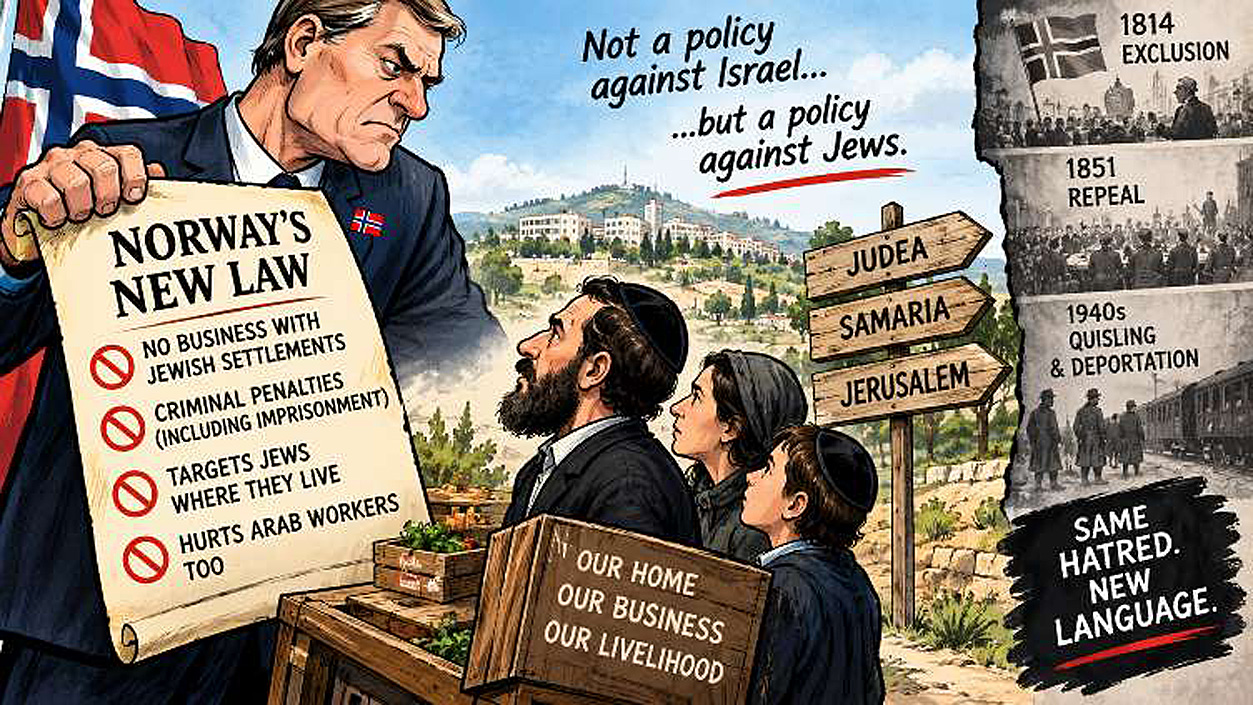 Norway’s ban on Jews
(Sept. 22, 2026 / JNS) “I will never accept a world in which Jews feel unsafe.”
Norway’s Foreign Ministry has put out a bill for consultation, expected this fall before its parliament, the Storting in the capital of Oslo, that would send Norwegian citizens and companies to prison—up to three years—for buying from, selling to, building for or investing in businesses owned by Jews who live in Judea and Samaria, including in the most ancient, revered, Jewishly significant parts of Jerusalem. Negligent violators get six months.
Norway’s law purports to address what it refers to as Israel’s “colonization policy.”
As they say in Norway: dritprat.
Set aside borders and sovereignty. Set aside self-determination and statehood. Set aside “occupation” and “settlements.” Set aside every position you may hold on Israel or its policies or even on its very “right to exist.” The proposed law addresses none of those.
It does not, in fact, address or impact the State of Israel. It focuses exclusively on trying to destroy the private lives of roughly 850,000 Jews for the apparent crime of living where Norway has decided Jews shouldn’t be allowed to live.
That is the entire law. Everything else—every Norwegian excuse, explanation and rationalization—is gaslighting. As the foreign ministry explained in its official press release: Norwegians “must not profit from or support” anything connected to Jews who live or work in Judea and Samaria.
That’s not foreign policy; that’s a twisted antisemitic purity test imposed on Norwegians.
In Judea and Samaria, of course, it isn’t only Jews who pay for this. Tens of thousands of Arabs depend for their livelihoods on Jewish-owned businesses, earning wages that run two to five times what’s available in the Palestinian Arab economy and accounting for a meaningful share of its GDP. The law’s supporters don’t particularly care about that since their purpose is not to help Arabs but to punish Jews.
Oslo wants the same thing the Nazis wanted: Judenrein territory, achieved by expulsion or, preferably, worse.
And Judenrein is the right word. What Norway is proposing is not merely comparable to what the German Nazis did. It is precisely what they did: criminalization of commerce with Jews because they’re Jews—undesirables whose very presence is intolerable.
Of course, the Nazis only exercised that power inside territory they actually controlled. Norway wants to exercise it over land which isn’t Norway’s, in a dispute it isn’t a party to, for the sole purpose of making sure Jews aren’t allowed to live in, of all places, Judea—the undisputed indigenous homeland of the Jews.
If, after the mass killings and expulsions that emptied Christian Europe and the Muslim Middle East of their Jews, the refugee remnant has no right to live in the most historically Jewish place on Earth, regardless of which political entity controls it, then Jews have no right to live anywhere. No right, in other words, to live at all.
It may seem extreme to accuse Norway of being more grotesquely antisemitic than Nazi Germany, until you pay attention. From its inception, modern-day Norway has treated Jews as “undesirables.” Ethnic cleansing, defined as the eradication of Jewish life, was one of the country’s foundational beliefs well before Nazism.
Its celebrated 1814 constitution—explicitly modeled on the American and French examples, and still taught as one of the most liberal founding documents of its age—contained this doozy: Jøder ere fremdeles udelukkede fra Adgang til Riget. “Jews are still excluded from admission to the kingdom.”
“Still,” because this was a proud continuation of the ban Christian V imposed in 1687. This wasn’t a mob’s or a monarch’s whim. It was Oslo’s constitutional convention debating whether Jews were, as one of the very few dissenters argued, “human beings after all.” His colleagues, describing Jews instead as “crude, corrosive vermin,” prevailed.
By 1814, Sweden, Denmark, Prussia, Austria and the Netherlands had all been liberalizing their own restrictions on Jews for a generation. Norway formally incorporated its Jew ban into its foundational DNA at the precise moment its neighbors were dismantling theirs.
Norway’s founding document is even more antisemitic than the Nazi Party’s founding platform, which stripped Jews of citizenship but did not ban their presence outright. Norway was Judenrein—a Jew-free polity—well over a century before Hitler’s regime existed to even coin the word. No wonder Norway claims to love the “Palestinian” cause: Both eagerly treat Arabs as cannon fodder in pursuit of their ambitions to dehumanize and demonize Jews. Henrik Wergeland, who became Norway’s national poet, spent his final years fighting to repeal what he called “the clause of shame” and died in 1845 without seeing it done. His blind, 82-year-old father picked up the fight. The Storting finally repealed it in 1851.
Norway got a second chance, however, and seized it eagerly.
In March 1942, reinstating the Jew ban was one of Quisling’s first acts as head of his new government—not as a German mandate, but as a Norwegian initiative. Norway’s Holocaust-era laws classified full, half- and quarter-Jews so thoroughly that it went further than the Nazis’ Nuremberg Laws. Of Norway’s tiny Jewish community, about 770 were rounded up (by Norwegian officials, not German soldiers) and deported to Auschwitz. Thirty-four survived.
Hitler didn’t need to import or impose Jew-hatred in Norway. It has always been essential to the country’s DNA.
The crime the Scandinavian country now wants to create also has a parallel. The Palestinian Authority has spent decades treating land sales to Jews as a capital offense; in 1997, its justice minister announced the death penalty for it. “Palestinian” land dealers were murdered within weeks. A P.A. military court sentenced a man to death by hanging in 2009 for selling land to Jews in Judea and Samaria. Official P.A.-funded religious authorities have ruled that anyone who sells to a Jew forfeits burial in Muslim soil. A “Palestinian”-American was sentenced to life in hard labor for it in 2018.
But Norway didn’t need this precedent now any more than it needed Hitler’s then. Norway is offering the P.A.’s stance of ethnic-cleansing legitimacy: The same underlying offense, punishing people for doing business with Jews, now available with the imprimatur of a Western parliament.
Eide has told the U.N. Human Rights Council that “human rights and human dignity is universal” and that “every person has equal and inherent rights that no government can take away.”
Really? Israel, the state Eide condemns in this conflict, extends full and equal citizenship to 2 million Arabs who vote, hold seats in its parliament and sit on its Supreme Court. The P.A., which demands that its territory be entirely free of Jews, is the one Eide wants to reward by ethnically cleansing the Jews of Judea and Samaria right now. Apparently, he agrees with Norway’s founding fathers that Jews are not “human beings after all.”
After the decimation and expulsion of Jews from Christian Europe and the Muslim Middle East, and after Jews found refuge in the tiny sliver left of their indigenous homeland, Norway wants to export its psychotic Jew hate to Judea and Samaria—the most Jewish place on the planet, where Jews have lived, often under conquest and abuse, but indigenous and without interruption for more than 3,000 years.
Norway tries to make it fashionable, invoking the new language of international law, wielding the new excuses of “colonization” (as though Jews can be colonizers of their own homeland), but the law itself makes abundantly clear that it is about none of that. Norway is attacking Jews—private citizens, individuals and families—and businesses to deprive them of their livelihoods, to make them unsafe.
Its clause of shame may soon be its laws of shame.
|
|
ERDOGAN Talking about a “Palestinian” State
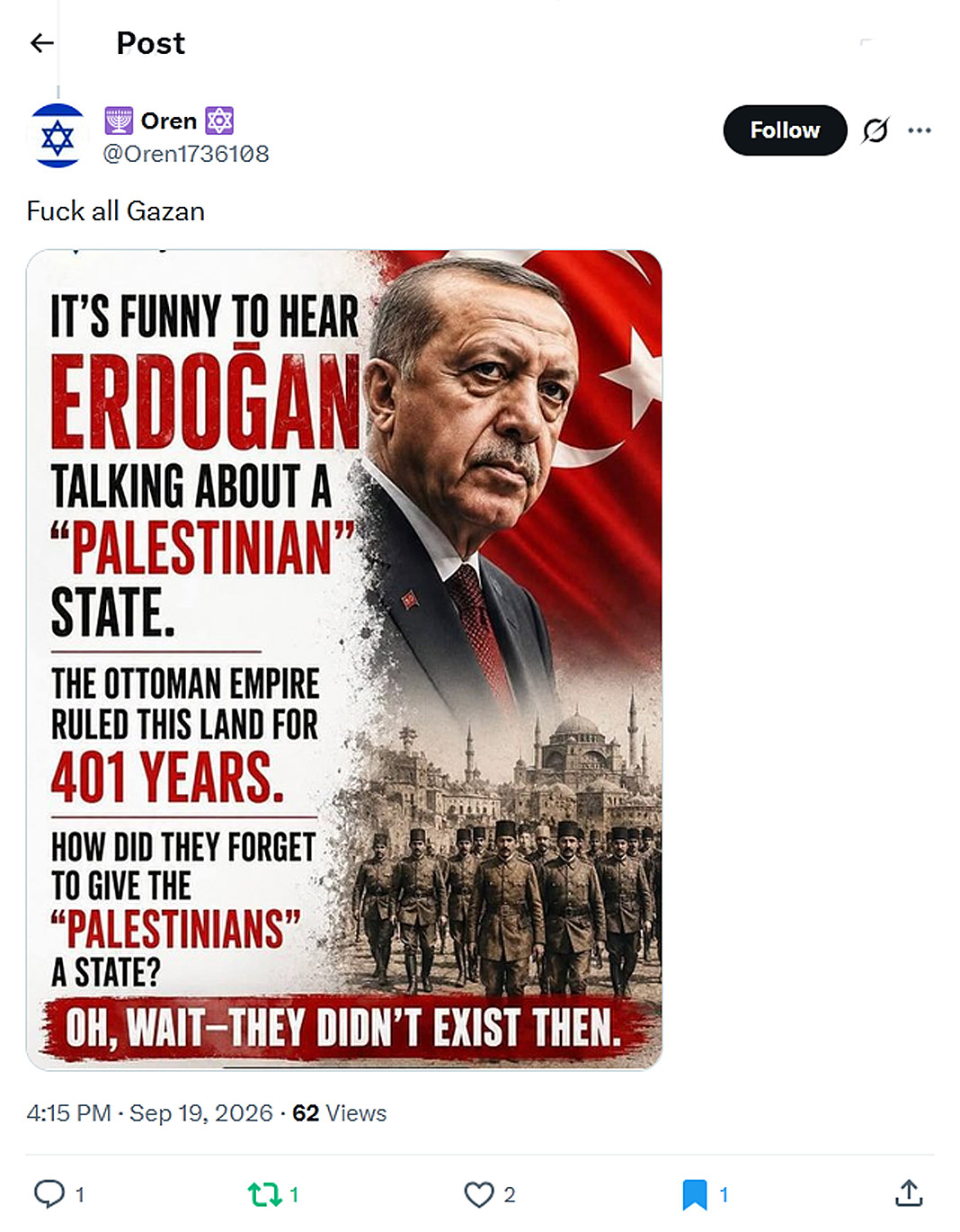 Oren-tweet-19September2026-ERDOGAN Talking about a ‘Palestinian’ State |
|
Europe in Free Fall by Guy Millière
 Europe’s erasure as a civilization is underway. Europe is on a path toward rapid, widespread decline — potentially irreversible. It is already extremely late in the day. Unless drastic actions are taken to reverse firmly entrenched trends, European civilization, simply demographically, will soon be part of the past. (Image source: iStock)
On February 14, 2026, US Secretary of State Marco Rubio delivered a laudatory speech about Europe and its legacy at the Munich Security Conference. He noted, however, that Europe is weakening. “We don’t want our allies to be weak,” he said.
His remarks initially were well received by the European political leaders and journalists in the room; not for long. Several journalists soon mentioned that, while Rubio appeared friendlier toward Europe than US Vice President J.D. Vance’s had been a year earlier, he was still “arrogant” in presuming that Europe needed advice on how to be stronger.
Some recalled that the Trump administration’s November 2025 National Security Strategy had warned that Europe faces the “prospect of civilizational erasure” — a claim they described as an “insult” to Europe.
Political leaders were also quick to express their rejection of what Rubio had said. The European Union’s foreign affairs and security policy chief, Kaja Kallas, in her own speech in Munich, declared: “Contrary to what some may say… Europe is not facing civilizational erasure.”
German Chancellor Friedrich Merz made a point of emphasizing that “European values” were not those championed by the Trump administration.
These reactions unfortunately have not changed the terrifying fact that Europe’s erasure as a civilization is underway. Europe is on a path toward rapid, widespread decline — potentially irreversible. It is already extremely late in the day. Unless drastic actions are taken to reverse firmly entrenched trends, European civilization, simply demographically, will soon be part of the past.
Economically, Europe is in ghastly shape. In 1980, the nine member states of the European Economic Community (today’s 27-member European Union) accounted for approximately 27% of global GDP, according to the IMF. By the end of 2025, the figure for the same nine countries (plus the former East Germany) had fallen significantly to just 15.5% of global GDP. Some European economists explain this disparity by citing the rapid development of China and the East Asian nations. A look at the US economy, however, shatters that explanation: in 1980, the United States accounted for 25.3% of global GDP — less than the EU’s share. By the end of 2025, the United States accounts for approximately 26% of global GDP — slightly more than in 1980.
For nearly five decades, the European Union’s economic growth and productivity rates have lagged behind those of the United States. Statistics also show that the total general government tax revenue as a percentage of GDP has increased in almost all member countries of the European Union — a trend not seen in the United States. Today, general government tax revenue accounts, on average, for more than 40% of the European Union’s total GDP. The figure for some countries is lower (22.4% for Ireland), but higher for several others: Denmark (45.8%), France (45.3%), Belgium (45.1%), and Italy (42.6%). The total general government tax revenue (federal, state, and local taxes plus social security) in the United States in 1980 was 25.6% of GDP. Today, it is still 25.6%. On average, populations in European Union countries pay far higher total taxes than Americans do, despite significant US investment in defense. The gap between the European Union and the United States has become immense.
European Union countries have established welfare states that have steadily expanded since 1980 and stifle economic growth. Today, social spending accounts for nearly 40% of total government budgets across the European Union — a figure far higher than that of the United States. Social insurance mandatory contributions in Europe are 2 to 2.5 times higher than in the United States for the same gross salary. This burden significantly increases labor costs for European companies and explains why employee take-home pay is lower in Europe than in the US. On average, in Europe, paying a monthly salary of €2,000 ($2,300) costs a company €3,800 ($4,375). In the US, paying a monthly salary of $2,000 costs a company only $2,200 to $2,800, depending on the state where it operates. The difference is considerable, and helps explain why unemployment in Europe is higher than in the United States.
The European Union has also proliferated stifling regulations that place a heavy encumbrance on businesses. Restrictions on gas and electricity production, combined with a drive for a rapid and extremely costly transition to “renewable energy”, have resulted in natural gas prices in Europe that are now three to five times higher than in the US, and electricity prices that are 2 to 4 times higher than in the US. To survive, many European companies have relocated production outside Europe.
International investment is turning away from Europe. Nine of the world’s top ten tech companies are American; the tenth is Taiwanese. There are no major European players in this crucial sector, and Europe is almost entirely absent from the field of artificial intelligence.
Although heatwaves have been affecting Europe for more than two decades, the continent remains resistant to air conditioning, viewing it as an expensive luxury (AC consumes costly electricity). On average, only 20% of households in EU countries have air conditioning. In 2003, a heatwave in Europe killed more than 20,000 people. Almost nothing was done to prevent a recurrence, so in 2026, another heatwave has already claimed 25,000 lives.
Other factors are also contributing to Europe’s decline.
Pessimism about the future — fueled by the questionable narrative berating “man-made global warming” and the hyped-up fear that the planet may become uninhabitable — is on the rise in Europe. Polls show that 63% of Europeans now believe their best years are behind them, and 77% believe that life in their country will be harder for the next generation. This pessimism is accompanied by a sharp drop in birth rates, with figures indicating that the population is rapidly aging. The average birthrate in the European Union now stands at 1.34 live births per woman, well below the generational replacement level of 2.1. This reflects an accelerating aging process that places an increasingly heavy obligation on pension and healthcare systems. In Spain, the figure is 1.10 live births per woman; in Italy, it is 1.14, and in Poland, it is also 1.10. Without major changes, Spain, Italy, and Poland will experience rapid population decline. Figures show that there were 3.46 million births and 4.81 million deaths in the European Union in 2025.
A trend toward downplaying traditional family roles is gaining ground in Europe, further exacerbating the problem of demographic replacement. In several European countries — Spain, Sweden, France, and the UK — sex education goes hand in hand with school textbooks explaining “gender identity,” “the possibility of sex reassignment” and “diverse family structures,” including having two mothers or two fathers. Across Europe, the number of same-sex and single-parent families is rising, and statistics show that such families generally have fewer children than families with both a father and a mother.
Europe’s population is decreasing, but mass migration, at this stage anyway, might be more of a burden on Europe’s finances than a contribution to its workforce or economic growth. Bureaucratic reports rosily predict “long term” gains. Even if mass migration were an economic benefit, it nevertheless is leading the European continent to cultural death.
Most new immigrants in Europe come from the Muslim world and appear to have no interest whatever in assimilating or becoming more westernized. Many are emphatically discouraged from doing either by the leaders of their communities, for instance, by “honor killings.” In addition, Muslim women have more children than non-Muslim women. In the UK, Muslim men may have up to four wives if married abroad, each of whom receives extra social welfare benefits. Muslims are doctrinally directed to despise Europe’s tolerance of the gay way of life; reject what is taught to their children regarding both history and sex education; see Europe as decadent and contemptible, and to openly reject the new societies in which they chose to live. There appears to be a growing demand among immigrants, in fact, to make Europe more like the Third World countries they abandoned.
The proportion of Muslims in the United Kingdom, France, Belgium, the Netherlands, and Sweden has been increasing decade after decade – with consequences that anyone even slightly versed in history could have expected. Warnings have gone unheeded.
Most Muslims arriving in Europe come from countries where antisemitism and hatred of Israel are widespread. Once settled in Europe, they remain antisemitic and hateful toward Israel, and contribute aggressively to the sharp rise of Jew-hate and anti-Israel bias in the countries where they now live. Many native Europeans ally themselves politically with them, declare themselves “anti-Zionist” (hostile to the existence of Israel), and show immense tolerance for Muslim antisemitism.
In the UK, the Equality and Human Rights Commission established in an October 29, 2020 report that the Labour Party was guilty of “inappropriate political interference” by Jeremy Corbyn’s office in several antisemitism cases. Corbyn was suspended from party membership and, in 2024, expelled from the party. He created a separate party with another former Labour member, Zarah Sultana, an “anti-Zionist” Muslim. Both were reelected in 2024 and are still MPs.
In France, the main left-wing party, La France Insoumise (France Unbowed) is “anti-Zionist,” openly supports Palestinian organizations, and refuses to define Hamas as a terrorist organization. Some of its leaders who have made antisemitic remarks have been prosecuted but not convicted.
Starting immediately with the terrorist group Hamas’s invasion of Israel and massacre of October 7, 2023, and throughout Israel’s war against Hamas in Gaza, anti-Israel demonstrations chanting slogans in support of Hamas were on the march in all major Western European cities. Appallingly, since the massacre, antisemitic attacks have seen a sharp increase across Western Europe, while Jews continue to leave Europe.
A poll conducted for the European Jewish Congress (EJC) shows that a majority of Jews still in Europe would like to leave. Ariel Muzicant, the president of EJC said in 2024, “We’re losing the battle. 57% of European Jews are considering leaving. In a few years, 50% of the communities may no longer exist.”
Political parties defending Western civilization and values — while asserting their opposition to the Islamization of Europe and “civilizational erasure” — are gaining electoral momentum. Meanwhile, political leaders across major European nations and at the helm of the EU appear determined to prevent those parties from governing (such as here, here and here).
In Germany, Alternative für Deutschland (AfD) leads in polls of voter intentions but faces a boycott by other parties known as the Brandmauer (“firewall”), with all other national and state parties forming alliances that exclude the AfD to prevent it from forming or even participating in governments.
In the United Kingdom — no longer part of the EU — Reform UK won many recent local elections and might be positioned to eclipse the Conservative Party. Meanwhile, a national poll conducted on July 26-27, 2026, revealed that the Labour Party had reached a record low among potential voters: 22%, the worst results for a British governing party since the 1940s. With no general election due until 2029, Keir Starmer resigned as prime minister, and his successor, Andy Burnham, was appointed by the Labour Party, apparently trying to avoid a new general election as long as it can.
In France, the National Rally (NR) has been the country’s most popular party for years. During the 2024 legislative elections, the NR appeared poised to win an absolute majority. Just before the election’s second round, President Emmanuel Macron urged all other parties to form a “Republican Front.” Their leaders called for votes to go to whichever candidate stood the best chance of defeating the NR contender: leading moderate right-wing voters to vote for far-left candidates, and left-wing and far-left voters to vote for moderate right-wing parties. The result was a fragmented National Assembly, unable to form a government cohesive enough to make policy decisions.
France’s economic situation was already concerning; it has since worsened. Unemployment is at 8% and is rising. Bankruptcies among small and medium-sized enterprises are increasing (in 2025, 69,957 businesses went bankrupt). National Rally’s Marine Le Pen has been leading the polls for the 2027 presidential election. She had been sentenced to three years in prison and 45 months (with 30 months suspended) of a public office ban, for actions that had previously led to dropped charges for Jean-Luc Mélenchon, the leader of France Unbowed. The alleged crime was that Le Pen and Mélenchon allowed parliamentary assistants to Members of the European Parliament to work in Paris for the MEPs they served. Le Pen appealed the case to the Court of Cassation, France’s supreme court of appeal, which suspended the sentence.
Le Pen’s conviction has not diminished her popularity. The Court of Cassation has stated it will issue its ruling before the 2027 presidential election, and the court’s president has hinted that the conviction will be upheld — meaning that if elected, Le Pen would become the first French president to win office while under a prison sentence. Mathilde Panot, president of the France Unbowed group in the National Assembly, declared that her party would not recognize the legitimacy of Le Pen’s election should she win, and would call for an uprising.
The “offense” of those political parties disfavored by Europe’s “elites” consists of defending the values of the West, fighting the Islamization of Europe, and opposing the erasure of European civilization. These political parties are consequently subjected to exclusionary maneuvers and are relentlessly harassed by rival political leaders who not only seem to disagree but are also dragging the continent into a free fall and a possible cultural death.
|
Why Is Israel Taking Gaza Kites Seriously?Recently, several kites have flown into Israeli territory from Gaza. Here’s why Israelis are so concerned.By Chaim Lax 24August2026 https://honestreporting.com/why-is-israel-taking-gaza-kites-seriously/  Hamas Kites
Key Takeaways:
These were some of the incredulous responses on social media after Israel’s defense minister instructed the IDF to “act forcefully” against those sending kites from Gaza into Israel, following reports that several had been discovered in Israeli communities bordering the Gaza Strip.
To those unfamiliar with the history of Hamas, Israel, and Gaza, the reaction might seem excessive. Why would one of the region’s most powerful militaries be concerned about a handful of kites drifting across the border? But the history of weaponized kites from Gaza explains why Israel is not simply dismissing the latest incidents as child’s play.
Kids flying kites in Gaza had those kites land on Israeli territory Not only is this newsworthy, byt residents called the IDF and asked them to respond! And what did the IDF do? Well the Defence Minister ordered the military to respond “immediately and forcefully” to any further launches, describing each incident as an “act of war.” I am not making this up! His exact words: “A balloon is treated like a kite, and a kite is treated like a drone, with or without explosives. Anyone organizing, carrying out, or facilitating the launches will be dealt with immediately and with full severity.” Please help me understand how this is real, because I’m honestly lost for words HonestReporting-tweet-24August2026-why Israel takes incendiary balloons and kites from Gaza so seriously In 2018, Palestinian terrorists launched waves of balloons and kites carrying incendiary and explosive devices into Israel, setting thousands of acres ablaze, destroying crops and wildlife, and threatening nearby communities. Israeli children were even warned not to touch balloons or kites they found in case they were booby-trapped. This wasn’t harmless “protest.” It was a deliberate weaponization of everyday objects against Israeli civilians. Israel has every reason to ensure it never happens again. 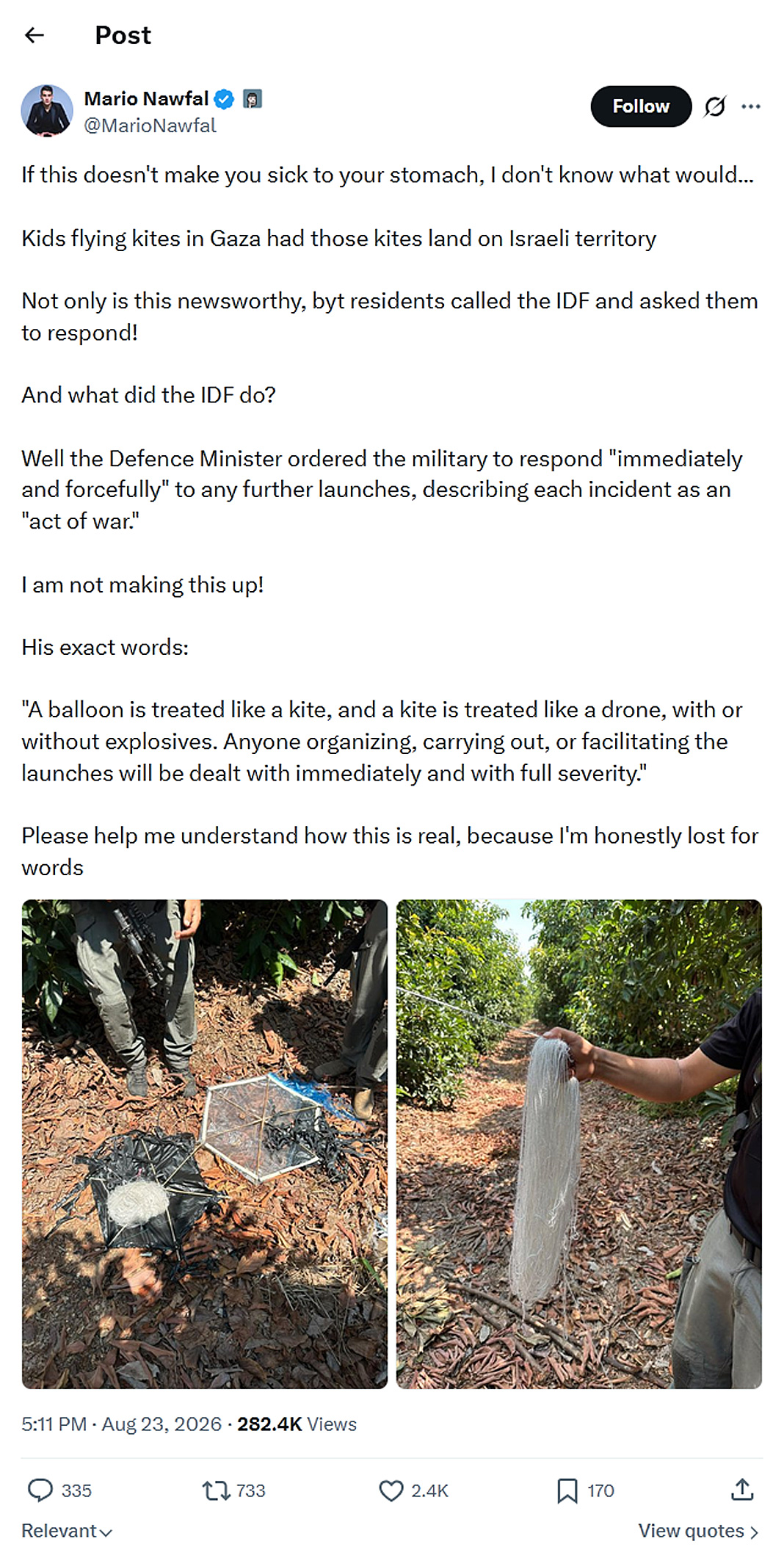 Mario Nawfal-tweet-23August2026-Hamas incendiary balloons and kites from Gaza harmless 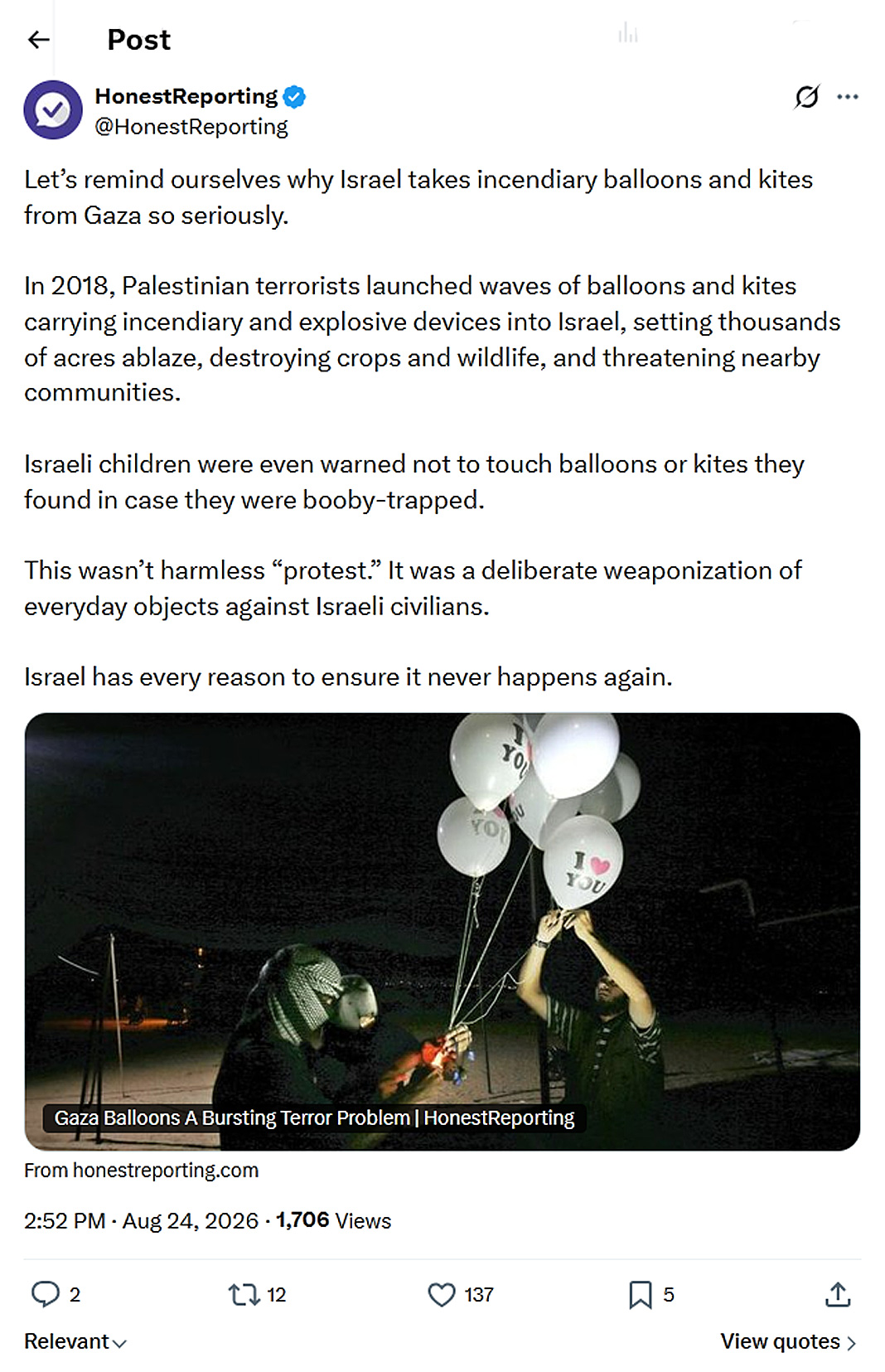 HonestReporting-tweet-24August2026-why Israel takes incendiary balloons and kites from Gaza so seriously
When Kites Became WeaponsIn 2018, Israel faced weekly mass Palestinian riots and protests along the Gaza border fence. Within weeks, kites fitted with incendiary materials began to be launched across the border into Israel.
Palestinian terrorists soon added incendiary balloons, which could travel farther into Israeli territory. What looked like children’s playthings became delivery systems for fire and, later, improvised explosives, Molotov cocktails, and grenades.
As the Meir Amit Intelligence and Terrorism Information Center noted at the time, Hamas did not formally claim responsibility for the low-tech attacks, but there were clear links between the terrorist organization and those launching the kites and balloons.
By the summer of 2018, the attacks had become relentless. Between July and September, incendiary kites and balloons were reported to have caused an average of 12 fires per day inside Israel.
Over just a few months, those fires scorched thousands of acres of Israeli agricultural land and nature reserves, killing wildlife, destroying farmland, and damaging natural ecosystems. The cost ran into millions of shekels, with some estimates suggesting that parts of southern Israel’s environment could take a decade to fully recover.
The use of incendiary kites and balloons by Palestinian terrorists peaked in 2018 and 2019, but it did not end there. In 2021, Hamas broke a recently established ceasefire with Israel by launching incendiary balloons into the Jewish state.
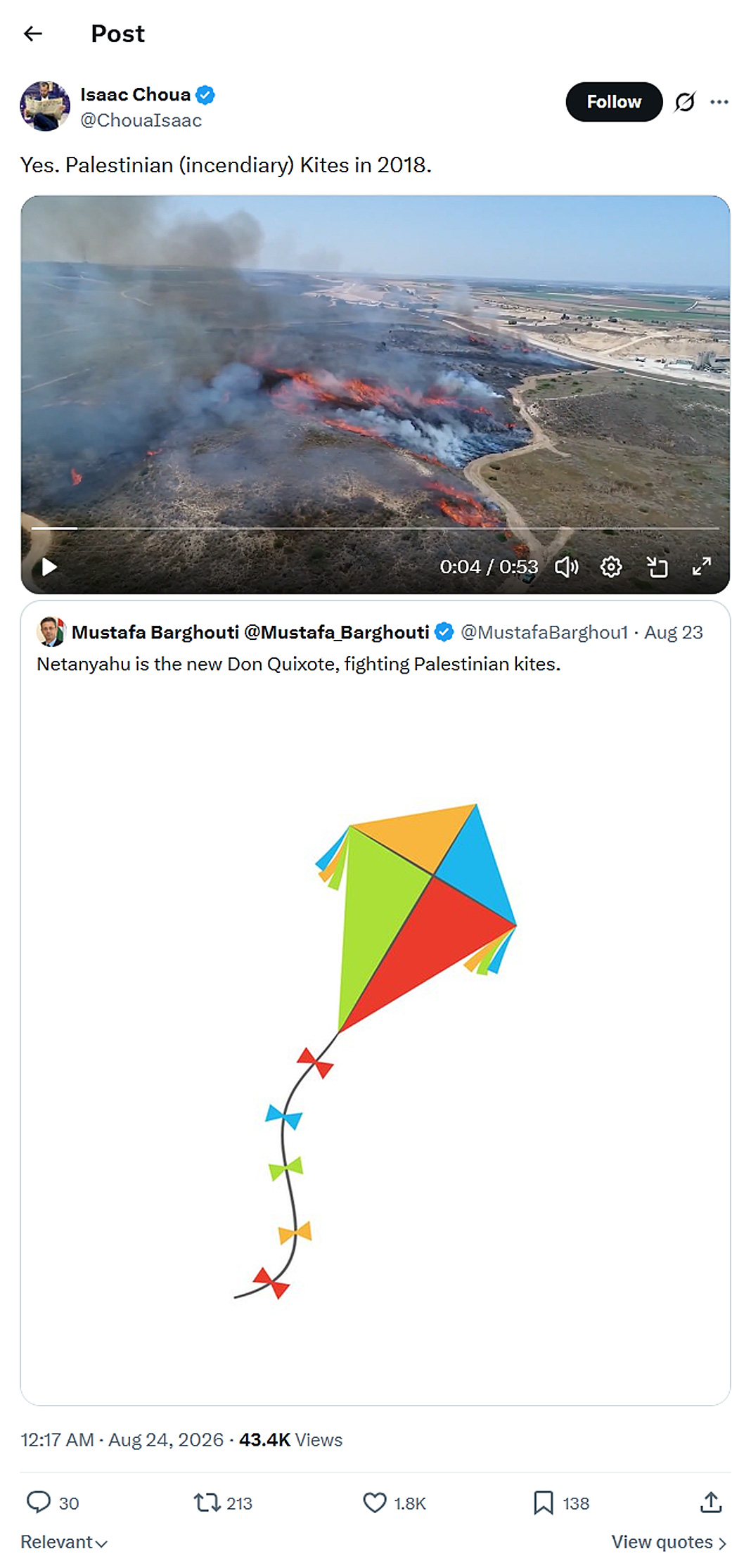 Isaac Choua-tweet-23August2026-Palestinian (incendiary) Kites in 2018
Why the Latest Kites Have Raised AlarmThat history provides the context for Israel’s concern over the latest kites. It is possible that several Gazan children simply lost control of them and that they happened to drift into Israeli communities. But Israeli officials reportedly see reasons to consider another possibility.
According to reports, the IDF believes that the kites, which did not carry incendiary materials, may have been deliberately directed across the border by Hamas to test Israel’s response to objects launched from Gaza.
There were also reports that some of the kites were attached to strings between two and four kilometers long and carried messages in Arabic, making the explanation that they were simply children’s playthings less convincing.
The unusually long strings have reportedly fueled suspicions that the flights could be connected to intelligence gathering or serve as a dry run for fiber-optic drones, a technology Hezbollah has used against Israeli troops in southern Lebanon.
The IDF confirmed this evening that four kites launched from Gaza have landed in Israeli communities along the border, including those hit hardest by the October 7 massacre. The kites are believed to have crossed from Gaza and were connected to wires stretching several kilometers. No suspicious findings were detected on them, and the IDF says there was no danger to the public. But the development is concerning not just for the Israelis who could be the potential victims of these kites if they turn into weapons. The use of kites as a potential delivery platform is reminiscent of the improvised optical fibres explosive drones Hezbollah has used against Israeli forces in Lebanon. If Hamas is experimenting with a new type of weapon that can cross the border and potentially deliver explosives, instead of disarming as it vowed to the Board of Peace the meaning could be extremely hazardous for the people of Gaza just as much and for any foreign states that plan to invest in the new Gaza Strip.  Guy Azriel Diplomatic Correspondent-tweet-22August2026-Kites from Gaza
Hamas Is Already RebuildingThe timing has added to those concerns.
In May 2026, Israeli media reported that the IDF was increasingly concerned about Hamas rearming and rebuilding its terrorist infrastructure, as well as the possibility that the group could seek to reignite fighting with Israel.
Three months later, the sudden appearance of kites over Israeli border communities inevitably raises the question of whether Hamas is once again probing Israel’s defenses: first with harmless objects, potentially followed by incendiary devices or more sophisticated weapons.
One of the central lessons Israel drew from October 7 was the danger of dismissing Hamas’ activities as insignificant simply because they do not appear immediately threatening. Tactics that seem crude, performative, or even absurd can still be used to gather intelligence, test Israeli responses, or prepare the ground for something more dangerous.
So however ridiculous Israel’s concern over a few kites may appear from afar, it does not exist in a vacuum. Israelis living near Gaza remember years in which kites and balloons set their fields and nature reserves ablaze. And after October 7, Israel has even less reason to assume that apparently harmless activity along the Gaza border is necessarily what it seems.
Liked this article? Follow HonestReporting on Twitter, Facebook, Instagram and TikTok to see even more posts and videos debunking news bias and smears, as well as other content explaining what’s really going on in Israel and the region. Get updates direct to your phone. Join our WhatsApp and Telegram channels!
© Divuach Ne’eman, 2025
Chaim LaxOriginally from Toronto, Canada, Chaim moved to Israel in 2018. He has a B.A. (Hons) in Political Science and History from York University as well as an MA in Israel Studies from the Rothberg International School at Hebrew University. Prior to joining HonestReporting, Chaim worked with a variety of Israel advocacy organizations in both Canada and Israel.
|
|
Throwing Stones
 Cat-tweet-21October2025-Adele Biton age 4 killed by thrown stone
 Adele Biton age 4 killed by thrown stone BACKGROUND: Remember all those killed by “Just throwing rocks”UPDATE:Palestinian terrorists threw stones at the IDF, IDF returns fire
The soldiers did not hesitate and responded by opening fire. Do you support a hard line against terrorism?  Isaac-tweet-25August2026-stone throwing at IDF-IDF return fire
Israel Police released stone throwing video
Israel Police released previously omitted seconds from footage showing the Palestinian man who was later shot by Israeli forces in Qalandiya throwing stones at security forces during the evacuation of the UNRWA compound, moments before the shooting. The footage adds important context to the incident and challenges the narrative presented in the original clip. @selenaryan_  Mossad Commentary-tweet-27August2026-Israel Police released stone throwing video
|
|
Map of 2023 Hamas-led attack on Israel Map of 2023 Hamas-led attack on Israel
|
|
HAMAS REFUSES TO DISARM
Hamas representative in Iran Khaled Qaddoumi rejects disarmament, saying the group’s weapons will remain as long as what he calls the Israeli “occupation” continues. Qaddoumi has repeatedly rejected calls for Hamas to surrender its weapons, arguing that disarmament is not an option while Israel remains in what Hamas describes as “occupation.” The position highlights one of the biggest obstacles to any long-term Gaza settlement: Israel demands Hamas fully disarm, while Hamas continues to defend retaining its weapons for “resistance.”  Mossad Commentary-tweet-25August2026-HAMAS REFUSES TO DISARM
|
|
Anger in Trump administration, Board of Peace over Israeli claim that Hamas will not be disarmed via peace planBoP source claims assassinations of Hamas leaders ‘will not get rid of Hamas’J. Micah Hancock | Published: 17September2026 | https://allisraelnews.com/anger-in-trump-administration-board-of-peace-over-israeli-claim-that-hamas-will-not-be-disarmed-via-peace-plan
The current Israeli strategy of targeted assassinations of Hamas commanders and terrorists involved in the Oct. 7, 2023, Hamas attacks “will not lead to the elimination of the organization,” a source close to the Board of Peace (BoP) says.
“The government’s policy is targeted assassinations, while leaving Hamas with its army and its rule,” the BoP source told i24 News’ Hebrew edition.
“The Board of Peace wants the complete dismantling and elimination of Hamas. Israel is eliminating individual Hamas members, but not Hamas itself,” the source claimed.
The remarks come amid a lack of progress in the Gaza Peace Plan put forward by U.S. President Donald Trump, who is also the chairman of the BoP.
The BoP announced in July that Hamas had agreed to disarm, but Hamas has claimed that such disarmament is conditional on the full withdrawal of the IDF from the Gaza Strip.
Israel maintains that the original peace agreement calls for the full IDF withdrawal only after the disarmament of Hamas, and together with the entry of the International Stabilization Force (ISF), which is not yet ready to take on the role of policing the Gaza Strip.
In the meantime, as the two sides remain firm in their positions, the IDF has continued carrying out targeted assassinations of Hamas commanders and terrorists involved in the Oct. 7, 2023, Hamas invasion of southern Israel.
The terrorist infiltrated through the Erez Crossing during the October 7 Massacre, advanced terror attacks against Israeli civilians and IDF troops, and operated to restore Hamas’ terror capabilities, in systematic violation of the ceasefire. He was eliminated to remove the threat he posed. Prior to the strike, measures were taken to mitigate harm to civilians, including the use of precise munitions and aerial surveillance. The IDF is aware of reports indicating that an uninvolved individual was harmed as a result of the strike. The IDF regrets any harm to uninvolved individuals and makes every effort to minimize such harm. The incident is under review.  Israel Defense Forces-tweet-17September2026-IDF eliminated Sharif Shadi Ibrahim Labad
Notices of such killings have been released by the IDF on a near-daily basis over the past couple of weeks, despite a request by the U.S. to only strike in the event of imminent danger.
The Israeli government says it is keeping its promise to bring all the terrorists involved in the Oct. 7 attacks to justice. The IDF does also frequently claim that some of the terrorists are actively involved in plans to carry out attacks against its soldiers along the Yellow Line.
Recently, the terrorists advanced attacks against Israeli civilians and IDF troops in systematic violation of the ceasefire. The terrorists were eliminated in order to remove the threat they posed.  Israel Defense Forces-tweet-16September2026-ELIMINATED 3 Terrorists
Washington is reportedly upset after Defense Minister Israel Katz stated that Hamas was not going to disarm, and that Israel would have to disarm it by force, before implementing a plan of voluntary migration.
“We all understand that this (disarmament) is not going to happen – and the IDF is prepared, once given the directive to eliminate Hamas, to finish the job so that we can also implement the migration plan,” Katz said in response to criticism from political challenger Ofer Winter.
Katz, along with National Security Minister Itamar Ben Gvir have championed a voluntary migration plan for Gazans to leave the enclave, heading to countries willing to receive them. Katz has referred to a poll from earlier this year, which found that around 80% of respondents were interested in leaving Gaza.
Both politicians have claimed that many countries are willing to receive immigrants from Gaza, although no countries have publicly made such a statement.
Earlier this month, Katz claimed that Israel was waiting for approval from the U.S. to begin a voluntary migration program, claiming that most Gazans were eager to leave.
A senior Trump administration official challenged Katz’ words in a statement to public broadcaster Kan News.
President Donald Trump is “committed to the full implementation of the 20-point plan, including the disarmament of Hamas.”
The official said that Washington remains committed to the disarmament of Hamas, despite the delay in achieving that goal.
The official also reaffirmed the Israeli understanding which calls for Hamas to disarm before the IDF withdrawal.
“Israeli forces will withdraw, and an international stabilization force will work with the Palestinian police to assume responsibility for Gaza and ensure it becomes a safe place for its residents and its neighbors,” the official said about the plan for Gaza after Hamas’ disarmament.
According to Channel 12 News, Hamas has decided not to respond to the IDF targeted killings in order not to give the Israeli government an excuse to resume military operations inside the Hamas controlled territory.
That report came just days after a survey by the Jerusalem Media and Communication Center (JMCC) found that only 13.3% of Palestinian respondents in Gaza and the Palestinian territories in Judea and Samaria, support armed resistance as the best way to handle the conflict with Israel.
The poll also found that a slight majority (50.1%) of Palestinian respondents believe the Oct. 7 attacks harmed the Palestinian cause. Slightly more (55.8%) said they viewed negotiations as the best method for achieving Palestinian national interests.
|
|

Palestinian State: Western Policy Making vs. Middle East Reality2October2026 10:27 am – https://theettingerreport.com/palestinian-state-western-policy-making-vs-middle-east-reality/
Ambassador (ret.) Yoram Ettinger, “Second Thought: a US-Israel Initiative”
*The late King Hussein recognized Jordan’s susceptibility to a repeat of the deadly “Black September,” due to its intrinsic demographic vulnerabilities, such as the restive Palestinian majority time bomb, which traditionally collaborates with the subversive/terroristic Muslim Brotherhood, while the Bedouin tribal society is inherently fragmented. Therefore, the King warned Western and Israeli policy makers that a Palestinian state west of the Jordan River would doom the pro-Western Hashemite regime east of the river. Moreover, a Palestinian state would deny Jordan the defensive benefits of the Israel’s full control of the mountain ridges of Judea and Samaria, that played a key role in aborting the “Black September” Palestinian assault. In fact, a more volcanic “Black September” could reoccur due to the presence of 1-2 million Syrian refugees in northern Jordan (some of them terrorists and drug traffickers), Iran-inspired terrorist activities in Jordan and the neighboring Iraq, and the potent presence in Jordan of Hamas terrorists, who are inspired by the October 2023 horrific terror offensive against Israel, and Western appeasement of Hamas, in particular, and Palestinian terrorism, in general.
*Western policy makers’ infatuation with the proposed Palestinian state has been driven by Western preoccupation with the moderate Palestinian talk, which is aimed at Western target audiences. On the other hand, Arabs have been preoccupied with the rogue Palestinian intra-Arab walk, which has led the Arabs to display indifference-to-rejection toward the proposed Palestinian state.
*Since 1948, Arab countries have never flexed military, financial or political muscles on behalf of the proposed Palestinian state. No Arab war against Israel was launched due to the Palestinian issue, and never did Arabs intervene militarily during Israel-Palestinian wars. In fact, in November 2023, an Iranian-Algerian-Palestinian proposition to end all diplomatic-economic-defense-tourist ties with Israel was rejected by a joint summit of The Arab League and the Organization of Islamic Cooperation.
*While the Arab talk has been overwhelmingly supportive of the proposed Palestinian state, the Arab walk has systematically refrained from – and occasionally opposed – the establishment of a Palestinian state.
*Arabs do not sacrifice their interests on the altar of a proposed Palestinian state, which they consider as an existential threat. They are fully aware of the 55-year-rogue Palestinian intra-Arab track record, terrorizing their host Arab governments in Egypt (1950s), Syria (1960s), Jordan (1970), Lebanon (1970-1982) and Kuwait (1990). This track record has positioned Palestinians as the role-model of intra-Arab subversion, terrorism, treachery and ingratitude.
*The Arabs are, also, aware of the Palestinians’ collaboration with – and training of – terrorist organizations in Asia, Africa, Europe and Latin America, as well as their relationship with radically ruthless anti-Western regimes, such as Nazi Germany, the Soviet Bloc (including ideological and operational links with the Soviet KGB and the East German Stasi), Ayatollah Khomeini, North Korea, Cuba, Venezuela, China and Russia.
*Western policy makers have contended that Palestinian terror has been driven by despair, and therefore should be dealt with diplomatically and financially – not militarily – and bolstered by appeasement and concessions. However, Middle East reality documents that Palestinian terror has been driven by a fanatical ideology (e.g., Fatah’s and PLO’s 1959 and 1964 Charters – before the 1967 War), which mandates the total uprooting – not size reduction – of the “illegal Zionist entity.”
*Western policy makers have been obsessed with speculations about a reformed Palestinian state. In contrast, Arab policy makers have been preoccupied with the well-documented Palestinian rogue track record. They are convinced that assessments of the nature of the proposed Palestinian state – and its geo strategic impact – should be based on the well-documented track record rather than well-intentioned speculations.
*Therefore, Jordan and Egypt did their utmost to prevent the establishment of a Palestinian state, when they fully controlled Judea and Samaria (the West Bank) and Gaza in 1949-1967. Moreover, in 1948, the Arab League established the “All Palestine Government,” downgrading it to a “Palestinian Desk” in 1950-52, and eliminating it in 1955.
*In 1970, Jordan’s Prime Minister Wasfi al-Tal and Commander of the Armed Forces Habis al-Majali stated that Palestinian ideology was fundamentally incompatible with Jordan’s national sovereignty. In 1974, King Hussein warned Western policy makers that a Palestinian state in the West Bank would leverage Jordan’s demographic reality (e.g., a Palestinian majority) and constitute a real and clear existential threat to the Hashemite regime. In 1993, the King told the Head of Israel’s Mossad that the Oslo Accord could lead to a Palestinian state west of the Jordan River, an irredentist springboard, destabilizing Jordan – a death sentence to Jordan’s pro-Western Hashemite regime east of the Jordan River. That warning was echoed by Jordan’s military Chief-of-Staff and Head of Military Intelligence during the October 1994 signing of the Israel-Jordan peace treaty.
*The toppling of Jordan’s Hashemite regime would transform Jordan into another platform of anti-Western Islamic terrorism, involving the Muslim Brotherhood, Palestinian terror organizations, proxies of the Ayatollah regime, ISIS, etc. This terrorism would not be confined to the area of Jordan, but would spread southward, triggering existential threats to the pro-Western Arab regimes in Egypt (via the terror-ridden Sinai Peninsula), Saudi Arabia, the UAE, Bahrain and Kuwait, further destabilizing the Middle East – the epicenter of 9/11-like anti-Western Islamic terrorism, the location of 48% of global oil reserves and a critical intersection of trade sea lanes between the Far East and Western Europe.
*The toppling of the Hashemite regime would advance a key strategic aspiration of the Ayatollah regime to establish contiguous land access to Israel and to the Mediterranean (via Gaza), while encircling Saudi Arabia.
*A Palestinian statewould welcome cooperation with China and Russia, which would include intelligence stations and the funding of – and access to – an upgraded port in the Gaza Strip, bolstering their stature in the western Mediterranean, as Middle East powerbrokers at the expense of the US.
*Western policy makers, who accord much significance to moderate Palestinian talk, and therefore speculate on a reformed Palestinian state – which would abandon core ideology, depart from its rogue track record, and embrace peaceful coexistence – would benefit from the following country colloquialism: “You may put your boots in the oven, but that don’t make them biscuits!”
|
|
IDF Prepares for War with the PA
Defense Minister Israel Katz told ministers the IDF has been instructed to prepare for a scenario in which Palestinian Authority security forces and Tanzim gunmen turn their weapons on Israeli civilians and troops in Judea and Samaria. Katz said that if such an attack occurs, Israel would declare war on the PA and launch a “short and forceful” campaign involving ground and air forces, targeted eliminations and expulsions of senior figures, destruction of weapons and terror infrastructure, and large-scale evacuations from combat zones. “There will not be an intifada lasting years as there was in the past,” Katz said, “but rather a short and forceful war with a clear decision and a change in the reality.”  Mossad Commentary-tweet-6October2026-IDF Prepares for War with the PA
|
|
Palestinian Textbooks continue to glorify terror and promote violence
Students learn addition and subtraction by counting “martyrs.” Newton’s law of gravity is illustrated with a slingshot aimed at Israeli soldiers. A fifth-grade reading lesson features Dalal Mughrabi, who participated in the 1978 Coastal Road massacre that killed 38 Israeli civilians including 13 children – presented as a hero. An eighth-grade grammar lesson glorifies suicide bombers who wore explosive belts. The same textbooks – produced by the Palestinian Authority’s Education Ministry in Ramallah with European Union funding – are used in PA schools, UNRWA schools, and Hamas schools alike. “These books clearly helped create the environment that led to October 7,” said IMPACT-se researcher Arik Agasi. “Our warnings were not heeded.” Despite repeated international demands to end incitement in school textbooks, the Palestinian Authority continues to embed terror glorification and antisemitic content. This is a profound betrayal of its own future generations. This deliberate perpetuation of hatred and violence cannot be ignored. PA leaders must be held accountable for choosing indoctrination over peace and standing in the way of any hope for a better, more peaceful future.  StandWithUs-tweet-3September2026-PA-textbooks-glorify terror-promote violence
 PA-textbooks-glorify terror-promote violence
|
|

Pools, marble and mansions: Inside 100 Palestinian luxury homes in West BankRegavim’s Real Estate Under Occupation features 100 Palestinian villas and estates, arguing that images of private wealth complicate international portrayals of life in the West Bank.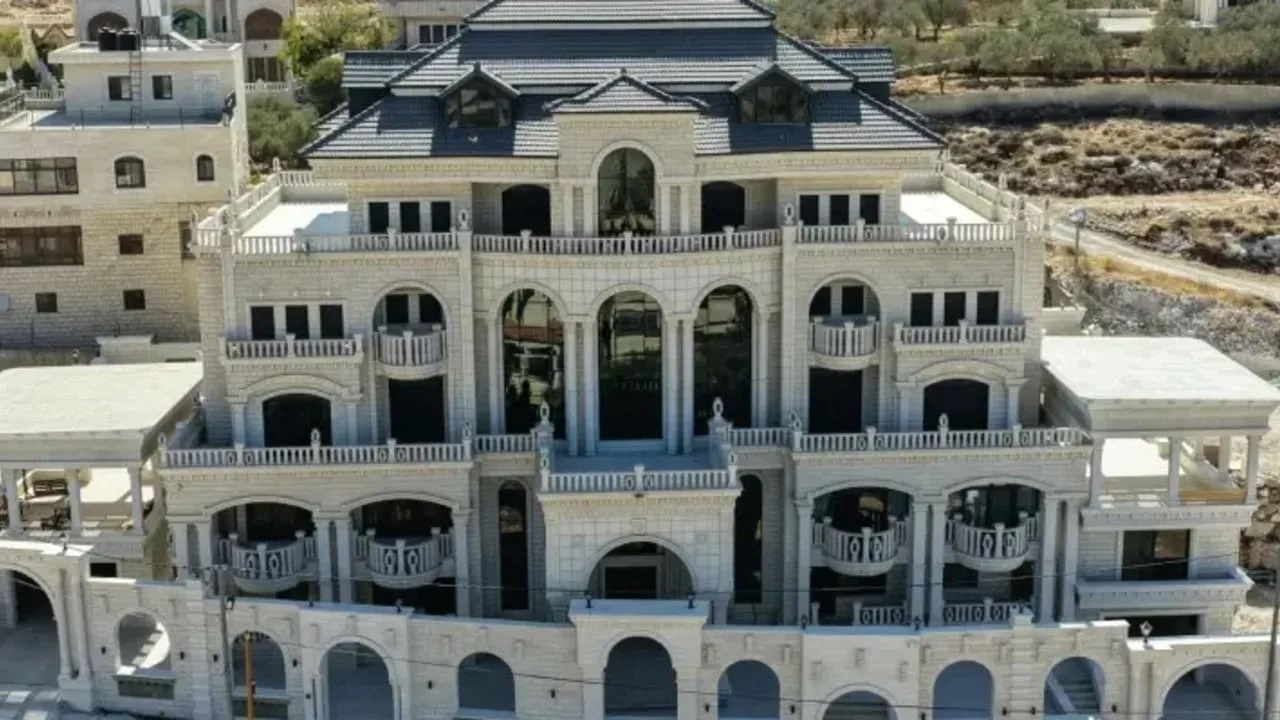 A property in Mukhmas, listed by Regavim at 2,400 square meters 2026.
By NACHUM PERRY
A photography book published by Regavim showcases 100 privately owned Palestinian villas and estates across the West Bank, seeking to challenge what the organization describes as a selective international portrayal of Palestinian life.
Titled Real Estate Under Occupation, the book features swimming pools, fountains, marble staircases and landscaped grounds. Regavim, an Israeli NGO that campaigns on land use and construction enforcement, said its field coordinators photographed all the featured properties in a single day.
In Shuqba, a Palestinian village northwest of Ramallah, the team documented an estate that Regavim described as covering 4,800 square meters, with a central swimming pool, landscaped lawns, shaded entertaining areas and a large courtyard.
In Nahalin, southwest of Bethlehem, the book features a neoclassical property listed at 1,120 square meters, with seven balconies, a turret, a fountain and an ornamental pool.
In Khirbet Zif, in the Hebron Hills, the organization documented gated compounds with swimming pools, gardens, guest accommodations, saunas, security cameras and private access roads. Other properties featured stone columns, electric gates, orchards and private parking.  A villa in Shuqba 2026. (credit: COURTESY/REGAVIM)
The measurements are those supplied by Regavim; they should not all be read as interior living-space figures.
The introduction uses sarcasm to place terms such as “oppression,” “severe deprivation” and “daily hardship” alongside photographs of luxury homes. Regavim said it aimed to show how selective imagery could influence public opinion and foreign policy, while acknowledging that poverty existed.
he photographs document individual examples of wealth. They do not establish how common such wealth is across the Palestinian population. In its May 2026 economic update, the World Bank reported that economic activity in the West Bank remained substantially below its pre-October 2023 level, despite modest growth in 2025.
Luxury homes and American tiesThe villages of Mukhmas, Deir Dibwan and Turmus Ayya feature prominently, with large homes and substantial ties to Palestinian communities in the United States. Some properties appeared unoccupied when photographed; a single visit cannot establish whether a home is used seasonally or stands vacant long-term.
Turmus Ayya’s mayor estimated earlier this month that about 80% of the town’s residents held US citizenship. That estimate applies to Turmus Ayya and should not be extended to the other villages.
Building permits depend on location
The properties featured include homes in Areas B and C, administrative divisions established under the Oslo agreements. The framework assigned Palestinian authorities civilian responsibilities in Area B, including planning, while Israel retained planning authority in Area C.
Construction in Area C requires Israeli approval. Establishing whether a particular property was built without permission requires checking its location and permit records. The material reviewed did not substantiate the original article’s suggestion that a large proportion of the featured homes were illegal. UN humanitarian officials have also documented the difficulty Palestinians face in obtaining building permits in Area C.
Naomi Kahn, director of Regavim’s international division, said: “For years, the international community has been fed a slanted picture that presents Palestinian life in the West Bank solely through the prism of poverty and oppression.
“We decided to turn the camera toward the reality on the ground: In just one day of photography, we documented enormous villas, swimming pools, and extraordinary private wealth that are systematically erased from the biased narrative.
“International policy must be based on facts and not on manipulation. ‘Real Estate Under Occupation’ invites decision-makers and the public to see the full picture with their own eyes.”
|
|
“Settler Violence” Palestinian libel
No one doubts where your heart is. Your support for Israel is unwavering and historic. There is violence in Judea and Samaria — there has been for many years. But Jews don’t wake up in the morning saying “I’m going to go kill a Palestinian today.” The opposite, of course, is not true — hundreds and hundreds of Jewish residents of J&S have been murdered by Palestinian terrorists. Most Palestinian residents of J&S cheered 9/11, 10/7, support Hamas and want to push the Jews out of all of Israel, not just J&S. So of course there is violence between Jews and Arabs in Judea and Samaria. But the two questions are 1) why does it exist, and 2) how is it being used by Israel’s enemies? It exists for the reasons described above — Jews need to defend themselves. Some acts of defense are debatable, some may be inappropriate. But they are acts of defense nonetheless against ruthless thugs that simply refuse to live in peace on any terms with their Jewish neighbors. The “settler violence” libel is being used, as you recognize, as part of a coordinated PR effort by the same people who falsely accuse Israel of genocide. The Palestinian-Americans who had no difficulty building beautiful houses in the area are now draping American flags on their houses so that attacks against them — which they instigate — can be filmed as attacks against America. It’s all a cynical campaign and its roots go back more than a century. Of course I agree that settler violence hurts Israel’s “standing” in the world, but it hurts less than giving Palestinian terrorists free rein to kill more Jews. Unfortunately, labeling the Jews who fight back as “terrorists” is a win for the anti-Israel PR machine who then create a moral equivalency between both sides. Your correct observation that the Jews committing acts of violence are a tiny fraction of the total Jewish population is a distinction entirely lost on the media, who have a false narrative to uphold. 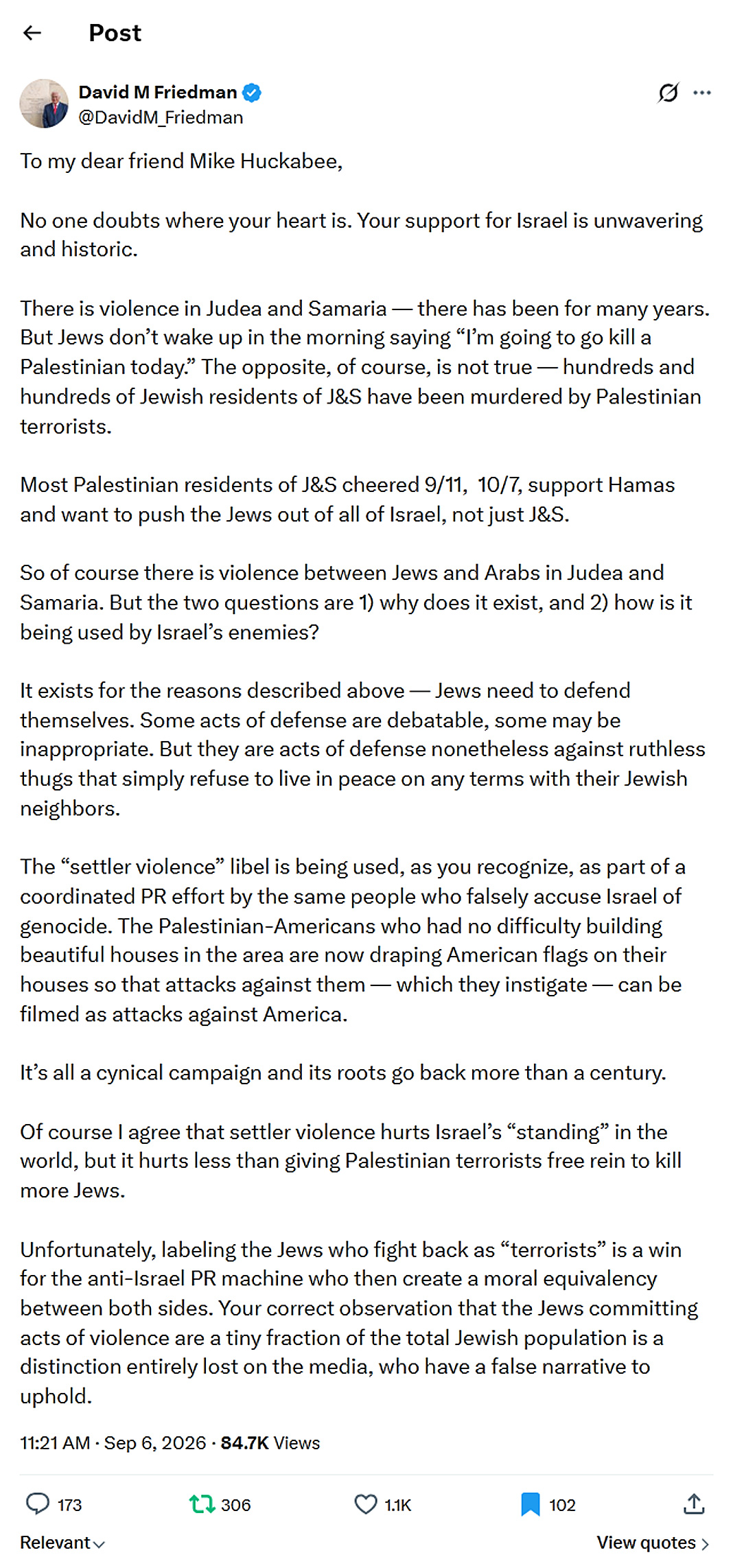 David M Friedman-tweet-6September2026-Settler Violence-Palestinian libel
|
|

The Jews in Their Land: The Archeological EvidenceBy Hugh Fitzgerald – on 6September2026 https://gellerreport.com/2026/09/the-jews-in-their-land-the-archeological-evidence.html/
Antisemites are in a permanent state of denial. They deny that there was ever a Holocaust. They deny that Jews have been oppressed through time and space. And now, those who hate the very idea of a Jewish state deny that Jews ever lived in the Land of Israel. But the archeological evidence tells a different story: it is full of mentions of ancient Israel, not only by Jews, but also by Egyptian pharaohs. More on the silent witnesses of the Jews’ connection to their land can be found here.
The cancellation of that exhibition was a shameful episode in self-censorship by the administrators at the British Museum, afraid of offending Muslim Arabs. Possibly it was thought that they would be angered enough to end any financial contribution to the museum, but as a visit to the the British Museum and a reading of its records make clear, by far the greatest contributors to the Museum have been Jews. Among them is the Sir Percival David collection of 10,000 Chinese ceramics, worth more than $1 billion, the Waddesdon Bequest that was bequeathed in 1898 by Baron Ferdinand de Rothschild, an unparalleled collection of nearly 300 Renaissance and medieval pieces, including exquisite jewelry, gold plate, enamels, and micro-carvings; the Hull Grundy gift donated in 1978 by the German-born Jewish philanthropist and art historian Anne Hull Grundy, this gift comprised over 1,200 pieces of 17th- to 20th-century European jewelry.
In the Land of Israel today, there are more than 20,000 archeological sites that tell the story, for the past 3,500 years, of the Jews in their land. Palestinian Arabs have been known to destroy artifacts at these sites, or to steal artifacts from them, ripping them from their historical context, in order to sell them abroad. But there is just too much of this evidence — ceramics, tools, the in weapons, eating utensils, drinking vessels — to overlook, and too many foreign, non-Jewish archeologists who have seen these sites, helped in some cases to discover them, unearth them, and study them, to deny their existence.
|
|
New town founded in response to sanctionsAs Britain backs boycotts targeting Israeli communities, the first buildings of Metzukei Eretz are being installed in eastern Binyamin ahead of the first families’ arrival.Arutz Sheva / Published: 9September2026, 12:50 PM (GMT+3) / https://www.israelnationalnews.com/news/432942
Facing British Sanctions: The First Structures Have Been Placed in the New Settlement
The first buildings of the new town of Metzukei Eretz are being transported and installed along the Alon Highway in eastern Binyamin, as preparations continue for the arrival of the first families in the coming weeks.
The construction comes against the backdrop of Britain’s decision to promote boycotts and sanctions against Israeli towns in Judea and Samaria, with additional countries reportedly joining the effort. Despite the measures being advanced by foreign governments, preparations for the establishment of the new town are continuing.
This is the first time in decades that a new town has been established along the Alon Highway, which was planned and approved in advance as an official, organized community. The buildings currently being installed will house the families forming the town’s initial core. At the same time, work is being accelerated to connect the town to water and electricity networks and to prepare access roads. Construction has also begun on the site’s first public building.
Binyamin Regional Council head and Yesha Council chairman Yisrael Gantz welcomed the development in response to the measures being promoted by Britain.
“Our response to sanctions and boycotts is here, on the ground. While Britain is trying to punish Jews for living and building in Judea and Samaria, we are putting up the first structures of a new town in our ancestral land,” Yisrael Gantz said. “The British Mandate ended long ago, and boycotts from London will not determine the future of Judea and Samaria. They will try to impose boycotts, and we will continue to build. More families, more homes, more towns, and Israeli sovereignty,” he added.
|
|
BARRY’s NewsletterA Particular British Hatred of Israel.Introduced by the new Left-wing Burnham Government.The View from Israel.
Ed Miliband is the Foreign Minister and ill-informed puppet of the new British Prime Minister, Andy Burnham.
This is part of Ed Miliband’s statement to the British Parliament about Israel doing what it is entitled to do in an area of Judea that stretches between Jerusalem, Israel’s capital and the town of Maale Adumim located on the side of the major Israeli highway from Israel’s capital down to the Dead Sea and on to Eilat.
“This Israeli government’s publication of a tender for the E1 settlement project is an unacceptable and destructive act. E! would cut across the heart of Palestine and risks separating the West Bank from East Jerusalem which would endanger the viability of a two-state solution. “ August 20, 2026.
“In the coming weeks we will set out a comprehensive set of measures to respond to the Israeli Government policies, protect the viability of the Palestinian state, target sanctions at those who participate in illegal settlement expansion, and support a just and lasting peace for Israelis and Palestinians.”
Israel’s Foreign Minister, Gideon Saar, immediately hit back saying, “There have been no new decisions regarding development in E1. The decision was made in 2025. The tender process has been under way for several months, with certain tender documents published only in recent days.”
Miliband is also threatening further restrictions on trade with Israelis in Judea and Samaria and Jerusalem.
The UK Lawyers for Israel are insisting that the British Government has got in all wrong.
E1 is in Area C which was maintained by Israel under the Oslo Accords. The area in question is between Jerusalem and the substantial town of Maale Adumim which every driver passes as they drive down to the Dead Sea and beyond to Eilat.
This is not land Israel is likely to give away but there is substantial Illegal building in this area as I have been warning for years having taken a field trip with the legal organization Regavim who have been banging on to deaf ears about Palestinian and European illegal occupation on this land with the further illegal action of transferring population into this area to produce “facts on the ground,” namely poor Arab shepherds and poor homeless Bedouin who re provided shelter, namely prefabricated structures by various EU governments. As I say, absolutely illegal. All without approved planning, without complying to safety regulations, no engineering oversight, without proper connections to any authorized electric companies. When I last visited there was no visible permanent or authorized water supply or even sewage.
UK Lawyers for Israel insists that this construction is being undertaken in breach of national and international law and against international agreement and this illegality is being done to create facts on the ground and prevent Jewish settlement. Completely the reverse of what Miliband is pushing.
It is extraordinary that in these circumstances the UK would choose to make this the issue they want to beat Israel with. It begs the question has Miliband taken a trip to this area with Regavim to see and learn for himself who, precisely, is breaking the law here.
It is not Israel.
If he and Burnham are so concerned about legality and actual peaceful relations in the region and instead make such outlandish remarks not founded in law, nor facts on the ground, they should ask for a guided tour of the area with a copy of the Oslo Accords as it relates to where they would be standing.
This, as Natasha Hausdorff suggests, is less about the actual facts on the ground here but more about political concerns in the UK.
The most serious charge (lie) that the UK Foreign Secretary made was that “E1 would cut across the heart of Palestine and risks separating the West Bank from East Jerusalem, which would endanger the viability of a two-state solution.”
Natasha asks, “Where has the Foreign Secretary been the last thirty years?”
A two-state solution is not viable and it is not Israeli building but Palestinian terrorism that has made this impossible.
What Miliband is pushing is the false and disgusting opinion that Jews should not reside in this area because they are Jews.
Gideon Saar, Israel’s Foreign Minister, criticized Miliband’s patronizing tone. It is not only his arrogant tone but his ignorance that is most jarring, and it came with a threat.
“Britain will not stand back and accept the destruction of the two-state solution,” said | Miliband in Parliament indicting he will make good on his threat “with a comprehensive set of measures to respond to the Israeli Government’s policy” and Israel expects that it will be followed by his proposed trade ban.
Israel law professor Eugene Kontorovich said, “The real illegal presence here is the UK’s Jerusalem consulate itself, which operate in Israel’s capital without having presenting their credentials or received authorization from the State of Israel, in violation of the clear provisions of the Vienna Convention on Consular relations. “
Kontorovich reveals a history of Britain itself refusing to comply with a real international law.
Saar said this British move to be “deeply unfortunate.”
Israel has already taken steps to show its displeasure with this British Government. It is a warning shot of other measures to come should Burnham-Miliband confront Israel further.
The disgraceful British Government is working on a plan, via the House of Commons Foreign Affairs Committee, to take immediate steps to prepare a comprehensive ban on what it calls “illegal settlements in the West Bank” and what it calls “an end to trade in the West Bank and East Jerusalem” with “illegal settlements in the West Bank.”
It recommended, if not ordered, British business not to do business with these “illegal settlements” or any economic or financial activity with them.
This is a return to the past era of BDS (boycotts, divestments and sanctions that died a death in part because it actually damaged and negatively affected thousands of Palestinians who had received work and salaries on an Israeli scale including welfare benefits not afforded to them by Palestinian employment. In other words, the BDS Movement actually negatively impacted thousands of Palestinian families.
So determined is this left-wing government to obsess how further they could press on with their ban, they have proposed stopping any goods or services reaching Jews living in Judea.
Their justification for these steps is, they claim, that these “settlements” are illegal, which they are not, and that the UK has a “legal obligation” not to aid or assist Jews who are living in their ancient homeland.
UK Lawyers for Israel explained to the British Government that “The UK Government has no legal obligation to ban trade with businesses operating in the vicinity of Israeli communities established or re-established outside the 1949 armistice line (“the Green lines). “On the contrary, the measures under discussion, if implemented, would be liable to breach the UK’s legal obligations under ‘The Trade and Partnership Agreement between the UK and the State of Israel (the UK-Israel TPA), the Protocol on Ireland/Northen Ireland to the Brexit agreement) and the General Agreement on Tariffs in Trade (GATT) and the General Agreement on Tariffs in Services (GATTS).”
In addition, any UK steps in this direction could expose British companies to sanctions under US Federal laws.
If that wasn’t bad enough, these measures could lend fuel to the already high level of anti-Semitism currently festering in Britain.
Let me make it plain. These Jewish homes are NOT illegal under international law. What is being pressed by the current British government is an abuse of Article 49 of the 4th Geneva Convention as it goes after only Israeli property owners while ignoring the blatant and largescale transfer of Arabs into the area by the Palestinian Authority which would likely be an actual breach of international law primarily based on the Oslo Accord agreement with Arafat signed on behalf of the Palestinian Authority.
Ignoring all that, Britain is under no legal obligation to stop trading.
Putting it plainly. Jews living in Judea is not a criminal act.
The advisory handed down by the ICJ does not constitute a law. Neither does it authorize any government to react against Jews living in Judea or Samaria or Jerusalem. It did not order the enforcement or obligate any government to act against Israel in this matter. Neither did the ICJ subscribe any regulatory measures on this issue. It was simply an opinion requested by the UN General Assembly. As such, it binds no state. It creates no obligation to any country to act independently of it.
The ICJ did though expose itself to a prejudice against Israel by excluding decades and thousands of serious even deadly Palestinian crimes emanating into and out of this area.
It is claimed that the actions of Israel have created in “inhospitable environment for Arabs in east Jerusalem.” This despite the findings of a Palestinian news agency poll found that 93% of the Arabs residents living there prefer living under an Israeli authority in a united city rather than a Palestinian one, and an Israeli survey found that 86% of Arab residents living there are satisfied with their lives.
Incidentally, there are today, dozens of Arabs living illegally in Jewish owned homes in East Jerusalem ever since the arrival of the Jordanian army in May 1948 both in the Old City of Jerusalem and also in the Shimon HaZedek district of east Jerusalem. This despite the Jewish families desperately trying not only to re-establish their rights to their property but to evict the trespassing Arabs that sit in their homes to this day.
Those feeling the toughest effects of this nonsense are Palestinians themselves, especially those living and working in the area and who are receiving Israeli grade wages as well as Israeli grade social benefits.
British counter measures will seriously impact thousands of Palestinian workers if they lose their jobs due to British interference.
According to a Palestinian survey, quoted by Natasha Hausdoff of UK Lawyers for Israel, the number of Palestinians working in this area rose from 48,000 in the first quarter of 2026 to 53,000 in the second quarter of the year, and even in Israel itself, regardless of the uneasy state of security, Palestinian employment inside Israel itself rose from 30,000 in the first quarter to 35,000 in the second quarter.
Hardly a sign of Israeli discrimination against Palestinians that the British, as well as other faulty Western governments are prone to claim.
Israeli salaries, by the way, are twice as high as those under the PA.
This, by the way, during a time when Israelis possess a genuine fear of Palestinian intentions.
One would have thought that the British government would be invested in encouraging this growing employment of Palestinian by Israel. It is, therefore strange that the Burnham-Miliband government remained quiet about this positive Israel initiative. Do they not think this gesture should not be highlighted rather than abolish it? If not, why not? Do they not think this helps to reduce tensions and the conflict?
Britain is, therefore, imposing an arbitrary discrimination on Israel.
As an interesting sideline, the UK Lawyers for Israel have raised a comparison which accuses Britain of anti-Israel hypocrisy in that there is a similar situation with Morocco which is occupying the Southern Sahara. Britain has not only not brought measures against Morocco but, on the contrary, rather than decline to accept Moroccan products from Western Sahara, it has, in fact, increased them.
Hypocritical Britain!
This shows a particular discrimination of this British Government against Israel.
Barry Shaw,
The View from Israel,
Israel Institute for Strategic Studies.
It is not possible for Israeli-based writers to receive subscriptions directly to Israel. Please support our work via this link to our IISS tax-exempt US donation link; https://strategic-israel.org/donations
Thank you!
|
|
Dutch Customs Targets Israelis
Days after a Dutch ban on products from Jewish communities in Judea and Samaria took effect, an El Al passenger says everyone arriving on her flight from Tel Aviv was pulled aside at Schiphol and forced to have their luggage screened. The reason this matters: Dutch Customs now officially bans even souvenirs, gifts and personal items originating in the targeted communities — and travelers can be required to prove where their belongings came from. Goods can be confiscated and cases referred for prosecution. Read that again. Europe is once again demanding that Jews prove the origin of the things in their suitcases. It’s 2026 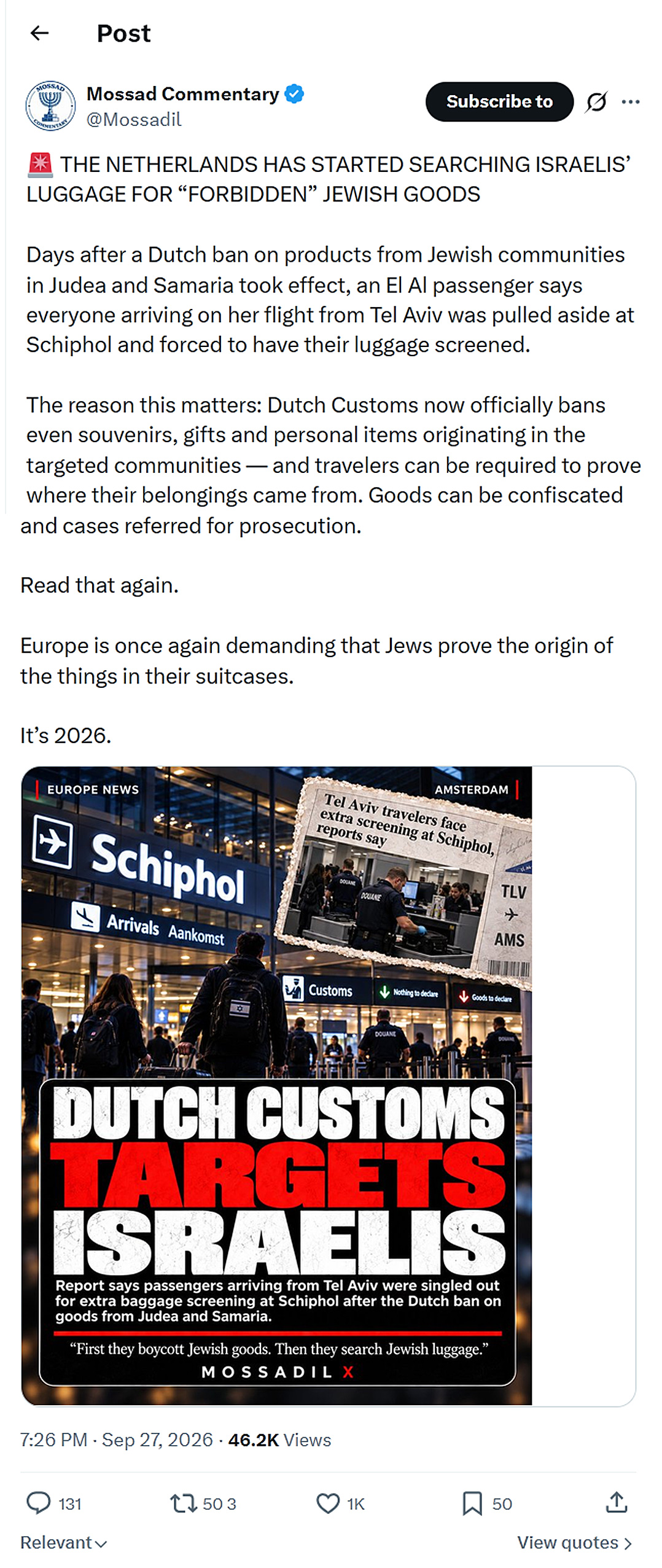 Mossad Commentary-tweet-27September2026-Dutch Customs Targets Israelis
|
|
Israel retaliates against Dutch boycott, revokes diplomats’ immunityFollowing the Dutch boycott of Israeli products, Sa’ar orders diplomats in Ramallah to surrender Israeli-issued documents within seven days.
Israel National News / 17September2026, 9:17 PM (GMT+3) / https://www.israelnationalnews.com/news/433730
Foreign Minister Gideon Sa’ar announced on Sunday that Dutch diplomats operating in Ramallah have been ordered to return their Israeli-issued diplomatic documentation within seven days, in response to measures taken by the Dutch government against Israel.
According to a statement issued by the Israeli Foreign Ministry, the decision follows the implementation last week of Dutch restrictions prohibiting the import and sale of products originating in Judea and Samaria, eastern Jerusalem, and the Golan Heights.
Sa’ar informed the Dutch Embassy in Israel that the diplomatic privileges and immunities granted by Israel to the diplomats in question will expire at the end of the seven-day period.
The Foreign Ministry clarified that the Netherlands may continue representing its interests with the Palestinian Authority, provided its diplomatic personnel operate from Palestinian Authority territory rather than Israeli territory.
The statement also noted that Sa’ar had ordered the removal of the Dutch delegation from the International Support Center for Gaza in Kiryat Gat last month, and confirmed that the decision has since been implemented.
Sa’ar emphasized that Israel would respond to measures directed against it, warning that countries pursuing hostile and unilateral policies toward Israel would diminish their own influence and relevance in the region.
The Foreign Minister also raised concerns about growing antisemitism and incitement in the Netherlands, accusing the Dutch authorities of failing to address the phenomenon adequately. He further argued that the Dutch government’s anti-Israel policies were contributing to the atmosphere of hostility.
The diplomatic measures come amid growing tensions surrounding the Dutch boycott, which took effect on September 22.
Dutch news outlet NieuwRechts reported that passengers arriving at Amsterdam’s Schiphol Airport on flights from Israel were being subjected to additional customs inspections following the introduction of the restrictions.
According to an account published by opinion writer Sivan Behr, passengers arriving on an El Al flight from Tel Aviv were directed to undergo baggage checks, including those who had entered the Nothing to Declare lane.
Behr described confrontations between Israeli passengers and customs officials and reported concerns that travelers could face scrutiny over products purchased in Israel, including wine, dates, and olives.
US Ambassador to Israel Mike Huckabee also criticized the restrictions, warning that Dutch visitors returning from Israel could face penalties for bringing home souvenirs originating in the affected areas.
The Dutch boycott prohibits the purchase, sale, and import of products originating in Israeli communities in Judea and Samaria, as well as commercial services facilitating such transactions.
|
|

Mark DubowitzMark Dubowitz is the FDD’s chief executive and an expert on Iran’s nuclear program and sanctions. Israel must prepare for the possibility of financial warfareThe model Washington used against Iran could one day be turned against Israel. The precedent has already been set: US support is eroding, and Jerusalem still has time to prepare for a threat to its banks, companies and the economy as a whole.by Mark Dubowitz – Published on 06September2026 09:54 – Last modified: 06September2026 09:54 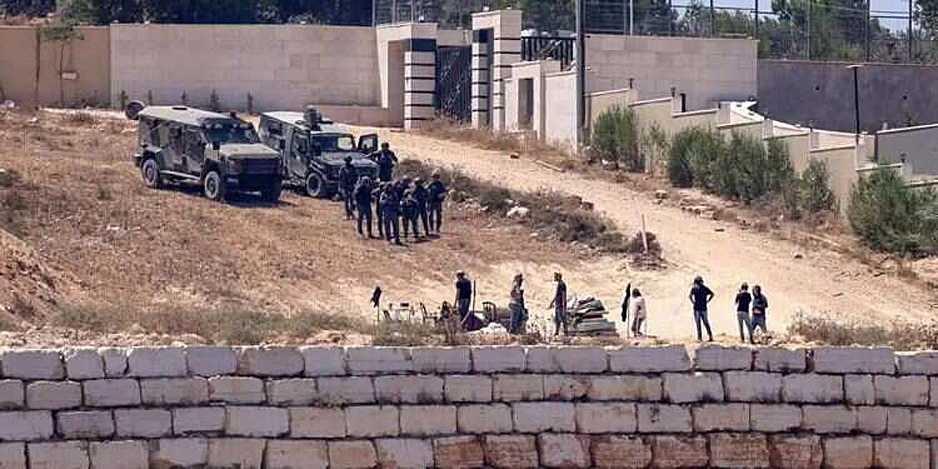 IDF forces in Qusra. Photo: AFP
For two decades, the United States built a formidable financial warfare machine designed to cripple Iran. Ironically, parts of that same machinery are now being assembled against Israel by some of Washington’s closest allies.
The model used against Iran was devastating because it operated like a steadily tightening noose. First, the legal infrastructure is established. Then it is internationalized. Sanctions are imposed on individuals, expanded to companies and entire sectors, and ultimately brought to bear on the financial system itself.
Sanctions set the process in motion, but the real damage was inflicted by banks and investors who, fearful of incurring Washington’s wrath, went far beyond what US law actually required. Iran became commercially toxic.
Israel is prepared for missiles, drones, terrorism and cyberattacks, but it must now prepare for another kind of weapon as well: the US dollar. Anyone who believes such a scenario is far-fetched should think again.
The precedent already existsIn February 2024, US President Joe Biden signed Executive Order 14115, declaring a national emergency in response to the situation in Judea and Samaria and authorizing sanctions against Israeli settlers and entities connected to them. Whatever one’s views of the people placed on the sanctions list, a precedent had been established: Using emergency powers, the United States imposed a sanctions regime on citizens of a close democratic ally.
President Donald Trump revoked the order immediately upon returning to the White House, but the precedent itself cannot be erased. The order was written and implemented, and US allies had already joined the effort.
Within 72 hours of the sanctions announcement, Israeli financial institutions began restricting the accounts of those who had been listed. Finance Minister Bezalel Smotrich protested, but the Bank of Israel refused to back down, warning that ignoring US sanctions could endanger Israeli banks’ access to the international financial system. It was a vivid demonstration of the leverage Washington possesses, even inside Israel.
 Joe Biden. Photo: Mark Schiefelbein, AP
Public opinion mattersNow imagine not a handful of individuals, but 200 targets, including Israeli companies and banks. The target list is already taking shape. A UN database lists 158 companies from 11 countries involved in activities connected to Israeli settlements, spanning banking, construction, communications, energy, transportation and technology.
Israel’s political shield is also eroding. Prominent US politicians increasingly feel free to adopt tougher positions. After decades in which Israel enjoyed a large advantage, polls now show more Americans sympathizing with the Palestinians than with Israelis. Nor is this solely a Democratic phenomenon: 57% of Republicans under 50 hold an unfavorable view of Israel. Those figures should concern Israel and its friends because, ultimately, public opinion shapes policy.
A dangerous spiralNow fast-forward to January 2029. A president hostile to Israel enters the White House. The United States stops blocking measures against Israel at the UN. European sanctions expand, and the Biden administration’s sanctions order returns, this time broadened and enshrined in legislation, extending from violent settlers to companies operating in Judea and Samaria.
Wall Street would do the rest. Banks would steer clear of anything they perceived as a risk. Financial institutions’ overcompliance can sometimes be more destructive than the sanctions themselves. At the final stage, the distinction between the two sides of the Green Line could disappear, with measures expanded to target the Israeli government and the core of the economy. Israel is particularly exposed because of its dependence on international capital. High-tech accounts for 58% of Israeli exports, while about 70% of venture capital investment comes from foreign investors.
None of this is inevitable. Israel still has time to prepare, but it must begin now. Jerusalem should prosecute perpetrators of violent acts with determination, thereby depriving its adversaries of one of the strongest grounds for imposing sanctions. It should conduct stress tests of Israeli banks and major companies against the scenario of a future sanctions wave and map the economy’s vulnerabilities.
Israel also needs a permanent interministerial economic-security team, together with private-sector participation, to conduct financial war games, monitor threats and prepare countermeasures.
 Wall Street trade. Photo: GettyImages
A change is neededDiplomatically, Israel must distinguish between legitimate criticism of its policies and financial measures designed to paralyze its economy. It should deepen its relationships with US governors and financial institutions, whose decisions could prove critical if the climate in Washington changes.
At the same time, Jerusalem must diversify its risks and expand its ties with additional markets. Most importantly, Israel and the United States should deepen their military, technological, intelligence and economic integration to such an extent that inflicting financial harm on Israel would also carry a significant cost for Washington.
Israel’s domestic politics will affect its ability to wage this battle. As an American, it is not my place to tell Israelis how to vote. But as someone working in Washington to defend Israel, I believe it is important to spell out the consequences: If the current coalition returns to power without changing its policies and conduct, defending Israel against a campaign of financial warfare will become far more difficult. Israel’s friends cannot indefinitely compensate for decisions made in Jerusalem that erode international support for the country. Israelis should factor this strategic reality into their public debate, whatever political conclusions they ultimately draw.
The blueprint for financial warfare against Israel already exists, but the outcome has not yet been written. There are roughly two years until the next US presidential election to reduce Israel’s vulnerabilities, strengthen its alliances and deepen the economic integration that could deter such a campaign, or stop it if deterrence fails.
The question is not only who will hold the pen in Washington in 2029, but what Israel will do between now and then to ensure that pen is never used against it.
|
|
 https://www.fdd.org/ UN Human Rights Council, European Governments Launch Economic Warfare Against IsraelBen CohenResearch Fellow and Senior Editor
International opprobrium towards the presence of Israeli communities in Judea and Samaria, commonly known as the West Bank, is discernibly shifting from rhetorical condemnation to economic and legal warfare.
Three episodes reported during the last week illustrate the trend. On September 26, the United Nations Office of the High Commissioner for Human Rights (OHCHR) issued an updated version of its database — described by Israel as a “blacklist” — that identifies Israeli and international businesses allegedly “involved in certain activities in illegal Israeli settlements in the occupied Palestinian territory.” On September 28 — less than a week after The Netherlands’s ban on the import of goods from these communities went into effect — passengers who arrived at Amsterdam’s Schiphol Airport on a flight from Tel Aviv were subjected to “intrusive” searches of their baggage by Dutch customs officers. On September 29, three weeks after the British government announced a ban joined by 11 other western states, passengers disembarking a flight from Tel Aviv to the United Kingdom’s Luton Airport similarly reported extra screening of their baggage by the UK Border Force
In addition, at the beginning of September, Luxembourg’s financial authority confirmed that it would no longer approve the prospectuses required under EU law to enable the sale of Israel government bonds.
These developments demonstrate that the architecture of sanctions and other punitive measures traditionally aimed at the adversaries of western democracies are now being applied to the State of Israel. Moreover, because supply chains connecting Israel with Judea and Samaria are closely intertwined, tracing a product’s origin to one side of the Green Line is practically impossible, meaning that measures ostensibly designed to affect a narrow set of targets, negatively impact the Israeli economy as a whole.
UN Human Rights Council Expands Database ‘Blacklist’Launched in 2016 under Resolution 31/36 of the UN’s Human Rights Council — which during its existence has passed 116 resolutions condemning Israel, 16 on Iran, and 13 on Russia — the database naming companies allegedly involved in activities connected to Israeli communities in the disputed territories has been significantly expanded, with 214 companies now included compared to 158 in 2025.
While the great majority of the companies listed in the database are Israeli, it also includes American and European businesses. Six U.S. companies — Airbnb Inc., Booking Holdings Inc., Expedia Group Inc., Motorola Solutions Inc., RE/MAX Holdings Inc., and TripAdvisor Inc. — have been present since 2020. Two more were added this month: the nonprofits Friends of Ir David and HaYovel.
European Measures Now Given Legal TeethThe OHCHR database is designed to galvanize both governments and private businesses, but it does not have the force of law underpinning it. This is not the case with the three European countries, two of whom are EU members. In the Dutch case, the importation of goods from Judea and Samaria as well as the Golan Heights can result in custodial sentences of up to six years and fines of up to 1.1 million euros. Similarly draconian penalties could be imposed in the United Kingdom once it completes the implementation of its ban over the next six to nine months.
In the case of Luxembourg, while no legal penalties are envisaged, preventing the sale of Israel bonds sends the unmistakable signal that the EU is ready to take measures punishing Israel on both sides of the Green Line. This may well encourage EU states hostile to Israel, such as Ireland and Spain, to push for the suspension or revocation of the EU-Israel Association Agreement in force since 2000.
The U.S. Must Protect American Companies Trading With IsraelThe United States should act immediately to stymie economic warfare against Israel, particularly as it negatively impacts American companies, which conduct over $54 billion worth of trade with the Jewish state annually.
The Trump administration should tie the payment of $4 billion of arrears to the United Nations to a verifiable end to the OHCHR’s campaign of pressure against Israel. It should also seek to protect U.S. entities from exposure to the campaign, if necessary through reciprocal measures against participating UN entities and foreign governments.
Ben Cohen is a research fellow at the Foundation for Defense of Democracies (FDD). For more analysis from the author and FDD, please subscribe HERE. Follow FDD on X @FDD. Follow Ben on X @BenCohenOpinion. FDD is a Washington, DC-based, nonpartisan research institute focusing on national security and foreign policy.
|
|
“Silenced No More:” Dr. Cochav Elkayam-Levy on October 7th, Denial and the Fight for TruthINTERVIEW: October 7 Civil Commission founder Dr. Cochav Elkayam-Levy spoke to HonestReporting about challenges in recording the massacre’s atrocities.By Ben M. Freeman October 07, 2026 https://honestreporting.com/silenced-no-more-dr-cochav-elkayam-levy-on-october-7th-denial-and-the-fight-for-truth/
 Dr. Cochav Elkayam-Levy on October 7th
Key Takeaways:
On the morning of October 7th, 2023, Dr. Cochav Elkayam-Levy was with her father in hospital when the sirens began. Immediately, her WhatsApp and Telegram groups filled with messages, while social media was flooded with footage, much of it filmed and shared by Hamas themselves. Cochav began watching. As an international law and human rights expert, she understood very quickly that she was seeing crimes against humanity. But there was something else happening too. The visibility of the violence was part of the violence.
“The visibility became a terror itself,” she told me.
The atrocities were not simply committed. They were filmed, shared, and consumed, allowing the violence to travel beyond the places where it happened. The images became another means of terrorizing Israelis and Jews, extending the horror of October 7th long after the attacks themselves.
Even the day that we spoke on the phone, it was difficult for Cochav to talk about the massacre. Throughout our conversation, she tried to keep her emotions in check. October 7th remains, she said, the hardest day. But it was also the day that changed the course of her life.
Three years later, Cochav is the leading figure documenting the sexual and gender-based violence committed during the October 7th massacre. She founded the Civil Commission on October 7th Crimes by Hamas Against Women and Children and led the work that became Silenced No More, a major report documenting the systematic sexual violence committed during the attack and against hostages in captivity. Published in May 2026, it draws on more than 430 testimonies and over 1,800 hours of visual material, and identifies 13 distinct patterns of sexual violence. None of this was planned. She did not set out to become an investigator or the guardian of an archive. She became one because she understood that the evidence had to be protected.
The First EvidenceCochav’s understanding of the sexual violence of October 7th came gradually, although there were signs from the first day. She saw the footage of Shani Louk and Naama Levy. As a feminist scholar, she recognized at once what she was seeing.
Over the next week, more footage and testimony arrived. Cochav remembers one video from the beginning of the war. The upper part of a woman’s body had been burned, while her lower body had been left exposed. She began putting the pieces together. Without meaning to, she was beginning to conduct an investigation. She collected footage and testimonies as they emerged, documenting evidence of sexual and gender-based violence almost in real time.
At the same time, Cochav and other Israeli human rights experts began contacting their colleagues in the United Nations. They sent information to UN officials and called on them to condemn the crimes and demand the immediate release of the hostages. They hoped international pressure might help bring them home. Cochav felt she had a responsibility to raise her voice. In fact, she believes international institutions already had access to more information than she did. Some of the videos she had struggled to find were already being broadcast by international media. She kept sending material, but there was almost no response. Emails and messages went unanswered.
Then an Israeli women’s protest movement asked Cochav to address the United Nations Committee on the Elimination of Discrimination against Women (CEDAW). The day before she was due to speak, the committee released a statement which made no mention of October 7th or the hostages. For Cochav, it was a moment of profound betrayal. She had built her career around international law and human rights. She had studied these institutions and believed in what they were supposed to represent. Now, she said, her “entire belief system collapsed” before her eyes.
The following day, she asked the committee a simple question: “Does international law exist for us as Jewish women, for Israeli women?”
If these institutions could not speak for Israeli women now, what did any of it mean? Her speech went viral and inspired protests around the world. But for Cochav, something else had become clear. If the world was not going to believe what had happened, they were going to have to prove it.
Becoming the GuardianA few days after the speech, Cochav had a realization. “Something is wrong,” she remembers thinking. People were not believing what had happened, or they were not understanding it.
“We have to establish an archive under the most compelling international norms,” said Cochav.
In reality, the archive had already begun. People had been sending her material, and videos and testimonies were sitting on her phone and in her email. Much of Cochav’s life before October 7th seemed to have prepared her for this work. Her expertise in international law and her knowledge of the UN and human rights mechanisms meant that she understood how these systems were supposed to work. She could also see that they were failing.
At first, Cochav thought she would gather the evidence and eventually hand it over to somebody else. She wanted distance from the task because the material was so horrific. But slowly, she understood that she could not simply hand it away.
“I realized I am the guardian,” she said.
Cochav still feels that responsibility today. Some families do not know exactly what happened to their loved ones, and that reality shaped the way every case had to be handled. There was no room for carelessness when the material represented the final moments of real people whose families were still living with unimaginable loss.
The work also had a huge impact on the researchers. Some reached a point where they simply could not continue.
“I cannot do this,” team members would tell her.
“We understand and we hug them,” she explained her response.
But carrying that responsibility took its toll on her too. While she tried to support the people around her, she had to find a way to keep going herself. For Cochav, motherhood became an anchor. Her responsibility to her children gave her strength and purpose during a period that was hugely traumatic for her. She is stronger now than she was when she was writing the report and feels that she is beginning to come back to herself. But the responsibility has not gone away. What happened to these women has to matter.
“It must count,” said Cochav. The Instability of the TruthCochav understood very quickly that documenting the crimes would not be enough. She was also going to have to fight for them to be acknowledged. The reaction of human rights institutions made that clear almost immediately.
The erasure did not paralyze her. It drove her. Speaking at a conference in Haifa, Cochav described what she saw happening as “the instability of the truth.” As she put it, “We are losing the sense of knowing what happened. We have to preserve the truth.” For me, that sentence goes to the heart of what has happened since October 7th. The facts were still raw when narratives denying or diminishing Jewish experience began to appear. Cochav knew that the truth had to be preserved, but she did not know just how difficult that would become.
Until very late in the process, she was not sure they would succeed in publishing the report. The entire process had to be rigorous and every piece of material had to be reviewed carefully. The claims had to stand up to scrutiny, even as the burden on the people examining the evidence grew heavier. Still, they continued. Human rights activists do not often get to finish work like this and say, “We did it.” But they did. Cochav is clear that this achievement belongs not only to her team, but also to the advocates and activists around the world who fought alongside them.
Now comes the question of what happens to what they preserved. For Cochav, these stories cannot simply sit in an archive. What happened to these women must become the basis for meaningful change. When the Human Rights World Looked AwayFor Cochav, one of the deepest disappointments after October 7th came from the human rights world of which she had long been a part. Some of the people she admired, including people who had helped shape her as a scholar, turned their backs on Israelis after October 7th. But Cochav makes an important distinction.
“It’s the people, not the ideas,” she explained.
Cochav has not abandoned the idea of human rights because some of the people and institutions that claimed to defend them failed. And importantly, not everyone failed. Through this work, Cochav met women and survivors of sexual violence from around the world, including Yazidi survivors and women from Sudan and Ukraine. Among them she found real sisterhood and solidarity.
“We will be here, we are here, we believe, we are together in fighting this,” she said.
Before Silenced No More was released, the work received support from Hillary Clinton, leading legal experts, and former UN officials. Their support was more than symbolic. It was an important stamp of verification from people with authority in international law, human rights, and politics. After experiencing the silence of institutions she had trusted, that recognition mattered deeply. For Cochav, it became part of the healing.
Denial in Real TimeIn my upcoming book, I wrote about the denial of October 7th as an attempt to erase Jewish experience. I described it as analogous to Holocaust denial. I wanted to know how Cochav understood the phenomenon after spending three years confronting it herself. She sees an important similarity, but also a frightening difference. Denial of October 7th began while October 7th was still happening. The massacre was being filmed, videos were being uploaded and people around the world could watch what was happening. Yet denial came almost immediately. The Holocaust was denied after the fact. October 7th was denied as it happened.
For Cochav, that tells us something about how fragile truth has become. Technology has also made denial more sophisticated. We have access to more evidence than previous generations could have imagined, yet that has not necessarily made truth easier to establish. There is another element that Cochav finds particularly disturbing. The Holocaust helped bring about the international human rights system we have today. Yet some of the institutions entrusted with protecting those rights have, in her view, helped create the conditions in which denial of October 7th has been allowed to grow.
In Silenced No More, Cochav and her colleagues describe October 7th as a genocidal attack. The report also examines the war crimes and crimes against humanity committed that day. For Cochav, the question of genocidal intent is present in the evidence itself. The archive contains material in which terrorists commit crimes while expressing that intent.
“It was a vividly genocidal attack,” she told me. “There was an intention to genocide.” What We RememberThree years on, I asked Cochav what she wants the world to remember about October 7th. She wants people to understand what Silenced No More established about the sexual violence committed that day. It was not incidental. The evidence shows, she argues, that it was calculated and carried out with extraordinary cruelty.
But that is not where she wanted to end. After everything she has seen, Cochav still believes in goodness. What allowed her to carry this for so long, she told me, was remembering that “there was as much goodness in this world as there is evil.” That goodness has to be protected.
“We must fight back to preserve the good,” Cochav said, and she believes we will. “We will rise. I already feel it in my bones.”
I believe her.
Interviewing Cochav is a great honor, but more importantly, so is being able to call her my friend. At the end of our conversation, I found myself holding back tears as I tried to tell her what her work has meant to me and to so many others.
“Cochav, I want to say thank you,” I said. “Thank you for the work you have done, for the stories you have preserved, and for refusing to allow what happened to these women and their families to be denied or erased. We owe you an enormous debt of gratitude.”
Cochav took responsibility for stories that should never have needed a guardian. But because she did, they cannot be erased.
Liked this article? Follow HonestReporting on Twitter, Facebook, Instagram and TikTok to see even more posts and videos debunking news bias and smears, as well as other content explaining what’s really going on in Israel and the region. Get updates direct to your phone. Join our WhatsApp and Telegram channels!
© Divuach Ne’eman R”A, 2025
|
|

Inside the protest playbook to vilify Israel on ‘global day of action’The London-based coalition distributed tactics to ‘shut down city squares’ and ‘encircle government buildings’ By Asra Q. Nomani Fox News
WASHINGTON, D.C. — As demonstrators, including the headline-grabbing CodePink agitators, descend on the nation’s capital late Saturday afternoon for a “coordinated global day of action” against Israel, they will join a worldwide wave of marches and planned disruptions that may appear to be unfolding independently. In Kuala Lumpur, Malaysia, on Friday, anti-Israel demonstrators carried signs deploying emotionally charged language against Israel, including one featuring a Palestinian flag and a bloodied hand with the message, “STOP GENOCIDE.”
Nearby, two women carrying mock machine guns flanked a cardboard image of a handcuffed Israeli Prime Minister Benjamin Netanyahu with a noose around his neck.
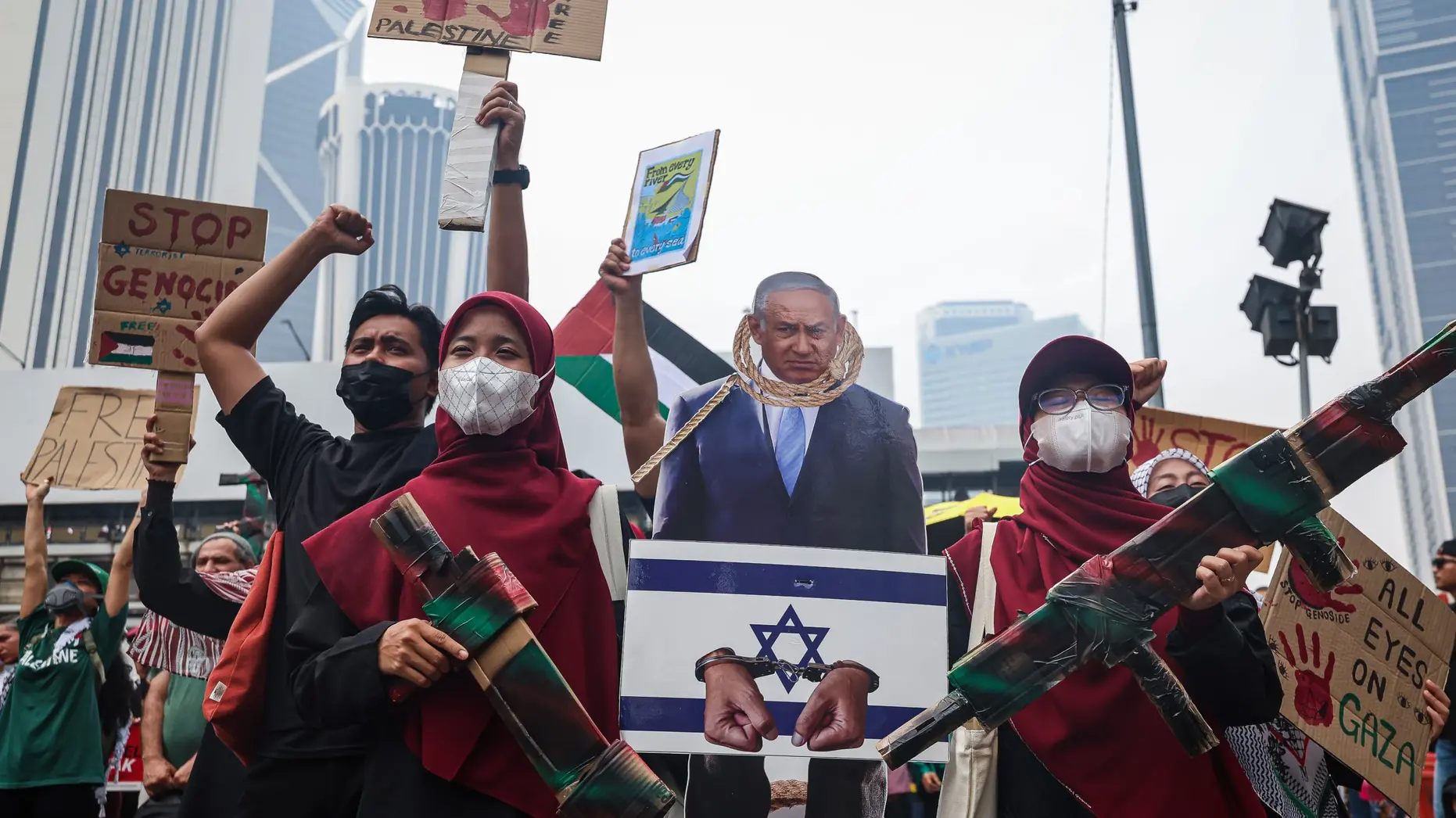 Anti-Israel demonstrators carry a cutout depicting Israeli Prime Minister Benjamin Netanyahu alongside mock cardboard weapons and placards during a rally Oct. 9, 2026 in Kuala Lumpur, Malaysia. (Annice Lyn/Getty Images)
But a Fox News Digital investigation has found that, long before the first demonstrators gathered, the messages for the protest’s “communications framing” and transnational action plan had already been written, the banners designed, the tactics circulated and the media strategy laid out to “turn public outrage into collective leverage.”
The campaign documents reveal that coalition organizers instructed participating groups to direct protesters to “shut down city squares,” “encircle government buildings” and “blockade complicit corporate hubs.”
The document declares, “This is not a symbolic march and not a routine protest.” Fox News Digital identified 179 organizations in the coalition, while an interactive Google Map published by the network lists 322 events scheduled across three days through Sunday.
They include a rally on an “Intifada Trail” in Saint John, New Brunswick, Canada; a protest in Bangladesh by the “Bangladesh Intifada Youth Collection”; and actions in South Africa by “Social Intifada.”
All three use “intifada,” a term associated with Palestinian uprisings against Israel, including periods marked by deadly terrorist attacks. Activists describe the term as a call for resistance.
The global coordination illustrates how contemporary protest movements combine international leadership, local activist networks, standardized visual branding, emotionally charged messaging and traditional news outreach into a single mobilization infrastructure in which professional political organizing amplifies the sincerely held convictions of individual demonstrators.
 Organizers from Global Action for Palestine shared a map for Global Day of Action events for 2026. (Global Alliance for Palestine)
Among the participating organizations is CodePink, a 501(c)(3) nonprofit that has received $1.33 million from Neville Roy Singham, a Shanghai-based tech tycoon who has funneled $278 million into a network of nonprofits under scrutiny by the House Ways and Means Committee and its chairman, Rep. Jason Smith, over allegations that some operate as “Trojan horses” and proxies for the Chinese Communist Party and other malign foreign interests. CodePink and other organizations under scrutiny have denied wrongdoing.
Two days ago, CodePink co-founder Medea Benjamin and D.C. coordinator Olivia DiNucci dispatched a letter to members, directing them to join the “Feminist Contingent” at the Library of Congress for the “global day of action.”
“And don’t forget to WEAR PINK!” they noted.
The network’s connections were also visible last week, when CodePink co-founder Jodie Evans, who married Singham in 2017, joined an anti-Israel protest in New York City, marching behind a band of activists from Revolutionary Communists of America as they chanted, “Long live the intifada.”
Evans told Fox News Digital Singham supports CodePink’s efforts and the “amazing work” nonprofits are doing to “stand up when violent things are happening.”
Taken together, the documents reveal a coordinated protest and influence campaign spanning continents, combining accusations of Israeli “genocide,” attacks on the news media, workplace and university walkouts, blockades, political lobbying and carefully orchestrated publicity.
 Anti-Israel-carefully orchestrated publicity
A review of the planning documents for the global protests reveals the machinery behind the wave of anti-Israel demonstrations across continents as not only a protest campaign but a psychological operation.
 October-10-2026-Mobilization-Organisations
In a document, leaders of the Global Alliance for Palestine”spell out “What Organisations Can Do” to oppose the state of Israel and support a “global day of action” Oct. 7, 2026. (Global Alliance for Palestine)
At the center of the international mobilization are three organizations identified in the campaign documents: the Global Alliance for the Palestinian Territories, launched in July 2025 in London as a “truly international popular front for Palestinian liberation”; the Anti-Apartheid Movement for Palestine; and the Global Coalition to End the Occupation of Palestine.
An online directory displays 179 organizational logos from participating groups worldwide. Fox News Digital extracted the names from the logos and built a database of the coalition.
The same pattern of coordinated organizing has emerged in another international protest movement — the “student protests” rolling through France.
A separate Fox News Digital investigation identified a network of 50 organizations coordinating and amplifying those demonstrations. Only 15 were classified as youth- or student-led groups, while the remaining 35 included communist organizations, labor groups, political organizations and professional protest coordinators.
Organizers supplied participating groups with campaign materials, coordination and strategic support to “turn public outrage into collective leverage.”
In an August “Launch Statement,” the alliance laid out a strategy to synchronize student demonstrations, workplace actions, rallies and civil disobedience across Asia, the Americas, Europe, Africa and the Middle East
The stated objective wasn’t simply to organize demonstrations but to add Israel’s war in Gaza to the international media agenda, turning separate protests into a coordinated communications effort intended to shape what audiences around the world see, hear and think about the conflict.
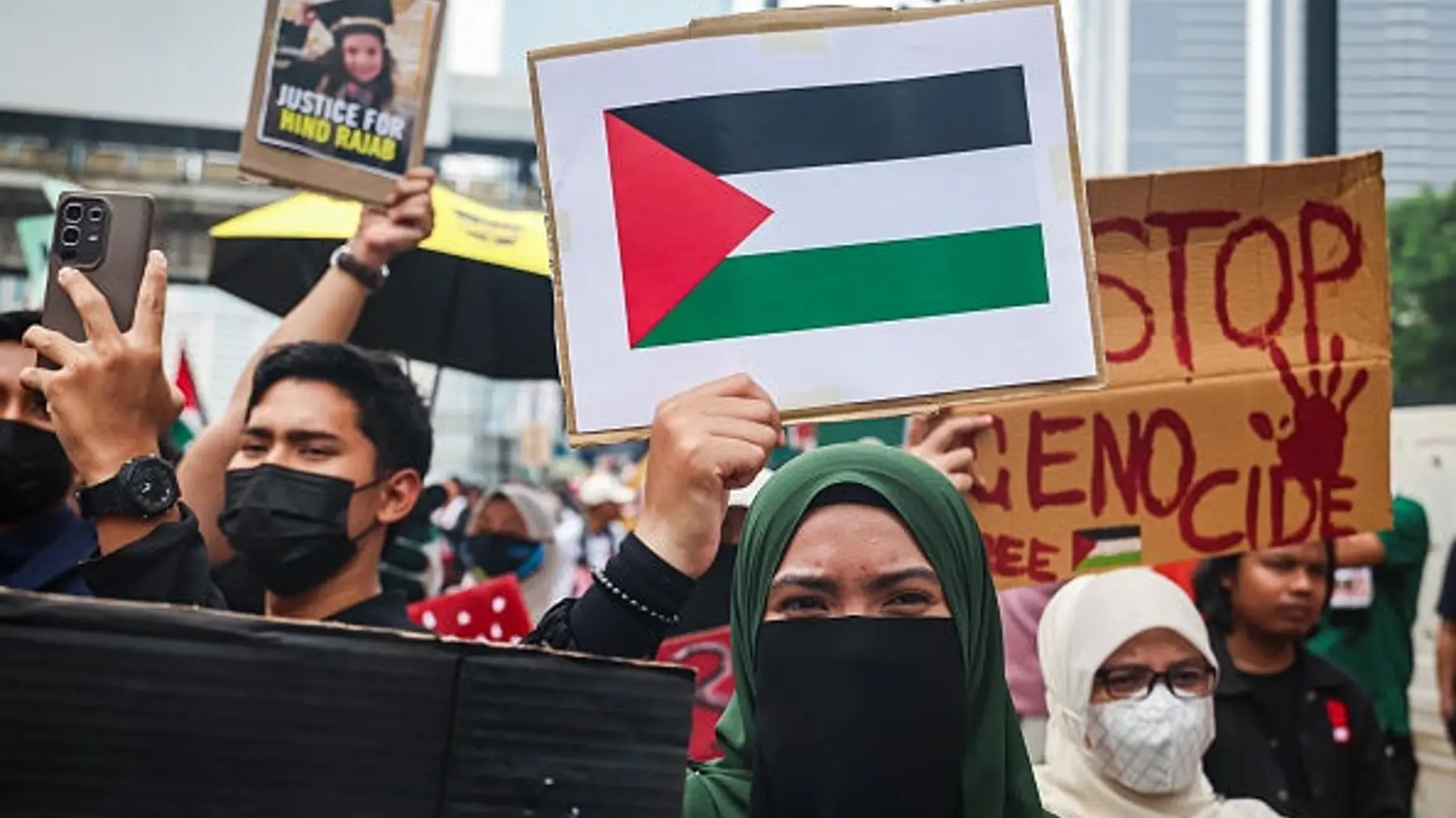 Anti-Israel demonstrators hold a Palestinian flag and signage during a rally Oct. 9, 2026 in Kuala Lumpur, Malaysia, as part of a “global day of action” against Israel. (Annice Lyn/Getty Images)
But the most revealing aspect of the operation may be its stated objective of shaping what the world sees, hears and thinks about the Israeli-Palestinian conflict.
In a “Launch Statement” in August, the alliance declared that the demonstrations are intended to return Israel’s military campaign against Palestinians to the international media agenda.
The campaign materials describe a strategy of synchronizing protests across continents, connecting student demonstrations, workplace actions, rallies and civil disobedience from Asia to the Americas, Europe, Africa and the Middle East.
The result is a coordinated communications campaign designed to transform demonstrations organized by separate groups into the political impact of a single international mobilization.
 Nancy Snow, communication scholar and author
Weeks before the demonstrations, the alliance had already prepared a collection of campaign posters in seven languages — English, Arabic, Turkish, Finnish, French, Portuguese and Spanish. They supplied graphics for a large street banner carrying carefully selected slogans, along with protest-sign designs from folders marked “HANDHELD PLACARDS” and “STREET DEMANDS.”
One of the downloadable images is a poster with the message “GAZA GENOCIDE” next to graphics of barbed wire and watermelon, both symbols of Palestinian “resistance” against Israel.
In Malaysia, a woman wearing a black-and-white Palestinian keffiyeh raised her fist while holding a printed version of the watermelon and barbed-wire placard, with the organizers’ branding in smaller letters on her sign: “GLOBAL ALLIANCE FOR PALESTINE.”
Behind her, other women carried the same sign and other signs featuring additional graphics from the same campaign materials.
 A woman covers her hairs with a Palestinian keffiyeh scarf and raises her fist while holding a placard reading “Gaza Genocide” during an anti-Israel rally Oct. 9, 2026, in Kuala Lumpur, Malaysia. The sign is part of a series of downloadable pre-made graphics created by organizers of the global protest. (Annice Lyn/Getty Images)
Other placards held by protesters in Malaysia yesterday read, “HUMANITY IS NOT A CRIME” and “STOP THE GENOCIDE WAR!”
Another downloadable sign, carried in Malaysia, reads: “LET GAZA LIVE!”
The campaign’s “Communications Framing” employs familiar techniques of political persuasion: repetition, emotional imagery, collective identity, moral urgency and the portrayal of inaction as complicity.
The materials offer a window into the battle for public attention that increasingly accompanies international conflicts.
 Women at an anti-Israel rally on Oct. 9, 2026, in Kuala Lumpur, Malaysia, hold placards with messages created by the leaders of the Global Alliance for Palestine for protests around the country. The messages read “Humanity Is Not a Crime,” “Let Gaza Live” and “Stop the Genocide War.” (Annice Lyn/Getty Images)
One poster declares, “You cannot erase a homeland.”
Another commands, “End the genocide. Defend the land.”
A third combines an image of a child with the message, “Defend the land. Protect its children.”
Another repeats the words “Silence normalises” across the background before presenting the word “genocide” in oversized red lettering.
But the campaign’s internal messaging guidance goes further, prescribing accusations against Israel and the news media in a section called “Slogans & Hashtags,” with “Call to Action & Core Street Demands.”
 In a “concept paper” for the Global Alliance for Palestine, organizers share guidelines for “Slogans & Hashtags” that carry explicit negative messages about Israel. (Global Alliance for Palestine)
Among its recommended slogans is the blunt declaration: “Israel Kills. The Media Justifies.”
Another declares, “1,100 Days of Israeli Genocide — The Killing Continues.”
Yet another calls for action under the message, “1,100 Days — From Every Street, One Demand: End Genocide, End Occupation.”
Together, the slogans strategically combine accusations of “genocide” with demands for political action, while claiming the media “justifies” Israel’s conduct.
 In a “concept paper” for the Global Alliance for Palestine, organizers share guidelines for “Communications Framing,” including “Core Messages” that intentionally describe Israel negatively. (Global Alliance for Palestine)
In its “Concept Paper,” the alliance describes Israel’s actions as a “war of extermination” and calls for countries to stop providing weapons to the Israeli state.
The same document instructs participating organizations in its “Communications Framing” to use language that is “disciplined, credible, urgent and impossible to ignore.”
It also directs organizers to portray “institutional silence” as part of the problem and public mobilization as necessary to confront what the alliance calls continuing complicity.
The objective isn’t simply to communicate a political position but to encourage audiences to emotionally identify with a movement and participate in its activities.
The campaign presents its allegations of “genocide” and other violations of international law as established claims.
On Friday, South African human rights lawyer Navi Pillay received the 2026 Nobel Peace Prize for her work, which included arguing that Israel has committed a “genocide” against Palestinians. Israel disputes the “genocide” accusation.
 pro-palestinian-demonstrators-New York City-the People’s Forum
The organizing documents go beyond encouraging supporters to attend demonstrations.
Instead, organizers describe a campaign intended to “interrupt business-as-usual” and organize “high-visibility rallies, marches, picket lines, sit-ins and peaceful blockades” at “civic sites, government offices, financial hubs and corporate locations” that its organizers have “identified as complicit in sustaining or normalising Israeli violence.”
They also recommend synchronized “workplace, campus and creative interruptions,” including “silent walkouts,” banner drops, nighttime projections, street theater, “die-ins” and “other highly visible public actions that interrupt normal routines and make the political demand impossible to ignore.”
A detailed logistical plan urges organizations to “allocate funds,” arrange transportation and establish “legal, stewarding, and participant support.”
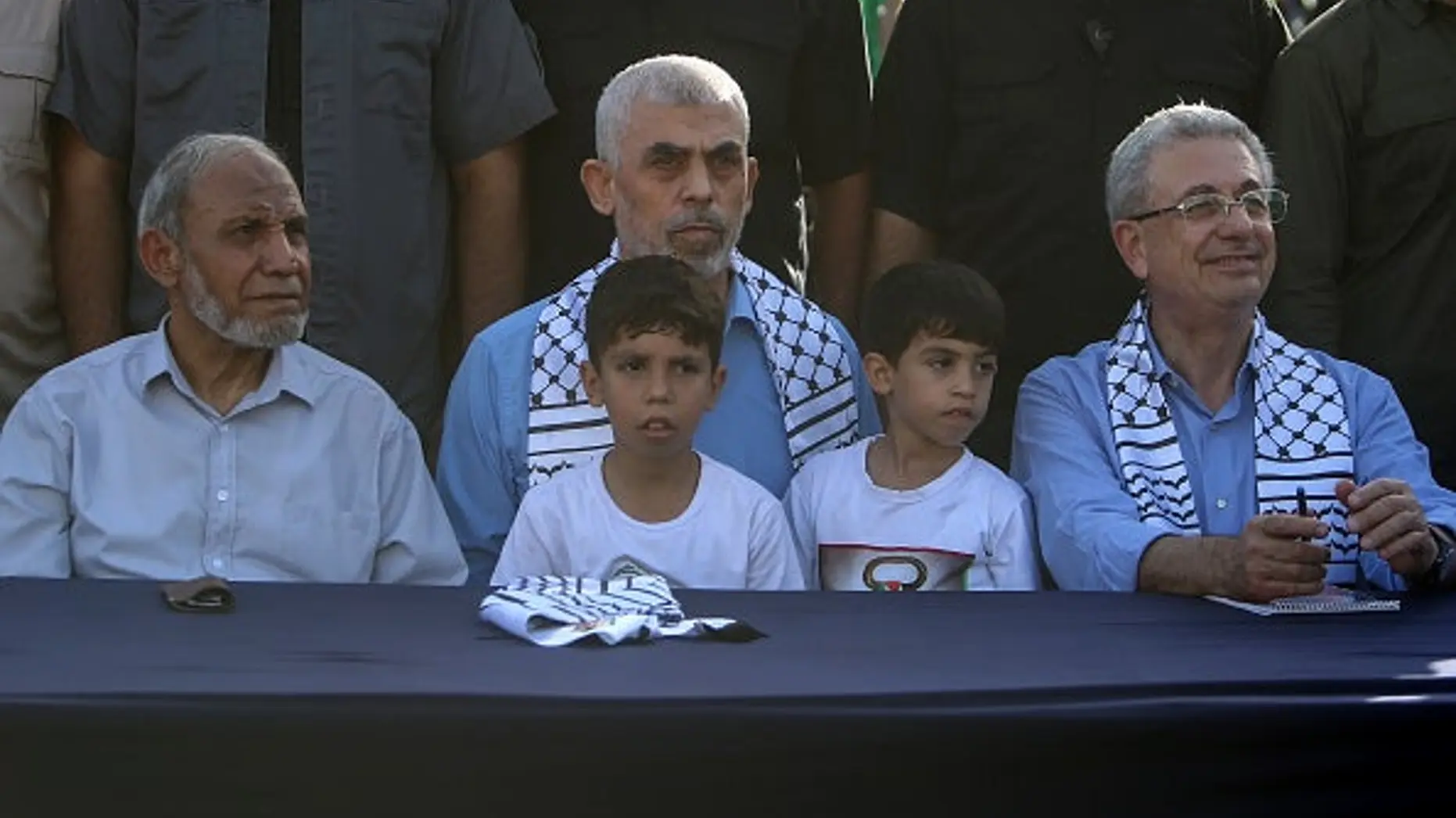 Yahya Sinwar, center, Hamas leader in Gaza; Mahmoud al-Zahar, right, senior Hamas leader; and Mustafa Barghouti, left, secretary general of the National Initiative and supporters of the Palestinian Hamas movement gather during a rally in solidarity with al-Aqsa mosque Oct. 1, 2022 in Gaza City, Gaza. (Mohammed Dahman/Getty Image)
The campaign’s organizational structure brings together prominent political figures with longstanding backgrounds in international politics and anti-Israel activism in Europe, the Middle East, Africa and Asia.
A press release for the protests identifies seven members of the international steering committee, including former British Labour Party leader Jeremy Corbyn, who joined a coalition supporting the Communist Party of Cuba; pro-communist former Greek Finance Minister Yanis Varoufakis; former Sinn Féin leader Gerry Adams; Palestinian political leader Mustafa Barghouti; former South African government minister Ronnie Kasrils; Indian activist Varsha Gandikota-Nellutla; and Italian politician Angelo Bonelli.
Anas Altikriti serves as secretary-general.
Jessica Breakey, the campaign’s public relations officer, didn’t respond to a request for comment.
Beyond the streets, the alliance’s strategy documents lay out a plan to convert the demonstrations’ visibility into “sustained political pressure” on lawmakers and government institutions.
In a separate advocacy document, organizers urge participating groups to mobilize protesters to write lawmakers, submit coordinated institutional letters and arrange meetings with elected representatives.
The campaign calls for “immediate, total arms embargoes” and “comprehensive state sanctions” against Israel for alleged violations of international law.
It also urges governments to suspend preferential trade agreements and institutional partnerships associated with Israeli policies.
The alliance demands an end to what it calls Israel’s “genocide and occupation,” without specifying whether its reference to occupation encompasses Gaza, the West Bank or the entire State of Israel. The distinction takes on particular significance amid chants of “from the river to the sea” at anti-Israel demonstrations.
Organizers encourage participating groups to use “targeted, template-driven letters” and “digital briefing toolkits” to support “localised political campaigning,” adapting them to their national political systems.
The documents provide direct instructions that participating organizations issue local press releases, distribute “ready-made social-media toolkits,” share “graphics across digital channels” and hold briefing sessions to “ensure clear, aligned messaging ahead of the weekend.”
|