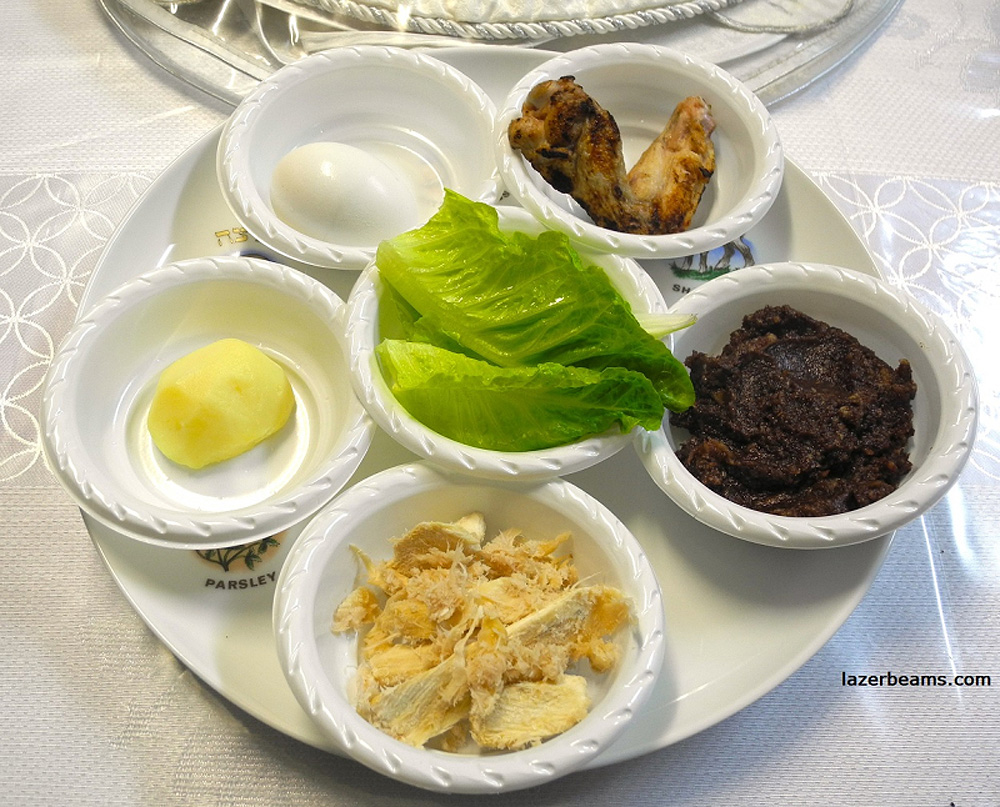
 Passover Seder Plate |
|
Seuda Moshiach The last meal of Pesach on the last Day of Pesach |
In honor of the Shabbat after Pesach Pesach Sheni |

Rabbi Arush on the SederRabbi Arush explains to use how to have “Leil haSeder K’Seder” – an enjoyable and meaningful Seder with tips, tricks and most importantly – all the segulot! PRINT THIS ARTICLE AND PUT IT IN YOUR HAGGADAH so that you can follow it as you go through the Seder.Rabbi Shalom Arush | Posted on 05April2023 | https://breslev.com/1091015/
 Rabbi Arush on the Seder Print this article and put it in your Haggadahso that you can follow it as you go through the Seder.Preparations for SederI am very careful to have the Seder ready the night before. Why?
Remember that it’s forbidden to work after mid-day on Erev Yom Tov, even more serious than working It is important to be happy on the holiday because holidays are the aspect of the “heart” and the heart needs to be happy! Make sure to do your preparation with happiness and excitement! Remember – keeping the holiday is not one mitzvah. It’s thousands of mitzvot ! One hour is 3,600 seconds, which means that there are 3,600 mitzvot every hour! One day is 86,400 seconds, which means 86,400 mitzvot! This is true for Shabbat and all the more so for the holiday! Be happy! Passover is thousands of wonderful mitzvot, even the simplest Jew who doesn’t learn leaves the holiday with tens of thousands of mitzvot! MaarivSeder night – it’s not night, it’s day! This night has the power as if it was day. The evening begins with Maariv! This is when we receive the light of the festival. Also, this is the only night that we say Hallel, and not only one time, but twice! Even women are required to say Hallel twice! At the time of Maariv, they must say Hallel even if they are at home! Ashkenazim and Sephardim! On this night all the prayers from the entire year go up to Shamayim (heaven)! Pray! Ask Hashem to help us have SederThe first thing to remember – the Seder begins with emuna!The Seder begins when and how Hashem wants. You must have patience and just be happy and singing. We all want to start with Kadesh right away, but sometimes there are obstacles, big and small. Before Kadesh comes emuna! Who wrote the Haggadah? Some say it was Rabbi Akiva, some say Eliyahu Hanavi, and some say Anshei Knesset HaGedolah (Men of the Great Assembly, during the time of Ezra). Either way, it was giants who wrote the Haggadah! There is so much in it! For someone who eats everything at the Seder according to its laws, all kinds of healing come into the food! Everyone must know themselves. If you can manage wine, fine. If not, maybe 50/50 wine/grape juice, and if not then only grape juice! This is not a night to get drunk. Make sure to say my prayer before every cup of wine! (Available in Harav Arush’s Haggadah in Hebrew). Matzah – use hand matzah. Only time that we say the blessing “to eat matzah.” The first portion of matzah should be completely plain, no salatim (salads), no nothing. Thirty grams is a kezayit (the size of an olive). The best thing is to weigh your matzah before the Seder to know how much is a kezayit. But even the thinnest round hand matzah, has in it at least 4 kezayot. So eat at least a quarter of a hand matzah and you’re fine! Make sure you eat at least a kezayit of the maror as well. Say everything with a tune and also say it loudly, even yelling! It says that Hashem “heard our cry.” So this is a night to cry out to Hashem! There is an amazing Zohar on this. It’s a segulah for tikkun habrit. To lean – to lean to the left is not enough. You must lean on something. On a pillow, on the arm chair, on whatever – but lean on something! Everything has its segulah. Tonight is also a night to remember childless women – the three angels came to Avraham Avinu on Seder night! Sarah Imenu was remembered on Pesach! Certainly you can also be remembered on Passover to find a soulmate if it is also a night to have children. Haggadah
The MealEven the meal has segulot! It’s an aspect of redemption!
|
|
Sefirat HaOmer Chart 2026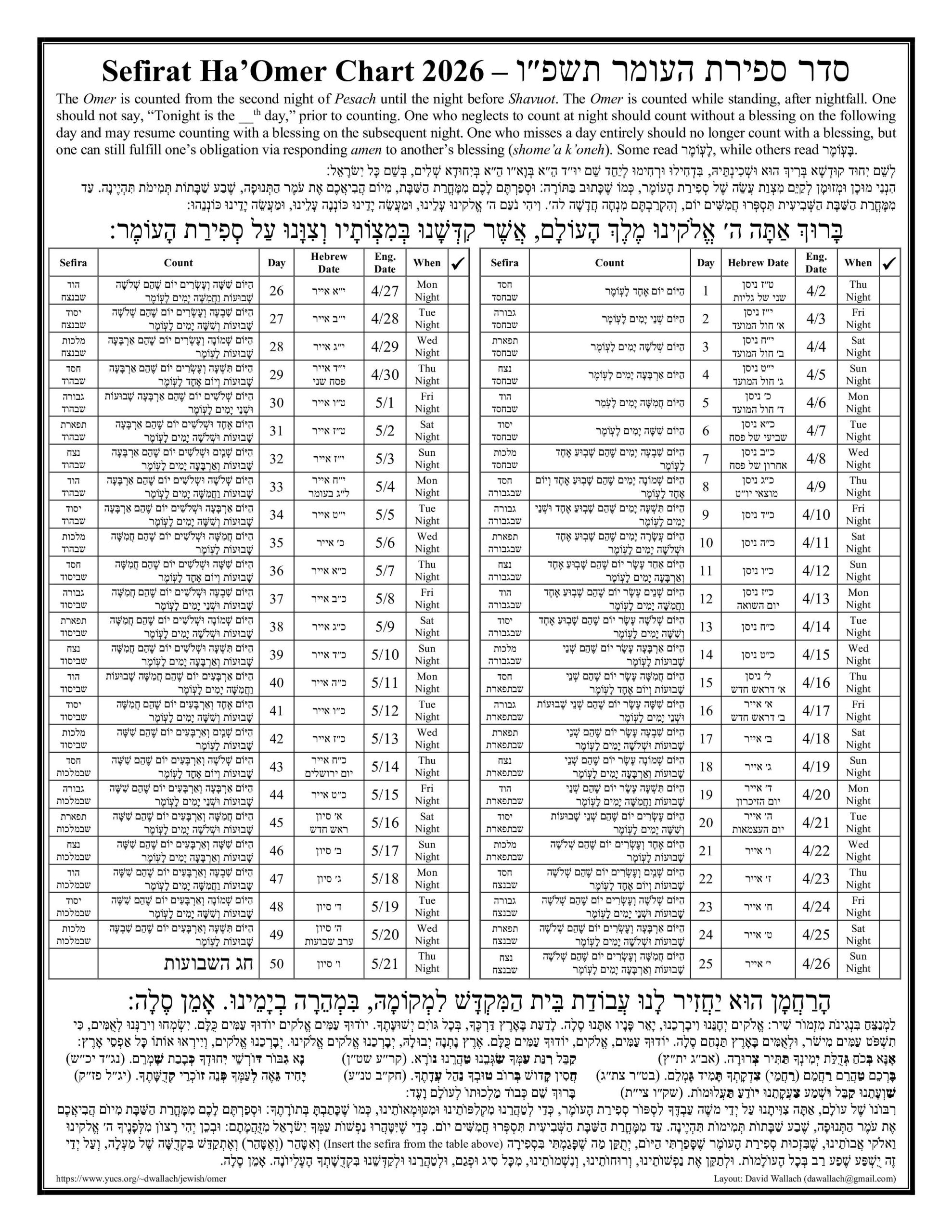 Sefirat HaOmer Chart 2026
Count Today’s Omerhttps://www.chabad.org/holidays/sefirah/omer-count.htm
|
|
 Rabbi Lazer Brody and Moses
Jabotinsky’s Pesaach lessons: For this hard-to-be-a-Jew yearJabotinsky anticipated the recurring need to answer, to defend, to explain – and sometimes simply to endure. Read and gain strength.Ronn Torossian / Published: 6April2026, 8:48 AM (GMT+3) https://www.israelnationalnews.com/news/425099  100 Israeli old Shekel coin – Zeev Jabotinsky- צילום iStock
In 1911, on the eve of a century that would test the Jewish people in ways even he could scarcely have imagined, Ze’ev Jabotinsky – the Revisionist Zionist leader – turned to the Passover seder not as ritual alone, but as a living framework for understanding Jewish character, continuity, and responsibility.
In his essay “Four Sons,” Jabotinsky did not merely reinterpret a familiar passage; he recast it as a reflection on how different individuals adapt – psychologically, emotionally, and morally – to the same shared history. A study in how Jews respond differently to pressure, belonging, and identity across generations. Jabotinsky’s story is said to be adapted to the psychology of four typical children across generations of Jewish life. Each son reflects not just a personality, but a posture toward belonging, memory, and obligation.
Jabotinsky wrote: “The first [son] is clever, the second is impudent, the third a simpleton, and the fourth ‘such that he doesn’t even know how to ask.’ And each must be answered in order, according to his tastes and measure of understanding.”
The Clever: [The Wise son]“The clever boy wrinkles his high forehead, gazes searchingly with his big eyes and wants to know what really the matter was. Why did they first love his forefathers in Egypt, welcome them with open arms, and then begin persecuting and tormenting them, and, so queerly they kept on persecuting and tormenting them and throwing the baby boys into the rivers, but wouldn’t for anything let them go. What was the explanation, Daddy?’ – asks the clever boy.”
Here Jabotinsky recognizes the intellectual instinct that has so often defined Jewish survival: the refusal to accept narrative without interrogation. The clever child is not satisfied with miracle; he demands coherence in history, even when history itself resists coherence. His response is adaptation through inquiry – a need to make sense of contradiction, to reconcile acceptance and rejection, emancipation and persecution. His question echoes forward into modernity, into politics, into every effort to understand a world that has always treated Jews differently.
The Impudent: [The Wicked son]The second boy is ‘impudent’ – there he sits -back in his chair, crossing his feet and grinning ironically – and asks – what are all these funny customs and memories which should have been forgotten long ago!
“‘Blunt his teeth’ says the ritual of the Passover concerning this son. But I doubt if his teeth can be blunted … for nothing is more unvanquishable than indifference. Nothing can touch him, once he says of his own people, ‘you,’ you can give him up … He will go on grinning at you with all his teeth, and nothing that you can do will blunt them.
And, indeed, you should not blunt the teeth of this son. Let him go on his way with strong teeth. Poor fellow, he will need them in the encampment of the triumphant whither he is drawn. He will have to crack hard nuts there, and the hardest will be the nut of contempt. Often and often will he have to take kicks in answer to loving speeches, be spat upon in answer to his flattery …”
The impudent son represents another form of adaptation: detachment. Jabotinsky’s insight cuts deeper than moral judgment – he identifies indifference, as a great danger. The rupture is linguistic as much as emotional: the shift from “we” to “you.” And yet, even here, Jabotinsky resists easy condemnation. He understands that this, too, is a response to pressure – an attempt to assimilate, to escape, to redefine oneself outside the collective. But the world this son runs toward, he warns, will not embrace him as fully as he imagines.
The Simpleton: [The Simple son]The third boy is the simpleton. His eyes are honest, clear and direct. For him the world is simple and indisputable. He loves to believe and worship with the simple faith of the primitive man … an artless, single-minded trustfulness.
“‘Daddy,’ he says, and planting his elbows and pressing his chest on the table, he stretches out his neck and turns to you … believing already everything you will tell him, for he wants to believe, ‘Daddy, when will a better time come?’
“Then tell him gently and simply about everything that is happening now in the great illimitable Diaspora. Tell him how in a thousand different places, the newly scattered temple of the undying people is being raised by a thousand hands. Tell him how gradually the hitherto scattered national will is being unified before our eyes, how again a real people is being created … like all healthy nations … Tell him how everywhere, with every day the pride and respect for our own individuality grows. … Tell him what wonderful poets are now writing in our tongue, and how beautiful … this tongue is. … And tell him further how gaily the colonist’s children are chattering in this language in Palestine. And how … by great labour … through a thousand obstacles … something new is rising and growing there.”
If the clever son adapts through questioning, the simple son adapts through trust. He does not demand explanation; he seeks reassurance. Jabotinsky answers with vision – of renewal, language, land, and collective will. This is a different kind of strength: the ability to believe in a future that must be built deliberately, against odds that are neither hidden nor denied.
The One Who Doesn’t Know How to Ask:“The fourth boy does not know how to ask. He sits at the table sedately, does everything properly and it does not even enter his head to ask what it is all about and why. According to the ritual, you should not wait for his questions but tell him of your own accord. I disagree. … [T]here is sometimes a higher wisdom … in that a man takes something from the past without question, without curiosity as to causes or effects. … According to the ritual, you should tell this son about everything that he does not ask. But I think, let the father too be silent and … kiss this son on his brow, the surest keeper of the sacrament.”
Here Jabotinsky offers the concept that preservation and instinct are also part and parcel of who we are. Simply carrying forward what was received. This Passover, these categories are no longer confined to the Haggadah; they are visible all around us – in bomb shelters and schools, in grocery stores and on campuses, in headlines and in the arguments within and beyond the Jewish world.
We are not just telling the story; we are living inside its questions.
It is a very hard year to be a Jew.
In Israel, our sons and daughters are spread out, fighting from Lebanon to Gaza, carrying the burden of defending our great Jewish state. Across the diaspora – from New York City to Australia, from Toronto to Paris – Jewish communities face a climate that feels increasingly precarious and uncertain.
Jabotinsky anticipated this recurring need to answer, to defend, to explain – and sometimes simply to endure.
As Jabotinsky wrote in another essay, “What Are We to Do?”:
“[O]ne permanent assignment that is entrusted to each of us, old and young, men and women, educated and ignorant, as a group and as individuals … is the defence of our people’s honor.”
The seder ends, as it always does, with a forward glance – not only toward redemption, but toward responsibility. The questions of the four sons do not disappear when the evening is over; they follow us outward, into a world that continues to demand response in different voices, with different kinds of courage.
This year, all year, even more than ever, we must embrace our tradition, our sons and daughters, our customs and beliefs.
Chag Pesach Sameach. Am Israel Chai.
Ronn Torossian is an Israeli-American entrepreneur, author and communal leader.
The Passover Story: Why Tell It?Lazer Brody
|
|

Days of MashiachThe Days of Mashiach consist of literally what has been happening in the State of Israel for 76 years, and literally what is happening in the State of Israel today.Rabbi Shmuel Eliahu / 6April2026, 6:35 PM (GMT+3) https://www.israelnationalnews.com/news/425132
HaRav Shmuel Eliahu is Chief Rabbi of Tzfat.
During the celebration of Pesach we are bidden to contemplate on our Redemption from Egypt and on our future Redemption, may it reach completion in our time soon. While the recital of the Haggadah gives us a general overview, there are understandings which benefit from further clarification.
Ingathering of Exiles and Removal of Foreign Rule
From the Gemara it appears that the Days of Mashiach consist of the ingathering of the exiles and the removal of foreign rule over us (literally what has been happening in the State of Israel for 76 years, and literally what is happening in the State of Israel today).
“It was taught: Ben Zoma said to the Sages: Shall the Exodus from Egypt be mentioned in the Days of Mashiach? Behold it is already stated: ‘Behold, days are coming, says the Lord, when they shall no longer say: As the Lord lives who brought the children of Israel up from the land of Egypt, but rather: As the Lord lives who brought up the seed of the house of Israel from the land of the north and from all the lands where I had driven them!’ They said to him: Not that the Exodus from Egypt will be uprooted from its place, but that the subjugation to the kingdoms will be primary, and the Exodus from Egypt secondary to it” (Berachot 12A).
According to this, in our days we must relate on every Seder Night both the story of our Redemption from the kingdoms and also the miracles of today.
Rabbi Elazar ben Azariah rejoices because he understands that the Redemption will be very great.
According to the opinion of the Sages, in the Days of Mashiach they will also mention the Exodus from Egypt, but it will be secondary to the story of the freedom from the subjugation of the kingdoms. And according to the opinion of Ben Zoma and Rabbi Elazar ben Azariah, they will mention only the miracles that exist in current times.
To illustrate the dispute, we may say that according to the opinion of the Sages, the departure of the Jews in our generation from 102 countries to reach Israel is ten times the Exodus from Egypt; therefore they mention the Exodus from Egypt as secondary to the Redemption of our times.
According to the opinion of Rabbi Elazar ben Azariah and Ben Zoma, they will not mention the Exodus from Egypt at all in the generation of the ingathering of exiles. It will apparently be a hundred or a thousand times greater than the Exodus from Egypt, and therefore it is not mentioned at all.
Accordingly,Rabbi Elazar ben Azariah is profoundly happy when he understands that, according to Halakha, the future greatness of the Redemption will be so great in relation to the Exodus from Egypt – “higher than all blessings, songs, praises, and consolations that are spoken in the world.” This is indeed very joyful.
Corresponding to Four Sons
In the Haggadah we read about the Four Sons. The Torah mentions four times the obligation to tell the sons the story of the Exodus from Egypt. Each time the Torah speaks in a different style, and it is evident that it is speaking about four different types of sons.
In the book of Devarim it is written:
“When your son asks you tomorrow, saying: What are the testimonies and the statutes and the judgments that the Lord our God has commanded you? Then you shall say to your son: We were slaves to Pharaoh in Egypt, and the Lord brought us out of Egypt with a strong hand. And the Lord gave signs and great and terrible wonders in Egypt, upon Pharaoh and upon all his house, before our eyes. And He brought us out from there in order to bring us, to give us the Land that He swore to our fathers, etc.”
From the question and its style it appears that the wise son is in the Land of Israel.
In the book of Shemot, the Torah commands us to answer the son who asks in a defiant manner: “And it shall be when your children say to you: What is this service to you? Then you shall say: It is the Passover sacrifice to the Lord, who passed over the houses of the Children of Israel in Egypt when He struck Egypt and saved our houses. And the people bowed and prostrated themselves.”
The style of the question is like that of a wicked son. He sees the Passover as “your” service and not his own festival, and the answer to him is in a different style. This question is said when they are in Egypt and speaking about the Land of Israel.
The account of the simple son and the son who does not know how to ask is stated on the day of the Exodus from Egypt, after they have already departed.
Regarding the simple son it is written: “And it shall be when the Lord brings you into the Land of the Canaanite, as He swore to you and to your fathers, and gives it to you… And it shall be when your son asks you tomorrow, saying: What is this? And you shall say to him: With a strong hand the Lord brought us out of Egypt, from the house of bondage…”
Also: “And it shall be when the Lord brings you into the Land of the Canaanite, and the Hittite, and the Amorite, and the Hivite, and the Jebusite, which He swore to your fathers to give you, a Land flowing with milk and honey, and you shall perform this service in this month… And you shall tell your son on that day, saying: Because of this the Lord did for me when I went out of Egypt.”
Even though he does not ask, you initiate and explain to him.
In the Land of Israel There Are No Wicked People
How are we to understand this statement when the reality seems otherwise. The meaning is that the Torah assumes that the possibility of having wicked sons exists only when the Jews are in the difficult exile of Egypt; but when they have already gone out, their level rises, and when they enter the threshold of Eretz Yisrael they share in the blessing of wisdom which hovers over the Land.
This explains what Rabbi Avraham Azulai, of blessed memory, one of the students of the Ari, wrote in his praises of Eretz Yisrael. He states that in the Land of Israel there are no wicked people:
“Know that anyone who dwells in the Land of Israel is called righteous, even if they are not righteous as it appears; for if he were not righteous, the Land would vomit him out, as it is written: ‘And the Land vomited out its inhabitants.’ And since it does not vomit him out, he is certainly called righteous, even though he appears to have the status of a wicked person” (Chesed LeAvraham, Maayan 3, Nahar 12).
As we saw above, the Torah teaches that Hashem brought us up from Egypt to give us the Land of Israel – specifically the Land of Israel. Among the many reasons for this is that the air of the Holy Land grants wisdom and a clearer knowledge of the workings of Hashem. Similar to the belief in Hashem and a person’s love and reverence for Him, which all contain many levels, wisdom also levels upon levels.
HaRav Tzvi Yehuda HaKohen Kook, of blessed memory, told his students at the Mercaz HaRav Yeshiva in Jerusalem that a basic foundation of wisdom today is that the Jewish People realize that all Jews belong in the Land of Israel. May it come to pass soon.
|
|
Moshiach’s Meal-Seuda Moshiach – סעודת משיח
Moshiach’s Meal: What, Why and Howhttps://www.chabad.org/holidays/passover/pesach_cdo/aid/3965990/jewish/Moshiachs-Meal-What-Why-and-How.htm  Moshiach’s Meal Art by Rivka Korf Studio https://www.rivkakorf.com/
What Is the Moshiach’s Meal?Following a tradition instituted by the Baal Shem Tov, Jews all over the world celebrate the waning hours of Passover with Moshiach’s Meal (Moshiach’s Seudah in Yiddish), a feast celebrating the Divine revelation yet to come.
Why Do We Celebrate This Meal?On the last day of Passover, we read verses from the book of Isaiah as the haftorah.1 This reading includes many wondrous prophecies about the era of Moshiach.
The prophecy foretells of a leader upon whom “the spirit of the L‑rd shall rest, a spirit of wisdom and understanding, a spirit of counsel and heroism, a spirit of knowledge and fear of the L‑rd.”
In addition to bringing peace to mankind (“he will judge the poor justly, and he shall chastise with equity the humble of the earth”), the new peace and G‑dly understanding will extend to all of G‑d’s creatures: “And a wolf shall live with a lamb, and a leopard shall lie with a kid . . . and a small child shall lead them.”
The Baal Shem Tov, the founder of the chassidic movement, was the first one to celebrate this meal, with an open door, allowing anyone who wished to partake.
The sixth Lubavitcher Rebbe explained that on the last day of Passover the radiance of Moshiach is already shining.
When Is the Moshiach’s MealMoshiach’s Meal is held following Minchah (the afternoon service) on the eighth day of Passover. In Israel, where Passover is seven days long, Moshiach’s Meal is held on the seventh day.
The celebration customarily extends past nightfall, ushering out Passover amid song, words of Torah and inspiration.
How Is the Moshiach’s Meal Celebrated?In 1906 Rabbi Shalom Dov Ber of Lubavitch incorporated four cups of wine and matzah into Moshiach’s Meal, mirroring the Seder held the week before. You can also serve fruit and other Passover goodies.
If you will be celebrating with a group you can have people prepare stories or Torah thoughts related to Moshiach. The actual program is flexible, but you want to pace your four cups throughout the singing and speaking. Customarily, the leader of the group announces which cup you are up to. Note that you do not need to drink these cups in their entirety. A sip suffices.
|
|
Shevi’i shel Pesach: Meal of the Baal Shem TovThis story is traditionally told over on the last day of Pesach, at the “Meal of the Baal Shem Tov,” which is eaten just before sunset. We eat this meal to commemorate the Baal Shem Tov’s miraculous deliverance from the cannibals and his return to Istanbul.Breslev Israel staff / Posted on 07April2026 https://breslev.com/1079753/
 Meal of the Baal Shem Tov
After many years of wanting to go to Eretz Yisrael, the holy Baal Shem Tov finally decided to make the long journey. He hired a wagon and set out from Medzeboz, Ukraine together with his righteous daughter Udell and his student and attendant Reb Hirsch Sofer. They planned to travel to Istanbul by wagon and from there, to travel by ship to the Holy Land.
After several months on the road, the Baal Shem Tov, his daughter Udell, and Reb Hirsch Sofer arrived in Istanbul on the eve of Passover. The holy Baal Shem Tov took almost no money with him, because he had absolute faith that God would provide for all his needs on the journey. He had just enough money to rent the cheapest room in a local inn, but did not have any left over to buy the necessary items to celebrate the Seder that evening. He decided to go to the local study hall, learn Torah, and wait for God to provide him with all his needs.
Udell and Reb Hirsch were also not the least bit concerned, because miracles often occurred to the holy Baal Shem. They expected that God would certainly not abandon him now. Since Udell expected God to provide for their needs, she decided to go to the seashore to launder her father’s clothing for the upcoming holiday.
A very wealthy couple lived in Germany. The doctors had told them that they could never have children. They heard about the Baal Shem Tov and decided to travel to Medzeboz — perhaps he would be able to perform a miracle whereby God would give them a child. When they arrived in Medzeboz, however, they discovered that the Baal Shem Tov had already left for the Holy Land. They decided to follow his trail and try to catch up with him. They also arrived in Istanbul on Passover eve. They registered at an inn and asked many people in Istanbul if they had seen the holy Baal Shem Tov, but no one had seen him.
They decided to go to the docks and ask the sailors if the Baal Shem Tov had boarded one of the ships traveling to Eretz Yisrael. On their way to the docks, they saw a woman doing her laundry and they asked her if she had seen the Baal Shem Tov. That woman was the Baal Shem Tov’s daughter, Udell.
Udell told them that she was the Baal Shem Tov’s daughter and that her holy father was staying at the same inn where they were lodging. When the couple heard that, their joy knew no bounds. They invited Udell, her father, and Reb Hirsch to join them for the Seders.
When the Baal Shem Tov returned from the synagogue after the evening holiday prayers, he was not the least surprised and joined the wealthy couple at their Seder. At the beginning of the Seder, the Baal Shem Tov turned to the couple and said to them, “I know why you have come and your salvation will soon be on its way.” No sooner had he spoken, when his face suddenly changed, and a tortured pained expression replaced his pleasant countenance as he went into a trance.
His daughter, Udell, was concerned. Although she had seen his soul ascend to heaven on many occasions, she had never seen her father’s face so lifeless before. Some time later, however, the Baal Shem Tov returned to normal, and beaming with joy he said. “Heaven was angry for me for violating the laws of nature to make a miracle that would grant children to this couple, they therefore decreed that I should lose my share in the world to come for this act. I answered that now I could serve God for pure motives without expecting any reward and I rejoiced. The Satan saw that I became even happier when they took away my reward in the hereafter, and he then convinced the heavenly court to return my share in the future world.
After the meal, when the Baal Shem Tov came to the words of the Hallel, “Le’otot niflaot — For He performs wonders,” his voice rang out loud and clear, as he articulated the words with utter devotion over and over again. The sound of his words carried out far into the stillness of the night. The rest of the Seder passed and it was early morning by the time they finished. Until now, the merchant had refrained from making any comments or asking questions for fear of disturbing his Godly visitor.
But now that the Seder was over, he ventured several comments. “Rabbi, if I may ask…why did you repeat that particular verse of the Hallel?”
“The Jews of Istanbul were in grave danger,” disclosed the Baal Shem Tov. “While I was reciting that verse, my soul ascended to heaven and I interceded on their behalf. I continued with the Hallel when I was informed that the decree had been nullified. You will learn all about it tomorrow morning in shul.”
On the following morning, as the congregation assembled for their holiday prayers, one prominent member of their community suddenly rushed in: “Mazel tov, my good friends. Congratulate yourselves on having escaped imminent danger.”
Everyone crowded around to hear the details of his surprising announcement. “As you may well know,” he began, “our late Sultan was in the habit of dressing in common clothing to walk incognito among his people, as did his father, the previous Sultan. This particular stroll took him far out of the city limits and before he realized what had happened, he was surrounded by a group of roving bandits.
“They seized him and brought to their hideout. It occurred to the Sultan that these thieves did not know his identity.
“After his pockets had been emptied of the all his valuables, the Sultan was confident that he would be released. But the thieves informed him that they must kill him since he knew the location of their hideout. The Sultan contemplated his chances of survival. ‘If I reveal my identity, they will surely kill me, for they would realize that capital punishment would await them if anyone knew whom they had captured and robbed. Let me use my wits to see if I can save myself.’
‘I am trained with a particular skill which may bring you much profit,” the Sultan told his captors. They gathered around the Sultan in interest: “I know how to fashion valuable tapestries. My products will fetch high prices for you on the market. Try and see.”
“The robbers were interested in making a profit and willing to give his plan a fair try. They purchased simple mats from which the Sultan fashioned his tapestry. After two days, the first product was ready for the market. The finished product did not over impress the bandits, but the Sultan hastened to warn, “This tapestry can only be appreciated by a true connoisseur of art. Do not be daunted if at first people laugh at the price you ask. But by no means are you to settle for less than what I tell you. Go from shop to shop until you find the proper customer, a person who can appreciate this fine work of art.”
“It happened just as the captive has foretold. The bandits were greeted by jeers and hoots when they demanded an outlandish price for their merchandise. The scene was repeated at every store they entered.
“By now a large crowd of people had gathered to see the outcome of the farce. ‘Who would be mad enough,’ they wondered, ‘to pay the price these men were asking for what appeared to be a simple mat?’ Just then my father happened to walk by. He learned from the people around him the cause of the gathering and was shown the merchandise. He realized that there was something deeper here than what met the eye, and asked to examine the tapestry. A quick look showed him that there was nothing especially artistic about the piece before him except for one letter intricately woven and hidden in the cloth.
“‘I’ll take it at your price,’ my father promptly told them. He then inquired as to the craftsman who had fashioned it. The men were reluctant to give him any information. ‘If you like this work, we can bring you more,’ they promised but that was all they would say.
“The bandits returned to their hideout with good news for the imprisoned Sultan. Not only had his cloth been purchased at his price, but the customer wished to order more rugs. The Sultan was certain that some clever person bad caught on to his ruse and set about his work cheerfully, ingeniously weaving in the second initial into the center of the cloth.
“‘When this cloth was brought to my father the next day, he knew that he had been right in assuming that it contained a clue. After paying the price, he hurried to the Sultan’s palace with his tale. The palace broke into pandemonium. No one knew what had happened to the Sultan. Searches were being organized but no trace or clue had yet been found.
“When my father presented his story and evidence to the Sultan’s advisers, all agreed it was indeed the Sultan who was trying to send a message as to his whereabouts. My father was told to hold his tongue and to continue purchasing the tapestries.
“Day after day, letter by letter, the sultan spelled out directions to his location. Soon, a battalion of soldiers was dispatched to the robber’s hideout where they succeeded in freeing the Sultan.
“The Sultan did not forget my father, his benefactor, and summoned him to the Palace. ‘How can I thank you enough?’ he said. ‘Name a reward and you will have it.’
“My father refused to hear of a reward. ‘Is it not reward enough that I have had the privilege to save the life of my king? It is a privilege which is reward in itself.’ This was not enough for the Sultan, however. He made out a proclamation stating that my father and his children would forever have the privilege of free access to the Sultan’s palace and the attention of the Sultan himself for any need they may have.
“This all happened to my father many, many years ago. He never had any reason use his privilege. My father passed away as did the late Sultan. Until this day, I found no cause all these years to seek access to the Sultan’s.
“This year, our Sultan happened to be walking through the market place with his Chief Counselor, who is well know as one who vehemently hates Jews, when he noticed a flurry of activity. Cartloads of strange bread were being transported from place to place. The Sultan had never seen anything like it. ‘What are these cakes?’ he asked his Chief Counselor.
“‘’These are called matzot. They are eaten by the Jews throughout the holiday they call Passover. Some Jews pride themselves in eating only “shmura” (watched) matzos made from the blood of a Muslim child which they slaughter for that purpose,’ the Chief Counselor replied.
“The Sultan was stunned! ‘Don’t take my word for it, Your Majesty,’ the counselor said, ‘make your own inquiries. You will hear the same story.’
“The Sultan did ask around and learned that there were, in fact, many Jews who only ate the special loaves known as shmura matzah which were baked under the most careful supervision and inferred that his counselor’s comments were true. He was horrified and instituted a special inquiry to determine which Jews ate only shmura matzah. He intended to have his guards arrest the culprits while they sat at their Seder, and then have them executed.
“Last night, on the eve of our holiday, I had a dream. My father appeared to warn me of the impending danger. He instructed me to go straight to the Sultan, by virtue of my special privilege of free entry and tell him the truth. I was to expose the Sultan’s Chief Counselor for what he was — not a devout Moslem as the Sultan thought, but a practicing Greek Orthodox Christian. ‘Tell the Sultan to send his soldiers to the counselor’s home in the middle of the night,’ my father instructed, ‘and they will find him in bed with a cross on his chest.’
“I awoke towards evening, deciding that the dream had been simply a dream, and I went about with my preparations for the evening Seder. But suddenly I became very tired and had to lie down. I promptly fell into a deep sleep. My father appeared again, warning me to heed his advice for only I could save the community.
“When I awoke the second time I realized that it was not a meaningless dream and that immediate action had to be taken. It was already late at night when I arrived at the Sultan’s palace. Despite my right to enter the palace when I wished, I did not want to cause a commotion and wake the Sultan. I begged the palace guards to take me to the “Old Queen” – the Sultan’s mother.
“The Queen happened to be awake. She listened patiently to my story. I hastened to remind her that in all these years neither my father not I had used our privilege. If I was asking her to intercede for the Jews on my behalf, it was because the matter was one of life or death.
“The Queen asked me to wait while she spoke to her son. She did not plan to present the Jew’s cause for she had heard nothing of the impending decree and thought it might not be true. Instead, she decided to tell her son that her husband, the late Sultan, had appeared to her in a dream, instructing her to warn her son against issuing any evil decrees.
“At first the young Sultan denied any impending evil decrees. When his mother mentioned the Jews, he confessed. ‘Yes, Mother, but my law concerning the Jews is a beneficial one for it concerns those Jews who use Moslem blood in their matzah baking. I have ordered this cult to be destroyed for the public benefit.’
“Seeing that I had spoken the truth, the Queen now told the entire story to her son who asked that the wine merchant be brought before him. I ran forward, throwing myself at his feet, my story pouring out in tearful pleas. I begged the Sultan to follow my father’s suggestion of surprising the Chief Counselor in his home to prove that he was unfaithful to the Moslem faith. The Sultan followed my suggestion and all proved as I had predicted. In their fury, the soldiers executed the Chief Counselor on the spot.
“The Sultan immediately cancelled the decree that would have killed us all.”
“All this happened just as I was reciting the Hallel, did it not?” the Baal Shem Tov asked the merchant.
The statement was confirmed, for indeed the Baal Shem Tov had been aware of the miracle at the very minute that it happened which coincided with his recital of ‘Le’ose niflaot gedolot!’”
After the first two days of the holiday, the wealthy couple showed their gratitude by purchasing the Baal Shem Tov’s passage on a ship bound for the holy land. At sea, a massive storm broke out and threatened to sink the ship. The Baal Shem Tov divined that to calm the storm he could either throw his Torah writings or his daughter overboard, into the raging sea.
The Baal Shem Tov’s daughter, Udell, knew the value of her father’s Torah writings and decided to jump overboard. Just before she was about to jump, Divine inspiration came upon her and she changed her mind. She turned to the other passengers and said, “It is better that you should take my father’s writings and throw them overboard, because I am destined to have a grandson who will produce some of the most beautiful teachings and writings of all. His writings will save thousands of Jewish souls who have fallen to the depths of impurity and will help them return to their Father in Heaven.”
This grandson is none other than Rebbe Nachman of Breslev!
The sailors threw the Baal Shem Tov’s writings into the sea and the storm abated.
The passengers were exhausted from their ordeal. The ship weighed anchor near a small island to allow the passengers to rest and regain their strength. The Baal Shem Tov, Reb Hirsch and Udell took a walk on the island. They were abducted by a group of cannibals, who were planning to have them for their dinner.
The cannibals started sharpening their knives in preparation for slaughtering the Baal Shem Tov, Reb Hirsch and Udell. Reb Hirsch turned to the Baal Shem Tov. In desperation he yelled, “Do something! Save us from these animals!”
But the Baal Shem Tov couldn’t say a word.
Reb Hirsch screamed in panic, “Why do you remain silent?!”
The Baal Shem Tov answered, “I forgot everything. I can’t even remember the alef beit (the Hebrew alphabet). Maybe you can remember something?”
Reb Hirsch responded, “I also forgot everything! I can only remember the alef beit!”
“Then why are you silent? Say the alef beit!” the Baal Shem Tov ordered.
The Baal Shem Tov repeated each letter after Reb Hirsch. In the middle of their recital, the Baal Shem Tov’s knowledge and powers suddenly returned to him and he said that they would be saved shortly. Suddenly a loud whistle blew in the distance and the cannibals took fright and ran away. Another ship had just arrived on its way to Istanbul. The ship’s crew untied and freed the Baal Shem Tov and his party and brought them back to Istanbul.
They arrived safely in Istanbul on the last day of Pesach. The Baal Shem Tov said, “Now I know for certain that Heaven doesn’t want me to go to Eretz Yisrael.” Immediately after Pesach the Baal Shem Tov and his party returned to Medzeboz.
***
|
|

Pre Seder ChecklistCleaning for Pesach פסח (Passover). Remove all the Chametz and Don’t forget the KitchenShop for Pesach פסח (Passover) You know exactly what you can buy in every Store. and in many store everything is without Kitniyot. – Leavened foods concealed behind plastic at Jerusalem supermarket during Passover
The White plastic film covering the shelves of Chametz is what our local store dose, but a lot of stores remove all Chametz completely weeks before Pesach.
All the Dairy is Kosher for Pesach at least a week before Pesach.
I personal like Rami Levi Mehadrin in Givat Shaul, Jerusalem. The products have no Kitniyot.
 Pesach Supermarket Shopping
13 Nissan Did you remember to sell your chametz? Your local Chabad rabbi can help, or complete an online “Authorization for the Sale of Chametz” form by clicking here.Search for the chametz after dark (click here for the exact time). Recite the blessing prior to the search, and the nullification of the chametz (Kol Chamira) following the search. Click here for more information on the search and removal of chametz.
14 Nissan The day before Passover Bedikat Chametz: Checking for Chametz the Night before The day before Pesach פסח (Passover)
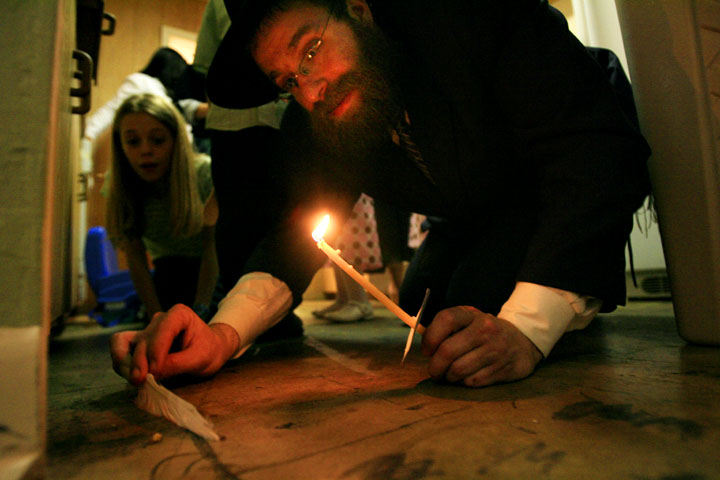 Rabbi Chaim Lazaroff, searches for leavened bread, also called chametz, at Chabad of Uptown April 17, 2008 in Houston. The candle is used to search for the chametz, while a feather is used to sweep it in to a wooden spoon. All three items are burned along with the chametz. The burning of leavened bread represents the eradication of the ego and all of the negative energies associated with the ego according to Jewish religious scripture. Pesach, or Passover, celebrates freedom. Egypt represents the limitation of ourselves. The observance of Passover is an exercise in being better today than we were yesterday and unleashing personal boundaries to drive ourselves to perfection.
Finish eating ChametzBurning and Nullifying the Chametz the day before Pesach פסח (Passover)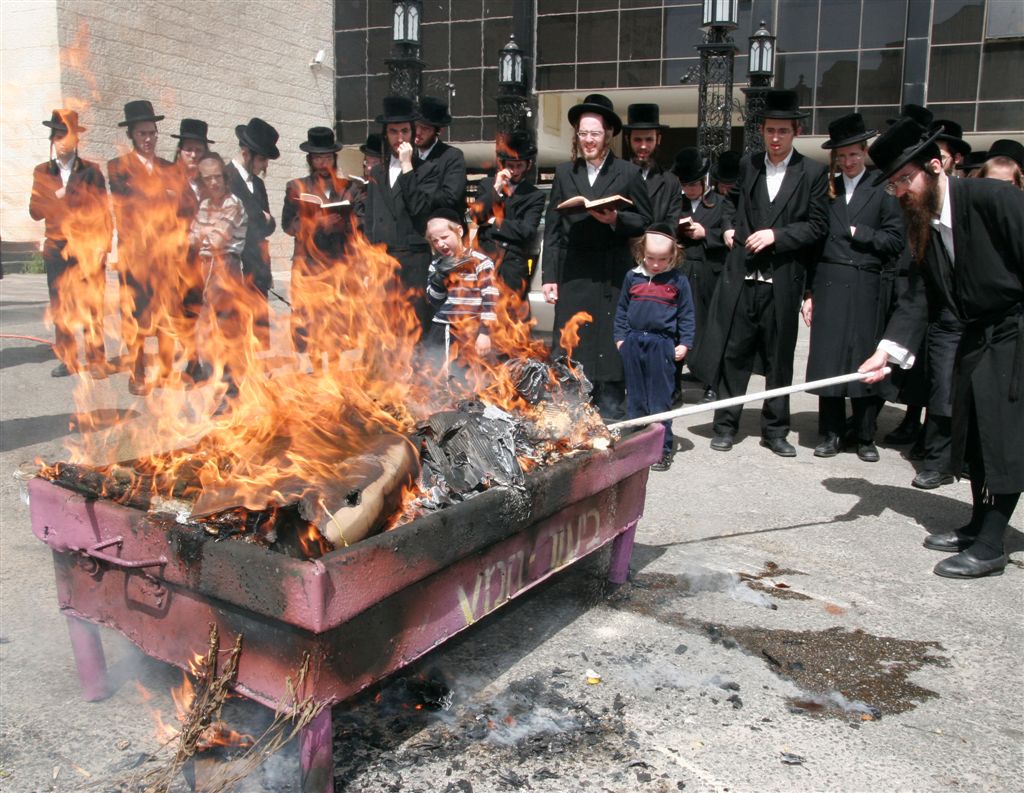 Burning-Chametz
Start Cooking for Pesach פסח (Passover)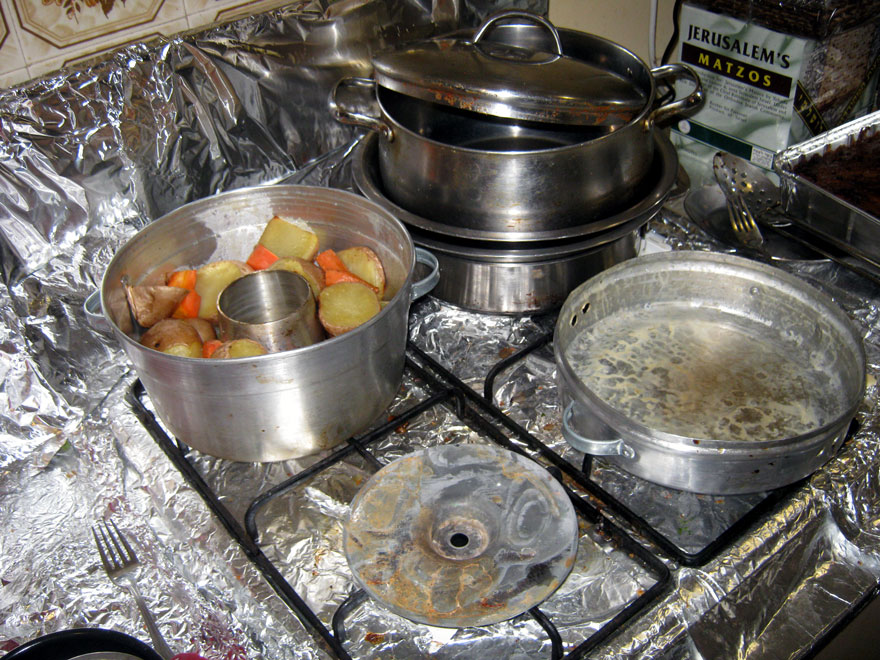 Wonder Pot-סיר פלא-potato-תפוחי אדמה
An Israeli Pesach Seder סדר פסח (Passover Seder)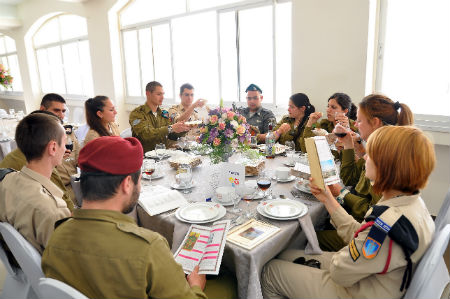 IDF Passover Seder IDF Passover Seder
|
|
Animal Sacrifice: It’s Not What You ThinkIs animal sacrifice cruel—or misunderstood? Explore how the Torah reframes ethics, compassion, and what it truly means to rise above instinct.David Ben Horin | Posted on 23April2026 | https://breslev.com/5222632/
 Animal Sacrifice It’s Not What You Think by David Ben Horin Why does Animal Sacrifice Seem Primitive Today?Animal sacrifice sounds like going backward. But what if the part of the Torah that seems most primitive… is actually the most refined?
At its core, animal sacrifice in Judaism is not about destruction—it is a structured system designed to bring a person closer to God.
In recent years, concern for animal welfare has grown dramatically. Studies from organizations like the Pew Research Center show a steady rise in the number of people who believe animals should be treated with near-equal moral consideration. That instinct comes from compassion—but without deeper context, it can also lead to conclusions that miss the Torah’s deeper design. What Is the Torah View of Life: Jungle or Moral Refinement?We like to say, “Welcome to the jungle.”
You don’t have to look far to see this mindset in action. In business, in careers, even in subtle social dynamics—people who would never describe themselves as aggressive often find themselves thinking in terms of survival, competition, and edge.
It’s how we explain the world when it feels harsh—competitive, ruthless, survival of the fittest. People clawing their way forward, stepping over each other just to get ahead. If that’s true, then life is just a polished version of animal behavior.
But the Torah quietly disagrees.
Long before modern debates about ethics, the Torah established a framework that limits harm, avoids predatory behavior, and embeds purpose into every action. It’s not primitive—it’s structured, intentional, and ahead of its time.
Why Do Some See Korbanot As Cruel?A friend once told me, “If the Temple is rebuilt, I hope they don’t bring back animal sacrifices. It feels cruel. We’ve evolved past that.”
That perspective echoes modern ethical voices like Peter Singer, who argue that minimizing animal suffering is a central measure of moral progress. It’s a serious argument, but it assumes that every system involving animals is inherently cruel, which is exactly where the Torah takes a different approach.
If you look closely, korbanot are not about descending into animal behavior. They are about rising above it. In fact, the word korban itself comes from karov, meaning closeness—revealing that the goal is not sacrifice, but connection.
The “jungle mindset” says: take, dominate, survive.
The Torah says: refine, elevate, serve.
The korbanot teach this through three quiet, powerful principles:
What are Lessons from Korbanot: Success, Ego, BehaviorWe live in a world that tells us:
I’ve caught myself in those moments—thinking in terms of winning, proving, pushing ahead. And every time, I realize afterward: that wasn’t clarity. That was instinct dressed up as strategy.
The Torah whispers something else:
If success requires stepping on others… is it really success? Or is it just a more sophisticated version of the jungle? What Is The Message Of Korbanot For Modern Life?The korbanot were never just about animals. They were about us. About taking our instincts—ego, anger, competition—and placing them on the altar. Not to destroy them. But to elevate them. To turn raw drive into something holy.
We don’t spill blood to prove dominance. We pour it on the altar to serve something higher.
And maybe that’s the deepest kindness of all. Not just how we treat animals. But how we refuse to become like them.
Key Takeaways:
This week, notice one moment where you feel the “jungle instinct” kick in—competition, frustration, ego. Pause. And ask yourself:
That moment—that choice—is your korban.
*** David Ben Horin lives in Afula with his family, 60,000 passionate Israelis, and Matilda, our local camel.
|
|
 https://www.oref.org.il/eng Home Front Command alerts during Shabbat and the holidaySilent wave during Shabbat and the holidayDuring Shabbat and the holidays, you can receive Home Front Command alerts via the Silent Wave frequencieshttps://www.oref.org.il/eng/articles/haredim/rockets-missles/4401
Radio Stations operating in “Silent Wave” format, providing preliminary guidelines, alerts, and end-of-event notifications; the National Emergency Portal on your computer; and the Home Front Command app—this is how you can receive the alerts in your area on Shabbat and Holidays.
Shabbat and Holidays observant citizens can receive the alerts and guidelines through the following means: Silent Wave on Radio StationsThe following radio stations cease broadcasting on Shabbat and holidays and provide preliminary guidelines, alerts, and notifications regarding the end of an event and exiting the protected space. Starting on the first day of Passover, on every Shabbat and holiday, the “Silent Wave” will broadcast the guidance area on every preliminary guideline and end-of-event notification.:
Please note: During Operation “Roaring Lion”, you can also receive Radio Kol Chai and Kol BaRama in the Northern region:
Leave the radio device turned on to one of these frequencies to receive only instructions and alerts during Shabbat and holiday.
To find the name of the guidance area for your town – enter the site homepage and enter the name of your town into the box at the top of the page. National Emergency PortalYou can connect to the National Emergency Portal (this website) before Shabbat, approve the activation of voice alerts in the pop-up window on the homepage, then go to the “Alerts” tab and define your location. The computer must be left active during Shabbat (it is important to disable “Sleep Mode” in the computer settings so the screen remains on). If rocket or missile fire occurs in your defined area, an alert will be received via sound and an on-screen display. Home Front Command AppIf you have a smartphone—you can receive alerts on the Home Front Command app if a threat is posed to your location (location services must be enabled) as well as for 10 areas of interest of your choice. On iPhone—ensure the device is not on “Silent” mode. People with hearing disabilities can set the alert to a 10-second vibration (on Android—set this in the app’s settings page; on iPhone—set the vibration in the device’s system settings). Additionally, the alert can be received accompanied by the flashlight flickering.  Home Front Command Quiet Wave on Shabbat
|
|
|
https://www.oref.org.il/eng This is How You Prepare for Shabbat in an EmergencyUsing a few simple actions you can prepare for Shabbat in emergency situations, while following the Home Front Command guidelines and observing Shabbathttps://www.oref.org.il/eng/articles/haredim/rockets-missles/4400
The State of Israel is in the midst of a war in the south and in the north. During a war, even when there is a temporary respite, you are still in a time of emergency that does not stop on Shabbat, so people who observe Shabbat must prepare and make the necessary adjustments before Shabbat, by following a number of simple steps.
This preparation is important and essential to enable you to follow the Home Front Command guidelines in full, even during Shabbat, while keeping both life-saving guidelines and the Shabbat.
Receiving alerts during Shabbat:To guarantee that you continue to receive alerts during Shabbat, you must connect before Shabbat to the Home Front Command’s means of alert. Click here for information on receiving alerts on Shabbat and holidays.
Preparing the protected space before ShabbatAt this time, we must be prepared and have the protected space ready in case an alert is received. This is even more significant before Shabbat, to make sure the protected space can serve us as needed during Shabbat. Therefore, it is important to perform the following actions before Shabbat begins: • Make sure the light in the protected space and on the way to it is switched on, so we can safely reach the protected room and avoid tripping in the room or on the way to it. • Remove any Mukze items that may interfere with the arrival and stay in the protected space. • Make sure that before Shabbat starts you leave some useful items in the protected room: bottles of water, a radio operating on the silent wave, a siddur, toys for the children, etc.
Spending the Shabbat away from home?• Make sure you hosts have a protected space that is suitable for your needs and those of your family. • Find out what is the time available to reach shelter in the location where you will be spending the Shabbat. • Prepare the protected space in the place where you will be staying before Shabbat starts and according to guidelines.
Preparing for emergencies in ShulOn Shabbat and holidays, it is customary to go to Shul with the children and the women’s gallery is also fuller than on ordinary days. Therefore, it is important to know and remind the members of the family of the behavioral guidelines at the Shul.
Even outdoors, the Home Front Command guidelines save livesNaturally, many families go on Shabbat with the children for walks in the neighborhood, to play in the park and visit extended family and friends. Therefore, it is important to know and to remind the children of the behavioral guidelines when receiving al alert on rocket and missile fire outdoors, according to the following: • In a built-up area – enter a shelter or a stairwell in a nearby building for 10 minutes. Stay away from the entrance area. • In an open area – lie on the ground and protect your head with your hands.
A special letter from the Chief RabbisWhen the Iron Swords War erupted, the Chief Rabbis, The Rishon Lezion Rabbi Izhak Yossef Shalita (שליט”א) and the Chief Rabbi, Rabbi David Lao Shalita (שליט”א), issued a letter with specific Halacha rulings for behavior in Shabbat during a war, along with Halachot referring to the behavior in time of war on normal days. These are the main points in the letter: 1. You must follow all Home Front Command guidelines and recommendations to the letter. When the guideline is to remain at home, do not leave the home at all, even not to pray, say your prayers alone. 2. Pray only in Shuls that have protected space or are close to protected spaces. If an alert is received, go to the protected space immediately until the danger passes. People who are ill and walk slowly should pray in their homes, unless the Shul is in a shelter. 3. If you receive an alert during Amida, you must stop immediately and walk silently to the protected space, and then return and pray. If the delay was no more than five or six minutes, continue where you left off, if it was more than five or six minutes, start over from the beginning of Amida. If an alert is received in the middle of reading from the Torah, close the scroll immediately and place a cloth over it and then go to the protected space, even if the Torah is left unguarded. When you return, continue the reading where you left off. 4. In every Shul, leave a mobile phone that is switched on before Shabbat, so it can be used to call emergency services in case of need. A mobile phone can be kept in your pocket on vibration mode. 5. Those who have a licensed weapon, should carry the weapon also on Shabbat, even if you do not usually trust the Eruv. It is important to make sure that in every Shul there is at least one person who is armed. Walk with your weapon covered by your clothes. 6. Leave the radio on, tuned to the silent wave, to make sure you receive the Home Front alerts. 7. In all prayers, include the Avinu Malkenu prayer, including on Shabbat and Rosh Chodesh (omitting the “Katvenu” part and in Shabbat and Rosh Chodesh omitting Chatanu Lefanecha), when opening the Heichal, repeat 12 times “Leolam Hashem Dvarech Nitzav Bashamaim” and the Psalms 20, 100, 121, 230, 242 as well as the special prayer we issued for this time. 8. For matters relating to Tvila and Tahara, consult your local rabbis. 9. Simchas such as weddings, Briths and such like must be conducted according to the Home Front Command guidelines. ויהי רצון שלא ישמע עוד שוד ושבר בגבולנו, ושב יעקב ושקט ושאנן ואין מחריד, ובא לציון גואל במהרה בימינו אמן. Shabbat Shalom Venishmartem Meod Lenafshotechem, with G-D’s help, together, we shall win!
|
|
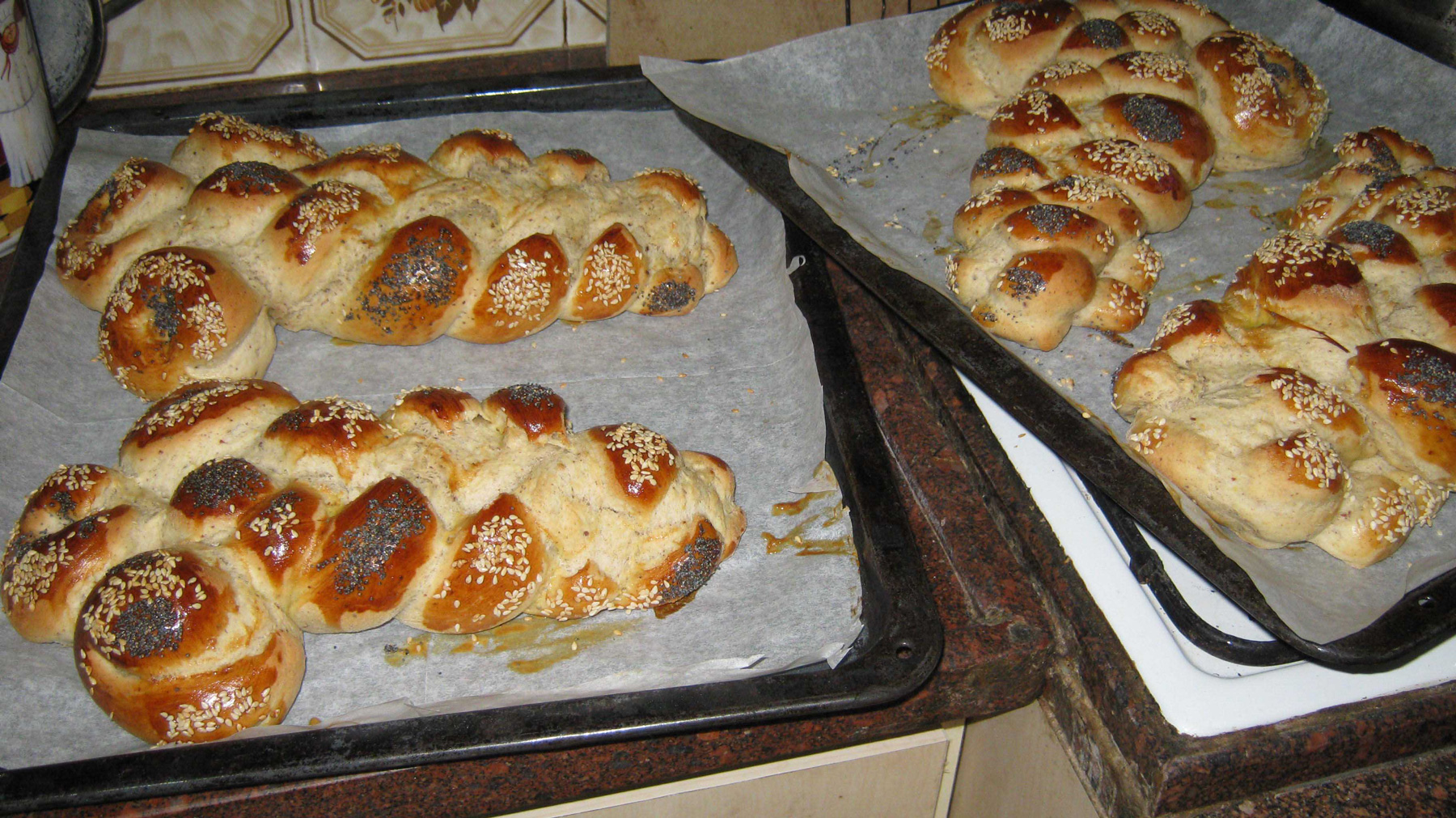
In honor of the Shabbat after PesachShlissel or Key Challah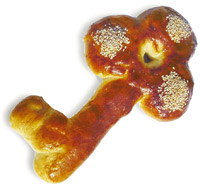 key challah There is a custom to bake key-shaped or Shlissel challah in honor of the Shabbat after Pesach. This is a well observed custom you might want to try for yourself. You can do this by slipping a key directly in the challah, by baking it in the dough or placing it in the braids as you shape. Many even shape their challah to look like a key. The custom is brought down in several books and is especially popular in hareidi communities – but many modern communities observe it as well. According to rabbis, the key is an expression of prayer for the blessings of G-d, as the “key” to a life of material plenty is in His hand.
Some versions of the custom require the placing of an actual key inside the dough, with the key actually baked into the challah, while others prefer the key-shaped bread in observance of the custom. Still others contend that it is sufficient to attach a key to an already-baked challah before it is brought to the Sabbath table. 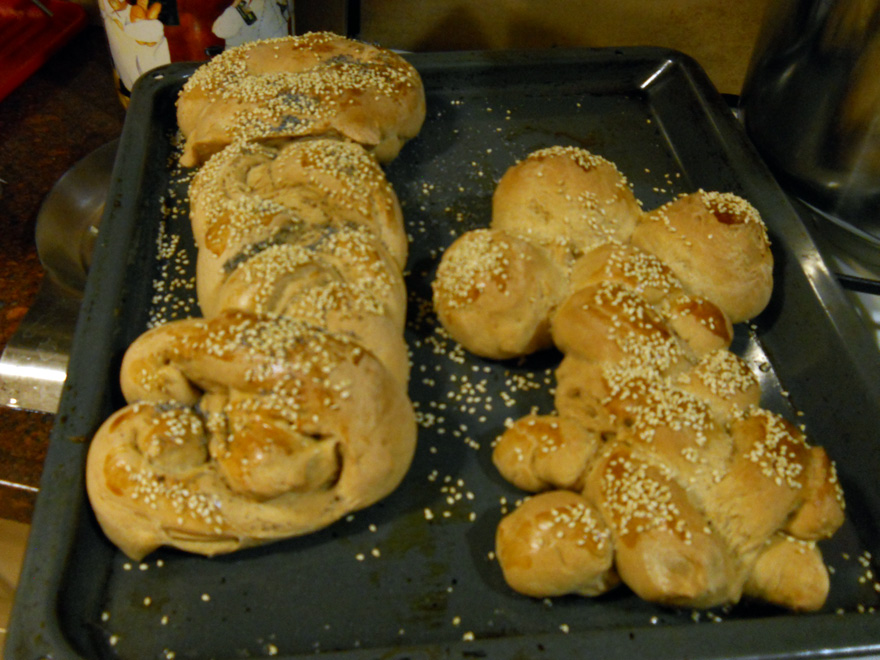 Shlissel or Key Challah served on the first Shabbat after Pesach |
|
Key Challah Shape Tutorial. Shlissel ChallahPosted 17April2020 Sonya’s Prep
It’s a custom to make challah in the shape of a key on the first Shabbat after Passover for a blessing of financial Stability/wealth. Join me as I make mine: Recipe: Bake at 350F for 45 minutes |
|
Tips for Making Shlissel Key Challah
|
|
 Shlissel or Key Challah-29April2022-1 |
|
 Shlissel or Key Challah-29April2022-2
|
|
The Secret of Pesach SheniPesach sheni – what’s that?? It’s a day when we can merit miracles and wonders! The message to learn from this is the power of ratzon, of desire. It’s the message of hope! Rabbi Shalom Arush | Posted on 11May2025 | https://breslev.com/1074146/  The Secret of Pesach Sheni by Rabbi Shalom Arush Editor’s Note: Pesach Sheni is celebrated on the 14th of Iyar.
A Second ChanceImagine yourself as Moshe Rabbeinu. Someone asks, “I missed putting on tefillin today – can I put them on now that it is nighttime?” The answer is obviously not! Jewish law specifically states that the mitzvah of tefillin is only for daytime – you cannot put them on at night. Why even bother asking?
The mitzvah to bring the Passover sacrifice or Korban Pesach is also for a specific time – the 14th of Nissan in the afternoon, on the eve of Passover. If you miss it, you miss it! Who would think about trying to do the Passover sacrifice after Passover? It’s ludicrous. Why even ask?
But a group of Jews came to Moshe Rabbeinu and asked this exact question! They explain that they were tamei, spiritually impure, at the time that they should have brought the Korban Pesach because they were carrying Yosef HaTzaddik’s coffin. Someone who is tamei is not allowed to bring sacrifices, so they were unable to participate in the Korban Pesach at the prescribed time. Now, they want to bring it later!
Moshe Rabbeinu wants to say that there is nothing to do – so next year, you’ll do it right. But they had such true desire, and they were upset that they were not able to bring the sacrifice – they wanted so badly to bring the sacrifice. “Why should we miss out?” they said. So Moshe Rabbeinu brings G-d their question – let’s see what G-d will say.
Hashem gave the mitzvah of Pesach Sheni – a second Passover! Someone who missed out on the Korban Pesach because they were tamei can bring the sacrifice one month later, on the 14th of Iyar. They do it exactly like it should have been done the month before, in all its intricate details. And retroactively, it becomes as if they did the Korban Pesach at the right time!
Even more, Pesach Sheni now became eternal. It wasn’t only for those people, just that year – every single year we are given another opportunity to get it right, to make up the past, on Pesach Sheni. It’s a new mitzvah! Hashem created a new Torah for them!
Nothing Stands in the Way of WillThere is an incredible message to learn from this – the incredible power of ratzon, of desire. You want something? You’re truly upset that you aren’t able to keep this mitzvah? Keep wanting, keep praying and don’t give up! Rebbe Nachman writes in Likutei Moharan that whatever a person truly wants, he gets!
I saw this today with one of my students. He told me a few days ago that he wanted so badly to go to Meron for Lag B’Omer. But what can you do? Everything is closed. But he was literally crying because he had so much desire, and he was so upset to miss it this year. He came to me today – he got special permission to go!
The same thing with Uman Rosh Hashanah. I could fill a whole book with stories of people who wanted to go and were unable, and in the end, went anyway. Nothing stands in the way of will! Nothing!
This is also a special message for anyone who feels impure, or thinks he is on a low level. He thinks to himself, “What have I done? I have done so many sins, I am so spiritually impure…” You want? G-d will make for you a new Torah! Even if you are in the lowest place, wherever you might be, you can come close to Hashem, and you can fix everything!
Someone came to me the other day, saying that he was on such a low level, he had fallen so low… I told him, “There is only one failure that a person can have. And that is if he falls from his desire [to fix].” If a person holds onto his will, and his desire to change, there is nothing that can stop him!
|
|

Matzah on Pesach Sheini: When and Why?By Yehuda Shurpin https://www.chabad.org/library/article_cdo/aid/3662334/jewish/Matzah-on-Pesach-Sheini-When-and-Why.htm 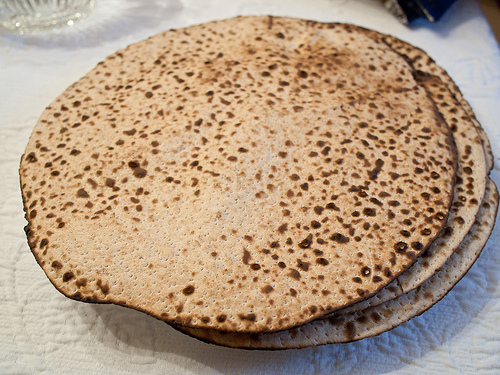 shmurah matzah
There is a widespread custom to eat matzah on the 14th of Iyar, known as Pesach Sheni (the “second Passover”), the day when those who were impure and/or unable to bring the Paschal lamb on Passover were given a second chance to do so.1 Just as the matzah eaten as the afikoman by the Seder commemorates the matzah and Paschal offering eaten in Temple times, so is this matzah a remembrance of the second Passover.
But if this is the case, a question arises: The Paschal lamb (and its accompanying matzah) was consumed on the evening of Iyar 15, but the widespread contemporary custom is to eat matzah on the day of Iyar 14, when the Paschal lamb was slaughtered and prepared. Why?
Now, it should be noted that some do in fact have the custom to eat matzah on the eve of the 15th rather than on the day of the 14th of Iyar. But why are they in the minority?
It’s All in the PrepRabbi Zvi Elimelech Shapiro of Dinov, known as the Bnei Yissachar, writes that although he himself ate matzah on the eve of the 15th, the main, public feasts are held on the day of the 14th, as per the custom of the Baal Shem Tov and his students.
On a somewhat mystical note, he explains that in the time period between Passover and the holiday of Shavuot, the emphasis is on the work of preparing and refining ourselves. Thus, we count the Omer, each day taking another step closer to the holiday of Shavuot, when we received the Torah. Appropriately, when it comes to celebrating the second Passover, the main emphasis is on the time of preparation, Iyar 14.2
The Last Remnants of the MiracleRabbi Yaakov Emden, known as the Yaavetz (1697-1776), writes that it was “revealed to me from heaven” that Jews were given a second chance to bring the Paschal offering specifically on the 14th of Iyar because that was the last day the Jews still had leftover matzah from when they left Egypt on Passover. After eating the last bit that night (eve of the 15th), the Jews complained to G‑d, “What will we eat?” and it was on the day of the 15th of Iyar that the manna began to fall. Thus, in a certain sense, the 14th marked the culmination of the miracle of the Exodus, while the 15th marked a new phase of the miracles in the desert.3
Although Rabbi Emden is explaining the timing of the second Passover, and not the reason for eating matzah nowadays, some cite this explanation as an additional reason for eating it both on the day of the 14th as well as the eve of the 15th.4
Not to Add to TorahRabbi Meir Dan Plotsky (1866–1928), in his work Kli Chemdah, offers a somewhat novel explanation for the widespread custom to eat the matzah on the day of the 14th. He explains that ordinarily there is a concern of not adding to the mitzvahs of the Torah. Now, if one simply does a time-bound mitzvah on a different day of the year without intention of doing the mitzvah (e.g., it’s a hot summer, so one builds a sukkah and eats in it), there is no issue of “adding to the Torah.” However, if it is in theory the proper time for the mitzvah, then there is potentially an issue of adding to the mitzvahs—even if there wasn’t any intention to do so.
Therefore, we specifically eat the matzah on the day of the 14th since the proper time to eat it really would have been the eve of the 15th (if someone were actually observing the second Passover because they were impure on the first Passover), and we wish to avoid making a custom to eat it specifically then. He writes that this is especially true in light of the Jerusalem Talmud’s statement that if the Moshiach will come between the first and second Passover, then all Jews will have the opportunity to bring the Paschal offering on the second Passover.5 Thus, since the second Passover could be an actual holiday for all Jews—when we would all be obligated to eat matzah—we don’t want to have a custom to eat matzah on the 15th, which gives the impression that we are adding to the observance of the day.
Others, however, question this explanation. They note that we eat matzah on all 7 (or 8) days of Passover even though there is no obligation to do so and there is no concern of “adding to a mitzvah.”6
Mystical NumerologyMany have the custom that after counting the Omer, they recite (among other things) psalm 67. This psalm contains 49 words (not counting the introductory verse). According to the Arizal, each word corresponds to a different night of the Omer, and one should have that word in mind when reciting the Omer. The same applies to verse 5 of that psalm, which contains 49 letters,7 each one corresponding to another night. (This can be seen in the standard Kehot Siddur, which includes the word and letter corresponding to each night of the Omer).
Based on this, some point out that the 14th of Iyar, which is the 29th day of the Omer, corrosponds to the word תַּנְחֵם, tancheim (“comfort them”), and the letter yud. The word tancheim has the numerical value of 498: ת-400 נ-50 ח-8 ם-40. Add on the yud, which had the numerical value of 10, and you have 508. This is the same numerical value as Pesach Sheni (פסח שני). Thus, we see a hint in the verse itself that the main celebration of Pesach Sheni is on the 14th of Iyar.8
As noted above, there is good reason to eat matzah on the night of the 15th as well, so although the common practice in Chabad is to eat matzah on the day of the 14th of Iyar,9 the Rebbe also encouraged people to eat matzah on the eve of the 15th.10
Footnotes 1. See Numbers 9:6–7. 2. See Shaar Yissachar, Pischa Zeira 12; Darkei Chaim Veshalom 631-2, cited in Igrot Kodesh, vol. 2, p. 352. 3. Siddur of Rabbi Yaakov Emden, Shaar Hayesod, “Chodesh Iyar.” 4. See Rabbi Yehoshua Mondshien in Otzar Minhagei Chabad, Pesach Sheini, “Achilat Matzah.” 5. Kli Chemdah, Parshat Vaetchanan. 6. See responsum Kol Yisroel, Orech Chaim 130. He writes that although according to some, there is indeed a “mitzvah” to eat matzah the rest of Passover, the term “mitzvah” in that context is not meant as obligation, but rather as a positive, meritorious act. 7. This count includes the letter vav in the words תִשְׁפֹּוט and מִישֹׁור, which is pronounced but not always written in the text. 8. Beit Naftali, cited in Minhag Yisroel Torah 493:10. 9. See Igrot Kodesh, vol. 2, p. 352. A translation of the letter can be seen here. 10. See Sicha of Pesach Sheini 5740 and 5743.
|