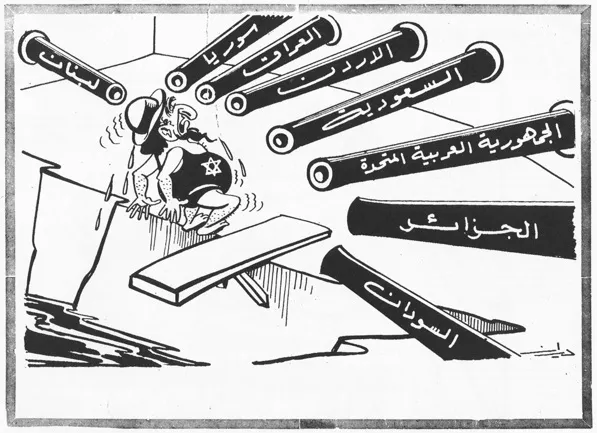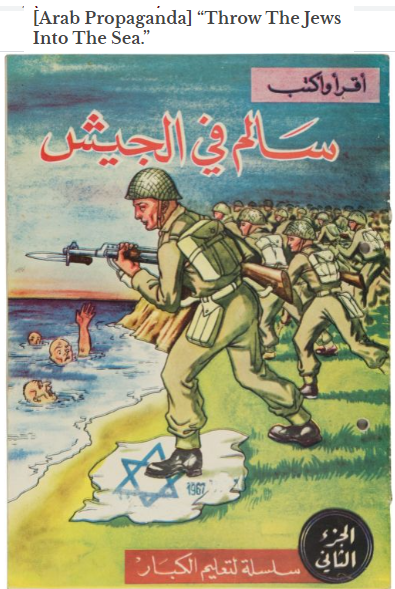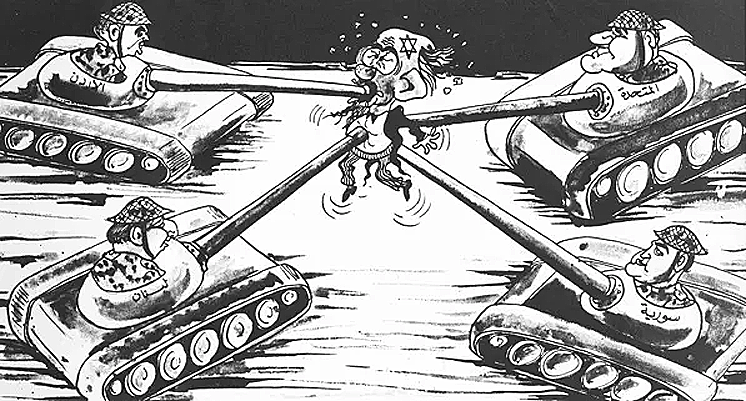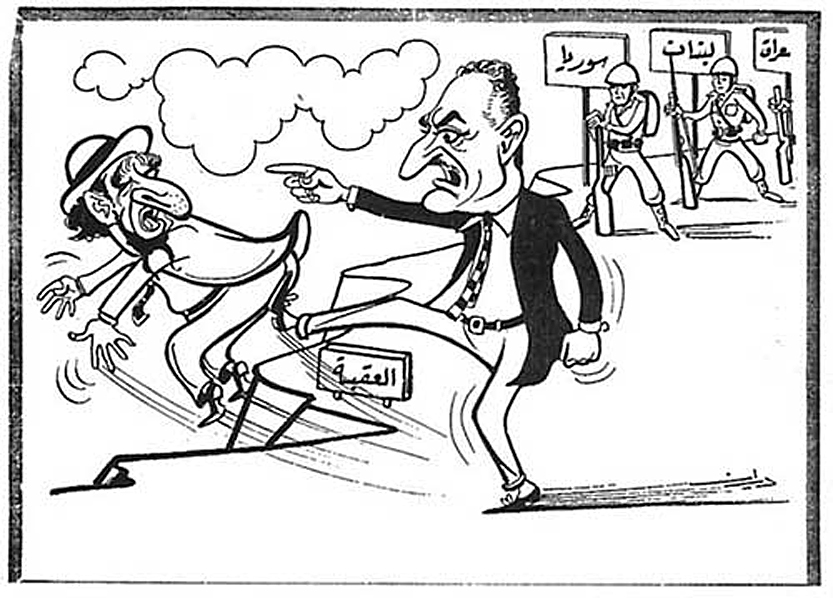
Six Day War – Israeli victory – Documentary – War of Redemption |
|
|
|
26 Iyar: Six-Day War (1967)In the spring of 1967, the Arab capitals paraded their arms and openly spoke of overrunning the Land of Israel and casting its inhabitants into the sea. The international media was almost unanimous in its belief that the small Jewish state, outflanked and outgunned by its enemies, stood little chance of survival. It seemed that, for the second time in a generation, the world was going to stand by and allow the enemies of the Jewish people to slaughter them in the millions. On Iyar 26 (June 5, 1967), Israel launched preemptive strikes on its southern and northern frontiers. In just six days, the Jewish army defeated five Arab armies on three fronts and liberated territories of its promised homeland amounting to an area greater than its own size, including the Old City of Jerusalem and the Temple Mount (see “Today in Jewish History” for Iyar 28). The openly miraculous nature of Israel’s victory spawned a global awakening of the Jewish soul, fueling the already present and growing teshuvah movement of return to G‑d and Jewish traditions. The Rebbe, Rabbi Menachem Mendel Schneerson, of righteous memory, called it a moment of biblical proportions, an “opportunity the likes of which has not been granted for thousands of years.” Many thousands of Jews flocked to put on tefillin and pray at the newly liberated Western Wall of the Temple Mount. Link: The Rebbe on the Six-Day War (video)
28 Iyar: Jerusalem Liberated (1967)The Old City of Jerusalem and the Temple Mount were liberated during the 1967 Six-Day War (see “Today in Jewish History” for Iyar 26). The day is marked in Israel as “Jerusalem Day.”
29 Iyar: Hebron Liberated (1967)One day after Israeli forces liberated eastern Jerusalem in the course of the Six-Day War, another of the holy cities, Hebron, was also liberated. Following the creation of the State of Israel in 1948, Jordan took over the control of Hebron along with the rest of the region. During this time, Israelis were not allowed to enter the holy city. The Jewish Quarter was destroyed, Jewish cemeteries were desecrated, 58 synagogues were destroyed and an animal pen was built on the ruins of the Patriarch Abraham Synagogue.
2 Sivan: Israel Captures Golan Heights (1967)Until the Six-Day War (see “Today in Jewish History” for Iyar 26), the Syrian army was deployed in strong fortifications on the Golan Heights, from which they repeatedly shelled the Israeli settlements below. On the fifth day of the war, the Israeli Army broke through the Syrian front. Facing very difficult topographical conditions, they scaled the steep and rugged heights. The Engineering Corps cleared the way of mines, followed by bulldozers which leveled a route for the tanks on the rocky face. After more than 24 hours of heavy fighting, the Syrian deployment collapsed and the Syrian forces fled in retreat. |
|
 the Jewish Virtual Library. logo https://www.jewishvirtuallibrary.org Jewish Holidays: Yom Yerushalayim – Jerusalem Dayhttps://jewishvirtuallibrary.org/yom-yerushalayim-jerusalem-day
Yom Yerushalayim (
The liberation of Jerusalem in 1967 marked the first time in thousands of years that the entire city of Jerusalem, the holiest city in Judaism, was under Jewish sovereignty. The destruction of Jerusalem was a watershed event in Jewish history that began thousands of years of mourning for Jerusalem, so, it follows, that the reunification of Jerusalem should be a joyous celebration that begins the process of reversing thousands of years of destruction and exile. Jerusalem is central to the Jewish tradition. Jews face in the direction of Jerusalem and all of the prayer services are filled with references to Jerusalem.
The observance of Yom Yerushalayim outside of the city cannot compare to its celebration in reunited Jerusalem. In Jerusalem, thousands of people march around the city and walk through the liberated Old City, where Jews were denied access from 1948 to 1967 while it was under Jordanian control. The march ends at the Kotel (Western Wall), one of the ancient retaining walls surrounding the Temple Mount, Judaism‘s holiest site. Once everyone gets to the Kotel, there are speeches and concerts and celebratory dancing.
Rare in the Jewish liturgy, a festive Hallel is recited during the evening prayers. This practice is only done on the first night (and, outside of Israel, on the second night) of Passover and Yom Ha’atzmaut. The Chief Rabbinate of Israel declared that the holiday version of Pseuki d’Zimra and Hallel should be recited. According to the major religious Zionist halakhists (decisors of Jewish law), even those who do not recite the blessing over Hallel (psalms of praise) on Yom Ha’atzmaut should recite it on Yom Yerushalayim because the liberation and reunification over the entire city of Jerusalem is said to be of an even greater miracle than Jewish political sovereignty over part of the land of Israel.
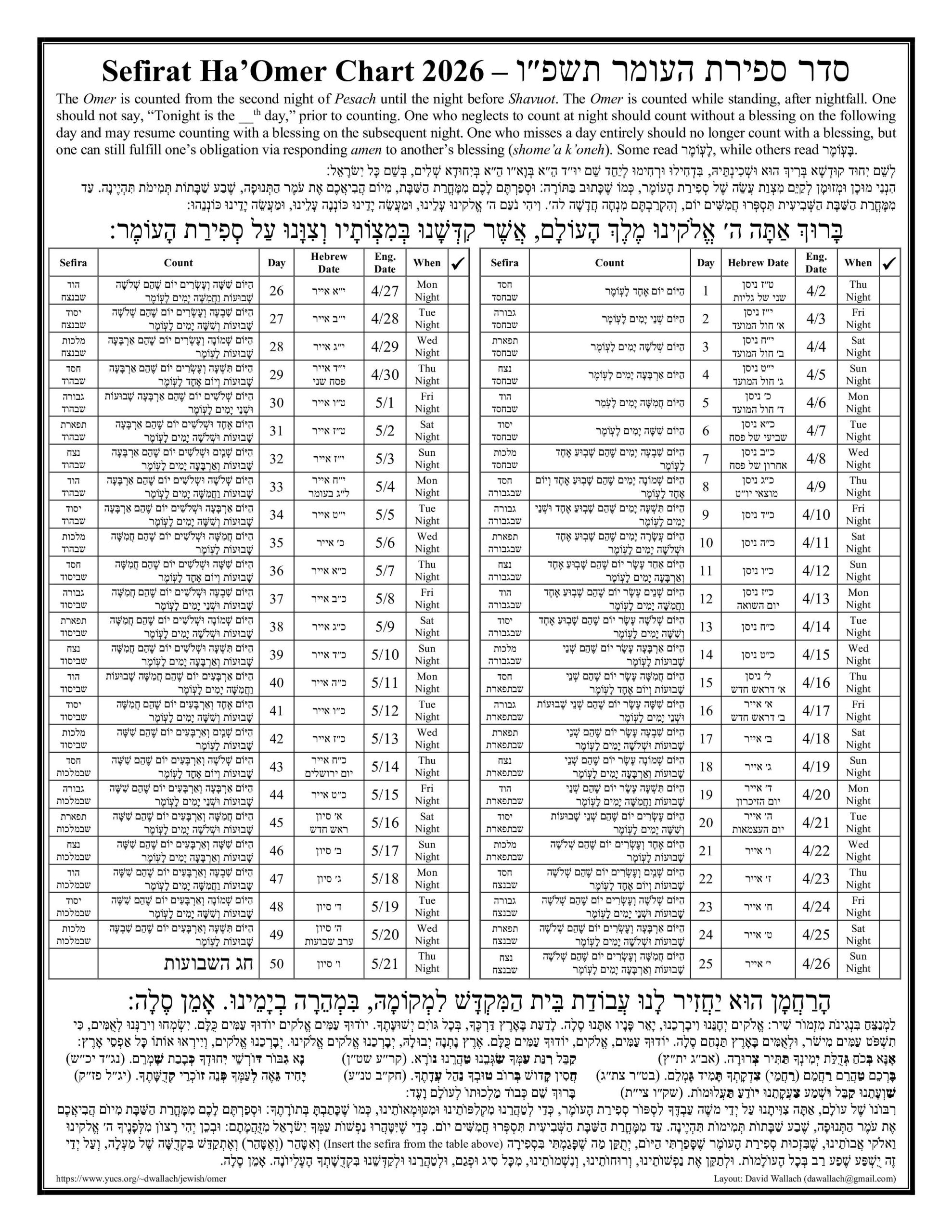
Many religious leaders also hold that the mourning restrictions of 33 days of the omer are lifted on Yom Yerushalayim for those who observe them after Lag B’omer. …
… The Israeli government decreed in 2004 that each year on Jerusalem day a national memorial ceremony would be held to commemorate and acknowledge the desires and contributions of the Ethiopian Jewish community.
Sources:
|
|

Israel celebrates Jerusalem DayJerusalem, capital of Israel, divided during the 1948 War of Independence, was reunited in June 1967. On May 29 2022 (28 Iyyar 5782) Israel celebrates Jerusalem Day, marking the reunification of the nation’s capital.Type: Information Topic: About Israel Israel Experience Secondary topic: Facts about Israel History Publish Date: 29.05.2022 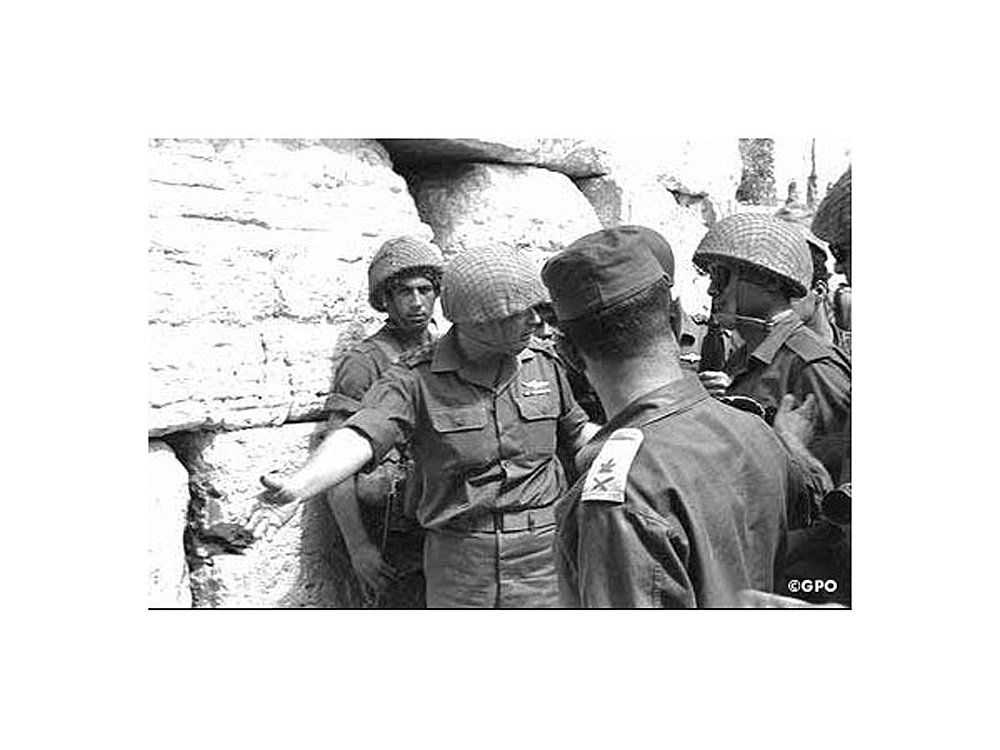 Western Wall-Rabin-Dayan-Narkis
Since the time of King David, except for the 19 years between 1948 and 1967, there has always been a Jewish presence in the ancient city of Jerusalem, the capital of Israel. From 1948 until 1967, the western part of the city was in Israeli hands, while the ancient, eastern part – apart from a small Israeli enclave on Mount Scopus – was under Jordanian control.
Jerusalem, divided during the 1948 War of Independence, was reunited in June 1967.
“Peace has now returned with our forces in control of all the city and its environs. You may rest assured that no harm whatsoever shall come to the places sacred to all religions. I have requested the Minister of Religious Affairs to get in touch with the religious leaders in the Old City in order to ensure regular contact between them and our forces, so as to make certain that the former may continue their spiritual activities unhindered.” – Prime Minister Levi Eshkol, June 7, 1967
King David made Jerusalem the capital of his kingdom and the religious center of the Jewish people in 1003 BCE. Some forty years later, his son Solomon built the Temple (the religious and national center of the people of Israel) and transformed the city into the prosperous capital of an empire extending from the Euphrates to Egypt.
Exiled by Babylonian king Nebuchadnezzar in 586 BCE, who conquered Jerusalem and destroyed the Temple, the Jews were allowed to return and rebuild the city and the Temple some 50 years later by the Persian King Cyrus.
Alexander the Great conquered Jerusalem in 332 BCE. The later desecration of the Temple and attempts to suppress Jewish religious identity under the Seleucid ruler Antiochus IV resulted in a revolt led by Judah Maccabbee, who rededicated the Temple (164 BCE) and re-established Jewish independence under the Hasmonean dynasty.
A century later, Pompey imposed Roman rule on Jerusalem. King Herod, installed as ruler of Judah by the Romans (37 – 4 BCE), established cultural institutions in Jerusalem, erected magnificent public buildings and refashioned the Temple into an edifice of splendor.
Jewish revolt against Rome broke out in 66 CE, as Roman rule after Herod’s death became increasingly oppressive. In 70 CE, Roman legions under Titus conquered the city and destroyed the Temple. Jewish independence was briefly restored during the Bar Kochba revolt (132-135), but again the Romans prevailed. Jews were forbidden to enter the city, renamed Aelia Capitolina.
After Byzantine conquest of the city (313), Jerusalem was transformed into a Christian center under Emperor Constantine, with the Church of the Holy Sepulcher the first of many grandiose structures built in the city.
Muslim armies invaded the country in 634, and four years later Caliph Omar captured Jerusalem. Only during the reign of Abdul Malik, who built the Dome of the Rock (691), did Jerusalem briefly become the seat of a caliph.
The Crusaders conquered Jerusalem in 1099, massacred its Jewish and Muslim inhabitants, and established the city as the capital of the Crusader Kingdom. Synagogues were destroyed, old churches were rebuilt and many mosques were turned into Christian shrines. Crusader rule over Jerusalem ended in 1187, when the city fell to Saladin.
In 1247 Jerusalem fell once more to Egypt, now ruled by the Mamluks, until the conquest by the Ottoman Turks in 1517. Suleiman the Magnificent rebuilt the city walls (1537). After his death, the central authorities in Constantinople took little interest in Jerusalem and the city declined.
Jerusalem began to thrive once more in the latter half of the 19th century. Growing numbers of Jews returning to their land, waning Ottoman power and revitalized European interest in the Holy Land led to renewed development of Jerusalem.
The British army led by General Allenby conquered Jerusalem in 1917. From 1922 to 1948, Jerusalem was the administrative seat of the British authorities in the Land of Israel (Palestine), which had been entrusted to Great Britain by the League of Nations. 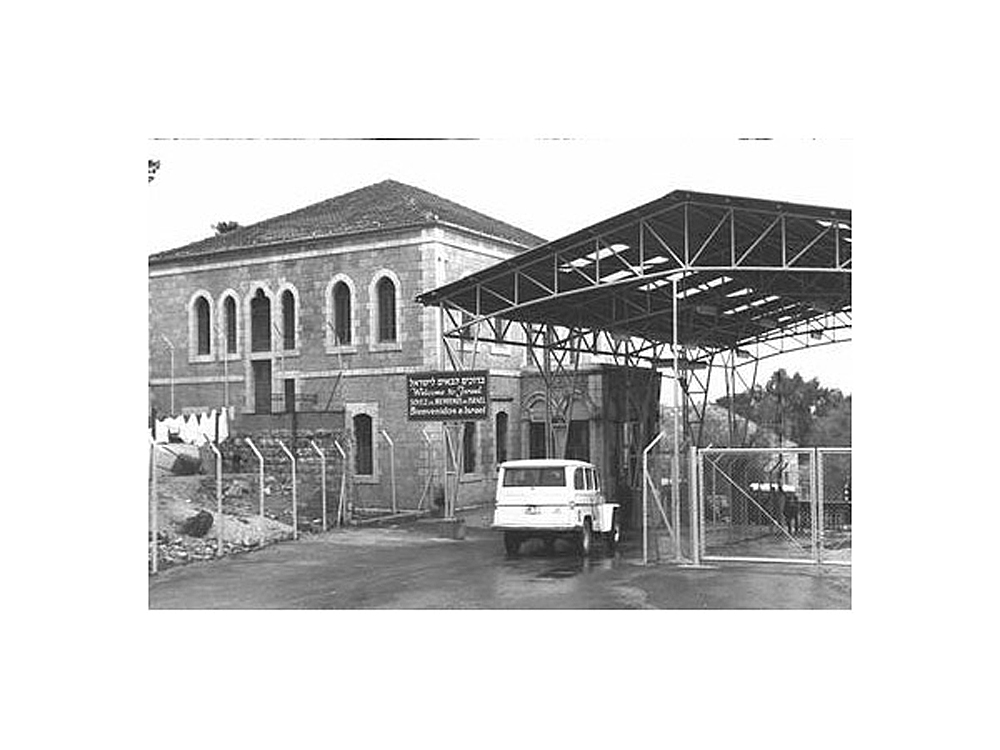 Mandelbaum Gate 1964 GPOMoshe Pridan
Division and reunification Upon termination of the British Mandate on May 14, 1948, and in accordance with the UN resolution of November 29, 1947, Israel proclaimed its independence, with Jerusalem as its capital. Opposing its establishment, the Arab countries launched an all-out assault on the new state, resulting in the 1948-49 War of Independence. The armistice lines drawn at the end of the war divided Jerusalem into two, with Jordan occupying the Old City and areas to the north and south, and Israel retaining the western and southern parts of the city.
When the Six-Day War broke out in June 1967, Israel contacted Jordan through the U.N. as well as the American Embassy, and made it clear that if Jordan refrained from attacking Israel, Israel would not attack Jordan. Nevertheless, the Jordanians attacked west Jerusalem and occupied the former High Commissioner’s building. Following heavy fighting, the IDF recovered the compound and removed the Jordanian army from east Jerusalem, resulting in the reunification of the city.
From the IDF website:
After the liberation of the city by the IDF, the walls dividing the city were torn down. Three weeks later, the Knesset enacted legislation unifying the city and extending Israeli sovereignty over the eastern part of the city.
The reunification of the city was also a fundamental moment in the history of religious tolerance, opening the city of Jerusalem to worshippers of all faiths, permitting Jews to return to the Western Wall and other holy sites, and allowing Israeli Muslims and Christians to visit those sacred places in eastern Jerusalem from which they too had been barred since 1948.
One year later, in 1968, it was decided that the day marking the liberation and reunification of Jerusalem – 28 Iyar according to the Jewish lunar calendar – would be national holiday in Israel. On Jerusalem Day we celebrate the reunification of the city and the Jewish people’s connection with Jerusalem throughout the ages.
|
|

From Mandelbaum Gate to Chut Shel ChessedAfter the miraculous events of the Six Day War (26-Iyar to 2-Sivan), Jews were allowed to return to their city. The Mandelbaum Gate, formerly the physical gate to Jerusalem, became Chut shel Chessed, the spiritual gate to Jerusalem.Rabbi Jacob Rupp | Posted on 25May2025 | https://breslev.com/259784/ 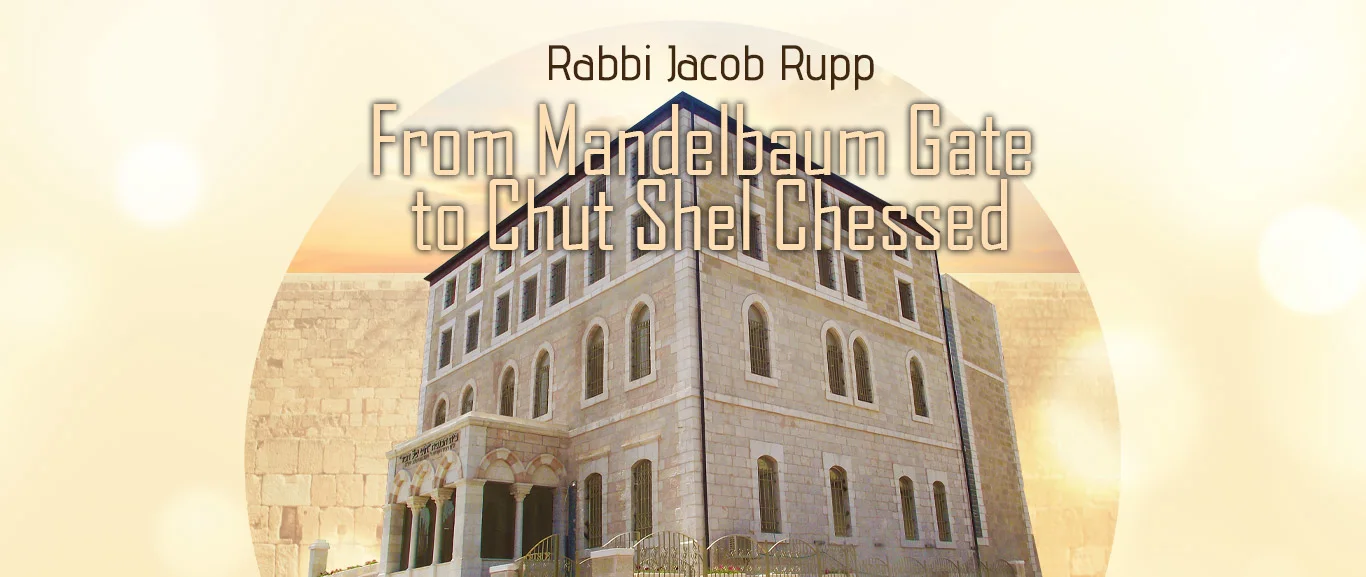 From Mandelbaum Gate to Chut Shel Chessed
For years, we watched in desperate envy and frustration as foreigners passed into the holy city unmolested while we could only stand at Mandelbaum Gate and watch.
Our nation is pursuing a dream. To some, our dream may seem trivial; to others, impossible to attain. Millions have worked towards it and thousands of years have passed, but we remain unabashed in our efforts to merit its fulfillment.
For two thousand years we have waited to come home. We have longed to gather in Eretz Yisroel, to rebuild our Third Temple, and to renew the close relationship with God that we once had.
The path to this goal has been paved with hardships. The monuments of our struggles and misery lie scattered throughout the world. They are found in nearly every country, from the remains of the Death Camps in Poland to Masada in Eretz Yisrael. Yet, despite our struggles, we persevere. From the story of Yosef and his brothers, we learn that before God gives us a test, He gives us the tools to overcome it. Like the night is the darkest right before dawn, oftentimes, the very article of our despair becomes a key to our salvation.
Today, we are plagued by an almost ironic taste of our redemption. We get so close to complete destruction and then, overnight, we can almost sense the beginning of our salvation. We can all but see the hand of our Creator guiding us. Who could have ever imagined the broken, bloodied souls limping out of Auschwitz, all the way to the holy city of Jerusalem?
Today, we are blessed to live in and visit the old city of Jerusalem. Nearly forty years ago, however, that was impossible. Today, the streets of Meah Shearim are full of commerce, shouting children, young families, and vibrant Yiddishkeit. Four decades ago, the area was a virtual war zone, located on the border between Israel and her hostile Arab neighbor. Where today schools and homes stand, one journalist described the area from 1948-1967 as “a ramshackle affair of corrugated tin checkpoints separated on each side by a wide, cobblestone expanse of street.” The bullet holes in the buildings testify to the violence that was an almost daily affair. For close to two decades, we suffered everything from kidnapping and beatings to sniper fire. But even more painful than the violence we endured was the knowledge that the Kotel, the last remnant of our Holy Temple, remained just beyond our reach.
Following the war of Independence, the entire Old City, including the Kotel, was under Jordanian control. The Arabs destroyed our synagogues, desecrated hundreds of our graves, and reduced the Old City into a crumbling, desolate village. Sewage ran down the main streets, and farm animals defecated on the stones upon which our holy sages had once walked.
Jerusalem was divided between East and West; old and new. Mandelbaum Gate was the only point of connection between the no man’s land that split the city. It was through this passage that people – Christian pilgrims, Western journalists, and Arabs, but no Jews – could cross into the Old City.
For years, we watched in desperate envy and frustration as foreigners passed into the holy city unmolested while we could only stand at Mandelbaum Gate and watch. We were so close to our enemy that we could see and speak to those Jordanian soldiers who refused to allow us entry. Every day we would see them stand on our holy ground while we remained powerless to remove them. At times the area was calm, at other times the soldiers would fire at us and our children.
Yet we never lost hope. People would climb onto the roofs of the highest buildings to watch the sun set over our holy city held hostage. All this came to an end, when, during the miraculous events of the Six Day War (26-Iyar to 2-Sivan), Mandelbaum Gate was torn down. We were allowed to return to our city.
Now, fast forward to today; the Old City has been rebuilt and is a popular place to visit, spend time, and pray. Meah Shearim has developed into a gem of traditional Judaism. But where Mandelbaum Gate once stood as a dreary symbol of Jerusalem divided, something amazing is going on.
On the site of so much frustration and despair, a new flame is being kindled! Jewish men are discovering their roots. The sound of Torah learning emanates from a building which had once, on a very physical level, separated us from our roots.
In what can only be described as a miracle, Chut Shel Chessed Institutions was given the privilege of changing Mandelbaum Gate from a source of spiritual frustration to a fountain of spiritual growth.
|
|
Go and Take Possession of the LandRabbi Arush gives an impassioned plea to live in Eretz Yisrael. There is no reason to be afraid. The more Jews who come, the greater the blessings will be. We are so close to building the Beit Hamikdash! Now, more than ever, is the time to come!Rabbi Shalom Arush | Posted on 06January2026 | https://breslev.com/4842746/  Go and Take Possession of the Land-by Rabbi Shalom Arush
Translated from Rabbi Arush’s feature article in the weekly Chut shel Chessed newsletter. The articles focus on his main message: “Loving others as yourself” and emuna.
And I am in ExileIn my latest trip to the diaspora, I visited many communities in France. I met Jews who felt very persecuted and frightened, the ground under their feet was unstable. This situation is shared by many Jews throughout the world. Antisemites have come to power in France. And in its neighbor, England, the change of government doesn’t bode well.
Every place I came to, I did my best to strengthen the people and teach them the perfect emuna (faith) that Hashem will do only good for us and will never abandon the Jewish People, and that we have no one to depend upon except our Father in Heaven. But at the same time, I called to them there, and I will continue to call to all Jews in the world, to immigrate to the Land of Israel.
This message is true for all of us: We, too, who are living in the Holy Land, must participate in the great effort to bring all Jews to Israel. And the effort on our part is mainly through our obligation to pray, as we wrote last week. We must know that an inseparable part of prayer for the Jewish People is the prayer for diaspora Jews, that Hashem should protect them wherever they are. Hashem should awaken them all to come on Aliyah to the Land of Israel, grant them the willingness and the ability to do so, and grant that there will be agreement of all family members to come to Israel. It is not for nothing that we pray three times a day in the Amidah about the ingathering of the exiles.
All of us must understand, on the one hand, the tremendous danger that is threatening Jews all over the world – both a material and a spiritual threat. Jewish institutions and shuls throughout the world are receiving the highest level of threats. On the other hand, we must understand the tremendous difficulty involved in coming on Aliyah. For many Jews this is an extremely difficult step to take. It is very hard to leave large and beautiful homes, jobs, good living conditions, household help, institutions, society, language, and a familiar culture – and to move to the Land of Israel and start life anew. For us, too, who live here, it can be difficult to find apartments and jobs; for diaspora Jews it is certainly hard, then. And therefore, we must help them with our prayers!
Love of the LandTherefore, the first thing to pray for is the desire to make Aliyah! On the one hand, we, in Israel, must pray that all Jews will have the desire to come on Aliyah, and we must pray for ourselves as well, that we will be able to appreciate the merit of living in the Land of Israel. And, on the other hand, the diaspora Jews should pray that they will long for the Land of Israel and will want, to the best of their ability, to make Aliyah.
Even someone who doesn’t see any chance of coming on Aliyah, even if he doesn’t see any way that he can make a living and purchase an apartment in Israel, and even if part of his family is totally against coming on Aliyah – still, in any case one can always want to! Who is preventing you from wanting? Who is preventing you from asking Hashem that you be given a strong and real will? True, it is forbidden to force things on other family members, and so one must pray that all family members, children included, will want to come on Aliyah.
Don’t confuse ability and desire. Under no circumstances should you stop wanting. For sure, sooner or later the desire will produce results, because the way a person wishes to go is the way that he is led. And the yearning for the Land of Israel is a positive thing, and has tremendous segulot, affecting both material and spiritual things. In the material – it is brought in Sefer Hamiddot: “Thanks to the yearning that a person yearns to come to Eretz Yisrael – by that yearning one receives an abundance of parnasah (livelihood).” 1
And, of course, the same thing is true about spiritual matters. There are countless sources for the fact that all the kedushah (holiness) and emuna (faith) and prayers open Divine Providence; good middot (traits) are rooted in the kedushah of the Land of Israel. Because the Land of Israel is not a physical place; rather, it is the only spiritual place that can provide the Jewish People with the ability to thrive spiritually.
Rabbi Nachman says: “Every person must ask from Hashem yitbarach (May He be blessed) that he feels yearning and longing for the Land of Israel. And, that all the tzaddikim should long for the Land of Israel, and this is a segula against anger and sadness… in other words, we ask for and long for the Land of Israel, and that way we are granted emuna…” 2
Rabbi Levi Yitzchak Bender would encourage the avreichim (married students) to remember every minute that they are in the Land of Israel and to be happy to have that merit, and to think: “I am walking in the Land of Israel, I am learning, praying, doing mitzvot, busy with chessed (acts of loving kindness), eating and sleeping – in the Land of Israel.” And he even said, “You can test me on this: When you think about the Land of Israel at every free moment – you will experience a great spiritual illumination and great success in all your service of Hashem!”
We have a general rule, that anyone who yearns for something holy – even if he doesn’t actually receive it – that holy thing begins to illuminate him and influence him! And therefore, even someone who is still in the diaspora, if he manages not to distract himself and every moment that he does remember he yearns for the holiness of the Land of Israel – he too will merit a “shot” of increasing emuna and tefilla, and will produce real chiddushei Torah (new insights in Torah) and in everything connected with serving Hashem.
The Land is Very, Very GoodTherefore, we must first of all pray for the will, but we must also pray for all the details and the details of the details, and ask Hashem to build for us millions of apartments that will be ready to receive all those millions of Jews, and that all of them – parents, children, and youths – will have communities, shuls, educational institutions, good sources of income, jobs, and vessels to absorb the material good and the spiritual good; and that all the immigrants will be received with love and joy and welcoming smiles. And when they arrive here, all of them will merit, together with all the residents of the Holy Land, to connect to the holiness of the Land of Israel, and that the light of emuna and tefilla will shine upon them and us to a greater extent and with greater power.
And it is clear as light that the Land of Israel is the safest place for Jews in the whole world.
The more Jews who live in the Land of Israel, the more the Land’s kedushah shines. This means that the holy emuna shines more, and that the tefilla shines more, and that we merit great, miracles that are above nature. Then, of course, the Jewish People are much better protected.
And that is the thing that brings the Geula (Redemption) closer the most, because “the main [cause of] galut (exile) is only lack of emuna”, and the Land of Israel and emuna, tefilla (prayer) and miracles are one thing, as brought in Likutei Moharan (Kitzur Likutei Moharan, 7): “Prayer and miracles and the Land of Israel are all one aspect and they all depend on one another… the main point of emuna, the aspect of tefilla, the aspect of miracles is only in the Land of Israel… and this is the way the Geula will come.”
It comes out that when we pray for the diaspora Jews to immigrate to Israel, we are actually praying for the complete Geula!
And that is what we see in parshat Devarim. Moshe bids farewell to the Jewish People before they enter the Land, because he is not going to enter it with them. He stands facing the Land of Israel and begins his final speech with a great rebuke of the people about the Sin of the Spies. He calls them to repair the sin of their forefathers who spurned the cherished land, and throughout the Torah he praises the Land and longs for it and prepares the Jewish people to live in it with emuna and connection to Hashem and His Torah.
The Sin of the Spies caused a weeping lasting through many generations. That means that all of us still need to correct this sin. And as they spurned the Land of Israel – we must fix that sin and yearn for and want that Land. We must pray and long for the kedushah of the Land of Israel and to do what we can to observe the mitzvah of living in the Land of Israel devotedly.
We see with our own eyes how Hashem is building and developing the Land, and how much blessing there is in the Land. Even better and more abundant natural resources will be discovered here. There will be tremendous abundance.
Therefore, there is no reason to be afraid, and all Jews should come on Aliyah to the Land of Israel. And the more Jews who come, the greater the blessing will be, and they will all live in abundance and in happiness. The Beit HaMikdash (Temple) will be built, and the Three Weeks will become a joyous time, Amen.
Editor’s Note: 1 Sefer HaMiddot, “Land of Israel”, second part, number 3 2 Likutei Moharan I, 155:3
|
|
The Six-Day War (June 1967)Within the brief span of six days, the IDF overran the Sinai peninsula took the entire West Bank of the River Jordan and captured a great part of the Golan Heights. The culminating event was the capture of the Old City of Jerusalem.https://www.gov.il/en/pages/the-six-day-war-june-1967 Type: Information< Topic: About Israel Secondary topic: Facts about Israel Publish Date: 12.06.2002 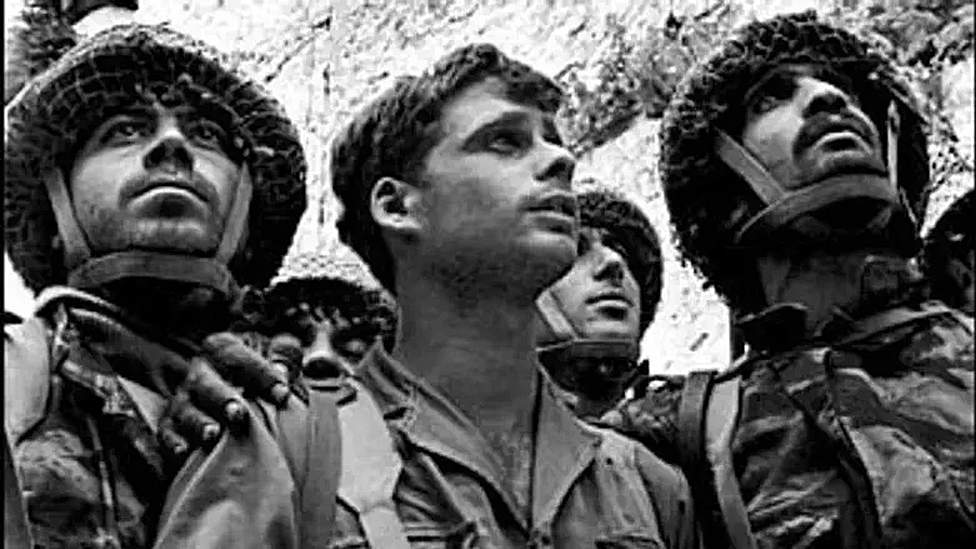 Paratroopers at the Western Wall in Jerusalem, June 1967© GPO/David Rubinger
The year 1967 began with confident predictions that it would not bring war. Nasser, it was argued in Israel, had learned the lesson of 1956 and would not start a war unless he was ready. In any case, his relations with Jordan were notoriously bad and a coalition between Nasser and King Hussein was out of the question.
In quick succession, events gave the lie to these predictions. A clash in the air, in which Syria – Russia’s closest ally in the Middle East – lost 13 planes, provided the opening signal. As a result of Soviet prodding, Nasser mobilized and sent 100,000 troops to Sinai. He demanded that the Secretary General of the United Nations withdraw UNEF forthwith, and – probably to his own surprise – succeeded immediately and the “firemen” departed. Then Nasser announced the closing of the Straits of Tiran to Israeli shipping (May 23) – a clearcut casus belli. He ended by taunting Yitzhak Rabin, Israel’s Chief of Staff: “Let him come, I’m waiting.”
Meanwhile he succeeded in bringing about close coordination with the Syrian army. King Hussein, in an abrupt about-face, flew to Egypt and signed an agreement placing his forces under overall Egyptian comand. It was to cost him half his kingdom.
Israel, its reserves fully mobilized, its nerves taut to the snapping point, waited for three long weeks. The situation seemed the reverse of 1956; Israel was alone, against a powerful Arab coalition. The Big Powers, vague promises notwithstanding, did nothing to reopen the Straits and Israel decided to go it alone.
On 5 June 1967 a cluster of planes flying from Egypt to Israel was seen on King Hussein’s radar screen. Convinced by the Egyptians that the planes were theirs, he promptly gave the order to attack – in Jerusalem! In fact the planes were Israel’s, returning from their devastating attack against the Egyptian airforce, which surprisingly had been taken by surprise; after taunting Rabin, Egypt was not ready when he came.
Within the brief span of six days, the IDF overran the whole Sinai peninsula, up to the Suez Canal; took the entire West Bank of the River Jordan; and in the last days, without the benefit of surprise, captured a great part of the Golan Heights, including the dominant Mount Hermon – from then on “the eyes and ears of Israel”. The culminating event was the capture of the Old City of Jerusalem and the re-encounter with the place most revered by Jews, the Western (Wailing) Wall. The blowing of the shofar at the Western Wall reverberated throughout the world.
776 Israeli soldiers fell in the Six-Day War.
Whilst all branches of the service had performed well, the Air Force had, for the first time, played a decisive role: clearing the skies at the outset made all that followed possible. This was the War of the Air Force.
Diplomatic efforts to bring to an end the by-now 40 years of conflict, which predated the establishment of Israel by more than two decades, came to nought. In November 1967, after months of deliberations, the Security Council unanimously adopted Resolution 242, calling for peace and recognition of the “right of every nation to live free from threat within secure and recognized boundaries”, in return for Israel’s withdrawal “from territories”, not “all the territories”, nor “the territories captured in the course of the recent hostilities”. However, the Arab League, in its session in the Sudan (1967) adopted a different resolution, the “Three No’s” of Khartoum: No peace, No negotiations, No recognition of Israel.
From “The Arab-Israeli Wars” by Netanel Lorch
|
|

Hidden and revealed miraclesWhen future historians come to write of our era, they will write of all the miracles but they will also discover another hidden miracle.Daniel Pinner / 25May2025, 10:49 PM (GMT+3) / https://www.israelnationalnews.com/news/408953 Paratroopers at the Western Wall in Jerusalem, June 1967© GPO/David Rubinger
First a brief note on the name of this day. Too many people call this day Yom Yerushalayim, the Day of Jerusalem, or more idiomatically Jerusalem Day.
A terrible name! The appellation “Yom Yerushalayim” appears once in the Tanach:
“Remember, O Hashem, to the sons of Edom, יוֹם יְרוּשָׁלִַם, the Day of Jerusalem, when they said Destroy1 Destroy! To its very foundations!” (Psalms 137:7). Yom Yerushalayim is the day that Jerusalem was destroyed. The day that Israel liberated Jerusalem 57 years ago is far better called יוֹם חֵרוּת יְרוּשָׁלַיִם or יוֹם שִׁחְרוּר יְרוּשָׁלַיִם, Jerusalem Liberation Day.
And now, having clarified the name of this day:
We have an ancient and well-established tradition of reading one chapter of Pirkei Avot (Chapters of the Fathers, or more idiomatically Ethics of the Fathers) each Shabbat from Pesach to Shavuot. Jerusalem Liberation Day falls on the 28th of Iyyar, and on the preceding Shabbat we invariably read chapter 5.
This includes an observation on miracles:
“Ten miracles were done for our ancestors in Egypt, and ten at the Red Sea” (Pirkei Avot 5:4).
It is intuitive that the ten miracles in Egypt were the Ten Plagues; yet all of the major commentators (the Rambam, Rabbi Ovadia of Bartenura, Rabbeinu Yonah of Gerona, Tosfot Yomtov, Tiferet Yisrael, among others) agree that the ten miracles in Egypt were not the ten plagues in and of themselves, but rather that in each case we were saved from the plagues.
Only thus did G-d demonstrate not only that He controls nature, but that He controls nature for the sake of the Jewish People.
Though Pirkei Avot does not specify which ten miracles were wrought at the Red Sea, various Midrashim (Tanchuma, Beshallach 10 and Mechilta de-Rabbi Yishmael, Beshallach 5 among others) enumerate them:
The Sea was split for them, and became a dome covering them; It was divided into ten channels, as G-d said to Moshe, “Stretch forth your hand over the sea and divide it” (Exodus 14:16); It became completely dry, so they would not even get their feet muddy, as it says, “…and the children of Israel walked on dry ground” (ibid 14:29); It became like thick, muddy clay, miring the Egyptians, as it says, “You trampled them in the sea with Your horses, with clay of mighty waters” (Habakkuk 3:15); The waters crumbled as it says, “You crumbled the sea with Your might” (Psalms 74:13); The waters became piles of rocks against which the Egyptians were smashed, as it says, “He smashed the sea serpents’ heads against the water” (ibid); The water was cut into pieces, as it says, “To He Who cut the sea into pieces” (ibid 136:13); The water was heaped into piles, as it says, “At the wind of Your nostrils the waters were heaped up” (Exodus 15:8); It became a solid wall, as it says, “The flowing waters stood erect like a solid wall” (ibid); Sweet water flowed out from the midst of the salt water for them, and the water froze, becoming like a glass jug, as it says, “The deep waters froze” (ibid).
So far, so easy to understand. G-d wrought ten miracles for our ancestors while they were yet in Egypt, and another ten at the Red Sea, and all were open, clear miracles which no observer could deny.
But Pirkei Avot continues: “Ten miracles were wrought for our forefathers in the Holy Temple:
No woman ever miscarried due to the aroma of the meat of the sacrifices; The meat of the sacrifices never rotted; No fly was ever seen in the place where the sacrificial meat was butchered; No nocturnal emission ever happened to the Kohen Gadol (High Priest) on Yom Kippur [which would have rendered him impure and unfit for Temple service]; The rains never extinguished the fire of the wood-pile on the Altar; The wind never disturbed the vertical column of smoke [arising from the Altar]; No disqualifying defect was ever found in the Omer or in the two Loaves [for Shavuot] or in the Showbread; Though the people were crowded together when they stood, they had sufficient space to prostrate themselves full-length on the ground; No snake or scorpion ever injured anyone in Jerusalem; And no one ever said to his fellow, The place is too small for me to overnight in Jerusalem” (5:5). In this list there is no single event that is miraculous in and of itself. The Jew who made the tri-annual pilgrimage to Jerusalem would not have gazed in awe at a pregnant woman not miscarrying from the aroma of the roasting meat of the sacrifices; no Jew would have been awestruck at seeing meat which had not rotted, or been overwhelmed at not seeing a fly around the meat-hooks set in the sides of the cedar-wood blocks on the eight stone benches to the north of the Altar or on the adjacent marble tables where the carcasses were flayed.
Similarly, the fact that the Kohen Gadol did not suffer a nocturnal emission on a specific Yom Kippur, or that the rain on any given Festival did not extinguish the fire of the wood-pile on the Altar, or that no disqualifying defect was found in the Omer or in the two Loaves or in the Showbread in a given year was not an open miracle. After all, how likely was it for any of these events to occur?
But after a total of 830 years (410 for the first Holy Temple and 420 for the second), the pattern would have become undeniable. For sure, the individual pilgrim who spent a week or two in Jerusalem without being bitten by a snake or stung by a scorpion would not have seen anything miraculous. But when no pilgrim – uncountable millions of Jews through those centuries – was ever harmed thus throughout 830 years of pilgrimages to Jerusalem, then the miracle becomes undeniable.
Just as the Ten Plagues and the Splitting of the Red Sea were physically impossible, so too the perfect functioning of all these systems of the Holy Temple without even a single mishap over 830 years was statistically impossible.
The fact that Pirkei Avot uses the identical phraseology – “ten miracles were wrought for our forefathers” – both for the open, revealed miracles in Egypt and at the Red Sea and also for the hidden, “mundane” miracles in the Holy Temple, suggests that the Mishnah places them on the same level, regards them as equally miraculous.
This year 5785 (2025) marks 58 years since the Six Day War, and Monday 28th Iyyar (26th May) is celebrated as Jerusalem Liberation Day, the day that the paratroopers liberated Jerusalem and restored it to Jewish sovereignty for the first time since the Roman general Pompey invaded Jerusalem in 63 B.C.E. and installed Hyrcanus as High Priest and vassal king of Rome.
In many ways the Six Day War straddles the boundary between hidden miracles and revealed miracles:
Israel was surrounded by a vast military coalition of Arab and Muslim states, whose stated purpose was to exterminate Israel and the Jews therein. Jordan, Syria, Lebanon, Egypt, Iraq, Saudi Arabia, Algeria, Morocco, Libya, Kuwait, Tunisia, Sudan, and Pakistan outnumbered, outgunned, and outmanned Israel on four borders. The sole neutral border was with the Mediterranean Sea, into which the Arab armies had vowed to push Israel.
Many of the individual battles which Israel won can be explained rationally: Israel enjoyed specific tactical advantages – shorter supply-lines, superior communications, a fortuitous wind in the Sinai Desert which raised a dust-storm at just the right moment, the rising sun dazzling the Egyptian soldiers on the morning of the first day of the war, the setting sun dazzling the Jordanian soldiers that evening, Egyptian soldiers who were unable to read the instructions for their missiles and were therefore unable to fire them…the list goes on.
But the statistical likelihood of all these events occurring by pure happenstance is vanishingly tiny.
Israel had zero margin for error. Hostile Jordanian forces stationed in the centre of Jerusalem (half of which was under illegal Jordanian occupation) and throughout Judea and Samaria, reinforced with Iraqi and Saudi divisions, were poised to sweep across Israel from east to west, to link-up with the Egyptian army, reinforced with Libyan, Algerian, and Tunisian divisions, preparing to invade from the south-west.
Meanwhile the Syrian Army, reinforced with Iraqi, Libyan, Yemeni, and Saudi divisions, was preparing to attack from the north and then sweep through the country to link-up with the other Arab forces in the Tel Aviv region.
Had any Arab army – any one at all – won even one single land battle, then Israel would have been destroyed. Israel had no strategic depth, no opportunity to recover from a single lost battle.
Under those circumstances, Israel’s very survival was precarious, to say the least.
The Israel Army made enormous mistakes during the Six Day War at every level, from the overall planning (or lack thereof) to general strategy to battlefield tactics, failures of command, breakdown of coordination between different units, breaches of discipline, and in several other areas. But all these errors were – again miraculously – not enough to lose Israel even a single battle, let alone the entire war.
And ultimately, Israel’s victory was so impressive, so overwhelming, so dazzling, that all those myriad mistakes became mere footnotes in the history books.
And when future historians will come to write of our era, they will discover another hidden miracle:
Throughout the decades since the Six Day War, every government of Israel has tried with all their might to get rid of those parts of Israel which the Army liberated during that war. On the 11th of Sivan 5727 (19th June 1967), just nine days after the war finished, Israel declared that she was willing to withdraw from the Golan Heights, the Sinai Desert (including the Gaza Strip), and Judea and Samaria (the “West Bank”) in return for peace treaties, normalisation of relations with the Arab states, and guarantee of navigation through the Straits of Tiran.
The Arab response was expressed in the Khartoum Conference two months later: “No peace with Israel, no recognition of Israel, no negotiations with it”.
Israeli governments ever since have pleaded, begged, cajoled Arab countries to take back the territories that they lost in the Six Day War. Successive Israeli governments (the present one no less than previous ones) have yearned to give away the Temple Mount – Judaism’s holiest site – to anyone who was willing to talk to them: the PLO, Jordan, Saudi Arabia, Egypt, the UN, the Arab League, the European Union, Switzerland, the Vatican, the Organisation of Islamic Conference – anyone.
Decades of political chicanery, secret discussions, Israel’s most brilliant and experienced diplomats, negotiations, classified agreements, more secret discussions, Israeli government officials pleading with the USA to enforce some kind of agreement – and in spite of all these massive efforts by successive Israeli governments, the Temple Mount and the entire Old City of Jerusalem remains under Israeli sovereignty.
It is a miracle no less than the miracles which the Mishnah records were wrought for our forefathers in the Holy Temple that the Temple Mount is still under Israeli control and sovereignty. True, it does not seem miraculous that any one of the Israeli government’s attempts to give away the Temple Mount failed: after all, international diplomacy is a history filled with failures.
But the statistical likelihood that after well over half-a-century of non-stop appeals by the Israeli government to give away the Temple Mount not one foreign power would ever accept is vanishingly tiny.
The Six Day War was indisputably a series of miracles. And the aftermath – well over half-a-century – has been a series of miracles no less.
|
|

The Rebbe on the Six-Day WarAugust 12, 1967as recalled by Chaim Gutnik  A Lubavitcher dons Tefillin with an Israeli soldier
The following is a transcript of the Rebbe‘s remarks given in a private meeting on Av 5, 5727 (August 12, 1967), shortly after the Six-Day War, as recalled by Rabbi Chaim Gutnick of Melbourne, Australia, and published (in Hebrew) in Kfar Chabad Magazine, issue no. 806:
…Three times in our generation, G‑d has granted us an opportunity for the beginning of the Redemption. But these opportunities were missed, and it is the Jewish leadership which is to blame.
The first opportunity was in 1948. You know that I have a particular enthusiasm for Rashi‘s commentary on the Torah. Well, Rashi says regarding the waters of the Flood that, at first, G‑d brought down “rains of blessing”1 upon them and waited to see if they would repent; only after they failed to do so did this turn into the very opposite of “rains of blessing,” G‑d forbid.2
In 1948, G‑d sent “rains of blessing.” This was a time when even the Russians supported the Jewish people against the British, who had attempted to annihilate the nation of Israel. This was a time of opportunity. But the Jewish leaders stood by and debated whether or not to make mention of G‑d’s name in the “Declaration of Establishment.”3 Thus the Redemption was put off by fifty years.
The second opportunity was the Sinai Campaign [of 1956]. If the Jewish people would have believed that their salvation would come from G‑d rather than from French MIGs and British warplanes, all would have been different.
But never has there been an opportunity such as this one. This was a war won by Torah and mitzvot. There can be no doubt of this. A Jew in Moscow recited Psalms, and a Jew in Buffalo, New York, put on tefillin, and this helped the Jews defeat their enemies in the Land of Israel.
If the Jewish leaders would have utilized the opportunity to rouse the people to the observance of Torah and mitzvot, our situation today would be entirely different. Think about it: a young man in Israel was summoned, handed an Uzi, and told: “Leave your wife and children at home and go to El-Arish to fight.” In every war there are draft-dodgers; here, no Jew, not even one for whom the word “Jew” is nothing more than an appellation, refused to fight. It was a time when the entire people of Israel were in a state of “We shall do and we shall hear.”4 When this young man fought at El-Arish, his Torah and mitzvot fought for him. The Shechinah (Divine Presence) came down into the trenches to assist the soldier fighting on the borders of the Land of Israel.
If the Jewish leaders would have told that soldier to utilize the reserves of faith and courage that were revealed in him during the war toward a commitment to Torah and mitzvot, with the same “We shall do and we shall hear,” he, and the entire Jewish nation, would have responded, and everything would have been different. But again the leaders were silent, and the great opportunity was lost. They were too timid to tell the Jew the truth: that this is the time for a return to Torah.
The very first chapter of the first section of the Shulchan Aruch (Code of Jewish Law) begins not with Maimonides‘ “Thirteen Principles of Faith,” but with the Rama‘s ruling that “One should not be intimidated by mockers.” Why? Because when one does not fulfill this rule, one is prevented from fulfilling the entire Shulchan Aruch. Perhaps I speak too sharply, but the Jewish leadership is bankrupt. They avoid me because they know that I will demand of them to speak the truth. Their timidness to speak the truth, contrary to the rule, “One should not be intimidated by mockers,” is holding back the Redemption.
Jews must be told to keep Torah and mitzvot. I initiated the tefillin campaign—this is only the beginning. My hope is that through the mitzvah of tefillin, the Jewish people will be brought closer to other mitzvot—to keep kosher and Shabbat, and ultimately the entire Torah. My aim is that millions of additional hands should become tefillin-wearing hands.
The Jewish people will respond when spoken to about Torah and mitzvot. Not only teenagers—also forty-year-olds, people advanced and established in their lives, are ready to hear the truth, if only their leaders will speak it to them.
We still have not lost the opportunity. It’s still not too late. Now it is August.6 If we will do our job, if the shluchim6 will do their job and tell the world the truth, we can bring the Redemption…
Footnotes 2. Rashi on Genesis 7:12. 3. The Israeli “declaration of independence,” adopted on May 14, 1948. Most of the 37 signatories opposed any mention of G‑d in the document. In the end, they compromised by including an oblique reference to “the rock of Israel” in its last paragraph. 4. Cf. Exodus 24:7. 5. I.e., only two months after the war. 6. “Emissaries”–the men and women dispatched by the Rebbe to Jewish communities in every part of the globe to encourage the observance of Torah.
|
|
Jerusalem’s Future Depends on … Us!Regardless of years of political discourse and negotiations about Jerusalem, her future depends on each of us!
Rabbi Lazer Brody / Posted on 20May2025 / https://breslev.com/266242/
 Jerusalem’s Future Depends on … Us! by Rabbi Lazer Brody
In tractate Chagiga 14a, the Talmud teaches us that Yerushalayim wasn’t destroyed until the “men of faith” disappeared. In other words, as long as there were a few people around with emuna, uncompromising faith in Hashem – happy all the time because they’re glad to be alive, happy to be Jews, glad to have Torah and mitzvot, and appreciative of all of Hashem’s blessings – Jerusalem wasn’t destroyed.
Hashem created this whole universe for only one reason – emuna, so that people would learn emuna. emuna is the key to the entire creation. Rebbe Nachman of Breslev writes that emuna and Eretz Yisroel are one entity; the security, welfare, and very existence of Israel depend on emuna!
Jerusalem is called Kirya Ne’emana – the city of emuna. As such, it was destroyed because of the weakening of emuna. Let’s take a look at the cause of this weakening of emuna. Where did it come from? How did it happen?
Let’s look at the Torah in Parshat Shlach, where the meraglim – the twelve spies – return from their reconnaissance mission in Eretz Yisroel. They had to gather as much intelligence on the country as possible, so they toured from south to north and from west to east. After they saw giants, with the exception of Calev ben Yephuneh and Yehoshua (Joshua) bin Nun (the son of Nun), none of the spies – and each one was a leader of his respective tribe – believed that the Jewish people could defeat such adversaries. The emuna of the meraglim had crumbled! They returned to Moshe (Moses) and the Children of Israel encamped in Sinai and totally discouraged the people. That night was Tisha B’Av, the first disastrous Tisha B’Av in our people’s history. The Children of Israel didn’t believe Calev and Yehoshua, but they did believe the ten other spies, which was tantamount to a total lack of faith in Hashem. The people cried all night long.
The Talmud teaches us, in tractate Sota 35a, that Hashem said to the children of Israel, “You’re crying tonight for nothing? I’ll make sure that you cry for generations to come!”
That was the first Tisha B’Av. Subsequently, Tisha B’Av witnessed the destruction of the 1st and 2nd temples, the fall of Beitar, the expulsion from Spain in 1492, and the beginning of the Holocaust and other disasters.
Something seems to be wrong here. Hashem runs the world according to the ATFAT principle, A Turn For A Turn. That’s how Hashem educates us. So we have to ask, If we cried for only one night, why did we have to suffer on Tisha B’av ever since? Is that fair? Is that ATFAT? Where’s the proportion here?
Let’s try to understand. First of all, crying for nothing demonstrates a complete lack of emuna. Crying and complaining on the way out of Egypt evidenced extreme insensitivity. Hashem performed phenomenal miracles for the children of Israel in Egypt and on the way out. He fed, clothed, and provided health care for millions of people in the desert for forty years! Imagine the size of the budget necessary to care for so many people for so many years. Look at the difficulty the US Government had in care for 800,000 homeless people after hurricane Katrina; and that was for less than a year in the “Land of Opportunity” with all its riches, resources, and modern technology! Now think about what Hashem did for so many more people for 40 years in the world’s biggest wasteland. There’s hardly anything in Sinai but sand, rocks and mountains!
Let’s take a closer look at Hashem’s miracles. The ten plagues hit the Egyptians selectively, without harming a hair on a Jewish head. Look what Hashem did to the entire Egyptian Army when He split the Red Sea. During the 40 years in the desert, Hashem personally fed and clothed over 2 million Jews. Not a single person died from a scorpion bite or anything similar.
So, instead of thanking Hashem for these incredible miracles, the people complained. “Hashem wants to send us to some dangerous place . . . these giants are going to kill us!” They voiced all kinds of complaints, and even worse, they had a sour attitude. This was not simply a lack of gratitude; it was amnesia and a lack of faith!
Suppose the children of Israel had looked at their world through emuna eyes. They would have said, “Baruch Hashem. Hashem has taken care of us until now; He will continue to do so in the future!” Instead they cried out and complained.
Doesn’t this sound terrible? Guess what, the root of ignorance, ingratitude and complaint is still in us. In every generation, it sprouts more poisonous shoots of lack of faith.
The future of Yerushalayim doesn’t depend on Israeli or American politicians. It depends on us, whether or not we make ourselves anshei amana, people of faith. If each of us makes a concerted effort to strengthen his or her emuna and replace complaints with praises to Hashem for all the wonderful blessings He bestows on us, we will be doing our part to strengthen Yerushalayim and hasten the full redemption of our people and the rebuilding of the Beit HaMikdash. Amen.
|
|

Stories of Immigration and Absorption15May2026 https://www.israpundit.org/stories-of-immigration-and-absorption/ By Ari Bussel Translated by Peloni
I come from a family of immigrants, half of them illegal immigrants for they broke the British Mandate over Palestine: My mother arrived through the illegal “Aliyah Bet” immigration from Europe, from the DP (Displaced Persons) Camps after the Second World War. My father arrived to the State of Israel exactly two years after Israel’s rebirth.
My father’s father fought the Nazis in General Anders’ Polish Army, and at the end of the war found himself in Italy, from where he joined his brother in New York. The two brothers lived in Manhattan, one with his wife in Upper East Side and the other with his second wife (the first was murdered during the Holocaust) in Upper West Side, this until the end of their lives.
Even before the Second World War, part of the family on my mother’s side (Edelson, Gordon, …) emigrated to the United States, and today, a hundred years later, the family numbers five generations, an enormous and sprawling tree. My great aunt married the love of her life in Chicago during the Great Depression, and at their wedding a full orchestra played, something that cost five dollars. Since then they wandered westward and settled in Los Angeles.
When young Israel turned to adulthood (in human years), the Israeli part of the family continued on to the United States, where I was born. My life story is almost entirely in the United States. The only debt I had to repay, according to my grandmother, was military service in the IDF. My grandmother who survived both the Nazis and the Soviets claimed: “Even if you were not born, did not live, and will not live in the country, this is your debt and your duty.” That is what she said, and that is how it was.
During my military service, my girlfriend and I were both officers, but in different branches of General Headquarters, and Dagnit was one rank higher than me. When I completed my service and returned to the United States, our paths parted. Three decades later, we met at the opening event of a Christian Media Summit in Jerusalem — I as one of the conference invitees who arrived from about fifty countries, and Dagnit as Director General of the Ministry of Immigration and Absorption among those welcoming us.
Dagnit’s parents belong to the community that immigrated to Israel from India (from them I learned, for example, to eat amba; also the respect to one’s vocation and to public service). Like Dganit’s and my backgrounds, immigration and absorption are not unusual for any Israeli – for modern Israel is a country made up of an amazing tapestry of people who for two millennia craved to return to their homeland and finally gathered and came.
Several years passed since our encounter, and I just read an article announcing that Dganit had been selected for the position once again, because of her rich experience and the acute need for a functioning ministry, especially due to the increase in Antisemitism around the world in the past two and a half years and the need to be prepared to absorb massive waves of immigrants.
Israel in the past dealt with waves of immigration. The older generations will remember the tent transit-camps, all the communities that arrived from Arab countries from which they were expelled, as well as the Survivors of the inferno that burned everything to the ground in Europe.
The middle generation will remember the Russian immigration (and the development of the city of Rishon LeZion into one of the largest cities in the country because of it, as well as Avigdor Lieberman’s unexpected electoral success; where he reamins to this very day) and the Ethiopian immigration and its unique difficulties.
The younger generation is aware of the immigration from France (after the immigrants bought apartments in Eilat and in the coastal cities, most of them returned to France, knowing that in time of need they would be able to escape comfortably to Israel) and perhaps that from Argentina (which did not quite reach Israel — those fleeing Argentina stopped and became “stuck” in Miami or Spain).
Modern Israel just celebrated its 78th birthday. If a generation is generally accepted to last 25 years, then three generation-lengths have experienced different groups of immigrants and have dealt differently with each. There is one common denominator though: The children born in Israel are all Israelis, and everyone who served in the IDF was forged into a most extraordinary mold and has become an Israeli through and through.
Fighting AntisemitismIf immigration and the birth pangs of absorption are not new to the Israeli landscape, certainly Antisemitism is very well known to every Jew wherever he may be throughout the world. For very many centuries we have been the scapegoats, experienced persecution and hated simply because we are Jews.
In recent years people in Israel have been very interested in “antisemitism” and in the outbursts that we feel abroad. Like everything in Israel, everyone is an expert in everything, especially in things about which they do not know the first thing. I cannot forget one of the official delegations that arrived in Los Angeles “to learn” about Antisemitism on the ground. They were not interested to hear, see or learn a thing. They knew everything in advance, before even stepping foot in the Tom Bradley International Terminal at LAX. When we sat in the yard of a private home in North Beverly Hills with members of the delegation and local hosts, they simply dismissed with contempt the descriptions of what happens in high schools and even elementary schools against Jewish students. It did not match their idea of “antisemitism” or what they “knew.” They were so arrogant until the moment the dam burst. Parent after parent confessed what their children experience.
Did anything sink in? The Israelis came, investigated, were impressed, ignored, and returned full to the brim with old knowledge and impressions that had nothing to do with what is really happening on the ground; all they had before the visit. And what was done with this knowledge? Nothing. Was there continuity to those visits? Of course not. Good money and great effort thrown away without benefit. The main thing was that it was determined — as had been known in advance — that there is “antisemitism” and therefore more and more programs and government offices that do nothing need to be budgeted.
Therefore, when I met Dagnit I asked whether her Ministry had contingency plans for absorbing sudden, massive immigration, one that is not voluntary but forced by circumstances. Dagnit understands contingency plans; like me, she served in the GHQ, and in the IDF one prepares and trains for every scenario. At least that was how it was in our time. I hoped that at minimum, at a certain point she would remember that inquiry of mine, because when something is recorded somewhere in our gray cells, and at another time it is mentioned once again, perhaps even in another context, and once again etc., eventually the person will relate to the issue as though the person had invented it at that very moment.
Years before, I raised exactly the same issue in writing as well as in a chance meeting with the ministry’s Director General and members of his entourage who arrived at the Herzliya Conference. Antisemitism was not very popular then, and the ministry, like every other government office, did not like additional work or ideas that could lead to it. Most likely I was dismissed as a foreign correspondent who knew not what he was asking (at that time, no one cared about “antisemitism”).
Writers write, report, tell and warn, and nothing is done. We warned about the preparations of the Radwan Force to invade and conquer the Galilee and beyond, as well as about what looked like tunnels being dug, but this was all dismissed. Hamas-ISIS implemented the same, as they did a few years ago with the abduction of one Gilad Shalit. We wrote and warned of the arrival of the Turkish terror flotilla to liberate Gaza, only to sit later at the National Inquiry into the Mavi Marmara and the lynching of Israeli navy seals and hear the Chief of General Staff gives testimony that if he had to do it again, he would act differently. Likewise in the USA, colleagues of ours went into mosques in NYC and warned about what was taking place there, but nobody bothered to pay attention. It sounded too crazy, until 9/11 happened.
A day will come when the State of Israel will have to deal with sudden, massive immigration, not voluntary but forced by circumstances, and then Israel will apparently find herself unprepared, as though this were a blow that fell from the skies and was impossible to prepare for or foresee in advance. As though the signs were not there, and all the warning lights had not flashed with full force for a long time.
On that day, apparently, it will be very unpleasant and uncomfortable. There will be no surplus budgets. There will be no available person-power. There will be no operational plans, contingency plans, training, table-top exercises or past experience. We will need to improvise, invent, innovate, and cope. If the transit tent-camps of the past left the society with a deep scar, imagine what will happen when the Jews of Britain or New York or Los Angeles arrive. (In Los Angeles alone there are about a million Jews and Israelis, and we are spoiled and lazy and not used to hardships.) Without their property. With virtually nothing except their lives.
For those who say, “This is not realistic, this is utterly impossible, this simply will not happen:” The Jews of France also thought so. The Jews of Argentina too. Yes — also all the enlightened Jews in Warsaw (from where my father came) or in Germany a hundred years ago. In 1978 the Israelis in Tehran were evacuated by jumbojets sent by the State of Israel. The Iranian Jews found their way through Italy and England to “Tehrangeles.” Almost all of them left with nothing; only their lives did they manage to save.
Israel is not prepared, as preparations seem to be an unnecessary burden. This will cost us dearly. Ari Bussel May, 2026
|
|
Before the 1948 WarIsrael created a State under the noses of the British Mandate for Palestine before World War 220 Iyar: Mt. Scopus Hospital (1939)The Hadassah University Hospital and Medical Center was opened on Mt. Scopus, Jerusalem. The hospital, designed by renowned Bauhaus architect Erich Mendelssohn, opened as a modern, 300-bed academic medical facility.
21 Iyar: Kfar Chabad Established (1949)The Chabad-Lubavitch village in Israel, Kfar Chabad, was founded by the sixth Lubavitcher Rebbe, Rabbi Yosef Yitzchak Schneersohn, on Iyar 21 of 1949. The first settlers were mostly recent immigrants from the Soviet Union, survivors of the terrors of World War II and Stalinist oppression. Kfar Chabad, which is located about five miles south of Tel Aviv and includes agricultural lands as well as numerous educational institutions, serves as the headquarters of the Chabad-Lubavitch Chassidic movement in the Holy Land.
|
||

What Was the Land of Israel Like Before 1948?Looking at the geographical and geopolitical landscape in the twenty-first century, the Land of Israel before 1948 is almost unrecognizable When we see modern-day Israel – an ultra-modern country of more than 9 million citizens…David Brummer 27February2020 12:00 am https://honestreporting.com/land-of-israel-before-1948/ 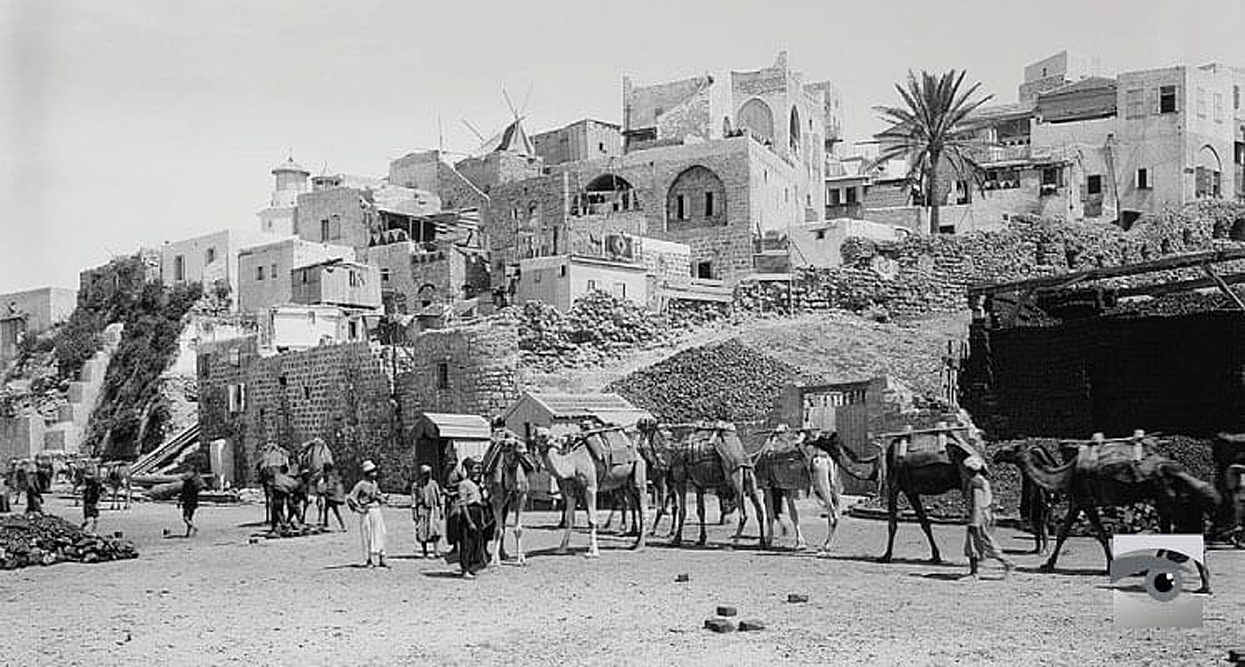 Israel before 1948-The city of Jaffa around the year 1900 Looking at the geographical and geopolitical landscape in the twenty-first century, the Land of Israel before 1948 is almost unrecognizable
When we see modern-day Israel – an ultra-modern country of more than 9 million citizens – it is often difficult to conceptualize what the country was like before 1948. Looking at the skylines of many of Israel’s cities, with gleaming, shiny multi-story office blocks, apartment buildings – and increasingly skyscrapers (at least in Tel Aviv), the geographical landscape is utterly unrecognizable.
The changes and differences, however, do not end there. Before David Ben Gurion, the first Prime Minister of Israel, announced Israel’s Declaration of Independence on May 14, 1948, 600,000 Jews lived in the land. According to estimates, approximately one-fifth – or up to 120,000 Jews were living in Jerusalem – the newly-declared capital of the nascent state. Approximately 2,000 Jews lived within Jerusalem’s 500-year-old city walls – as they had done for legitimately centuries – certainly since the return from exile in Babylon in the 6th century BCE.
Outside of Jerusalem, Jews were widely dispersed across Mandate Palestine. Approximately half of the remaining 480,000 Jews living in the country – 244,000 people – lived in the Tel Aviv area. The city’s first Jewish neighborhood – Neve Tzedek – was only established in 1887, the result of a lottery of an initial 60 families; and a need for space in Jaffa, a majority Arab town at the time. Tel Aviv itself was established in 1909. Prior to the civil war between Palestine’s Jews and Arabs in 1947-48 and then the international conflict that followed Israel’s Declaration of Independence, the land was sparsely populated.
Israel Zangwill, a Jewish British novelist and playwright (and someone deeply involved in the women’s rights movement, wrote a series of articles early in his career, in which he described Palestine as “a wilderness… a stony desolation… a deserted home” and a land that had “gone to ruin.”
A popular view of the country at the time was that Palestine was a “land without a people, waiting for a people without a land.” That is not entirely accurate – as there were obviously people populating Palestine, but they were not organized in a way that even gave the impression of a functioning country. It was an administrative backwater of the rapidly crumbling Ottoman Empire, which ruled the region for 400 years and did barely anything to develop it. The Arabs in the Holy LandBut what of the local Arab population?
By the end of Ottoman rule, there were several thousand living in Jerusalem, and as for the rest – for the most part, they were widely dispersed – mostly in villages and small towns – throughout Judea and Samaria and the Galilee. During the Ottoman period, most lived as tenant farmers in a somewhat feudal system with landowners, but some lived in towns such as Gaza, Hebron, Haifa and elsewhere.
At the end of the 19th century there were stirrings of Arab nationalism, which included wealthier Palestinian Arabs urging Turkish authorities not to allow Jewish refugees and pioneers from settling in the country.
One of the most vexing questions – or issues – today, is the notion that somehow all Palestinian Arabs were unceremoniously expelled from their land – or at the very least denied appropriate remuneration for it. That is simply not the case. It was only in 1856 that the Ottomans had passed a law allowing foreigners to buy land in the empire under the tanzimat reforms, which were a belated and somewhat half-hearted attempt at permitting people to feel part of the state by giving them rights.
By 1881, the Ottomans began banning land purchases by Jews and Christians, also declaring that Jews were still permitted to immigrate to the Ottoman Empire – but with the exception of Palestine. As with so many functions of Turkish rule, official declarations made in Constantinople, were much diluted when it came to Palestine.
The legal path to Jewish acquisition of land in Palestine remained open, and the Yishuv made the most of the opportunity. Arabs were willing to sell to wealthy Jews – such as Moses Montefiore or Baron Edmond de Rothschild – often at inflated prices. The Jewish National Fund was also able to purchase large tracts of land from the Ottomans and much of this was utilized by an enduring legacy of the Second Aliyah (1904-1914); namely the kibbutz movement. The records for those who would wish to open their eyes to see them are clear.
Palestine’s main port was Jaffa, the major point of entry in the Land of Israel before 1948. In the late 1920s, the British developed Haifa as a deep-sea port, attempting to take advantage of the oil found in Persia prior to the outbreak of World War I.
It seems ironic now that the Arab Revolt between 1936-1939 – a violent nationalist Palestinian Arab uprising, in part to protest growing Jewish immigration – led to the development of Tel Aviv as a port. The use of Jaffa was considered too precarious, and an effort to effect systemic change in the country, not for the first time, backfired massively on those it was intended to help. Palestine’s Jews meanwhile, continued to build the infrastructure of a potential state, acquiring land, investing in water technology, continuing to develop the Hebrew language and attempting to create a civic society that would be essential in the future.
The civic society of the Jewish part of Mandate Palestine, known as the Yishuv, included functioning quasi-governmental institutions. The Yishuv’s position was complex – it had to grapple constantly with fluctuating fortunes with regard to the British and their attempts to play Palestinian Arabs and Jews against each other.
A crucial moment arrived in November 1917 with the Balfour Declaration; a hard-won acknowledgment, from an imperial superpower, of the Jews’ long historical connection to the Land of Israel and which, despite its (possibly deliberate) ambiguity, seemed to guarantee a homeland for the Jewish people. Other imperial powers also discussed the fate of Yishuv, particularly in April 1920 in the Italian town of San Remo. Britain, France, Italy and Japan convened to discuss the division of the land that had been held by the Ottoman Empire.
Palestinian Arabs were infuriated that as a result of this, the Jews would have a national home in Palestine. Their response – as was so often the case – and in a pattern that has repeated for more than a century – was to react with violence. The riots in Jaffa in 1921 began to see a more coordinated Jewish defense, manifested in the creation of the Haganah.
In 1922, the Yishuv was dealt a further blow as Winston Churchill, who had until then been seen as a friend to the Zionist cause, decided to redraw the map of the Middle East. He cleaved away the portion of Palestine that was east of the Jordan River and created the country of Transjordan (later known as just Jordan).
The Jewish state that the Yishuv thought it would receive at the Mandate’s end would now be 75% smaller than they had been led to think. It would shrink further still in the decades to come, although they could not have known it at the time. However, despite this massive setback, the overarching goal of achieving a state was still central to the Zionist cause. Ben-Gurion and others were pragmatic enough to understand what that would mean and what that would cost.
The Rapid Development of Israel Before 1948The Land of Israel before 1948 was a curious mixture of ancient, slow-moving and traditional ways of life and also a place bursting with pioneering spirit. During the early 20th century, a period when the ossifying Ottoman Empire was still dominant, Jewish immigration and land purchases were increasingly changing a seemingly forgotten place. Jewish immigrants rapidly reinvigorated a land that had barely seen any infrastructure or modernization during a 400-year rule.
The physical landscape changed as advancements in water technology – which continued apace during the British Mandate period – particularly, irrigation and the ability to use even brackish water for agriculture, showed that even in the desert, human life could be sustained.
In addition, small towns began to grow into cities and new neighborhoods began to spill out from existing conurbations. In that atmosphere, the Hebrew language developed further, used in books, newspapers, radio and theater – a continued resuscitation from the dead. Political organizations were also critical, as the levers of the state – before there was even a state – were exercised on a daily basis. They created the building blocks of the thriving, modern state of Israel that we see today.
Enjoyed reading this article? Follow the Israel In Focus page on Facebook to read more articles explaining Israel’s history, politics, and international affairs. Click here to learn more!
Image Credit: Israel before 1948
|
||
How the Muslims treated the Jews
Hen Mazzig-tweet-3October2023-Israel was established in 1948. But Jews lived in the region for thousands of years. Before Israel existed, here’s what Jews in the Middle East could NOT do: In 1941, my grandma survived the Farhud. It was massacre against the Jewish community of Iraq, encouraged by the Nazis. Thousands of Jews were attacked by a mobs, which was backed by the Iraqi government. My grandma had to flee Iraq – they even took her citizenship. So did with other 150,000 Jews. Today there are no Jews in Iraq. They were ethnically cleansed. This didn’t just happen in Iraq. Jews were ethnically cleansed throughout the Middle East and North Africa. Almost a million Jew ran for their lives. The only place to take them wasn’t America, or Britain— it was Israel. Israel saved my Iraqi mother and my Tunisian father. It will continue to save Jews from everywhere else. 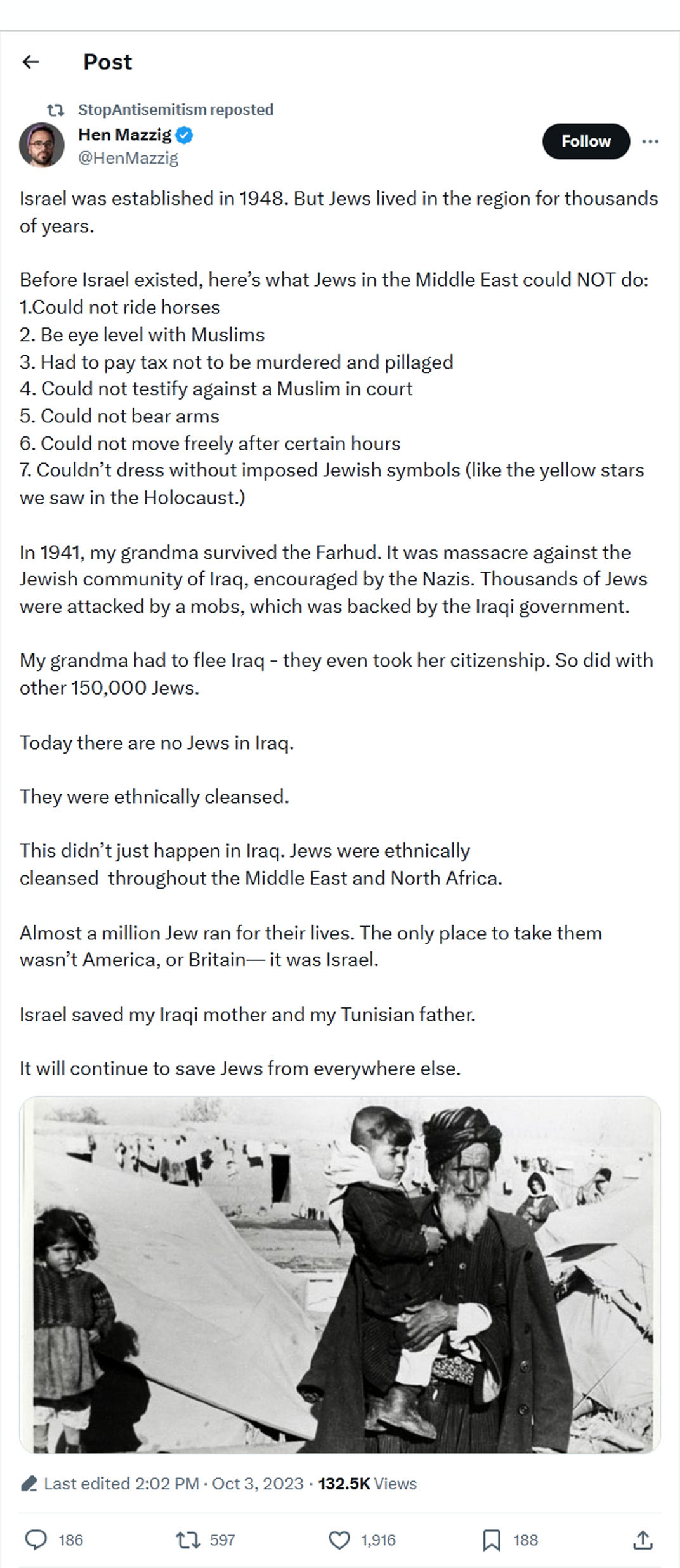 Hen Mazzig-tweet-3October2023–Israel was established in 1948. But Jews lived in the region for thousands of years.
|
||
How many Arabs lived in “Palestine” before the establishment of the State of Israel?
A list of facts with historical sources: 🔸In 1785, Constantine Francois Volney describes the “ruined” and “desolate” state of the country: “We with difficulty recognized Jerusalem… The population is supposed to amount to twelve to fourteen thousands…” 🔸In 1843, Alexander Keith wrote that “in this [Volney’s] day the land had not fully reached its last prophetic degree of desolation and depopulation.” 🔸In 1816, J.S. Buckingham had described Jaffa as “a poor village”, and Ramleh as a place “where, as throughout the greater portion of Palestine, the ruined portion seemed more extensive than that which was inhabited.” 🔸In 1835, Alphonse de Lamartine gave this description: “Outside gates of Jerusalem, we saw indeed no living object, heard no living sound. We found the same void, the same silence as we should have found in the enrombed gates of Pompeii and Herculaneum… a complete, eternal silence resigns in the town, in the highways, in the country… The tomb of a whole people.” 🔸In 1857, the British consul in Palestine, James Finn, reported back to England: “The country is in a considerable degree empty of inhabitants and therefore its greatest need is that of a body of population.” 🔸In 1867, Mark Twain wrote in The Innocents Abroad: “Stirring senses… occur in this valley no more. There is not a solitary village throughout its whole extent – not for thirty miles in either direction.” He goes on to describe Galilee, Judea, and around Jerusalem as deserts devoid of population. And for the country as a whole: “Palestine sits in sackcloth and ashes. Over it broods the spell of a curse that has withered its fields and fettered its energies… Palestine is desolate and unlovely… It is hopeless, dreary, heartbroken land.” 🔸In 1881 (the year designated by Arafat as the beginning of the Zionist “invasion” and “displacement” of the local population), English cartographer Arthur Penrhyn Stanley wrote: “In Judea it is hardly an exaggeration to say that for miles and miles there was no appearance of life or habitation.” 🔸By the third quarter of the 19th century, the total population of the entire country, Arabs and Jews, was only 400,000. Less than 3% of today’s figure. 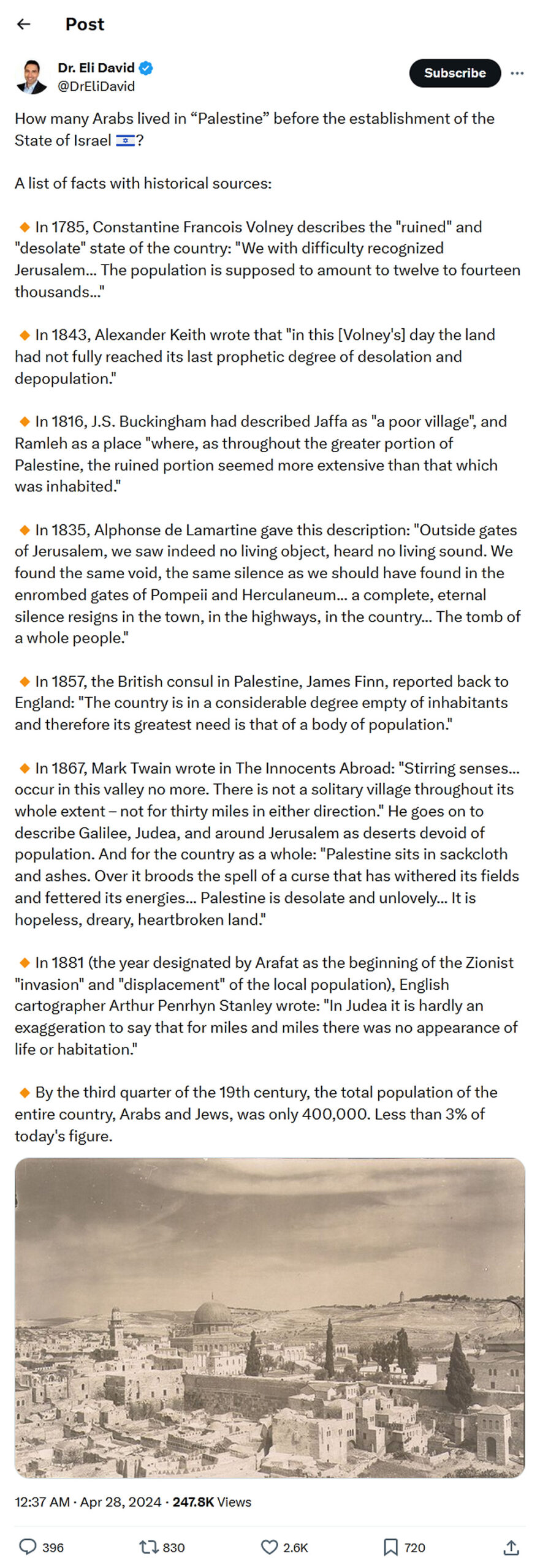 Dr. Eli David-tweet-27April2024-How many Arabs lived in Palestine before the establishment of the State of Israel
|
||
Dome of the Rock before the Six Day War-June 1967
Curious how they never cared about these iconic sites before it became a matter of fighting the Jews. 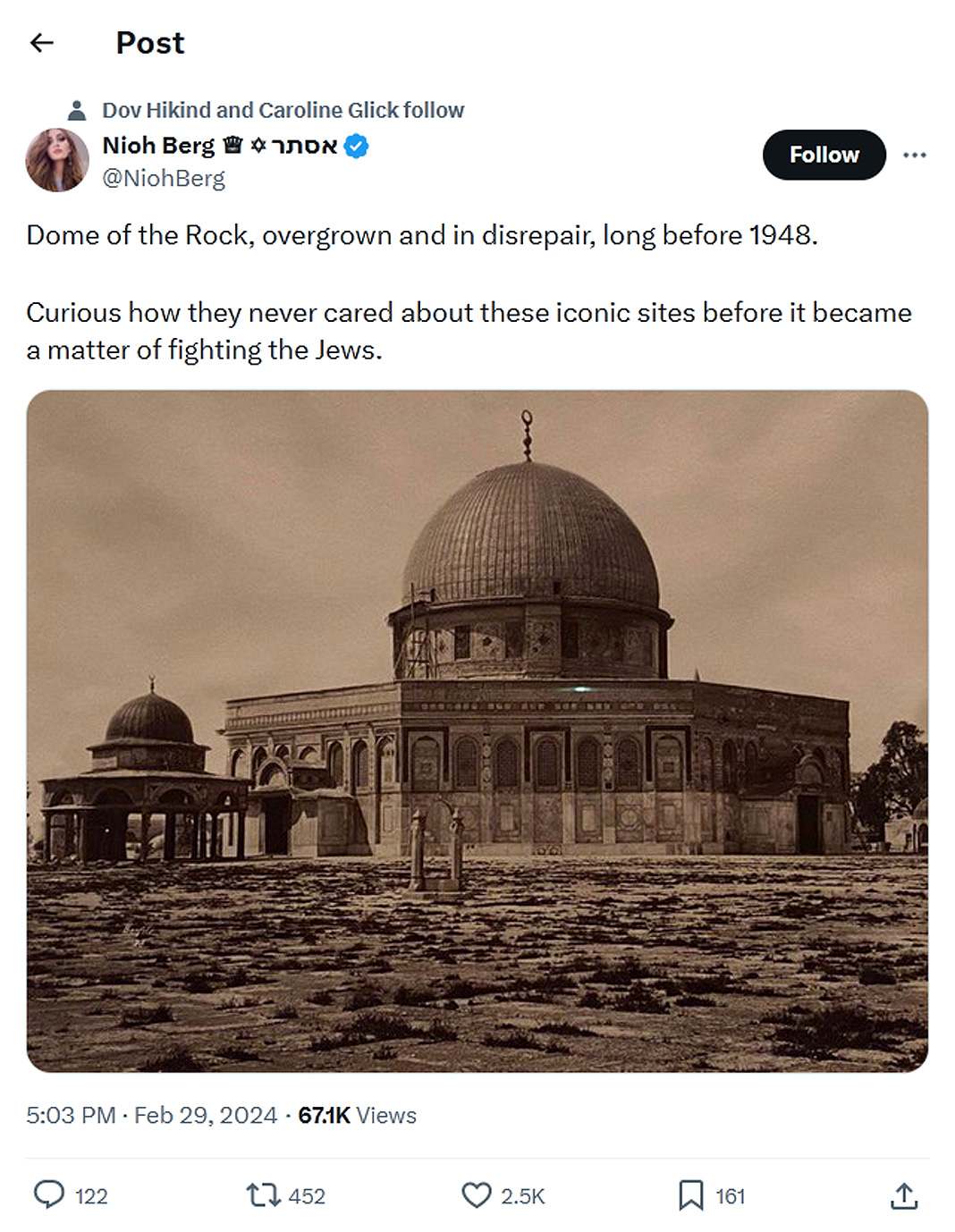 Nioh Berg-tweet-29February2024-Dome of the Rock before the Six Day War June 1967
|
||
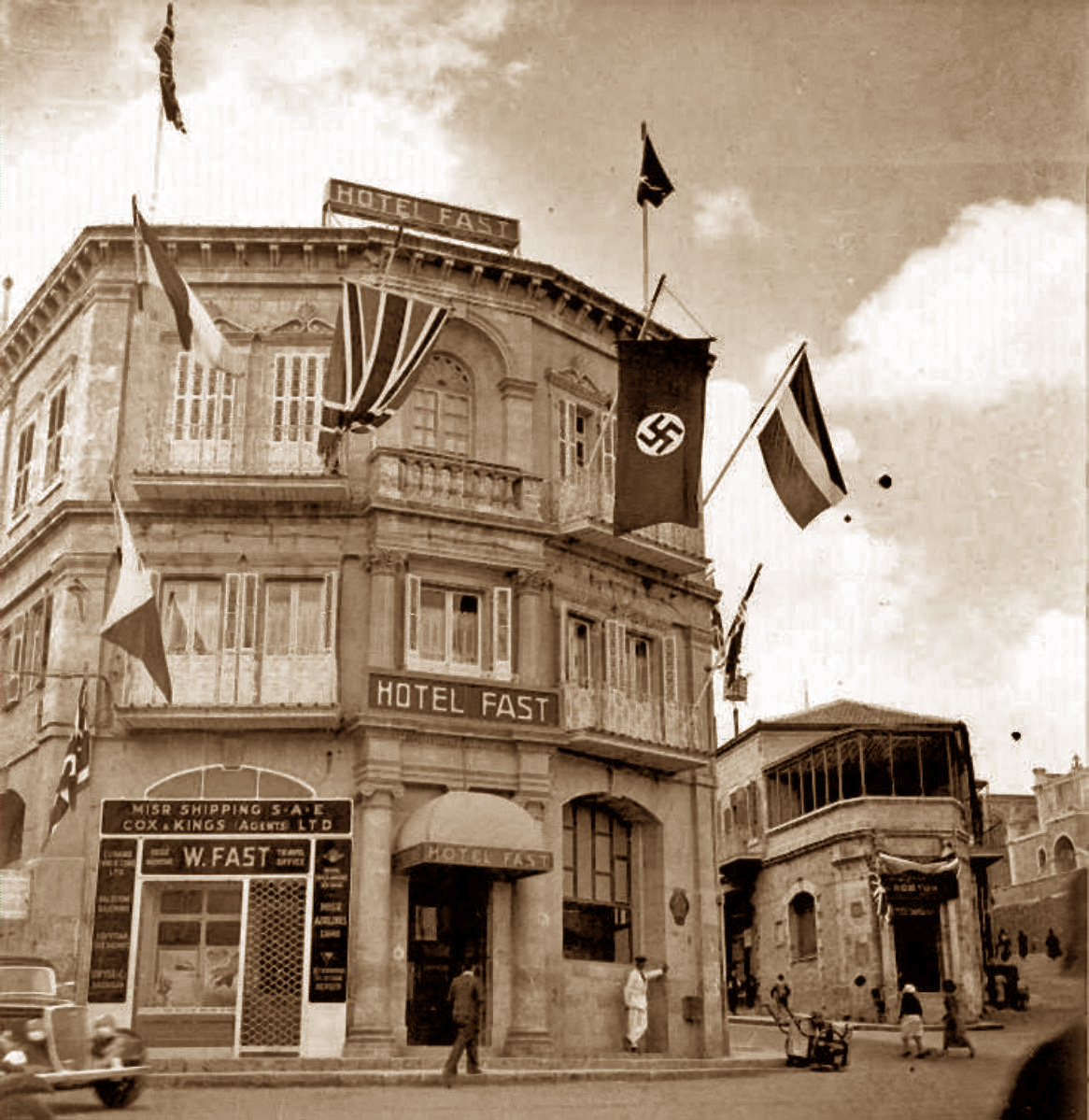 The German consulate in the Fast Hotel, 1933. (Wikimedia, Tamar Hayardeni) the Jewish Virtual Library. logo https://www.jewishvirtuallibrary.org Arab Riots of the 1920’sby Jacqueline Shields https://www.jewishvirtuallibrary.org/arab-riots-of-the-1920-s At the end of World War I, discussions commenced on the future of the Middle East, including the disposition of Palestine. On April 19, 1920, the Allies, Britain, France, Italy and Greece, Japan and Belgium, convened in San Remo, Italy to discuss a peace treaty with Turkey. The Allies decided to assign Great Britain the mandate over Palestine on both sides of the Jordan River, and the responsibility for putting the Balfour Declaration into effect. Arab nationalists were unsure how best to react to British authority. The two preeminent Jerusalem clans, the el-Husseinis and the Nashashibis, battled for influence throughout the mandate, as they had for decades before. The former was very anti-British, whereas the latter favored a more conciliatory policy.
One of the el-Husseinis, Haj Amin, who emerged as the leading figure in Palestinian politics during the mandate period, first began to organize small groups of suicide groups, fedayeen (“one who sacrifices himself”), to terrorize Jews in 1919 in the hope of duplicating the success of Kemal in Turkey and drive the Jews out of Palestine, just as the Turkish nationalists were driving the Greeks from Turkey. The first large Arab riots took place in Jerusalem in the intermediary days of Passover, April 1920. The Jewish community had anticipated the Arab reaction to the Allies’ convention and was ready to meet it. Jewish affairs in Palestine were then being administered from Jerusalem by the Vaad Hatzirim (Council of Delegates), appointed by the World Zionist Organization (WZO) (which became the Jewish Agency in 1929). The Vaad Hatzirim charged Ze’ev (Vladimir) Jabotinsky with the task of organizing Jewish self-defense. Jabotinsky was one of the founders of the Jewish battalions, which had served in the British Army during the First World War and had participated in the conquest of Palestine from the Turks. Acting under the auspices of the Vaad Hatzirim, Jabotinsky lead the Haganah (self-defense) organization in Jerusalem, which succeeded in repelling the Arab attack. Six Jews were killed and some 200 injured in Jerusalem in the course of the 1920 riots. In addition, two Americans, Jakov Tucker and Ze’ev Scharff, both WWI veterans, were killed resisting an Arab attack on the Jewish settlement of Tel Hai in March 1920. Had it not been for the preliminary organization of Jewish defense, the number of victims would have undoubtedly been much greater.
After the riots, the British arrested both Arabs and Jews. Among those arrested was Jabotinsky, together with 19 of his associates, on a charge of illegal possession of weapons. Jabotinsky was sentenced to 15 years imprisonment with hard labor and deportation from the country after completion of his sentence. When the sentence became known, the Vaad Hatzirim made plans for widespread protests, including mass demonstrations and a national fast. Meanwhile, however, the mandate for Palestine had been assigned to Great Britain, and the jubilation of the Yishuv outweighed the desire to protest against the harsh sentence imposed on Jabotinsky and his comrades.
With the arrival in Jerusalem of the first High Commissioner, Sir Herbert Samuel, British military government was superseded by a civilian administration. As a gesture toward the civilian population, the High Commissioner proclaimed a general amnesty for both Jews and Arabs who had been involved in the April 1920 riots. Jabotinsky and his comrades were released from prison to an enthusiastic welcome by the Yishuv, but Jabotinsky insisted that the sentence passed against them be revoked entirely, arguing that the defender should not be placed on trial with the aggressor. After months of struggle, the British War Office finally revoked the sentences.
In 1921, Haj Amin el-Husseini began to organize larger scale fedayeen to terrorize Jews. Colonel Richard Meinertzhagen, former head of British military intelligence in Cairo, and later Chief Political Officer for Palestine and Syria, wrote in his diary that British officials “incline towards the exclusion of Zionism in Palestine.”
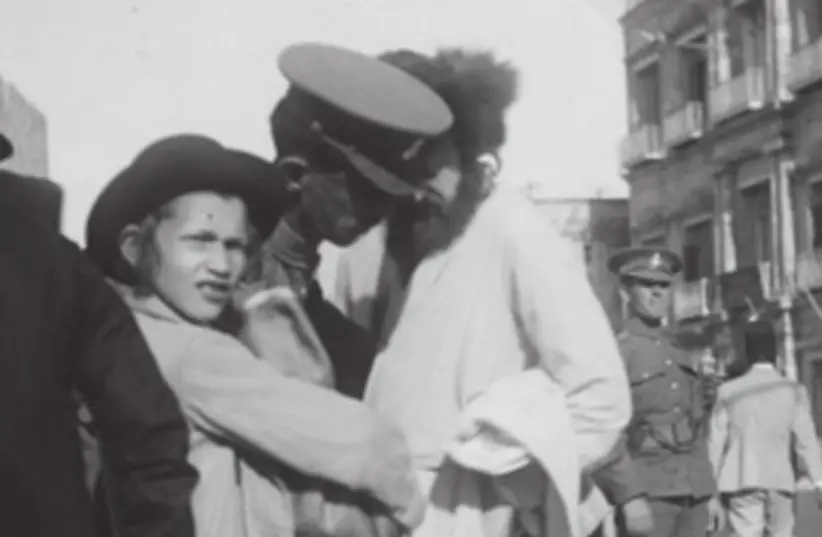 BRITISH POLICE officers corral Jewish men during the 1920 Jerusalem riots In fact, the British encouraged the Arabs to attack the Jews. According to Meinertzhagen, Col. Waters Taylor, financial adviser to the Military Administration in Palestine 1919-23, met with Haj Amin a few days before Easter, in 1920, and told him “he had a great opportunity at Easter to show the world…that Zionism was unpopular not only with the Palestine Administration but in Whitehall and if disturbances of sufficient violence occurred in Jerusalem at Easter, both General Bols [Chief Administrator in Palestine, 1919-20] and General Allenby [Commander of Egyptian Force, 1917-19, then High Commissioner of Egypt] would advocate the abandonment of the Jewish Home. Waters-Taylor explained that freedom could only be attained through violence.”
Haj Amin took the Colonel’s advice and instigated a riot. The British withdrew their troops and the Jewish police from Jerusalem, and the Arab mob attacked Jews and looted their shops. Due to Haj Amin’s overt role in instigating the pogrom, the British arrested him. Yet, despite the arrest, Haj Amin escaped to Jordan, but he was sentenced to 10 years imprisonment in absentia. A year later, however, British Arabists convinced High Commissioner Herbert Samuel to pardon Haj Amin and to appoint him Mufti.
Samuel met with Haj Amin on April 11, 1921, and was assured “that the influences of his family and himself would be devoted to tranquility.” Three weeks later, however, riots in Jaffa and Petah Tikvah, instigated by the Mufti, left 43 Jews dead. Following these riots England established the Haycraft Commission to evaluate the cause of these riots. The appendix of the report reads, “The fundamental cause of the Jaffa riots and the subsequent acts of violence was a feeling among the Arabs of discontent with, and hostility to, the Jews, due to political and economic causes, and connected with Jewish immigration, and with their conception of Zionist policy as derived from Jewish exponents . . . the Arab majority, who were generally the aggressors, inflicted most of the casualties.”
Following these riots, Haj Amin consolidated his power and took control of all Muslim religious funds in Palestine. He used his authority to gain control over the mosques, the schools and the courts. No Arab could reach an influential position without being loyal to the Mufti. As the “Palestinian” spokesman, Haj Amin wrote to Colonial Secretary Winston Churchill in 1921, demanding that restrictions be placed on Jewish immigration and that Palestine be reunited with Syria and Transjordan. Churchill issued the White Paper of 1922, which tried to allay Arab fears about the Balfour Declaration. The White Paper acknowledged the need for Jewish immigration to enable the Jewish community to grow but placed the familiar limit of the country’s absorptive capacity on immigration. Although not pleased with Churchill’s diplomatic Paper, the Zionists accepted it; the Arabs, however, rejected it.
Despite the disturbances in 1920-1921, the Yishuv continued to develop in relative peace and security. Another wave of riots, however, broke out in 1924 after another wave of pogrom’s sent 67,000 Polish Jewish refugees to Palestine. After a week of skirmishes in Jerusalem between the Haganah and Arab mobs, 133 Jews and 116 Arabs lay dead. The Yishuv’s main concern at that time was its financial difficulties; the economic crisis of 1926-1928 led many to believe that the Zionist enterprise would fail due to lack of funds. Zionist leaders attempted to rectify the situation by expanding the Jewish Agency to incorporate non-Zionists who were willing to contribute to the practical settlement of Palestine.
The prospects for renewed financial support for the Yishuv upset Arab leaders who feared economic domination by the Zionists. Led by Haj Amin al-Husseini once again, rumors of a Jewish plot to seize control of Muslim holy places began to spread in August 1929. Violence erupted soon after, causing extensive damage. Rioting and looting were rampant throughout Palestine. In Jerusalem, Muslims provoked the violence and tensions by building and praying on or near the holiest place in the world for Jews, the Western Wall. By late August, the Arabs, in well-organized formation, attacked Jewish settlements near Jerusalem. The disturbances spread to Hebron and Safed, including many settlements in between, and on the Kfar Dorom kibbutz in the Gaza Strip.
|
||
After six days of rioting, the British finally brought in troops to quell the disturbance. Even though Jews had been living in Gaza and Hebron for centuries, following these riots, the British forced Jews to leave their homes and prohibited Jews from living in the Gaza strip and Hebron to appease Arabs and quell violence. By the end of the rioting, the death toll was 133 Jews, including eight Americans, and 110 Arabs (most killed by British security forces).
More than 200 Arabs and 15 Jews were tried and sentenced for their role in the unrest in 1929. Out of 27 capital cases involving Arabs, only three of the death sentences were carried out, the others were granted “mercy” and their sentences were commuted to life in prison. Muhammad Jamjoum, Fuad Hijazi, and Ataa Al-Zir were put to death on June 17, 1930, because they were convicted of particularly brutal murders in Safad and Hebron.
The British approved payment of nearly 100,000 pounds to Jews for “loss of life and permanent incapacity, and proportionately up to the limits of the sum available in respect of damage to property” by Arabs in the 1929 riots. A “special Jewish Fund for relief and reconstruction purposes to repair the losses suffered by the disturbances of 1929” allocated another 433,000 pounds.
Like the riots earlier in the decade, afterward the British appointed Sir William Shaw to head an inquiry into the causes of the riots. The Shaw Commission found that the violence occurred due to “racial animosity on the part of the Arabs, consequent upon the disappointment of their political and national aspirations and fear for their economic future.” The report claimed that the Arabs feared economic domination by a group who seemed to have, from their perspective, unlimited funding from abroad. The Commission reported that the conflict stemmed from different interpretations of British promises to both Arabs and Jews. The Commission acknowledged the ambiguity of former British statements and recommended that the government clearly define its intentions for Palestine. It also recommended that the issue of further Jewish immigration be more carefully considered to avoid “a repetition of the excessive immigration of 1925 and 1926.” The issue of land tenure would only be eligible for review if new methods of cultivation stimulated considerable growth of the agricultural sector. The Shaw Commission frustrated Zionists, but the two subsequent reports issued on the future of Palestine were more disturbing.
The Hope Simpson report of 1930 painted an unrealistic picture of the economic capacity of the country. It cast doubt on the prospect of industrialization and incorrectly asserted that no more than 20,000 families could be accommodated by the land. The Hope Simpson report was overshadowed, however, by the simultaneous release of the Passfield White Paper, which reflected colonial Secretary Passfield’s deep-seated animus toward Zionism. This report asserted that Britain’s obligations to the Arabs were very weighty and should not be overlooked to satisfy Jewish interests. Many argued that the Passfield Paper overturned the Balfour Declaration, essentially saying that Britain should not plan to establish a Jewish state. The Passfield Paper greatly upset Jews, and interestingly, also the labor and conservative parties in the British Parliament. The result of this widespread outcry to the Secretary’s report was a letter from British Prime Minister MacDonald to Dr. Chaim Weizmann, reaffirming the commitment to create a Jewish homeland.
The Arabs found rioting to be a very effective political tool because the British attitude toward violence against Jews, and their response to the riots, encouraged more outbreaks of violence. In each riot, the British would make little or no effort to prevent the Arabs from attacking the Jews. After each incident, a commission of inquiry would try to establish the cause of the riot. The conclusions were always the same: the Arabs were afraid of being displaced by Jewish immigrants. To stop the disturbances, the commissions routinely recommended that restrictions be made on Jewish immigration.
Thus, the Arabs came to recognize that they could always stop Jewish immigration by staging a riot. Despite the restrictions placed on its growth, the Jewish population increased to more than 160,000 by the 1930s, and the community became solidly entrenched in Palestine. Unfortunately, as the Jewish presence grew stronger, so did the Arab opposition. The riots brought recognition from the international Jewish community to the struggle of the settlers in Palestine, and more than $600,000 was raised for an emergency fund that was used to finance the cost of restoring destroyed or damaged homes, establish schools, and build nurseries. Sources: Mitchell G. Bard, The Complete Idiot’s Guide to Middle East Conflict. 4th Edition. NY: Alpha Books, 2008.
|
||
“I do not shake hands defiled with Jewish blood”Rav Kook held the acting commissioner responsible for British inaction during the Hevron massacre and refused his outstretched hand.Rabbi Chanan Morrison / 22November2024, 2:36 PM (GMT+2) http://www.israelnationalnews.com/news/399613
 1929 Hevron massacre aftermath “Sarah died in Kiryat Arba, also known as Hevron, in the land of Canaan. Abraham came to eulogize Sarah and to weep for her.” (Gen. 23:2)
A somber gathering assembled in Jerusalem’s Yeshurun synagogue. The large synagogue and its plaza were packed as crowds attended a memorial service for the Jews of Hevron who had been killed during the Arab riots six months earlier, on August 24th, 1929.
On that tragic Sabbath day, news of deadly rioting in Hevron reached the Jewish leaders in Jerusalem. Yitzchak Ben-Zvi, then director of the National Committee, hurried to Rav Kook’s house. Together they hastened to meet with Harry Luke, the acting British High Commissioner, to urge him to take immediate action and protect the Jews of Hevron.
The Chief Rabbi demanded that the British take swift and severe measures against the Arab rioters. “What can be done?” Luke asked. Rav Kook’s response was to the point. “Shoot the murderers!” “But I have received no such orders.” “Then I am commanding you!” Rav Kook roared. “In the name of humanity’s moral conscience, I demand this!”
Rav Kook held the acting commissioner responsible for British inaction during the subsequent massacre. Not long after this heated exchange, an official reception was held in Jerusalem, and Mr. Luke held out his hand to greet the Chief Rabbi. To the shock of many, Rav Kook refused to shake it. With quiet fury, the rabbi explained, “I do not shake hands defiled with Jewish blood.”
The day after the rioting in Hevron, the full extent of the massacre was revealed. Arab mobs had slaughtered 67 Jews — yeshiva students, elderly rabbis, women, and children. The British police had done little or nothing to protect them.
The Jewish community of Hevron was destroyed, their property looted and stolen. The British shipped the survivors off to Jerusalem.
The tzaddik Rabbi Arieh Levine accompanied Rav Kook that Sunday to Hadassah Hospital on HaNevi’im Street to hear news of the Hevron community by telephone. Rabbi Levine recalled the frightful memories that would be forever etched in his heart:
When [Rav Kook] heard about the murder of the holy martyrs, he fell backwards and fainted. After coming to, he wept bitterly and tore his clothes “over the house of Israel and God’s people who have fallen by the sword.” He sat in the dust and recited the blessing, Baruch Dayan Ha’Emet (“Blessed is the True Judge”).
For some time after that, his bread was the bread of tears and he slept without a pillow. Old age suddenly fell upon him, and he began to suffer terrible pains. This tragedy brought about the illness from which the rabbi never recovered.
The Memorial ServiceSix months after the massacre, grieving crowds filled the Yeshurun synagogue in Jerusalem. A mourning atmosphere, like that on the fast of Tisha B’Av, lingered in the air as they assembled in pained silence. Survivors of the massacre, who had witnessed the atrocities before their eyes, recited Kaddish for family members murdered in the rioting.
Rabbi Jacob Joseph Slonim, who had lost his son (a member of the Hevron municipal council) and grandchildren in the massacre, opened the assembly in the name of the remnant of the Hevron community.
“No healing has taken place during the past six months,” he reported. “The murder and the theft have not been rectified. The British government and the Jewish leadership have done nothing to correct the situation. They have not worked to reclaim Jewish property and resettle Hevron.”
Afterwards, the Chief Rabbi rose to speak:
The holy martyrs of Hevron do not need a memorial service. The Jewish people can never forget the holy and pure souls who were slaughtered by murderers and vile thugs.
Rather, we must remember and remind the Jewish people not to forget the City of the Patriarchs. The people must know what Hevron means to us.
We have an ancient tradition: “The actions of the fathers are signposts for their descendants.” When the weak-hearted spies arrived at Hevron, they were frightened by the fierce nations inhabiting the land. But “Caleb quieted the people for Moses. He said, ‘We must go forth and conquer the land. We can do it!’” (Numbers 13:30)
Despite the terrible tragedy that took place in Hevron, we announce to the world, “Our strength is now like our strength was then.” We will not abandon our holy places and sacred aspirations. Hevron is the city of our fathers, the city of the Machpeilah cave where our Patriarchs are buried. It is the city of David, the cradle of our sovereign monarchy.
Those who discourage the efforts to restore the Jewish community in Hevron with arguments of political expediency; those who scorn and say, “What are those wretched Jews doing?”; those who refuse to help rebuild Hevron — they are attacking the very roots of our people. In the future, they will be held accountable for their actions. If ruffians and hooligans have repaid our kindness with malice, we have only one eternal response: Jewish Hevron will once again be built, in honor and glory!
The inner meaning of Hevron is to draw strength and galvanize ourselves with the power of Netzach Yisrael, Eternal Israel.
That proud Jew, Caleb, announced years later, “I am still strong… As my strength was then, so is my strength now” (Joshua 14:11). We, too, announce to the world: our strength now is as our strength was then. We shall reestablish Hevron in even greater glory, with peace and security for every Jew. With God’s help, we will merit to see Hevron completely rebuilt, speedily in our days.
AddendumWhile some Jewish families did return to Hevron in 1931, they were evacuated by the British authorities at the outset of the Arab revolt in 1936. For 34 years, there was no Jewish community in Hevron — until 1970, when the State of Israel once again permitted Jewish settlement in Hevron. This return to Hevron after the Six-Day War was spearheaded by former students of the Mercaz HaRav yeshiva, disciples of Rav Kook’s son, Rabbi Zvi Yehuda Kook.
In 1992, Rav Kook’s grandson, Rabbi Shlomo Ra’anan, moved to Hevron. Six years later, an Arab terrorist stabbed the 63-year-old rabbi to death. But soon after, his daughter — Rav Kook’s great-granddaughter — along with her husband and children, moved to Hevron, thus continuing the special link between the Kook family and the city of the Patriarchs.
(Stories from the Land of Israel. Adapted from Malachim Kivnei Adam, pp. 155-157; 160; 164-165)
|
||
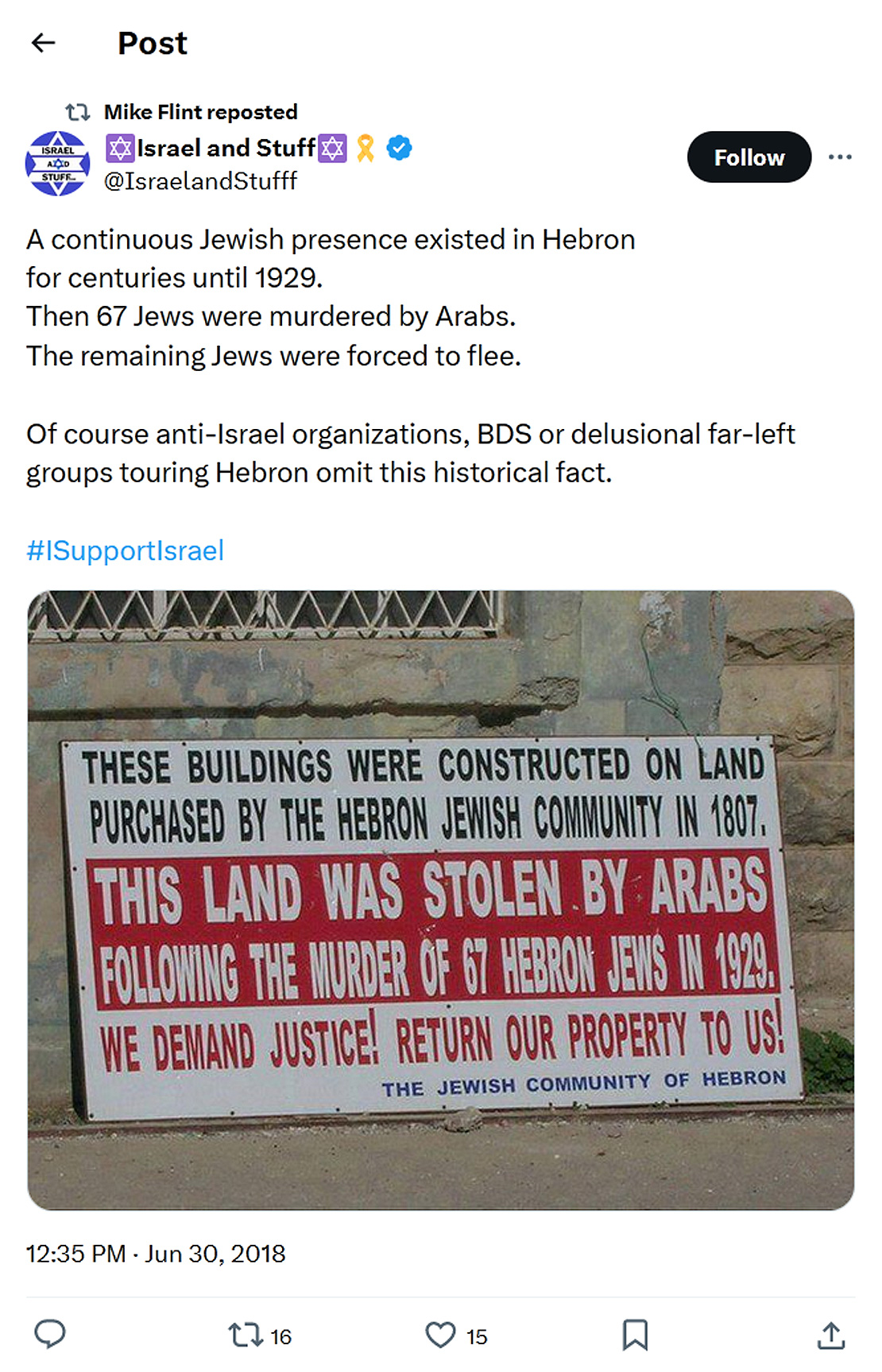
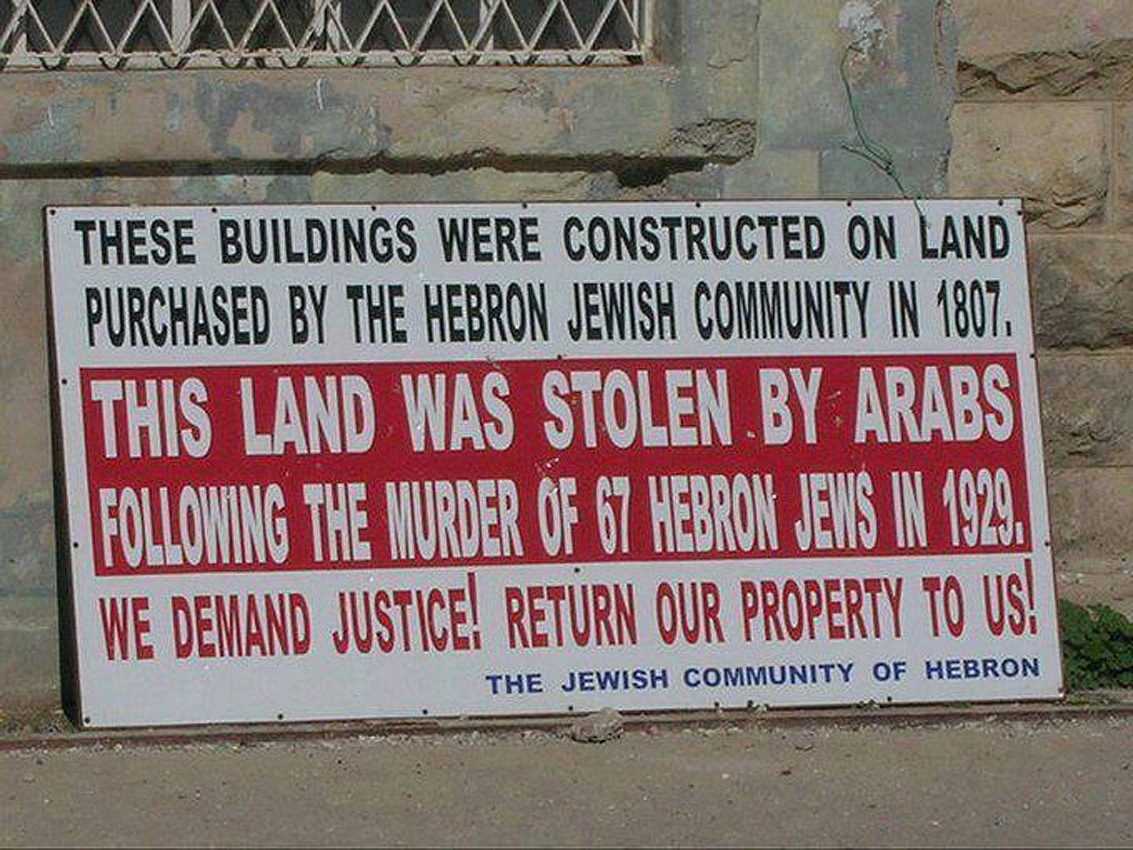
Divided Jerusalem (1948-1967)https://www.gov.il/en/pages/divided-jerusalem-1948-1967 Type: Information Topic: About Israel Secondary topic: Israel in Maps Publish Date: 07.11.2021
On November 30, 1948, following the cessation of the battle between the two armies in Jerusalem, two officers – Lt. Col. Moshe Dayan of the Israeli army and Lt. Col. Abdallah A-Tal of the Jordanian army – drew in thick wax pencils an inaccurate cease-fire line on a map of Jerusalem. This line, including the No Man’s Land between the two sides, was later included in the Israel-Jordan Armistice Agreement of 3 April 1949. The City Line divided Jerusalem between Israel (in the western part) and Jordan (in the eastern part, including the Old City and the Temple Mount) for 19 years, until The Six Day War in June 1967 when Israel re-united the city.
During these 19 years, the Jordanian army placed snipers on the City Line and initiated frequent shooting incidents at citizens and other targets on the Israeli side of the city, making life in the near-by Israeli neighborhoods almost unbearable. In addition, the Jordanians breached their commitment (in the Armistice Agreement) to allow free access of Jews to the holy sites, mainly to the Western Wall and to the cemetery on the Mount of Olives. They also desecrated Jewish holy sites.
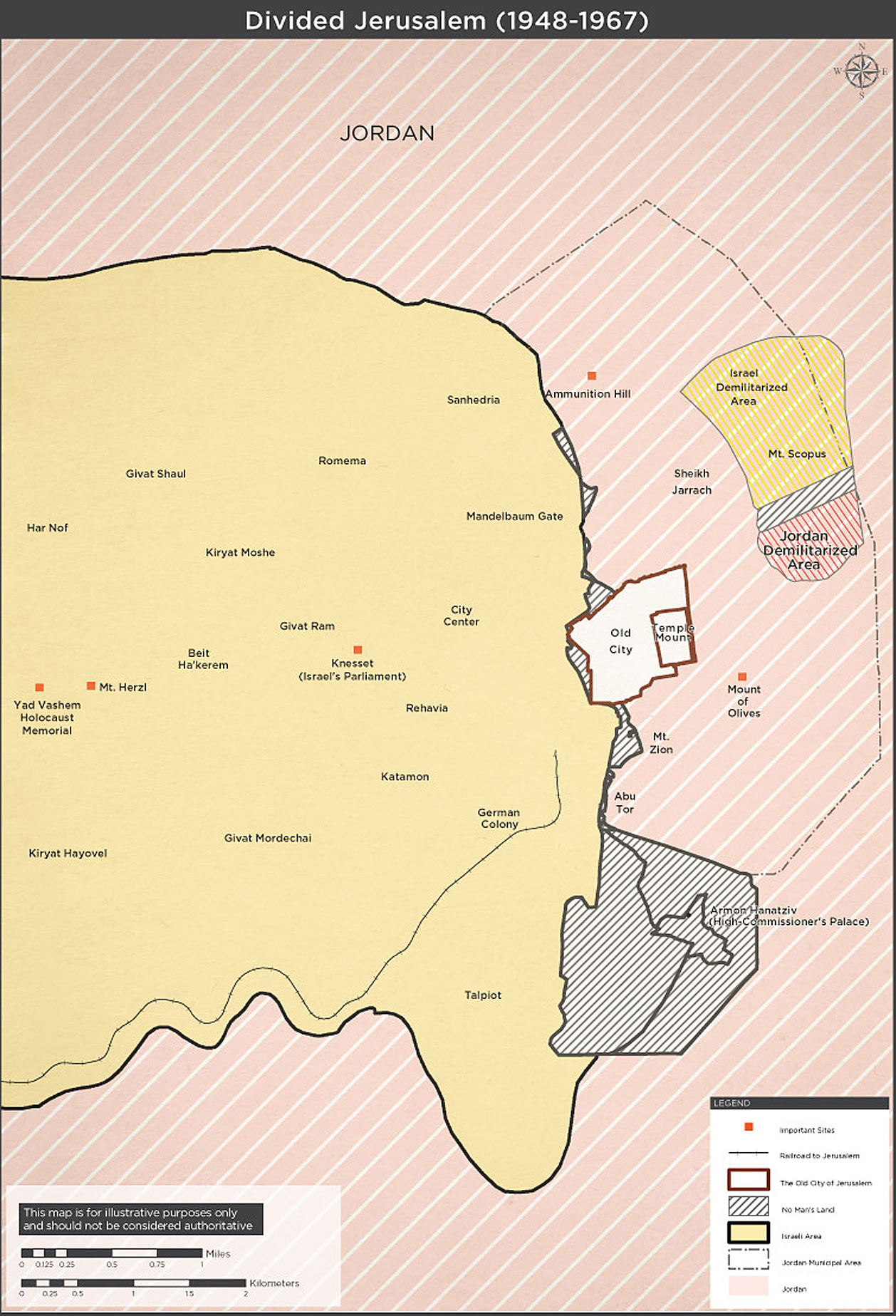 Map Divided Jerusalem (1948-1967)
|
|||||
The City That Doesn’t Forget Her Children28-Iyar: Yom Yerushalayim: I put my hand on the stones but the tears that flowed were not mine. They were the tears of all Israel, tears that scorched and burned the heavy gray stone. A MUST READ!!Rebbetzin Esther Jungreis | Posted on 06June2024 | https://breslev.com/1073929/  The City That Doesn’t Forget Her Children-by Rebbetzin Esther Jungreis
Of all the Arab armies, Jordan’s Arab Legion was the best trained and fiercest. Moreover, the border with Jordan was the most difficult to defend, so it was no surprise that, when King Hussein’s army first attacked, the Israeli military was convinced that the shots were just tokens to accommodate Nasser, and that Hussein would not risk war. But Jordan kept pounding away, its artillery and bullets raining upon Jerusalem. Still, Israel requested the UN Truce Supervision Office to convey to Jordan assurances of peace. But it was all to no avail, and Israel had no choice but to open a second front. The Jordanians possessed hundreds of Patton tanks, and tens of thousands of Legionnaires, powerful warriors, equipped with the most sophisticated weapons, who were prepared to fight to the end. The battles were fierce and savage, made all the more complicated by orders given to Israeli paratroopers to avoid damaging the many sites in the Old City. Many brave young men were injured or lost their lives – the sacrifice was great, but so were the miracles.
The Holy City was not prepared for battle. There were hardly any bomb shelters to protect the civilian population. Shells fell and did not explode, and many that fell and did explode caused no injury. A shell landed on Shaarei Tzedek Hospital’s baby nursery. Fearing the worst, nurses rushed in to save the infants, but miraculously, they were all unharmed. A shell penetrated the roof of the Mirrer Yeshivah but did not explode. Over the centuries, Jerusalem was ravaged and sacked many times, but G-d made a promise that the Wall, the remnant of the Holy Temple, would stand eternally and bear witness to the homecoming of our people. And now, almost two thousand year later, the moment had come. I have read countless reports from journalists and soldiers who participated in the battle for Jerusalem, and all their stories had one focus – “the Wall”.
Moshe Amirav, a paratrooper, describes the first minutes at the Wall: “Forward! Forward! Hurriedly, we pushed our way through the Magreb Gate, and suddenly we stopped, thunderstruck. There it was, before our eyes! Gray and massive, silent, and restrained. The Western Wall!
“Slowly, slowly, I began to approach the Wall in fear and trembling, like a pious cantor going to the lectern to lead the prayers. I approached it as the messenger of my father and my grandfather, of my great-grandfather and of all the generations in all the exiles who had never merited seeing it – and so they had sent me to represent them. Somebody recited the festive blessing, ‘Blessed are You, Oh L-rd our G-d, King of the Universe, Who has kept us alive and maintained us and brought us to this time.’ I put my hand on the stones and wept, but the tears that started to flow were not my tears. They were the tears of all Israel, tears of hope and prayer, tears of Hassidic tunes, tears of Jewish dances, tears that scorched and burned the heavy gray stone.”
And who can forget the photograph of our soldiers standing in awe – just looking up at the Wall? And who can forget the report of the IDF radio announcer: “…Suddenly, we recognized the familiar voice of the commander of the paratroops brigade, Colonel Mordechai ‘Motta’ Gur, giving orders to the battalion commanders to occupy the Old City: ‘Attention, all battalion commanders! We are sitting on the mountain range that looks down on the Old City, and are about to enter it. The Old City of Jerusalem that all generations have been dreaming about and striving toward. We will be the first to enter it.’
“With us on the roof,” the announcer continued, “was General Shlomo Goren, at that time, the Chief Rabbi of the Israeli Army. Rabbi Goren informed Gur over the walkie-talkie that he was on his way to meet him so as to be among the first to enter the Old City. As far as I remember, we were the only ones in the whole area running without helmets or weapons. Goren was armed only with a shofar and a prayer book and we carried only a tape recorder and a knapsack filled with batteries and rolls of recording tape.
“We ran, while trying to stay as close as we could to the Old City Wall to our right, but exposed to the sniper fire coming from the Mount of Olives on our left. As we ran, we passed two lines of paratroopers who were progressing carefully toward the Lions Gate. Goren was determined to get to the head of the line as quickly as possible. At the top of the street leading to the Lions Gate, we passed a still-smoking Jordanian bus. We stopped only at the Gate itself, which was blocked by an Israeli Sherman tank that had gotten stuck in the entrance. We climbed over the tank and entered into the Old City.
“Now the excitement reached its peak. Goren did not stop blowing the shofar and reciting prayers. His enthusiasm infected the soldiers, and from every direction came cries of ‘Amen!’”
The shofar was sounded in Jerusalem and its call reached Jewish hearts in the four corners of the world. The effect was magical. Our people because spiritually rejuvenated. Even those who had never believed, those who were hardened agnostics, felt something in their hearts. The Wall called them, and despite themselves, they felt a need to respond, to touch its stones, to place a note with a prayer in its crevices, to pour out their hearts and cry.
My husband and I made a decision. We knew that no matter what, we too had to be there, and so we took our four small children and traveled to Jerusalem. The city was congested with people – there wasn’t a hotel room to be had. For a moment, I panicked, but then my husband reminded me of the teaching of our Talmud: In Jerusalem, no one ever complained of discomfort, in the City of G-d, every man had a place, everyone was welcome.
It was Friday, Erev Shabbat, when we arrived, and there was no time to lose – the Sabbath Queen was quickly approaching and the entire city was readying herself for the arrival of the royal guest. Everywhere, stores were closing and public transportation was coming to a halt. As the siren was sounded, a stillness descended on the Holy City.
Suddenly, scores of people spilled into the streets. They came from every direction: young and old, men and women, Israelis and tourists, students and soldiers, pious Chassidim in long black coats and westernized Jews in business suits. They spoke in many tongues, espoused many ideas, and wondrously, they all merged into one. All of them were rushing, running to the same place, to the Wall.
We too, melted into the crowd. We didn’t know our way, but we followed the others. My heart beat faster and I clutched my children’s hands. I saw tears in my husband’s eyes. We were in Jerusalem.
We made our way through the dark alleyways. My son tugged at my sleeve. “Ima,” he asked, “how did our soldiers do it? How did they liberate the city? How did they get through these gates, these alleys?”
“Jerusalem’s time has come,” I answered, “and G-d Himself opened the gates.”
Then suddenly, without warning, the Wall was before us, more majestic than I could ever have imagined. We could not speak; there were only tears. For two thousand years we had waited for this moment. Our ancestors had prayed for this day. What would they not have given to stand here, even for a fleeting second, and yet they were denied the privilege. How strange that our generation, which was unworthy and wanting in faith, was the one to stand here in the presence of sanctity.
I looked up at the Heavens and searched for my grandfather. Surely the angels had gathered his ashes from Auschwitz and brought them as an offering to this very spot.
“Zeide, Zeide,” I cried into the night, “please walk with me, for here I cannot stand alone.”
All around us, people were praying and our voices became one with theirs. I poured out my soul. I looked up at the greenery sprouting from the crevices. Strange, I thought to myself, how these little branches grow without being watered. But then I saw the people around me and I understood from whence the branches received their nourishment. They were watered by the tears of a nations that had been waiting for two thousand years.
Walking back to our hotel we met a young soldier who had been among those who liberated Jerusalem. He told us about his best friend who had fallen on the Temple Mount on the very spot where once, long ago, the Alter had stood.
“I ran to my friend,” he told us. “I tried to help him, but it was too late. I broke down and wept, and as I cried, I heard an eerie sound. It was the braying of a donkey echoing in the night. The donkey actually seemed to sob with me, crying in pain as if imploring to be allowed to carry Messiah into the Holy City.”
Never before in the annals of mankind did a war last only six days.
Coincidence? Or was the seventh day begging to come? – The seventh day that is all Sabbath, the day that is Mashiach.
For a very brief moment, it appeared as if our people might just understand and be prepared to respond to this awesome challenge. But all too soon, the magic of the moment evaporated, and once again, we failed the test.
We reverted to our old ways – we congratulated ourselves on our success and came to take all those miracles for granted. Those of us who lived it have forgotten, and those were not yet born were never touched by it.
The fundamental law of Jewish survival stipulates that we cannot assimilate or become “like all the other nations of the world.” This law holds true not only in the countries of our exile, but in Israel as well. G-d did not bring us back to our ancient land so that we might become like all other nations and convert Jerusalem into New York, Parish, or London.
Just consider the tragedy that has befallen us. To live in the Land of the Patriarchs and yet spurn their legacy; to speak Hebrew impeccably, and yet not know how to pray; to live in the Land of G-d, and yet lack faith in Him.
We have failed the test.
But even if we failed the test, even if we forgot G-d, He does not forget us. His covenant and love are eternal and He will continue to call us. If we are blind to His miracles, He will find other ways to awaken us. So it is that since those heady days of the Six Day War, we have suffered many painful wake-up calls, but sadly, we have remained impervious to all. Nevertheless, G-d continues to call.
Many of us have heard the call, many are committed and live genuine Torah Jewish lives, but there are still so, so many who have yet to hear the call.
As we enter the final stages of our history, we have a choice – to stand straight and tall, to embrace with open arms and loving hearts our G-d-given covenant and sing His praise, or to continue to be blind and obdurate and delude ourselves into believing that we can live our lives without Him. But even as we stumble through the darkness, He will be holding our hand. He will not let go. He will not forget us. He will not forsake us. So let us return to Him with willing hearts, with love. Let us pass our test.
*** From “Life is a Test” by the author, rights are reserved for publishing “Bina”.
|
|||||
“It always has been Arab Muslim Orthodoxy that “Palestine” actually is the entire country of Israel, not merely Judea and Samaria. All PLO terror aimed is to drive the Jews out of Tel Aviv, Haifa, Ra’anana, and other cities, towns, and villages in pre-1967 Israel and “into the [Mediterranean] sea.”This is what it means to be “Pushed into the Sea”.
|
|||||
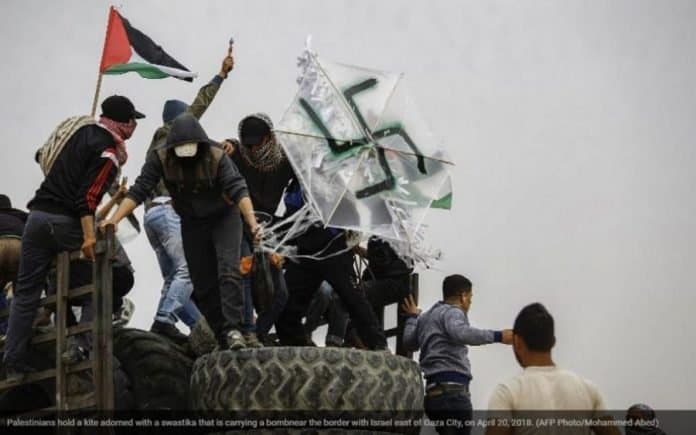 Gaza “protesters” loft molotov cocktail on swastika kite over Israeli border 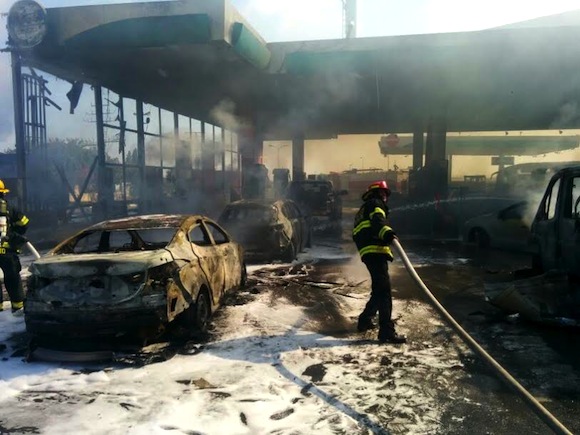 Friday, 11 July 2014 Miracle in Ashdod: Direct Hit on Gas Station, no Fatalities What’s the war like in Ashdod? |
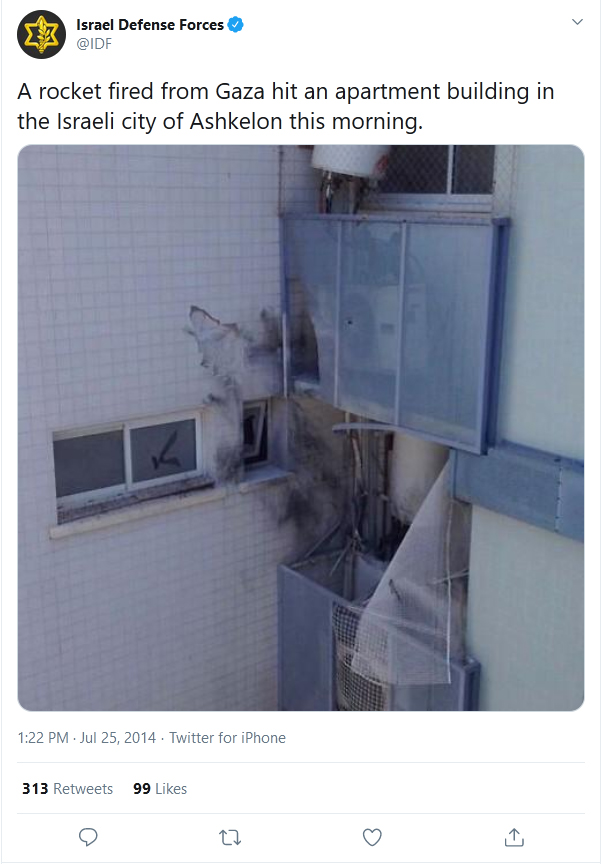 Israel Defense Forces tweet-24July2014-A rocket fired from Gaza hit an apartment building in the Israeli city of Ashkelon this morning. |
||||
“Israel is attempting to achieve balance of power with the Arabs. The Arab reply: This will be the only balance.”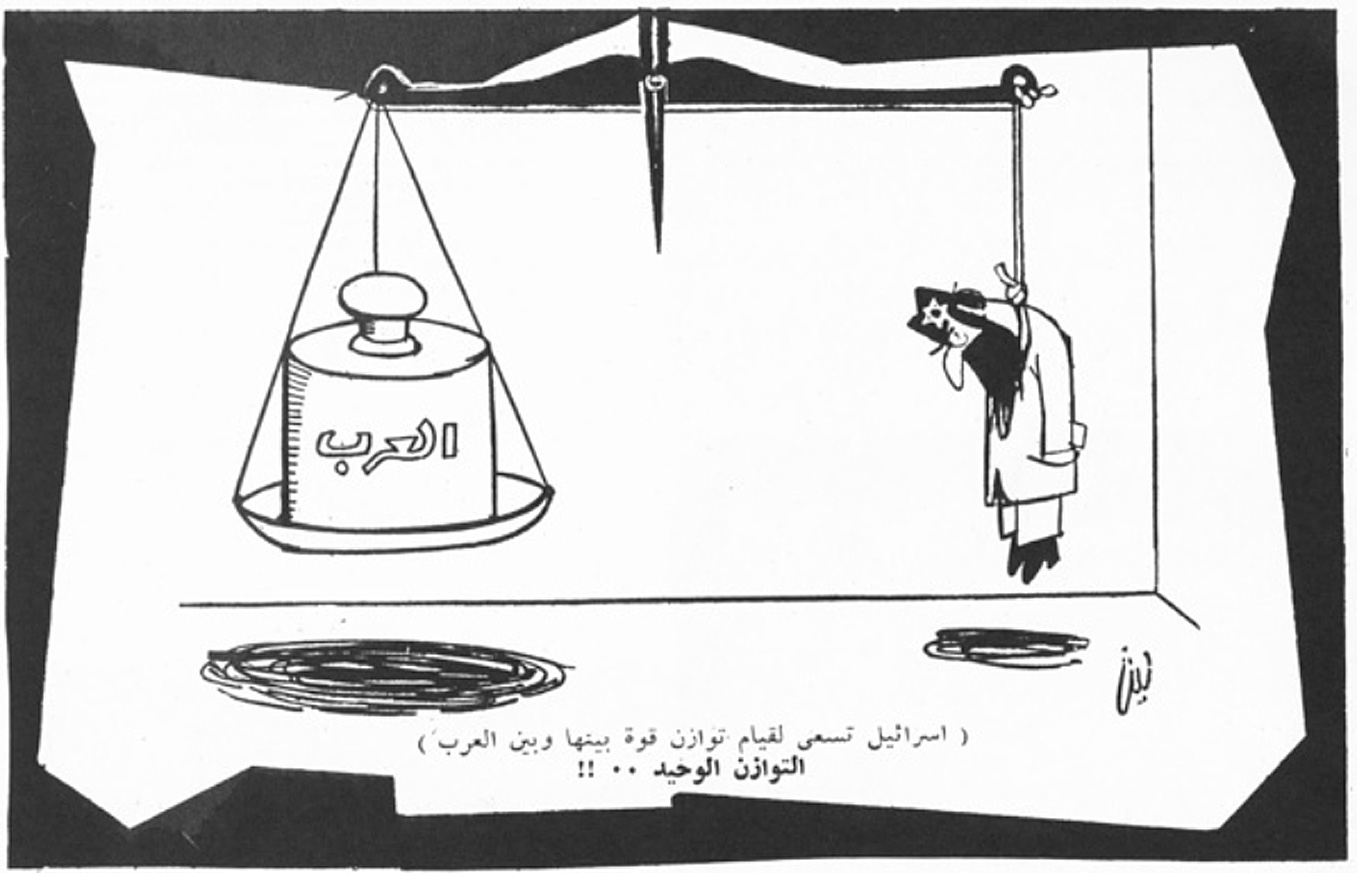 “Israel is attempting to achieve balance of power with the Arabs. The Arab reply: This will be the only balance.” Egyptian review, Roz-el-Yussef, February 14, 1966.
If you reject peace and start a war, you can’t claim victimhood
If you reject peace and start a war, you can’t claim victimhood. History matters. 🇮🇱 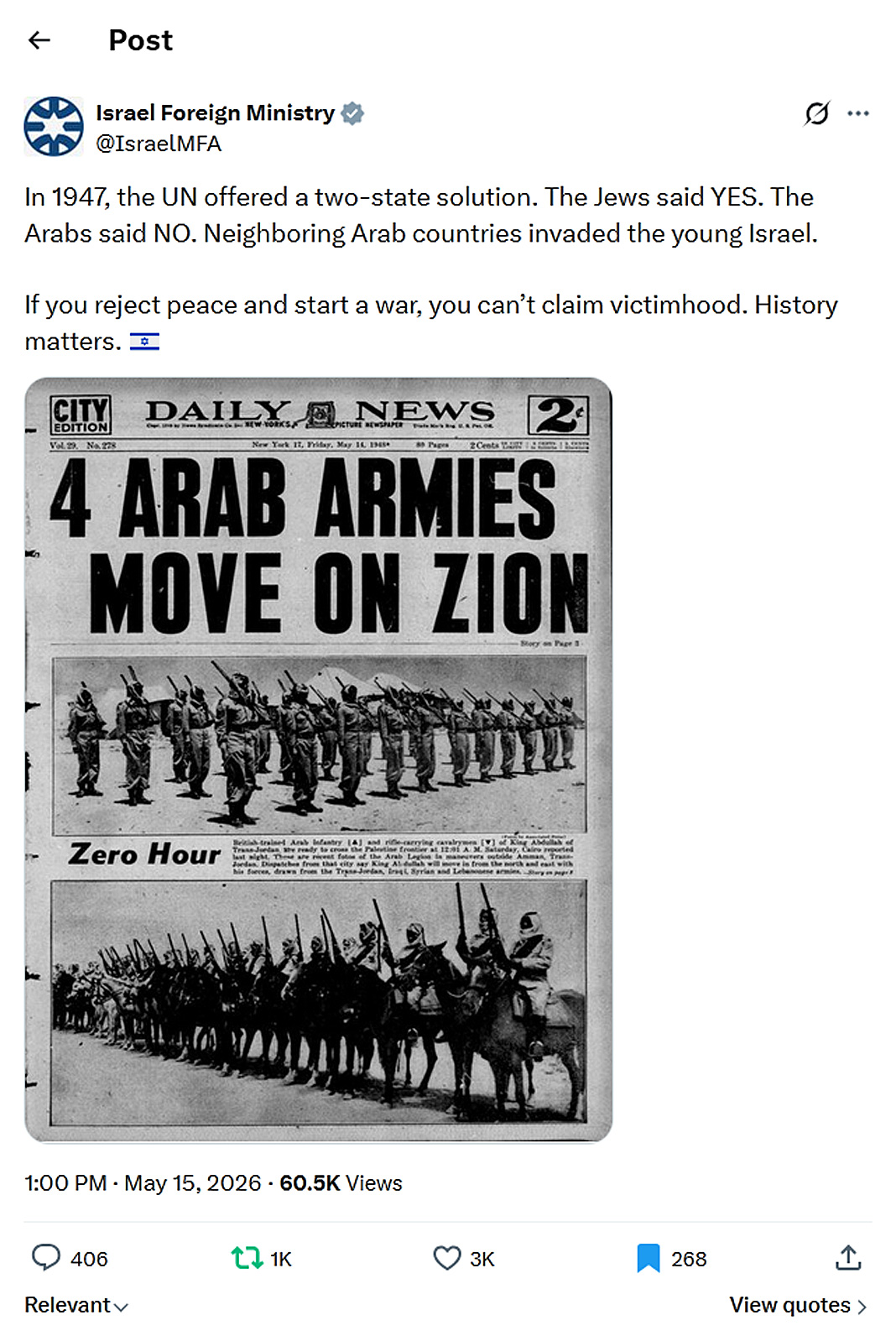 Israel Foreign Ministry-tweet-15May2026-reject peace-start-war-you can’t claim victimhood
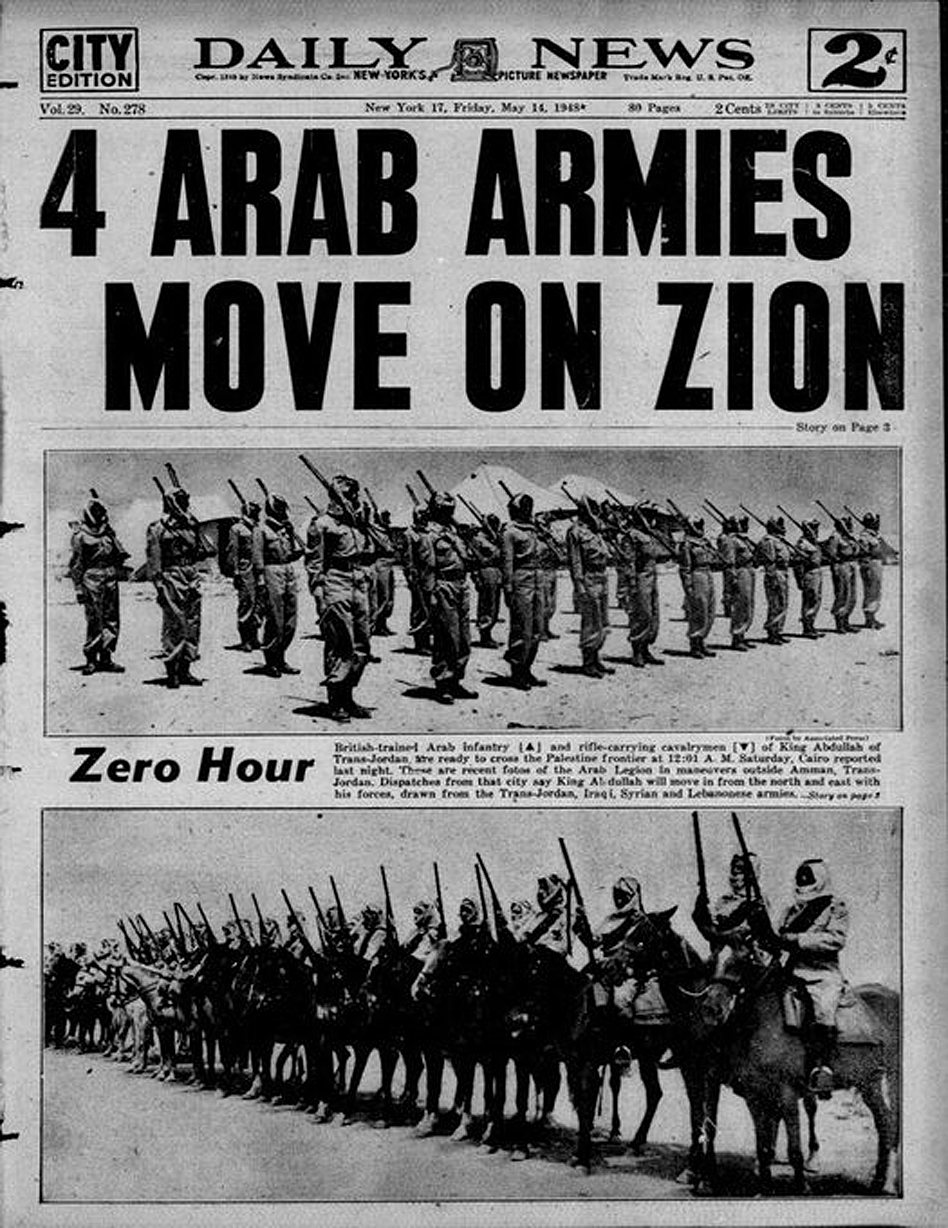 4 Arab Armies move on Zion-14May1948-Daily News
|
|||||
15 Seconds in Sderot, Israel
|
|||||
Kyle Orton’s BlogArab Statements of Exterminationist Intent Before the 1967 WarBy Kyle Orton (@KyleWOrton) on 19 June 2024 https://kyleorton.co.uk/2024/06/19/arab-statements-of-exterminationist-intent-before-the-1967-war/ 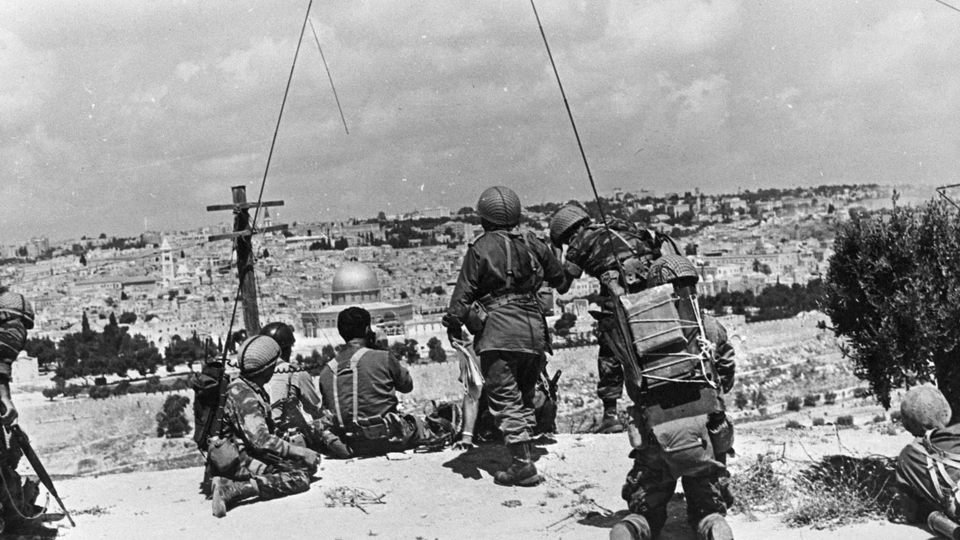 Jersalem Temple Mount Liberation-7June1967 Soldiers watching the Temple Mount | Photo: GPO
Israel pre-emptively struck against the Arab armies massing on her borders on 5 June 1967 and routed them by 10 June. The intention of the Arab States in 1967 had been plainly expressed over nearly twenty years. After the pan-Arab invasion had failed to destroy the Jewish State in 1948, Arab leaders—speaking directly and through their State-run media—made clear that they intended to wage another war that would succeed in eliminating Israel. As the Arab armies moved into position in May 1967, the Arab governments openly proclaimed that this was that long-awaited war.
Below is a far-from-exhaustive compilation of Arab statements in the lead-up to the Six-Day War:
In September 1953, after a false report that Adolf Hitler was still alive and living in Brazil, one of the Egypt’s State-owned newspapers, Al-Musawar, asked various public figures what they would want to say to the Führer. A number of the responses were negative. One was very notably positive: “I congratulate you with all my heart, because, though you appear to have been defeated, you were the real victor. … There will be no peace until Germany is restored to what it was … As for the past, I think you made some mistakes, such as opening too many fronts or Ribbentrop’s short-sightedness in the face of Britain’s old man diplomacy. But you are forgiven on account of your faith in your country and people. That you have become immortal in Germany is reason enough for pride. And we should not be surprised to see you again in Germany, or a new Hitler in your place.” The author of this statement was Anwar al-Sadat,[1] the man who a year earlier had read out the proclamation of the “Free Officers’ revolution” that toppled the Egyptian monarchy.
July 1959, Nasser: “We want a decisive battle in order to annihilate that germ, Israel. All the Arabs want a decisive battle.”[3]
2 February 1960, Radio Cairo: “We are getting ready for the decisive battle, and, at the right moment, we will strike with power and with speed. All our coming battles with Israel will be battles of life or death.”
10 March 1960, Radio Damascus: “The Arabs are determined that Israel shall be uprooted from their midst at any price.”
30 March 1960, “The Voice of the Arabs” transnational show on Radio Cairo: “The guarantee for peace in the Middle East lies in our weapons, in the strength of our own army, and we shall impose the peace, O Israel. We shall impose the peace on the day we will drive you into the expanse of the sea.”
15 September 1960, Jordan’s broadsheet Falastin: “In all frankness, we want to eliminate Israel … and care not when Israel protests that we contemplate war and jeopardise her security … because this is exactly our aim.”
29 April 1961, Egypt’s Al-Gomhuria, declared: “Today, it is in our power to defeat Israel. … The day will yet come when we shall … purge our country [i.e., the ‘Arab nation’] of the very existence of Israel.”
15 May 1961, Radio Amman: “There is no doubt that our war with Israel is imminent. … We will strengthen our forces and liquidate Israel completely so that she will disappear from the face of the earth.”
16 June 1961, Radio Amman: “We see in Israel a plague that should be utterly rooted out.”
12 July 1961, Radio Amman: “The establishment of peace in the area will be made possible only through the liquidation of the enemy State.”
17 August 1961, Nasser: “We will act to realise Arab solidarity and the closing of the ranks that will eventually put an end to Israel. …We will liquidate her.”
23 December 1962, Nasser: “We feel that the soil of Palestine is the soil of Egypt and of the whole Arab world. Why do we mobilise? Because we feel that the land is part of our land, and are ready to sacrifice ourselves for it.”
3 March 1963, Jordan’s Falastin: “It would appear, on the face of it, that the concentration of the Jews in the Occupied Region [i.e., Israel], militates in favour of Zionism. In our view, however, in the long run it will favour the Arab nation. … Why? Because this will turn Israel into one huge, worldwide grave for this whole Jewish concentration. And the day draws near for those who await it.”
21 March 1963, Egypt’s Al-Gomhuria carried an official government statement: “The noose around Israel’s neck is tightening gradually.” On the same day, Hassan Ibrahim, a member of the Egyptian Presidential Council, said: “Egypt has rocket bases capable of destroying Israel within a short time, and panic reigns in that country.”
2 April 1963, Nasser: “Israel emerged because the Arab world was weak and divided … but unity will mean triumph and the liquidation of Israel.”
4 April 1963, Egyptian State newspaper, Al-Akhbar: “The liquidation of Israel will not be realised through a declaration of war against Israel by Arab States, but Arab unity and inter-Arab understanding will serve as a hangman’s rope for Israel.”
19 August 1963, Syria’s Defence Minister General Abdullah Ziadeh: “The Syrian Army stands as a mountain to crush Israel and demolish her. This army knows how to crush its enemies.”
22 February 1964, Nasser: “The possibilities of the future will be war with Israel. It is we who will dictate the time; it is we who will dictate the place.”
12 April 1964, Jordan’s King Husayn: “Jordan, with its Left and Right Bank, is the ideal jumping ground to liberate the usurped homeland.”
27 July 1964, president of Ba’thist-led Iraq, Abd al-Salam Arif: “A war with Israel is inevitable. There is no escaping that war.”
30 October 1964, Chief of Staff in Ba’thist Syria, Salah Jadid: “Our army will be satisfied with nothing less than the disappearance of Israel.”<
16 September 1965, Nasser: “The war with Israel is an inevitable thing. … The Arabs waited seventy-five years until they succeeded in chasing out the Crusaders.” It has always been a common theme in Arab perceptions that Israel will perish as the Crusader States did.
13 March 1966, Syria’s daily Al-Ba’th newspaper: “The revolutionary forces in the Arab homeland, and the Ba’th at their head, preach a genuine Arab Palestine liberation … Our problem will only be solved by an armed struggle to … put an end to the Zionist presence. The Arab people demands armed struggle, and day-by-day incessant confrontation, through a total war of liberation”.
22 May 1966, Syria’s president Nureddin al-Atassi told troops during an inspection: “We want a full-scale popular war of liberation … to destroy the Zionist enemy.”
24 May 1966, Syria’s Defence Minister Hafez al-Asad: “We shall never call for, nor accept peace [with Israel]. We shall only accept war. … We have resolved to drench this land with our blood, to oust you, aggressors, and throw you into the sea for good.”
18 August 1966, Radio Damascus: “Syria has resolved to pursue its way, and continue preparing itself to bring about the liberation by way of popular revolutionary war. Our last punitive operations were … [a] warning the bandit State that the hour of liberation is drawing nigh, and the Arab masses are tired of waiting. … [Syria] is convinced of victory, because all the Arab masses are behind her, tensed for action. Behind Syria, too, stand her friends in the socialist camp.”
17 May 1967, “The Voice of the Arabs” on Radio Cairo: “Egypt with all her resources—human, economic, and scientific—is prepared to plunge into a total war that will be the end of Israel.”[6]
25 May 1967, Radio Cairo: “The firm resolve of the Arab people is to wipe Israel off the map.” On the same day, Nasser himself added: “If we have succeeded in restoring the situation to what it was before 1956 [by reoccupying the Sinai], then there is no doubt that God will help us and enable us to restore the situation to what it was before 1948 [when there was no Israel].”
30 May 1967, Radio Cairo: “In the light of the blockade of the Gulf of Aqaba, two possibilities are open to Israel, each one of them soaked in blood. Either she will die from strangulation of the Arab military and economic blockade, or she will die in the hail of bullets of the Arab forces surrounding her in the south, the north, and the east.”
1 June 1967, Iraq’s president Arif: “My sons, this day is the day of the battle and of revenge for your brothers who fell in 1948. … With the help of God we will meet together in Tel Aviv and Haifa.”
2 June 1967, founder of the Palestine Liberation Organisation (PLO) Ahmad al-Shuqayri: “We shall destroy Israel and its inhabitants and as for the survivors—if there are any—the boats are ready to deport them!”[7]
5 June 1967, “The Voice of the Arabs” on Radio Cairo: “Destroy them and lay them waste and liberate Palestine. Your hour has come. Woe to you Israel. The Arab nation has come to wipe out your people and to settle the account. This is your end, Israel. All the Arabs must take revenge for 1948. This is a moment of historic importance to our Arab people and to the holy war. Conquer the land.” NOTES
[1] Bernard Lewis (1986), Semites and Anti-Semites: An Inquiry into Conflict and Prejudice, p. 161.
[2] Semites and Anti-Semites, pp. 204-05.
[3] In 1959, Nasser was technically president of the “United Arab Republic” that combined Egypt and Syria.
[4] Ronen Bergman (2018), Rise and Kill First: The Secret History of Israel’s Targeted Assassinations, pp. 108-19.
[5] Syria had been a very unstable polity since March 1949, when a military coup felled the government that had presided over the failure to destroy Israel at birth. There were two more military coups that year, in August and December, the latter resulting in a restoration of civilian governance, but it soon devolved into autocracy under Adib al-Shishakli. Another military coup in February 1954 removed Al-Shishakli and another brief period of constitutional rule followed, led by the elderly Hashim al-Atassi, who was soon shunted aside. Shukri al-Quwatli, a Nasserite, became president in September 1955, took Syria decisively into the Soviet camp, and in February 1958 took Syria into the so-called “United Arab Republic” (UAR), theoretically a union of Egypt and Syria that was in reality more an occupation of the former by the latter. The UAR was dissolved in September 1961 by yet another military coup in Syria. Nazim al-Qudsi’s new Western-oriented government did not last long. The March 1963 coup brought the Ba’th Party to power and returned Syria to the Soviet camp, where it would remain for the rest of the Cold War. The February 1966 coup directed by Chief of Staff Salah Jadid saw the Alawi faction of Ba’thists seize control. Al-Atassi was of Sunni origins and it was precisely for that reason he was made the formal president during Jadid’s de facto reign. Al-Atassi was the face of the regime to a Sunni-majority population that regarded Alawis as infidels. Hafez al-Asad prevailed in the November 1970 “corrective coup”, which settled the intra-Alawi contest within the Ba’th Party and established the dynasty that still rules Syria.
[6] George Mikes (1969), The Prophet Motive: Israel Today and Tomorrow, pp. 79.
[7] Ephraim Kam (1974), Husayn Poteah Be’milhama (Husayn Opens War), pp. 284-8, quoted in: Michael Oren (2002), Six Days of War: June 1967 and the Making of the Modern Middle East, p. 132.
[8] Oren, Six Days of War, pp. 130-32.
|
|||||
Yasser Arafat and the Six Day War
One example: this day (May 5) in 1967, Fatah terrorists shelled the peaceful farming community of Kibbutz Manara as part of its ongoing cross-border terror campaign targeting Israeli civilians. In fact, between April and early May 1967, Fatah carried out more than a dozen attacks: planting mines and explosives, ambushing vehicles, and shelling border communities along Israel’s frontiers with Syria, Jordan, and Lebanon. On May 5, the violence escalated sharply. Palestinian terrorists fired mortars and rockets into Kibbutz Manara, a quiet farming community in northern Israel. Families huddled in shelters as shells rained down on homes, fields, and children playing outside. This was not random. It was part of a calculated strategy of provocation and attrition — designed to bleed Israel psychologically and drag the Arab states into full-scale war. Meanwhile, the famous Egyptian military build-up in Sinai and the closure of the Straits of Tiran casus belli for war did not begin until mid-May. Fatah’s terror wave came first. These constant raids created an atmosphere of unbearable tension. Israelis faced daily threats of mines on roads, ambushes on buses, and shelling of kibbutzim — long before Nasser made his dramatic moves. The terror played a significant role in maintaining constant tension and pushing the entire region toward the breaking point. When the Six Day War erupted in June, it was not an Israeli war of choice. It was the culmination of months of escalating Arab aggression — beginning with Arafat’s terror campaign in the spring of 1967. 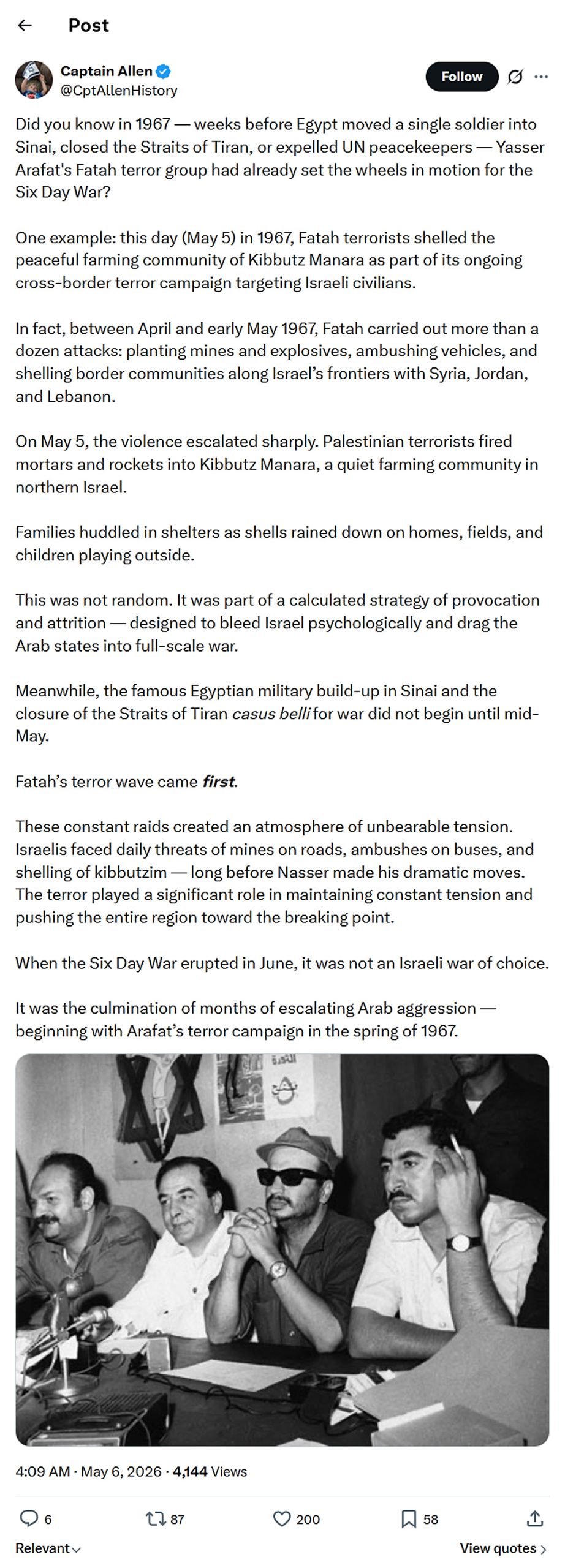 Captain Allen-tweet-6May2026-Yasser Arafat and the Six Day War
|
|||||