 Dumpster Diving anyone? |
|
|
The insane left has been calling for academic boycotts of Israeli Academics for decades.Now they are getting a taste of their own medicine.Would you like salt with your Crow? |
 Eating Crow definition |

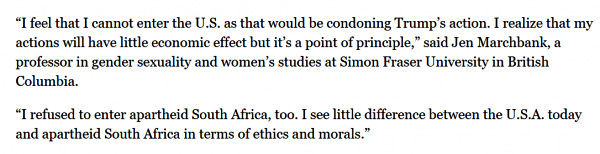
Academic boycott launched AGAINST U.S. after Trump Immigration Executive OrderPosted by William A. Jacobson January 31, 2017 http://legalinsurrection.com/2017/01/academic-boycott-launched-against-u-s-after-trump-immigration-executive-order/ 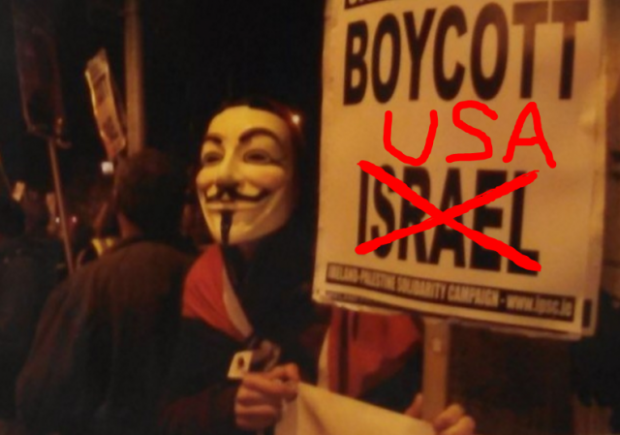 Boycott Israel Sign Crossed Out USA It’s not like I told you so. But I told you so. Many, many times. To those in the U.S. academic community who support the academic boycott of Israeli academics because they don’t like the policies of the Israeli government, I warned that they better prepare for the day when foreign academics start to boycott them for the actions of the U.S. government. That day has arrived sooner than I thought. Though the boycott of U.S. academics being mounted is much less severe than the boycott sought against Israel, it’s a boycott nonetheless. The Chronicle of Higher Education reports:
A column in The Guardian raises the same issue, Should academics boycott Donald Trump’s America?:
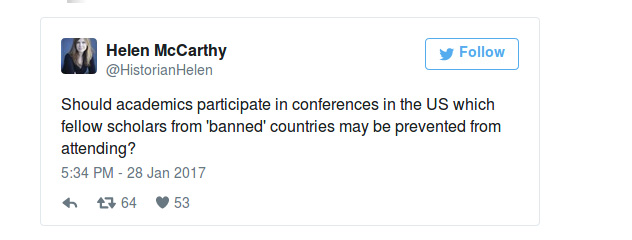 Helen McCarthy-tweet-28January2017-Should academics participate in conferences in the US
I’m basically laughing my ass off over this development because it proves my point that academic boycotts are a systemic threat. I still haven’t seen anyone call for an academic boycott of Turkey, despite thousands of academics having been arrested. And what about all the Arab countries and universities controlled by Hamas and the Palestinian Authority where there is no academic freedom? Pretty selective outrage among the circular firing squad forming on the left. UPDATE: The boycott is spreading, particularly in Canada, as the Toronto Star reports, and accusations that the U.S. is an Apartheid State are being made (just as they are made against Israeli to justify the boycott), Canadian academics boycott U.S. conferences over Trump ban:
|
|
|
|
 israellycool-logo https://www.israellycool.com/ New Report Confirms Ties Between BDS-Promoting NGOs and Terrorist OrganizationsDavid Lange February 3, 2019 https://www.israellycool.com/2019/02/03/new-report-confirms-ties-between-bds-promoting-ngos-and-terrorist-organizations/ Israel’s Ministry of Strategic Affairs and Public Diplomacy (MSA) today released its “Terrorists in Suits” report, which reveals over a whopping 100 links shared between the internationally-designated terrorist organizations Hamas and the Popular Front for the Liberation of Palestine (PFLP) and at least 13 anti-Israel BDS promoting NGOs.
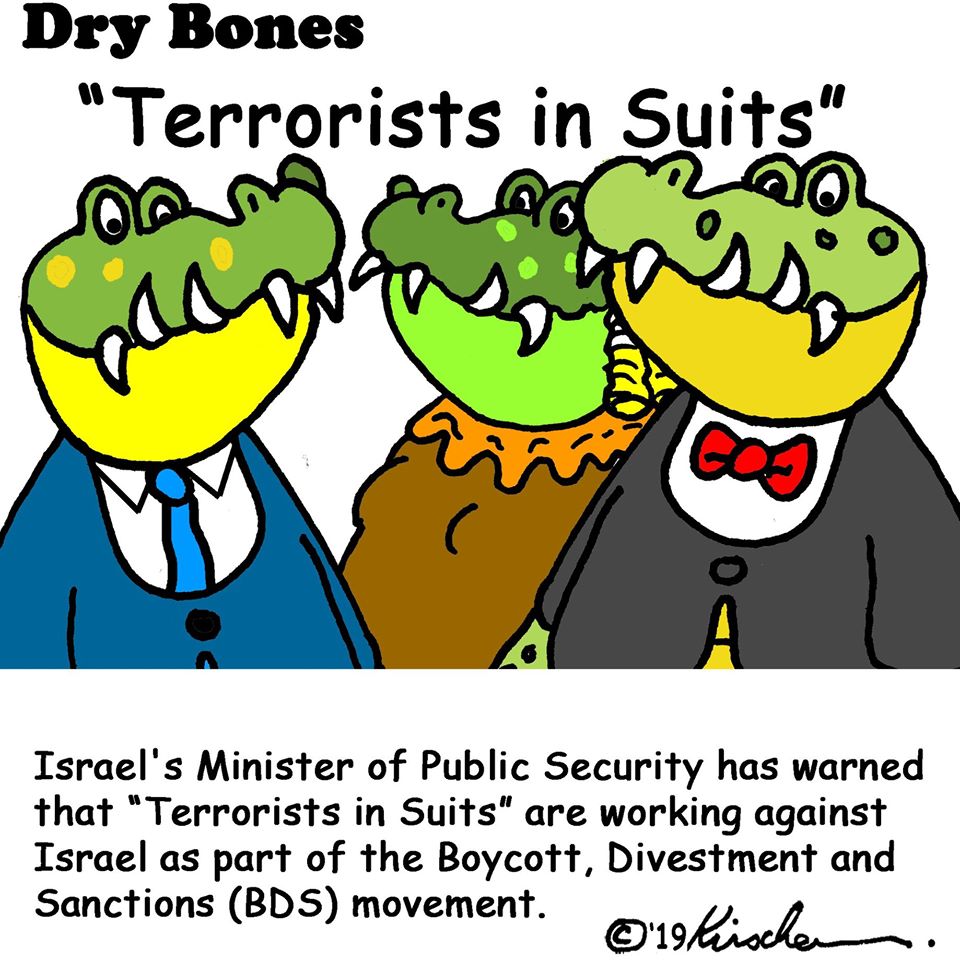 Ministry Of Strategic Affairs Report On “Terrorists In Suits” https://4il.org.il Click to Download the Report.
What Starts Online, Doesn’t Stay There |
|
BDS Leader Shredded by Missouri State Representatives |
|
|
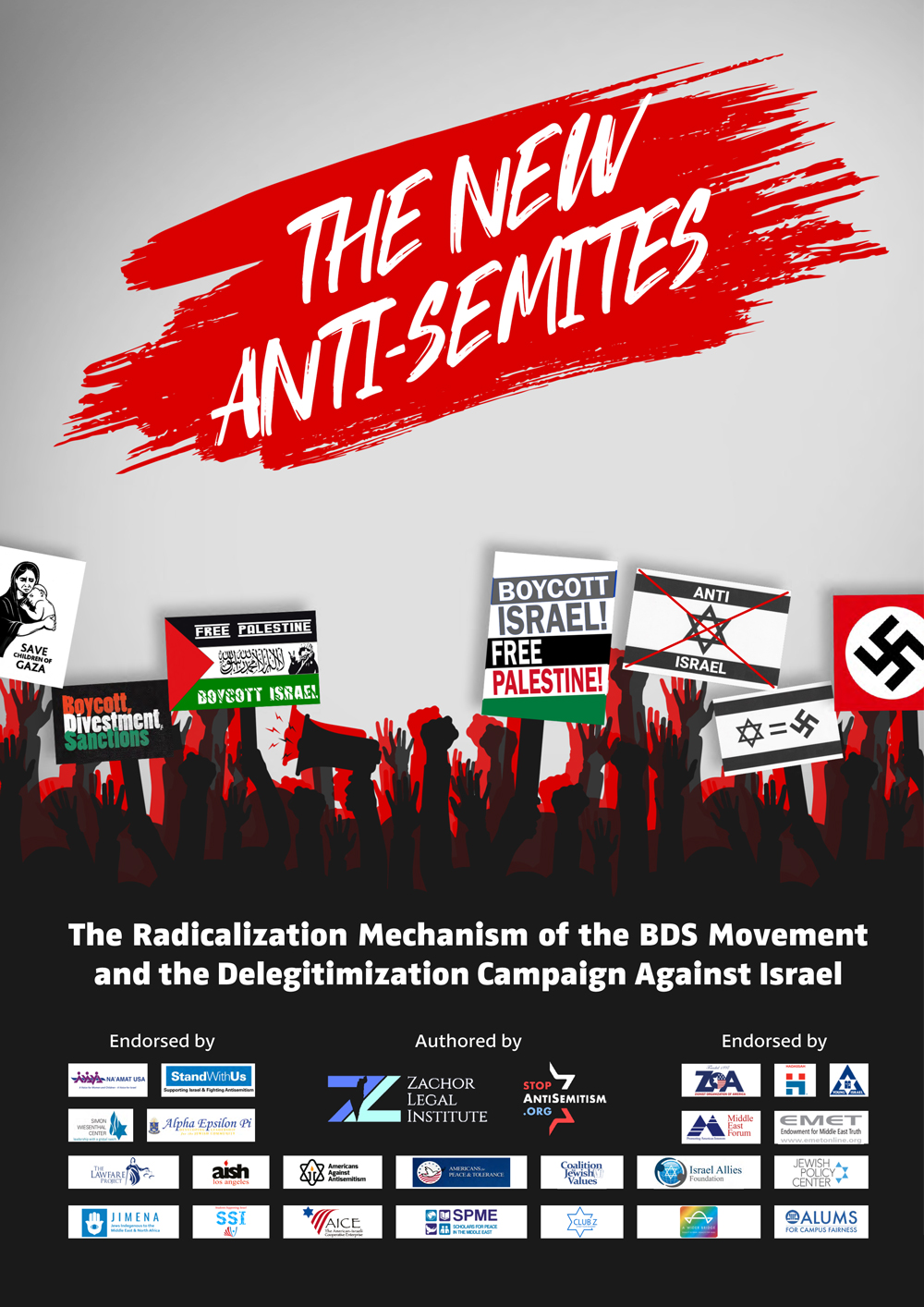
israellycool-logo https://www.israellycool.com/ New Damning Report Exposes the Dangerous Connection Between BDS Movement and Jew HatredBy David Lange 17December2019 https://www.israellycool.com/2019/12/17/new-damning-report-exposes-the-dangerous-connection-between-bds-movement-and-jew-hatred/
|
|
 thecollegefix-com-logo https://www.thecollegefix.com/ Trump signs executive order to combat anti-Semitism on college campusesJennifer Kabbany – Fix Editor 11December2019 https://www.thecollegefix.com/trump-signs-executive-order-to-combat-anti-semitism-on-college-campuses/ ‘My administration will never tolerate the suppression, persecution or silencing of the Jewish people’ President Donald Trump on Wednesday signed an executive order that aims to fight anti-Semitism — particularly on college campuses — by clarifying that federal laws protect against discrimination against Jewish people and warning public institutions could lose funding if they ignore “the vile, hate-filled poison of anti-Semitism.” “This action makes clear that Title VI of the Civil Rights Act, which prohibits the federal funding of universities and other institutions that engage in discrimination, applies to institutions that traffic in anti-Semitic hate,” Trump said in a ceremony right before signing the order. “This is our message to universities,” Trump said. “If you want to accept the tremendous amount of federal dollars that you get every year, you must reject anti-Semitism. It’s very simple.” |
|
New Research Study: Faculty Promote Their Anti-Israel Agenda In ClassesPosted by Samantha Mandeles Monday, 13January2020 https://legalinsurrection.com/2020/01/new-research-study-faculty-promote-their-anti-israel-agenda-in-classes/#more-306128 AMCHA Initiative: “Distorting and blocking the flow of knowledge is a violation of the norms and standards of scholarly inquiry and undermines the university’s academic mission”
 Faculty Promote Their Anti-Israel Agenda In Classes
In the years since our founding, Legal Insurrection has covered anti-Israel activism on our nation’s campuses. Though expressions of anti-Zionism on campus are often the work of radical student groups such as Students for Justice in Palestine (SJP), behind many such groups and their anti-Israel messaging stands faculty support for the Boycott, Divestment and Sanctions (BDS) campaign. For a recent example, see the latest attempt by a small minority of faculty to pass a BDS resolution at the American Historical Association’s annual meeting in American Historical Association Rejects Anti-Israel Resolution for the 4th Time. Of particular concern are university faculty who use their classrooms as platforms for spreading anti-Israel propaganda. Now, a new report released January 8th by the Santa Cruz-based AMCHA Initiative “provides the first-ever empirical evidence suggesting that faculty who support the academic BDS movement against Israel are actively promoting that political agenda directly to students in their classrooms.”
 AMCHA-logo
Founded by University of California academics Leila Beckwith and Tammi Rossman-Benjamin, the AMCHA Initiative monitors and combats anti-Jewish activity on hundreds of college campuses across the United States. The organization does excellent work; most recently, Legal Insurrection Foundation signed on to an AMCHA-authored letter expertly analysing and opposing a proposed anti-Israel public school curriculum in California (Legal Insurrection Foundation opposes proposed anti-Israel public school curriculum in California). AMCHA’s newest report builds on the group’s prior studies, which we have covered in the following posts:
The study, which examined 50 syllabi at 40 public and private American colleges and universities, was undertaken by AMCHA founders Professor Beckwith (Professor Emeritus at UCLA, renowned scientist, researcher, and statistician with a background in psychology and child development) and Professor Rossman-Benjamin (expert on antisemitism and former faculty member in Hebrew and Jewish Studies at the University of California). You can read the full study here (pdf) or below:
The study’s conclusions are disturbing; it found that:
But there are ways universities can combat professor-propaganda if they so choose; helpfully, AMCHA’s report includes concrete action items for university leaders to pursue in order to address these problems:
Ultimately, AMCHA’s report concludes that
|
|
Federal Court upholds constitutionality of Arkansas anti-BDS lawPosted by William A. Jacobson 23January2019 https://legalinsurrection.com/2019/01/federal-court-upholds-constitutionality-of-arkansas-anti-bds-law/ “Because engaging in a boycott of Israel, as defined by Act 710, is neither speech nor inherently expressive conduct, it is not protected by the First Amendment.” The U.S. has had a federal anti-Boycott law (Anti-boycott Regulations) on the books since the 1970s, to counter the Arab League Boycott of Israel. There is under consideration in Congress, and many states have passed, laws to modernize the anti-Boycott laws to take into account the new form of the boycott, the so-called Boycott, Divestment and Sanctions movement. As I have proven, BDS is a new form not only of the anti-Jewish boycotts of the 1920s and 1930s, but also of the Arab League Boycott, The REAL history of the BDS movement. The popular wisdom is that such laws are an unconstitutional infringement on free speech. This popular wisdom is based on a misunderstanding of the law and the laws. A decision in Arkansas upholding Arkansas’s anti-BDS law is a case in point. The Arkansas Times challenged Arkansas’ anti-BDS law, represented by the ACLU:
You can read the Brief in Opposition to the Preliminary Injunction and Brief in Support of Motion to Dismiss filed by Arkansas, setting for the arguments that the anti-BDS law was constitutional. Chief Judge Brian S. Miller in the Eastern District of Arkansas just threw out the lawsuit in an opinion which concluded that the law was not as the Judge initially expected it would be. The Order (pdf.) is embedded at the bottom of this post. The Judge’s opening paragraph was instructive of why we shouldn’t accept the common wisdom:
The Judge noted that there are many similar laws:
Here’s the heart of the Judge’s legal analysis upholding the law:
The court also rejected the common wisdom that there is an unfettered right to boycott:
The court then dismissed the case. In Arkansas, as elsewhere, anti-Israel pro-BDS activists still can dress up as peppers to protect America from Zionist vegetables. But they can’t contract with the state if they conduct their business with the state in a discriminatory fashion by boycotting Israel. Roz Rothstein of the pro-Israel StandWithUs is thrilled:
I’m sure the reaction from anti-Israel activists will be furious. I’m not familiar enough with the various state laws to compare Arkansas’s anti-BDS law to the others. But clearly the issue is not as clear cut, from a constitutional perspective, as some would have you believe. |
|
Full 8th Circuit Upholds Arkansas Law Barring State Contracting With Israel Boycotters (BDS)State power to regulate economic activity includes the power to regulate the purely commercial conduct of a boycott, appellate court says.Posted by Johanna Markind 22June2022 https://legalinsurrection.com/2022/06/full-8th-circuit-upholds-arkansas-law-barring-state-contracting-with-israel-boycotters-bds/ Arkansas’s anti-BDS law requiring state contractors to certify they don’t boycott Israel passes constitutional muster, according to the full Court of Appeals for the Eighth Circuit. The court’s decision in the highly watched case of Arkansas Times LP v. Waldrip, handed down this morning, affirmed the lower court decision upholding the state law. LIF covered the case previously, at:
Back in 2019, U.S. District Judge Brian S. Miller dismissed the case after finding that the state violated no constitutional right by requiring its vendors to certify that they don’t boycott Israel. The case was appealed. A 2021 decision by the Eighth Circuit initially reversed the lower court and claimed the law violated the First Amendment, based on a tortured reading of the statute. The Eighth Circuit then vacated (i.e., rescinded) that decision and ordered the case reheard before all judges of the circuit, instead of just the three-judge panel who had decided it earlier. The case was reargued on September 21, 2021. Judge Jonathan A. Kobes, who dissented from the vacated 2021 decision, wrote the majority opinion upholding the law. “The basic dispute in this case,” Kobes wrote, “is whether ‘boycotting Israel’ only covers unexpressive commercial conduct, or whether it also prohibits protected expressive conduct.” Briefly, the court upheld the state’s right to regulate boycotts as commercial conduct. While economic boycotts are often accompanied by expressive conduct protected by the First Amendment, Kobes’ majority opinion concluded, the boycott itself is not protected by the First Amendment. The opinion on this point corrected an absurd misreading of the statute’s so-called catch-all or garbage can provision in the vacated opinion. Frequently, laws will list examples of things that are covered by it, and then add in something like, ‘and other actions.’ That’s exactly what the Arkansas statute does. The court’s opinion explained:
The vacated opinion had tried to read “other actions” as covering protected speech activities, but its context in the statute indicates that “other actions” refers to commercial activities. Furthermore, accepted canons of statutory construction require a court to interpret a statute as presumptively constitutional, and not to stretch its meaning to force an unconstitutional reading. The Eighth Circuit’s en banc opinion read the law in this limited, presumptively constitutional way. It held that the law only applies to commercial activities, and is constitutional. Furthermore, the court’s opinion continued, the certification required of vendors is not unconstitutionally compelled speech. The majority opinion noted, “We are not aware of any cases where a court has held that a certification requirement concerning unprotected, nondiscriminatory conduct is unconstitutionally compelled speech.” Although the majority opinion did not discuss this, government contractors are commonly required to provide certifications for many things, including their assurance that they do not discriminate. In fact, the paperwork government contractors are required to submit is frequently copious and oppressive. But, certifications of this nature have not been held to be unconstitutionally compelled speech. Judge Jane L. Kelly, who wrote the subsequently-vacated opinion reversing Judge Miller’s original decision, wrote a dissent. She continued to argue that the term “other actions” in the statute reading
It’s unclear and therefore should be interpreted as potentially including expressive activity protected by the First Amendment. This is the first federal appellate opinion to address the substantive issues of anti-BDS laws, which have not been specifically addressed by the Supreme Court. (The Fifth and Ninth Circuit appellate courts previously vacated district court opinions after the states involved amended their anti-BDS laws, but neither court addressed the merits of the cases below.) Another case, A&R Engineering and Testing, Inc. v. Paxton, is currently pending before the Fifth Circuit. Circuit courts are not bound by the decisions of courts in other circuits, but as an en banc decision – that is, a decision by the entire circuit court and not just three judges from it – the Eighth Circuit’s Waldrip opinion is likely to carry a lot of persuasive authority. |
|
 Elder of Ziyon logo http://elderofziyon.blogspot.com/
Federal judge upholds anti-BDS law in Arkansas, says it has nothing to do with the First Amendment. He’s right.January 24, 2019 http://elderofziyon.blogspot.com/2019/01/federal-judge-upholds-anti-bds-law-in.html And they are discriminatory actions. If boycotting Israel is considered free speech, then so should boycotting African American businesses, or women-owned businesses. The ACLU disagrees:
Yet the argument that refusing to do business with a specific group is not considered a First Amendment issue was given by none other than the ACLU themselves, which wrote in another case:
I see no First Amendment difference between a “boycott” by a business of gay customers, as the Elane Photography case was, and a refusal to do business with Israeli-linked people or companies. In neither case is the issue free speech, as the ACLU says explicitly. Refusing to accommodate a gay couple on religious grounds may be a different story, because then there is a case of two differing sets of rights that contradict each other and those cases need to be decided by a judge to determine whose rights are more important under the law. But in this case, it is clear that boycotting itself is not considered free speech, even when the boycott is done through a medium of expression such as, as the ACLU letter notes, “countless other businesses that use words, pictures, or other forms of creative expression, including court reporting services, translation services, graphic-design agencies, architecture firms, sound technicians, print shops, and dance studios, almost any good or service involving computer code, makeup artists, hair stylists, florists, and countless other services.” Federal court upholds anti-BDS bill in ArkansasBy Jackson Richman January 24, 2019 / JNS https://www.jns.org/federal-court-upholds-anti-bds-bill-in-arkansas/
JerusalemCats Comments: If you are for BDS then you are for the Klu Klux Klan boycotting Gay, Blacks, Liberals and others. Are you for Cross Burning? And as the Judge stated. “Israel in particular is known for its dynamic and innovative approach in many business sectors, and therefore a company’s decision to discriminate against Israel, Israeli entities, or entities that do business with or in Israel, is an unsound business practice, making the company an unduly risky contracting partner or vehicle for investment.” |
|
And speaking about birdsJerusalem Bird Observatory
 Jerusalem Bird Observatory A great place for Hitbodedut http://natureisrael.org/JBO The Jerusalem Bird Observatory – JBO, houses one of many national bird-ringing centers. Together with the active ringing station, it serves as an ideal tool for conservation studies and research that monitor bird populations. Birds Migration patterns in Israel are studied throughout the various seasons and data is collected and analyzed in a comprehensive national database. The national database also receives information from our other birding stations throughout the country, including the Hula Valley, Eilat, Ma’agan Michael, Hazeva and Sde Boker. The JBO is located in the center of Jerusalem near the Knesset. Visitors can stop by for an eco-experience. Bird watching, presentations, about bird migration in Israel, and a comprehensive urban nature experience is available for tourists visiting as groups or individuals. The Gail Rubin Gallery, which was established to encourage nature artists and photographers in Israel, always houses exhibitions. The exhibitions focus on different aspects of nature and are free and open to the public whenever the building is open. Birdwatching in JerusalemThe Israeli government allocated the JBO a one-acre plot (5,000 square meters) of prime real estate, between the Knesset (the Israeli parliament) and the Supreme Court. The site is one of the few traditional birdwatching areas in Jerusalem that has not been harmed by development, and is centrally located, making it attractive as an educational and tourist center for the public. Since the establishment of the JBO, birds have arrived in greater numbers each year, to the great pleasure of bird and bird watcher alike. The JBO acts as a magnet for many common migrating and wintering birds: Wrynecks, Collared flycatchers, Masked and Red-backed Shrikes, and Thrush Nightingales can be seen migrating and European Robins, Hawfinches, and Bramblings are regular winter visitors. In addition many resident Israeli birds make their home at the JBO, including Palestine Sunbirds, Spectacled Bulbuls and Israel’s national bird, the Hoopoe. The endangered Lesser Kestrels can be seen nesting in springtime in nearby Musrara and many Short-toed eagles and Little Owls can be found in the hills surrounding the city. The JBO is also home to a vast amount of animals and plants that make up an inseparable part of the local environment. Visiting the JBOThe JBO is located directly next to the Knesset (Israeli Parliament), past the main entrance, nestled between the Rose Garden and Sacher Park. The bird hide of the JBO is open every day, 24 hours a day to the general public and is fully wheelchair accessible, thanks to the help of the Nyman family. Visitors are invited to sit and observe the natural diversity of birds and wildlife that live in or pass through Jerusalem. Feel free to meander the paved road that leads from the Knesset and the Rose Garden to the gate of the cemetery, but we ask that you leave the rest of the site for the birds and not leave the paved road. For the sake of the wildlife and the comfort of our visitors, please refrain from smoking, lighting bonfires, loud music or littering. Please keep your dogs on a leash while on the site. Schedule: Sunday-Thursday from 9:00-3:00pm or by appointment. Types of activities: Bird watching, night hikes, nature movies, bird banding, group tours, nature crafts, tree planting, photography workshops, sketching workshops, and birdwatching for beginners workshops. Bird Ringing is conducted several days a week and guided tours are available by appointment. Please call or e-mail for details. Phone: +972 (0)2-653-7374. Email: jbo@inter.net.il |
|
The secret history BDS hides from you |
|
Vengefulness of Eisav on Display TOP |
|
|
Elder of Ziyon logo http://elderofziyon.blogspot.com/ 24December 2018 Elder of Ziyon http://elderofziyon.blogspot.com/2018/12/a-frightening-parallel-between-german.html A frightening parallel between German antisemites in the 1920s and BDS activists todayAn eyewitness writing in 1920 described the effect in Germany of the publication of the Protocols of the Elders of Zion:
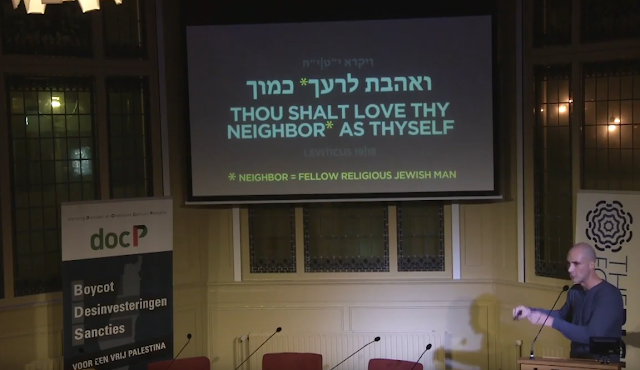
Imagine the scene. Authority figures – often academics – riling up groups of people, often students, with lies that are meant to do only one thing: to incite the audience into hating Jews. And their methods worked – they seemed to gather “incontrovertible facts” that fed into the people’s need to find a scapegoat, to find a symbol that they can channel all their hate into. This happens, today, too. What are BDS meetings all about, anyway? They are meant to incite the audience with lies (in this case, the Protocols are replaced with heavily edited videos and fabricated news stories) in order to get them to hate Israel, and Zionist Jews. Like the German antisemites of the 1920s, today’s Israel-bashers work hard to ensure that any information about their avowed enemies that is not wholly negative get censored, stopped, or drowned out with protests. The entire concept of accusations of “pinkwashing” and “artwashing” is meant to say that even when Israelis do something that aligns with modern liberal and moral values, it is really a nefarious plot to hide their unspeakable crimes. When Israeli Jews do something seemingly bad it is horrendous, when they do something good even that is bad. There is no room in their discourse for truth or honesty. And like then, there are enough idiots who are more than willing to fully adapt a simplistic theory of Jewish/Zionist evil to explain all the ills of the world (today including things like US police brutality, racism, colonialism, slavery, stealing organs, poisoning water, economic woes, and so forth.) And, sometimes, the BDS meetings go full circle to attack Jews themselves, as this recent video of David Sheen blaming false and twisted interpretations of the Talmud and Jewish scholars for Israeli actions at a BDS meeting in Amsterdam: 
This lecture is exactly what the witness from 1920 was talking about. Sheen makes explicit what BDS and Israel-haters have made implicit: the purpose of these meetings is to rile people up and cause them to hate mainstream Jews who dare to support the existence of a Jewish state and sanctuary for Jews worldwide. _______________________
In case you actually watch this antisemitic video, Sheen quotes Maimonides to make it appear that he teaches Jews to ethnically cleanse gentiles. But the quotes are taken out of context, of course; Maimonides says that gentiles who live in Israel and accept the basic moral (Noachide) laws are to be treated with respect:
And Maimonides’ words about how to treat Gentiles come from the Talmud, where they are mentioned (with some variations) no less than five times without any dispute: Tosefta Gittin 3:13-14, Jerusalem Talmud Gittin 5:9 47c, Jerusalem Talmud Demai 4:6 24a, Jerusalem Talmud Avodah Zara 1:3 39c and Babylonian Talmud, Gittin 61a. Similarly, Jew-haters like Sheen like to say that when the Talmud says “Whoever saves a life, it is considered as if he saved an entire world” it is really referring only to Jewish lives, but the quote is given twice: once in context of Jews, and once in context of everyone including non-Jews (Jerusalem Talmud, Sanhedrin 4:1 22a). Sheen’s claim that “neighbor” in Leviticus excludes females and the non-religious is too absurd to even discuss. It has no basis in reality, period. |
|
When you have to deal with a rude BDS Nazi that hates you because you are a Jew or someone who supports the State Of Israel.9 Comebacks for Dealing with Rude People
Published on November 30, 2014 Last modified January 14, 2022-https://www.powerofpositivity.com/9-comebacks-dealing-rude-people/?fbclid=IwAR3b4xxYEEXXwcseRRr6k68iwWokrDJyfzGVPcBWvFgpI_YkVYA5VvPYvsM  When people are rude to you, they reveal who they are, not who you are. Don’t take it personally.
People can tend to have a love/hate relationship with their families, bosses, friends, and even spouses. They can be the sweetest people with loving intentions one second, and the next, say something so offensive that makes you want to call them every name under the sun and react negatively. Questions like “When did you gain so much weight?” or “When will you ever get another boyfriend?” or “Why haven’t you found a job yet?” can really hit below the belt and really set off your temper, if you allow it. People don’t often think about what they say before they say it, which can lead to disaster if the person they are speaking to (you) becomes offended. You have a right to defend yourself and speak your mind, but you can come up with a retort that allows you to express yourself while still being positive and polite. Finding the right comeback to deal with rude people isn’t always easy, especially if that person signs your paychecks. If you have been wondering how to handle your mother-in-law who can’t seem to keep her mouth shut about your weight, or your boss who shows no remorse when he gives you extra work to do, consider these comebacks the next time you encounter rudeness. 1. Thank you.A simple “thank you” speaks volumes when you encounter rudeness. Not only does it show the other person that you didn’t let their words affect you, it reflects maturity on your part. You chose not to ignore the person or get angry, but met both of those tactics somewhere in the middle. A “thank you” usually implies that you acknowledge someone’s thoughtfulness and are responding to that. However, in this case, your “thank you” will mean that you acknowledge the person’s rudeness and you choose not to let it affect you. That will shut the other person down quickly when he or she realizes that the comments didn’t phase you. You choose how to react in any given situation, so choose happiness. It will keep your thoughts and actions positive, and show others that their rude words simply cannot take your power from you. 2. I appreciate your perspective.Not only does is this an intelligent approach, it will show the person that you only wish to communicate in an adult manner, and not stoop to their level. Any rude comments reflect the other person’s shaky perception of themselves, so remember that when someone blurts out something tactless. They may want to bring you down, but you don’t have to let them. Show them that you will only continue the conversation with dignity and respect. They may actually respect you more by reacting in such a considerate way. If this doesn’t happen, shift your focus with this next tip. 3. This conversation is now over.If you find yourself too angry to respond to someone in a civil way, simply end the conversation. You don’t want to cause permanent damage to a relationship by losing your cool, but you also don’t want to disrespect yourself by pretending like the person’s comments or questions are acceptable. Choose to take the high road and not allow the conversation to carry on, and you will be able to keep your dignity while skipping a potential all-out brawl or heated argument. 4. Why do you feel that was necessary, and do you really expect me to answer?Especially in group settings, this will likely put the other person in check very quickly. Instead of getting the expected irate response out of you, they will meet a calm, cool and collected you, ready to talk things over sensibly and decently. Also, it will give them a chance to redeem themselves, and apologize to you in front of your friends, family or co-workers. Other people do need to know that you do not tolerate rude or uncalled for questions and comments, and that you will call attention to their uncouth behavior. If they say “yes” to the second part of your question, you can simply reply with “Well, it looks like this isn’t your lucky day,” and be done with the conversation. 5. That almost hurt my feelings.While a little on the sarcastic side, it tells the other person that you choose not to absorb their negativity. It also deals with rude people in a mature way, and will probably discourage the other person from making any other remarks once they realize you aren’t affected by them. 6. You’re right.While most people have a hard time saying these two words, it will benefit you to make the other person believe they were in the right in what they said, and will likely cause the conversation to be cut short. What more can they say after this comeback? You admit their rightness, and then disengage from the conversation. While you might not get as much satisfaction by using this tactic, it will put a damper on the other person’s enjoyment since they won’t get a rise out of you, which is what they were after in the first place. 7. You always have something negative to say, don’t you?This takes the attention off of you and back onto them, making them think twice about their choice of conversation topics. Not only will you, rightfully so, draw their focus onto their own words, but also force them to reconsider what they say in the future. Speaking your mind when a person repeats behavior that offends you is never wrong or uncalled for; if you feel you need to draw attention to someone’s behavior, then listen to your gut. The person’s negativity likely affects other people besides you, so making them aware of their own toxic behavior will actually benefit you and others in future situations with this person. 8. I love myself, and I love you, too.This may only apply in certain situations with friends, family, and your spouse. If you say it to your boss, you might either get a strange look or get your named removed from the payroll, so use it at your discretion. However, this comeback had to make an appearance on the list because of its effectiveness at shutting down rude people. Kindness always prevails over negativity; darkness cannot thrive where light is present. When you express to the other person just how much you love life and others, their comments become irrelevant and lose power quickly. Their sour mood and bleak outlook on themselves, you, and life will not be a match for your extreme happiness and zest for life. People also aren’t used to such raw emotion from others, and will probably be too surprised to formulate a proper response. Your words have the ability to boost the entire energy of a room and promote more positive conversation. You can’t go wrong with that! 9. LaughThis reaction will definitely catch the offender off-guard and make a rude person feel embarrassed for even making the comment in the first place. For instance, if your aunt brings up your recent job loss at dinner again, just laugh. It will make the present moment seem a little less serious, and will send a message that you don’t let other people’s rude comments affect your mood or outlook on life. |
|
A good apology:
|
|
israellycool-logo https://www.israellycool.com/ Paris Peace Conference On Israel-Palestine Will Ignore French LawBy Brian of London January 15, 2017 http://www.israellycool.com/2017/01/15/paris-peace-conference-on-israel-palestine-will-ignore-french-law/  Eifel Tower base Today in France 70 nations will come together in Paris and blindly ignore the legal ruling of a highly significant French court (Court of Appeal of Versailles) just a few years ago. They will most likely issue a statement which creates the impression that Israel’s activities in Judea and Samaria are illegal. I wrote a couple of weeks ago that there hasn’t been a proper legal case to decide the legality of Jews living in the lands captured back from Jordan in ’67, specifically Judea, Samaria and parts of Jerusalem. I was wrong! There was exactly such a case and, even though I’ve written about it, it has received almost no attention and been buried. Here’s a very simplistic background on how western legal systems operate. In a Western country founded on Judeo-Christian principles, some form of elected body decides to pass and enact laws. Perhaps there is a foundational document (like the US Constitution) or centuries of history and a set of procedures and prior law on how stuff is done (the UK). One thing that unites all these systems is that new laws must be tested in court. A law enters the books when the elected officials have all agreed on it, but until someone breaks the law or challenges it in some way, it isn’t fully tested. Fortunately there isn’t a government for the entire world (and plans for such a monstrosity probably took a backward step when Hillary Clinton lost in November). The UN, as a club of dictators, despots and dastardly deed doers (with a sprinkling of decent, democratic states) certainly isn’t remotely close to a single government for the world that any sane person would submit to. The International Criminal Court in the Hague is also similarly problematic. International law, therefore, stems from a bunch of widely (but not universally) accepted treaties and agreements many nations have signed up to going back, in cases, hundreds of years and methods for deciding disputes are confusing. But just as with nations passing laws, until a court hears a case based on the law, interpretation of that law isn’t set. That’s why there is such a thing as a “legal opinion”. In any given case there are two or more sides arguing that they’ve understood the law correctly and the other side is wrong. That’s the situation with Israel’s status in territory it captured in various defensive wars since 1948. When I wrote “you can believe arguments one way or another, but you can’t yet say the matter of settlements is settled” I was overlooking one very important case from France in 2013 which I even wrote about back then! A week after the case concluded (with a resounding win for the Israeli side and a defeat for a PLO backed boycott effort) I wrote the following:
Exactly as I noted then, the legacy media completely ignored this ruling or downplayed it because it didn’t fit their lethal narrative: Jews are illegal settlers in what was once their own land. Nobody in the hostile legacy media has referred to it since (try to google for it).  People on the Jerusalem light rail train Jean-Patrick Grumberg (the original reporter I linked to back in 2013 on the story) has now re-published a more detailed account of the technicalities of the case which related to the building, in Jerusalem, of the light rail system which connects both predominantly Arab and Jewish neighbourhoods to the centre of Jerusalem. The entire blog post is definitely worth reading (a few times) but here are the headlines:
|
 By Maximilian Dörrbecker (Chumwa) – 2012-08-19OpenStreetMap data for the background, CC BY-SA 2.0, https://commons.wikimedia.org/w/index.php?curid=20740571 First and foremost, the Versailles Court of Appeals had to determine the legal rights of Palestinians and Israelis in West Bank. Their conclusion: Palestinians have no right – in the international legal sense – to the region, unlike Israel, who is legitimately entitled to occupy all land beyond the 67 line.Why is this an historical ruling: it is the first international case since the declaration of the State of Israel in 1948.The Court of Appeal does not deny the occupation, but it destroys one after another all the Palestinian arguments.Israeli occupation does not violate any international law.Propaganda is not international law.Humanitarian law was not violated.The PLO and the Palestinians were dismissed.This is how Jean-Patrick concludes his post (which also includes the entire court decision in French).
 The Jerusalem Chords Bridge or Jerusalem Bridge of Strings גשר המיתרים, Gesher HaMeitarim, also called the Jerusalem Light Rail Bridge is a cantilever spar cable-stayed bridge at the entrance to the city of Jerusalem, Israel, designed by the Spanish architect and engineer Santiago Calatrava. The bridge is used by Jerusalem Light Rail’s Red Line, Incorporated in the structure is a glass-sided pedestrian bridge enabling pedestrians to cross from Kiryat Moshe to the Jerusalem Central Bus Station. |
 Jews Down Under-logo https://jewsdownunder.com The Green Line Through Jerusalem.First.One.Through 28June2020 https://jewsdownunder.com/2020/06/28/the-green-line-through-jerusalem/ When the United Nations considered dividing Israel into an Arab State and a Jewish State in 1947, it sought to remove the contentious religious sites sacred to Jews, Christians and Muslims into a distinct “corpus separatum” which would be under international control. The area of Greater Jerusalem and Greater Bethlehem was to become a “Holy Basin,” and a unique model from the nascent United Nations. The Arabs rejected partition and five Arab armies invaded Israel. At wars end in 1949, armistice lines with Egypt, Syria and Jordan created new boundaries in the region. Jordan took control and soon annexed the area it seized, including three-quarters of the Holy Basin. The division for the Jordanian frontiers were marked in green and it became known as the “Green Line.” 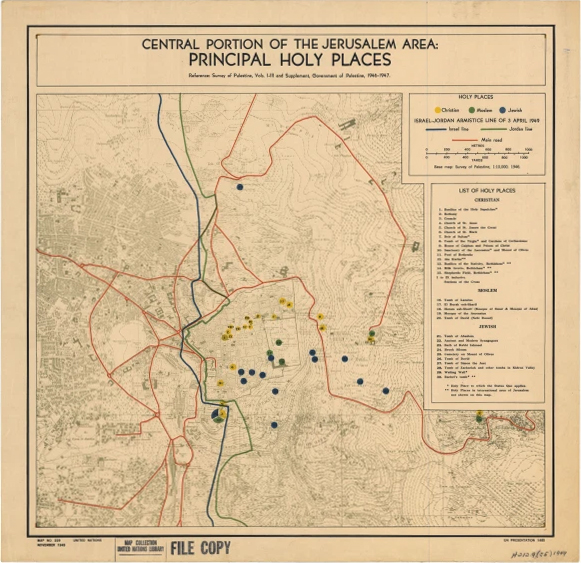 The division of Jerusalem in the 1949 Armistice agreement between Israel and Jordan. The division of Jerusalem in the 1949 Armistice agreement between Israel and Jordan. The Jordanian side included the entirety of the Old City of Jerusalem. The line ran right along the western side of the city, including the Jaffa and New Gates up to the Damascus Gate. The Jordanians forbade Jews from living in, visiting or praying at their holy sites in the city. The map above is from the United Nations and marks the city’s sacred locations. Note that even though the city is only considered the holiest for Jews, the Jewish locations are listed last. The holiest location, the Jewish Temple Mount, is not even marked as sacred to Jews. The Western Wall is marked as holy – to both Jews and Muslims. The map lists the Christian holy places first and includes numerous locations including each station of the Cross. It lists but does not show the various sacred spots in Bethlehem. The only holy location on the Israeli side of the lines is the Tomb of David, curiously listed as the only site holy to all three religions. ……  The world’s vision of Jerusalem from 1949 to 1967 was a place dominated by Christianity in terms of reverence, by Muslims in regards to prominence, and lastly by Jews, whose holiest spot was not even acknowledged and their basic human rights to live and worship were ignored. The world’s vision of Jerusalem from 1949 to 1967 was a place dominated by Christianity in terms of reverence, by Muslims in regards to prominence, and lastly by Jews, whose holiest spot was not even acknowledged and their basic human rights to live and worship were ignored. |

Pompeo Busts the ‘Occupation’ Myth The claim that Israeli settlements are illegal was flimsy in 1978 and is ridiculous in 2019. By Eugene KontorovichPosted By Ruth King 20November2019 http://www.ruthfullyyours.com/2019/11/20/pompeo-busts-the-occupation-myth-the-claim-that-israeli-settlements-are-illegal-was-flimsy-in-1978-and-is-ridiculous-in-2019-by-eugene-kontorovich/ https://www.wsj.com/articles/pompeo-busts-the-occupation-myth-11574207220 Israeli settlements in the West Bank do not violate international law. That is now America’s official view, announced Monday by Secretary of State Mike Pompeo. The historic decision repudiates the conclusions of a 1978 State Department memorandum. For decades, Israel’s detractors have appealed to consensus, asserting that settlements are illegal because the entire international community agrees they are illegal. As with Jerusalem and the Golan Heights, the Trump administration has refused to be cowed by a hollow consensus. By dissenting, the U.S. has destroyed both the consensus and the frail arguments that relied on it. The four-page 1978 memo, written by legal adviser Herbert Hansell, was hardly a thorough study. It painted with broad strokes across several issues and cited no precedent for its key conclusions. Most important, its legal analysis of occupation and settlements has never been applied, by the U.S. or anyone else, to any other comparable situation. Hansell’s memo took two analytic steps. First, it concluded that Israel was an “occupying power” in the West Bank. Next, it invoked an obscure provision of the Fourth Geneva Convention, which says the “Occupying Power shall not deport or transfer parts of its civilian population into the territory it occupies.” Hansell concluded that Jews who have moved past the Green Line into disputed territory have somehow been “deported or transferred” there by the state of Israel. Under international law, occupation occurs when a country takes over the sovereign territory of another country. But the West Bank was never part of Jordan, which seized it in 1949 and ethnically cleansed its entire Jewish population. Nor was it ever the site of an Arab Palestinian state. Moreover, a country cannot occupy territory to which it has sovereign title, and Israel has the strongest claim to the land. International law holds that a new country inherits the borders of the prior geopolitical unit in that territory. Israel was preceded by the League of Nations Mandate for Palestine, whose borders included the West Bank. Hansell’s memo fails to discuss this principle for determining borders, which has been applied everywhere from Syria and Lebanon to post-Soviet Russia and Ukraine. Even on its own terms, the memo’s conclusions no longer apply. Because occupation is part of the law of war, Hansell wrote, the state of occupation would end if Israel entered into a peace treaty with Jordan. In 1994 Jerusalem and Amman signed a full and unconditional peace treaty, but the State Department neglected to update the memo. Even if there were an occupation, the notion that it creates an impermeable demographic bubble around the territory—no Jew can move in—has no basis in the history or application of the Fourth Geneva Convention. Almost every prolonged occupation since 1949—from the Allies’ 40-year administration of West Berlin to Turkey’s 2016 occupation of northern Syria—has seen population movement into the occupied territory. In none of these cases has the U.S., or the United Nations, ever claimed a violation of this Geneva Convention provision. Mr. Pompeo’s action shows the U.S. understands that we can’t have one international law for one country and another for the rest of the world. Mr. Kontorovich is a professor at George Mason University Scalia Law School. |
Pompeo Declares BDS Movement Antisemitic, Seeks to Defund Anti-Israel Boycott CampaignersPosted by Vijeta Uniyal Thursday, November 19, 2020 at 3:00pm https://legalinsurrection.com/2020/11/pompeo-declares-bds-movement-antisemitic-seeks-to-defund-anti-israel-boycott-campaigners/ Secretary of State Mike: “We want to join all the other nations that recognize BDS for the cancer that it is.” U.S. Secretary of State Mike Pompeo recognized the anti-Israel boycott campaign, or the BDS Movement, as antisemitic. The State Department “will regard the global anti-Israel BDS campaign as anti-Semitic,” Secretary Pompeo said during a meeting with Prime Minister Benjamin Netanyahu in Jerusalem.
The State Department “will immediately take steps to identify organizations that engage in hateful BDS conduct, and withdraw US government support for such groups.” Secretary Pompeo announced on the second day of his Israel trip. “We want to join all the other nations that recognize BDS for the cancer that it is,” he added. Thursday’s move will “cut off government support for any organizations taking part in it, a step that could deny funding to Palestinian and international human rights groups,” the Associated Press noted. President Donald Trump’s administration is considering cutting U.S. funding for international activist groups who have been supporting boycott calls against Israel, including big names like Amnesty International, Human Rights Watch, and Oxfam, news reports suggest.
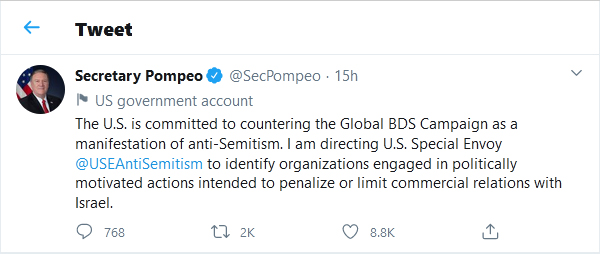 Secretary-Pompeo-tweet-19November2020-BDS-AntiSemitism
Israeli TV network i24News reported Secretary Pompeo’s remarks:
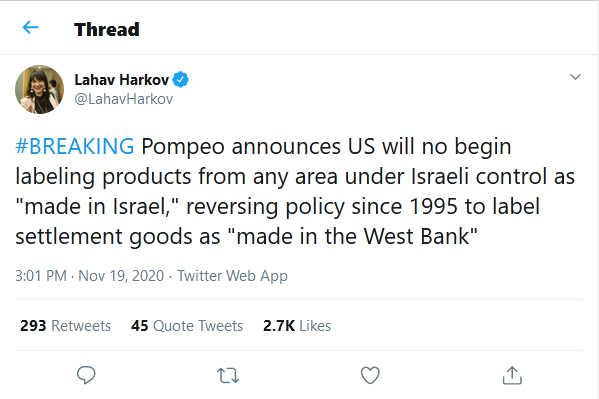 Lahav-Harkov-tweet-19November2020-labeling-products-made-in-Israel
On Thursday, Secretary Pompeo became the first U.S. Secretary of State to visit Israel’s Judea and Samaria region, often referred to in the mainstream media as the “West Bank.” President Trump last year recognized Israel’s sovereignty over the area. In a symbolic gesture, the Secretary of State visited the Psagot winery in Samaria. The top EU court, the European Court of Justice, in its November 2019 judgment, ruled against the winery, ordering mandatory labeling of products from the Judea and Samaria region as ‘settlement’ goods. “It is a blessing to be here in Judea and Samaria,” he wrote in the winery guestbook. “May I not be the last secretary of state to visit this beautiful land.” Rejecting discriminatory labeling of Israeli products as mandated by the EU, Secretary Pompeo announced on Thursday that products made in areas under Israeli sovereignty, which includes Judea and Samaria, “ will be required to mark goods as “Israel,” “Product of Israel,” or “Made in Israel” when exporting to the United States. ” The Palestinian leadership was angered by Pompeo’s visit to the region and his decision to do away with the discriminatory labeling. “The decision blatantly violates international law,” a spokesman for Palestinian Authority (PA) President Mahmoud Abbas declared. The PA “condemned” the announcement as “yet another biased, pro-Israeli move by US President Donald Trump’s administration,” the Times of Israel reported. ‘Secretary Mike Pompeo in Israel, Announces US Action Against BDS movement.’ Secretary Mike Pompeo in Israel, Announces US Action Against BDS movement
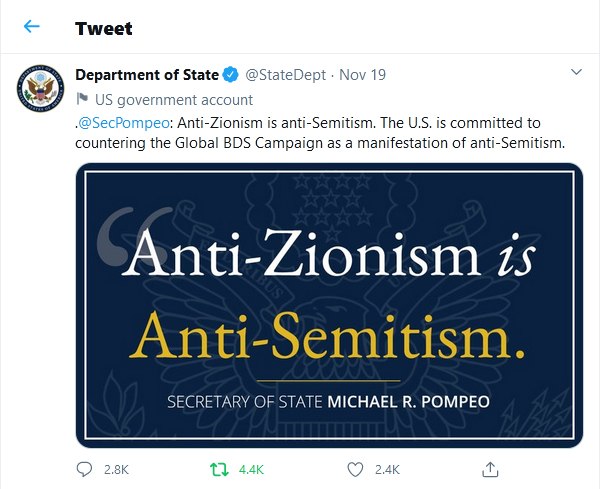 Department-of-State-tweet-19November2020-Anti-Zionism-is-anti-Semitism
|

The only question on settlement legality is: Why did it take so long?When it came to the issue of the settlements, the discussion was not, to quote Professor Eugene Rostow, “about legal rights but about the political will to override legal rights.”Dr. Richard L. Cravatts, 20November2019 http://www.israelnationalnews.com/Articles/Article.aspx/24755 In reversing the Obama administration’s shameful acceding to the UN Security Council’s 2016 resolution that Israeli settlements in Judea and Samaria were illegal under international law, US Secretary of State Mike Pompeo finally stated what was obvious to many legal scholars and others who have assessed the facts on the ground; namely, as Pompeo put it, “The establishment of Israeli civilian settlements in the West Bank is not per se inconsistent with international law.” Additionally, as he noted, while the decision “does not prejudice or decide legal conclusions regarding situations in any other parts of the world,” the Secretary emphasized that the affirmation of the settlements’ legality “is based on the unique facts, history, and circumstances presented by the establishment of civilian settlements in the West Bank.” Those “unique facts, history, and circumstances,” of course, have existed for some time now, but were ignored or purposely contorted to promote a defective diplomacy in which, it was thought, the realization of Palestinian Arab statehood was being compromised by the construction of Jewish housing in the ‘West Bank’. The settlement debate had also been hijacked by the Arab world and its Western apologists who, willingly blind to history, international law, and fact, continued to assign the blame for the absence of peace on the perceived offenses of occupation and Israeli truculence. Thus, for instance, then-Secretary Hillary Clinton and her predecessor, Condoleezza Rice, had both referred to the nuisance Israel caused by letting Jews live in the ‘West Bank’, against the wishes of the Palestinian Arabs who view that territory as once and forever theirs, as “unhelpful” in seeking a viable solution to Palestinian Arab statehood. What was truly “unhelpful,” however, were the repeated references to the ‘West Bank’ and Gaza, as well as East Jerusalem, as “Arab” land, the putative Palestinian state in waiting, encumbered only by Israeli oppression, the dreaded occupation, and those pesky settlers. This widely held notion that European Jews, with no connection to historic Palestine, colonized Arab land and displaced the indigenous Palestinian Arab population, of course, is a key part of what Professor Richard Landes of Boston University defined as the “cognitive war” against Israel; it serves the perverse purpose of validating Arab territorial rights to the ‘West Bank’ and Gaza, and, more importantly, casts Israelis as squatters who have unlawfully expropriated land that is not—and never was—theirs. Secretary Pompeo’s confirmation of the legality of the settlements serves to reverse the faulty historical assumptions and misreading of law that has animated the settlement debate, principally the fact that not only all of the land that is current-day Israel, but also Gaza and the ‘West Bank’, is part of the land granted to the Jews as part of the League of Nations Palestine Mandate, which recognized the right of the Jewish people to “close settlement” in a portion of those territories gained after the breakup of the Ottoman Empire after World War I. According to Eugene V. Rostow, the late legal scholar and one of the authors of UN Security Council Resolution 242 written after the 1967 war to outline peace negotiations, “the Jewish right of settlement in Palestine west of the Jordan River, that is, in Israel, the West Bank, Jerusalem, and the Gaza Strip, was made unassailable. That right has never been terminated and cannot be terminated except by a recognized peace between Israel and its neighbors,” something which Israel’s intransigent Arab neighbors have never seemed prepared to do. Moreover, Rostow contended, “The Jewish right of settlement in the West Bank is conferred by the same provisions of the Mandate under which Jews settled in Haifa, Tel Aviv, and Jerusalem before the State of Israel was created,” and “the Jewish right of settlement in the area is equivalent in every way to the right of the existing Palestinian population to live there.” The Six Day War of 1967, in which Israel recaptured Gaza and the ‘West Bank’, including Jerusalem, resulted in Israel being cast in another perfidious role—in addition to colonial usurper of Arab land, the Jewish state became a “brutal” “occupier” of Arab Palestine, lands to which the Jews presumably had no right and now occupied, in the opinion of many in the international community, illegally. But when did the ‘West Bank’, Gaza, and East Jerusalem become Palestinian land? The answer is: never. In fact, when Israel acquired the ‘West Bank’ and Gaza and other territory in 1967 after being attacked by Egypt, Syria, and Jordan, the Jewish state gained legally recognized title to those areas. In Israel’s 1948 war of independence, Egypt, it will be recalled, illegally annexed Gaza at the same time Jordan illegally annexed the ‘West Bank’—actions that were not recognized by most of the international community as legitimate in establishing their respective sovereignties. Israel’s recapture of those territories in 1967, noted Professor Stephen Schwebel, State Department legal advisor and later the President of the International Court of Justice in The Hague, made the Jewish state what is referred to as the High Contracting Party of those territories, both because they were acquired in a defensive, not aggressive, war, and because they were part of the original Mandate and not previously under the sovereignty of any other High Contracting Party. “Where the prior holder of territory had seized that territory unlawfully,” Schwebel wrote, referring to Jordan and Egypt, “the state which subsequently takes that territory in the lawful exercise of self-defense has, against that prior holder, better title.”’ It is also morally repellent, for those arguing on the Palestinian Arab side, that the ‘West Bank’, like Gaza, eventually be made judenrein, totally absent of Jews, that, as Mahmoud Abbas has loudly announced on more than one occasion, the future Palestinian state would not have one Jew living within its borders. Putting aside the fact that it is Israel that is continually derided for being racist and exclusionary (despite having one million Arab citizens), only in a world turned upside down would diplomats uphold a principle that Jews—and only Jews—not be allowed to live in certain territories, and particularly those areas to which they have irrevocable and inalterable biblical, historic, and legal claims. In fact, Professor Emeritus Jerold Auerbach of Wellesley College has written that, protests from the State Department and many in the West aside, “Israeli settlement throughout the West Bank is explicitly protected by international agreements dating from the World War I era, subsequently reaffirmed after World War II, and never revoked since . . . The [Mandate for Palestine] recognized ‘the historical connection of the Jewish people with Palestine’ and ‘the grounds for reconstituting their national home in that country’ . . . This was not framed as a gift to the Jewish people; rather, based on recognition of historical rights reaching back into antiquity, it was their entitlement.” While those seeking Palestinian statehood conveniently overlook the legal rights Jews still enjoy to enable them to occupy all areas of historic Palestine, they have also used another oft-cited, but defective, argument in accusing Israel of violating international law by maintaining settlements in the ‘West Bank’: that since the Six Day War, Israel has conducted a “belligerent occupation.” But as Professor Julius Stone discussed in his book, Israel and Palestine, the fact that the ‘West Bank’ and Gaza were acquired by Israel in a “sovereignty vacuum,” that is, that there was an absence of High Contracting Party with legal claim to the areas, means that, in this instance, the definition of a belligerent occupant in invalid. “There are solid grounds in international law for denying any sovereign title to Jordan in the West Bank,” Stone wrote, “and therefore any rights as reversioner state under the law of belligerent occupation.” So, significantly, the absence of any sovereignty on territories acquired in a defensive war—as was the case in the Six Day War of 1967—means the absence of what can legally be called an occupation by Israel of the ‘West Bank’, belligerent or otherwise. The matter of Israel violating Article 49 of the Fourth Geneva Convention is one that has been used regularly, and disingenuously, as part of the cognitive war by those wishing to criminalize the settlement of Jews in the ‘West Bank’ and demonize Israel for behavior in violation of international law. It asserts that in allowing its citizens to move into occupied territories Israel violates Article 49, which stipulates that “The occupying Power shall not deport or transfer parts of its own civilian population into territory it occupies.” The use of this particular Geneva Convention seems particularly grotesque in the case of Israel, since it was crafted after World War II specifically to prevent a repetition of the actions of the Nazis in cleansing Germany of its own Jewish citizens and deporting them to Nazi-occupied countries for slave labor or extermination. Clearly, the intent of the Convention was to prevent belligerents from forcibly moving their citizens to other territories, for malignant purposes— something completely different than the Israel government allowing its citizens to willingly relocate and settle in territories without any current sovereignty, to which Jews have longstanding legal claim, and, whether or not the area may become a future Palestinian state, should certainly be a place where a person could live, even if he or she is a Jew. And does anyone doubt that once the Palestinians, aided and abetted by mendacious Western elites, diplomats, and an anti-Israel international community of supporters, have purged Gaza, the ‘West Bank’, and East Jerusalem of all Jews, that new calls will then arise accusing Jews of “occupying” more “Arab” lands in Tel Aviv, Netanya, Tiberias, or Haifa? Professor Rostow himself saw through the disingenuous talk about legal rights and resolutions when it came to the issue of the settlements. The discussion was not, in his mind, “about legal rights but about the political will to override legal rights.” In fact, the settlement debate is part of the decades-old narrative created by the Palestinian Arabs and their Western enablers to write a false historical account that legitimizes Palestinian claims while air-brushing away Jewish history. “Throughout Israel’s occupation,” Rostow observed, “the Arab countries, helped by the United States, have pushed to keep Jews out of the territories, so that at a convenient moment, or in a peace negotiation, the claim that the West Bank is ‘Arab’ territory could be made more plausible.” With Secretary Pompeo’s bold statement reversing the legal status of the settlements, at least for the time being, that “convenient moment” may be less likely to occur and at least one key element in the cognitive war against Israel seems to have neutralized. Richard L. Cravatts, PhD, President Emeritus of Scholars for Peace in the Middle East (SPME), is the author of Dispatches From the Campus War Against Israel and Jews. The Jerusalem Chords Bridge or Jerusalem Bridge of Strings גשר המיתרים, Gesher HaMeitarim, also called the Jerusalem Light Rail Bridge is a cantilever spar cable-stayed bridge at the entrance to the city of Jerusalem, Israel, designed by the Spanish architect and engineer Santiago Calatrava. The bridge is used by Jerusalem Light Rail’s Red Line, Incorporated in the structure is a glass-sided pedestrian bridge enabling pedestrians to cross from Kiryat Moshe to the Jerusalem Central Bus Station.
|
Deputy Foreign Minister Tzipi Hotovely to Arab MKs: You are thieves of history tzipihotovely In a highly charged debate that developed in the plenum tonight (Wednesday, 12.7.17 [EDD-12July2017]) in the framework of a motion on the subject of UNESCO’s decision on Hebron and the Cave of the Patriarchs, Deputy Foreign Minister Tzipi Hotovely responded on behalf of the government to the Arab Knesset members.
|

What the Members of the Knesset need to do is listen to the Gedolim and transfer the terrorist and their supporters out of Israel.
|
This is what we get if we do not transfer the terrorist and their supporters out of Eretz Israel.
15 Seconds in Sderot, Israelsderotmedia23 June 2, 2008 |
 8 February 2017: Multiple rockets fired from Egypt into Eilat, Israel 3 hours on and not a single non-Israeli main stream media source has mentioned this, but every major news outlet has headlines screaming about ” illegal Jewish aettlements “. Reminder to every news reporter and editor: if you continue to ignore stories like this while headlining the fact that a few houses are being built in the Jewish homeland, then your ARE an antisemite |
Mahmoud Abbas Contradicts the Palestinian Narrative on Refugees |
This is what we have to deal with.Real Housewives of ISIS |
Now for some real TruthAlan Dershowitz Brilliantly Strikes down Anti-Israel Question at ConferenceShlomo Winner February 7, 2016 |
Rabbi Lazer Brody, The End of Days, 7-21-2015 2 |

One Raid Shows All You Need to Know About Israel’s Current Predicamentby Stephen M. Flatow / JNS.org (https://www.algemeiner.com/2018/01/23/one-raid-shows-all-you-need-to-know-about-israels-current-predicament/)  Israeli forces operating in the West Bank city of Jenin, Jan. 18, 2018. Photo: Reuters / Mohamad Torokman. JNS.org – You wouldn’t think that one isolated Israeli counter-terror raid could explode every major myth about Israel’s conflict with the Palestinian Arabs. But last week’s raid in Jenin came pretty close to doing just that. Overnight on January 17, Israeli commandos entered the city of Jenin in search of two particular Arab terrorists. When the operation was over a few hours later, the Israeli forces withdrew Wait — the Israelis withdrew? But isn’t Israel “occupying” the Palestinians? That’s what J Street and Jewish Voice for Peace are always telling us. Just this week, Rabbi Rick Jacobs, head of the Union for Reform Judaism, wrote that Israel is “ruling over millions of Palestinians.” I guess that Rabbi Jacobs hasn’t been to Jenin lately. In fact, I would imagine that he hasn’t been there since at least 1995. That was the year when Israel withdrew all of its forces from the city (and the other areas where 98 percent of Palestinians reside), and a new power took over: the Palestinian Authority (PA). Counter-terror raids like the one in Jenin are the only occasions when Israeli forces enter PA-ruled cities. Back to the story. The Israeli commandos were searching for the terrorists who carried out last week’s brutal drive-by murder of Rabbi Raziel Shevach, the father of six young children. As the Israelis were searching, The Times of Israel reports, “a violent riot broke out. … Palestinians hurled improvised explosive devices, rocks and fired at the forces.” Wait — what? Some on the left have been telling us for decades that ordinary Palestinian Arabs are moderate, peace-seeking, and opposed to terrorism. The residents of Jenin should have been delighted that Israeli forces were coming to rid their city of terrorists. In fact, if they’re so moderate, they should have been actively assisting the anti-terror efforts. Instead, the local residents impeded the hunt for the terrorists — by trying to shoot, stone and burn the Israeli soldiers to death. Would some J Streeter please explain this? I’m confused. Can these be Israel’s future peaceful neighbors? I wonder if Jenin residents’ passionate support for terrorism and hatred of Jews and Israel has anything to do with the anti-Jewish textbooks that are used in PA schools, or the non-stop anti-Jewish incitement in the PA-controlled media and mosques. Or maybe that’s all just a coincidence. Maybe how Palestinians behave has no connection whatsoever to what they watch, hear and read from their teachers, imams and political leaders 24 hours a day, seven days a week. Fortunately, the Israeli forces eventually caught up to two of the terrorists. They killed one and captured the other. Both were identified as members of a local Hamas cell. But that can’t be. The Palestinian leadership promised, in the Oslo Accords, to disband all terrorist groups, seize their weapons and outlaw them. In other words, to put them out of business. How can it be that, 23 years after the PA took over, Hamas still has active terrorist cells in the city? Surely the PA has the means to do the job. After all, the PA has one of the largest per-capita security forces in the world. Yet the PA never outlawed Hamas. It never arrested its members or seized its weapons. The PA treats Hamas like brothers, and allows the group to operate freely in Jenin, and everywhere else. But don’t take my word for it. Look at The New York Times. Every once in a while, the truth about the PA and Palestinian terrorists manages to slip into one of its articles. On March 23, 2014, the Times reported that Israeli troops were forced to enter the Jenin refugee camp in pursuit of terrorists because although Jenin is under the “full control” of the PA, “the Palestinian [security forces] did not generally operate in refugee camps.” Let me repeat what the Times said: The PA’s security forces do not operate in refugee camps. It doesn’t matter what the Oslo Accords say about the PA’s obligation to fight terrorists. It doesn’t matter how many Israelis the terrorists murder. The PA is not going to shut them down. Never has, never will. One final fact from the recent Jenin raid. The shots fired — by “moderate” Jenin residents and by terrorists whom the PA lets run free — wounded two of the Israeli soldiers. An Israeli military spokesman said that one soldier was injured “seriously,” and that one was injured “lightly.” According to IDF terminology, an injury is classified as “serious” if the victim’s life is in danger. A “moderate” injury means the victim could lose a limb. Anything short of losing a limb is categorized as a “light” injury. The victim might have to go through dozens of surgeries. He might have to walk with a severe limp, or he might suffer seizures for years to come. Technically, it’s still a “light” injury. These two courageous young Israeli men risked their lives to protect their fellow Jews — and their lives may well have been shattered as a result. But you will never hear anything further about it. You will never hear on CNN, or read in The New York Times, about what these two Israelis suffered, or how their future lives will be affected. That kind of news is not considered fit to print. Stephen M. Flatow, a vice president of the Religious Zionists of America, is an attorney in New Jersey. He is the father of Alisa Flatow, who was murdered in an Iranian-sponsored Palestinian terrorist attack in 1995. |
We recommend you turn off your Ad Blocker.
WE DO NOT ADVERTISE ON THIS SITE.
We do run widgets on the side panel.

Nefesh B’Nefesh: Live the Dream US & CAN 1-866-4-ALIYAH | UK 020-8150-6690 or 0800-085-2105 | Israel 02-659-5800 https://www.nbn.org.il/ info@nbn.org.il

English, Hebrew transliterated guide with Meat Chart and Oven Temperatures °F to °C
“BDS is an anti-Semitic campaign led by supporters of terror with one purpose: the elimination of the Jewish state.” Download the report MSA-report-Behind-the-Mask
Ministry Of Strategic Affairs Report On “Terrorists In Suits” https://4il.org.il Click to Download the Report.
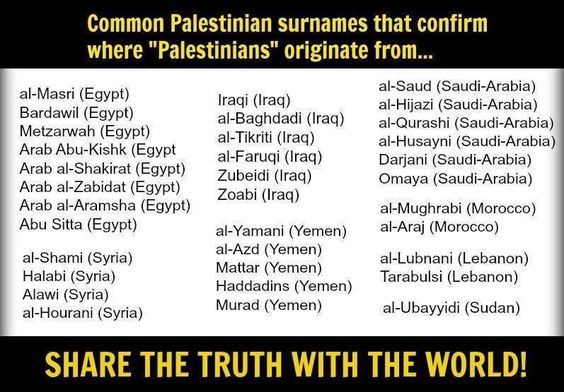
Common Palestinian surnames that confirm where ‘Palestinians’ originate from
Click to Enlarge

Why Do All These Rabbis Warn Against Getting the Covid-19 Vaccine?
Master of Universe, who can do anything!
And through this reveal to us the 50th gate of holiness, the secret of the ibbur, and may we begin from this day onward to be strong in keeping interpersonal commandments (i.e. being kind to others).
And by virtue of this may we witness miracles and wonders the likes of which haven’t been since the creation of the world. And may there be sweetening of judgments for the entire world, to all mankind, men women and children.
Please God! Please cure Coronavirus all over the world, as it says about Miriam the prophetess, “Lord, please, cure her, please.”
Please God! Who can do anything! Send a complete healing to the entire world! To all men, women, children, boys and girls, to all humanity wherever they may be, and to all the animals, birds, and creatures. All should be cured from this disease in the blink of an eye, and no trace of the disease should remain.
And all will merit fear of Heaven and fear of God, O Merciful and Compassionate Father.
Please God, please do with us miracles and wonders as you did with our forefathers by the exodus from Egypt. And now, take us and the entire world out from this disease, release us and save us from the Coronavirus that wants to eliminate all mortals.
We now regret all the sins that we did, and we honestly ask for forgiveness. And in the merit of our repentance, this cursed disease, that does not miss men, women, boys, girls, and animals, will be eliminated.
Please God, as quick as the illness came it will go away and disappear immediately, in the blink of an eye, and by this the soul of Messiah Ben David will be revealed.
Please God, grant us the merit to be included in the level of the saints and pure ones, and bless anew all the fruit and vegetation, that all will be healed in the blink of an eye, and we will see Messiah Ben David face to face.
Please God, who acts with greatness beyond comprehension, and does wonders without number. Please now perform also with us miracles and wonders beyond comprehension and let no trace of this cursed disease remain. And may the entire world be cured in the blink of an eye.
Because Hashem did all this in order for us to repent, it is all in order for us to direct our hearts to our Father in Heaven, and by that He will send blessings and success to all of our handiwork.
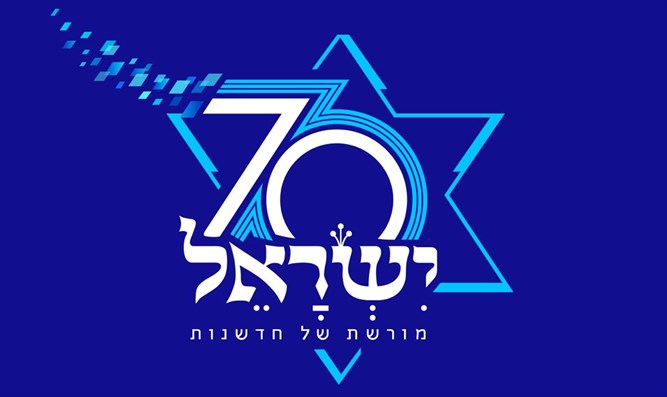

הסערה הבאה שרת התרבות מירי רגב הורתה להכניס ללוגו הרשמי של חגיגות היובל לאיחוד ירושלים את המילה שחרור ירושלים במקום איחוד העיר
נשלח על ידי
איתמר אייכנר
אחרי
US & CAN 1-866-4-ALIYAH | UK 0800 075 7200 | Israel 02-659-5800 www. nbn.org.il
Alyah : mode d’emploi http://www.jewishagency.org/fr/aliyah/program/7618
Choisissez celle qui vous correspond et inscrivez-vous sur notre site Internet en cliquant ICI ou par téléphone, en appelant le Global Center au 0800 916 647
The Jewish Agency Global Service Center http://www.jewishagency.org/global_center
US 1-866-835-0430 | UK 0-800-404-8984 | Canada 1-866-421-8912
The Jewish Agency Global Service Center


All Israeli Cats are required to take IDF Officers Military Training
Point of No Return: Jewish Refugees from Arab Countries
From the 1940s until the 1970s, and heightening with the founding of Israel in 1948, nearly million Jews were expelled from their homes across Arab countries such as Iraq, Syria, Lebanon, Egypt, Yemen, Libya, Algeria and Iran.
Jews were frequently subjected to pogroms, systemic violence and religious persecution. Their exiles were largely attributable to Arab regimes increasing their hostility toward Jews because of the very existence of Israel.
Today, while stories abound of many Arab refugees, few are aware or even acknowledge this forgotten exodus of Jewish refugees. Only in Israel has Nov. 30, the day after the UN voted to approve the Jewish-Arab partition plan of Palestine, been marked to commemorate their plight.



Buy from Amazon.com
Inspirational Breslev teachings in emunah, bitachon and hitbodedut- today!
Breslov Shiurim Podcasts
Subscribe to Podcasts on RSS, iTunes or Poddirectory

Podcasting Help Five Best Podcast ManagersRav Nasan Maimon | Breslov Torah | Free Listening on SoundCloudRabbiisrael on Sound Cloud

The Canary Mission database was created to expose individuals and groups that are anti-Freedom, anti-American and anti-Semitic in order to protect the public and our democratic values.



http://jerusalemcats.com Jerusalem Cats; All about Cats and life in Jerusalem Israel
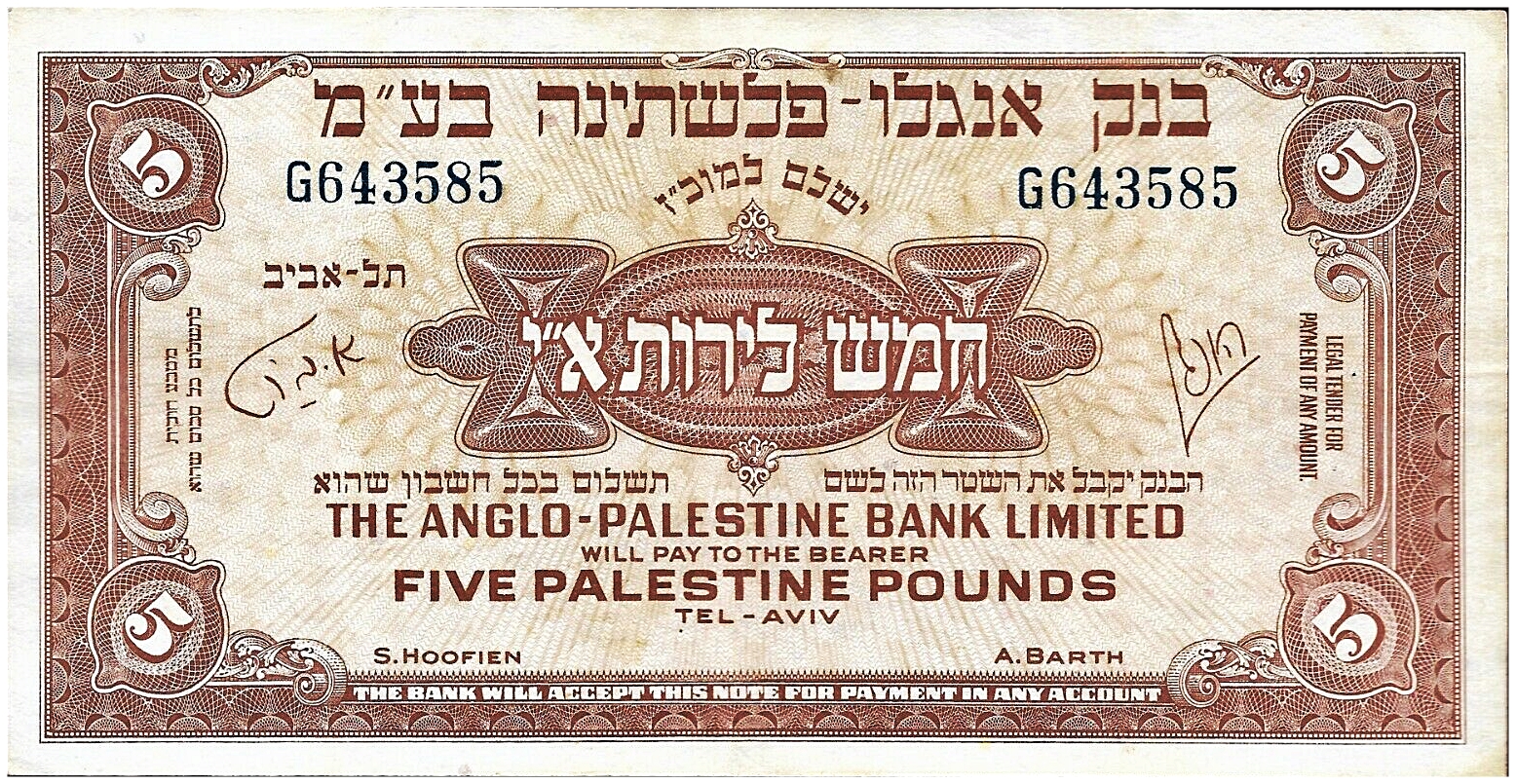
Issuer Israel
Issuing bank Anglo-Palestine Bank Limited
Period State of Israel (1948-date)
Type Standard banknote
Years 1948-1952
Value 5 Palestine Pounds
Currency Palestine Pound (1948-1949)
Composition Paper
Size 105 × 68 mm
Shape Rectangular
Demonetized 23 June 1952
Number N# 207999
References P# 16
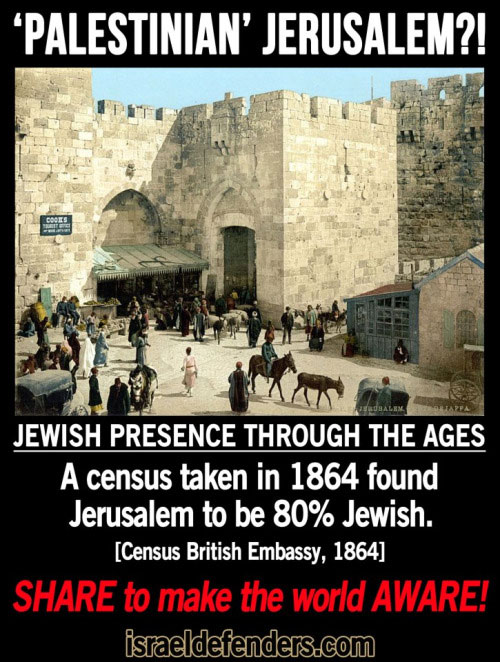
Jerusalem-80-percent- Jewish-British-1864-Census
“The Palestinian people does not exist. The creation of a Palestinian state is only a means for continuing our struggle against the state of Israel for our Arab unity… Only for political and tactical reasons do we speak today about the existence of a Palestinian people… to oppose Zionism.” Zuheir Muhsein, the late Military Department head of the PLO and member of its Executive Council.; March 1977, Dutch daily Trouw
London cab driver’s answer to a request from a Muslim to turn off the radio. (You just got to love the Brits.)
A devout Arab Muslim entered a black cab in London .
He curtly asked the cabbie to turn off the radio because as decreed by his religious teaching, he must not listen to music because in the time of the prophet there was no music, especially Western music which is the music of the infidel.
The cab driver politely switched off the radio, stopped the cab and opened the door.
The Arab Muslim asked him, “What are you doing?”
The cabbie answered, “In the time of the prophet there were no taxis, so get out and wait for a camel.”

I wonder how many years (hundreds for sure) Jewish people have lived in Quebec. I don’t believe that they have ever demanded that pork be removed from the school’s menu where their children attend…
Excellent reply by the Mayor of Dorval, Quebec, to the demands of the Muslim population in his community.
Put some pork on your fork.
Too bad the USA doesn’t have the common sense to publish this nationwide, even if they have a muslim in the white house. Should also be posted on signs all along U.S. borders.
Let’s hear it for a Quebec mayor.
MAYOR REFUSES TO REMOVE PORK FROM SCHOOL CANTEEN MENU. EXPLAINS WHY
Muslim parents demanded the abolition of pork in all the school canteens of a Montreal suburb. The mayor of the Montreal suburb of Dorval, has refused, and the town clerk sent a note to all parents to explain why..
“Muslims must understand that they have to adapt to Canada and Quebec, its customs, its traditions, its way of life, because that’s where they chose to immigrate.
“They must understand that they have to integrate and learn to live in Quebec .
“They must understand that it is for them to change their lifestyle, not the Canadians who so generously welcomed them.
“They must understand that Canadians are neither racist nor xenophobic, they accepted many immigrants before Muslims (whereas the reverse is not true, in that Muslim states do not accept non-Muslim immigrants).
“That no more than other nations, Canadians are not willing to give up their identity, their culture.
“And if Canada is a land of welcome, it’s not the Mayor of Dorval who welcomes foreigners, but the Canadian-Quebecois people as a whole.
“Finally, they must understand that in Canada ( Quebec ) with its Judeo-Christian roots, Christmas trees, churches and religious festivals, religion must remain in the private domain. The municipality of Dorval was right to refuse any concessions to Islam and Sharia.
“For Muslims who disagree with secularism and do not feel comfortable in Canada, there are 57 beautiful Muslim countries in the world, most of them under-populated and ready to receive them with open halal arms in accordance with Shariah.
“If you left your country for Canada, and not for other Muslim countries, it is because you have considered that life is better in Canada than elsewhere.
“Ask yourself the question, just once, “Why is it better here in Canada than where you come from?”
“A canteen with pork is part of the answer.”
If you feel the same forward it on.
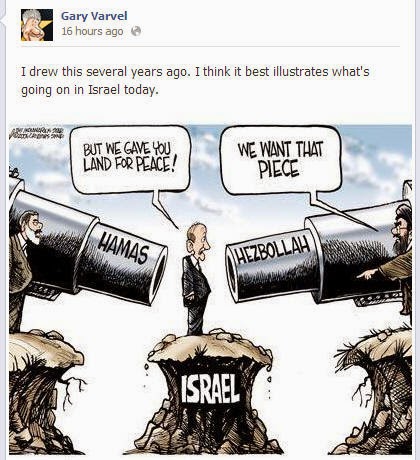
Judea and Samaria not West Bank
This reminds me of a Morty Dolinsky story from the time he was head of the Government Press Office:
When the late Morty Dolinsky was in charge of the Government Press Office in the 1980s, he once famously replied to a reporter, who asked for information about the West Bank, that he knew no West Bank as he banked at Leumi.